
Between November 1st and March 31st, drivers in specific French mountainous regions must comply with strict winter equipment laws. This guide clarifies the difference between approved winter tires and snow chains, helping you prepare for questions on vehicle safety and legal compliance in the French driving theory exam.
Article content overview
Driving in France requires a solid understanding of both the general Code de la route and specific seasonal regulations that adapt to the country's diverse geography. As part of road safety efforts to reduce accidents during colder months, French law mandates specific equipment for vehicles traveling through mountainous regions. Understanding these requirements is not only essential for your personal safety but is also a common topic in the Épreuve Théorique Générale (ETG).
Between November 1st and March 31st of each year, drivers entering certain mountainous regions in France must ensure their vehicle is properly equipped for winter conditions. This mandate applies to specific zones identified by local prefectures, which are marked by dedicated road signage. If you are preparing for your theory exam, it is critical to recognize that failing to comply with these rules can lead to significant penalties, including a standard fixed fine of 135 euros and the potential immobilization of your vehicle by the authorities.
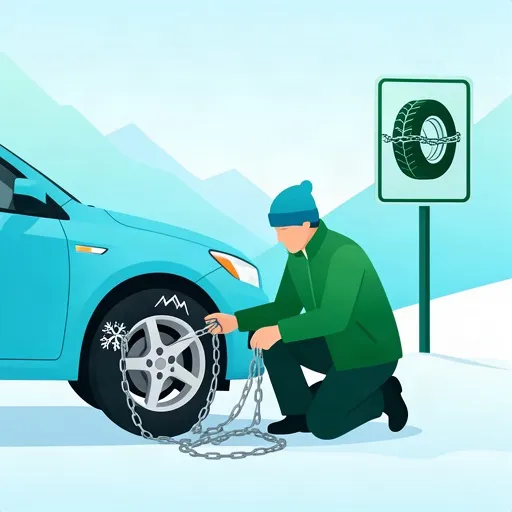
The law requires drivers in these designated zones to either fit their vehicle with four winter tires or carry at least one pair of snow chains—or equivalent textile devices like "snow socks"—that can be mounted on at least two driving wheels. It is important to note that carrying chains in the trunk is insufficient if the weather conditions demand their use; you must be prepared to install them when signage or road conditions dictate.
For the Code de la route, simply having "mud and snow" tires is not always enough to satisfy the highest safety standards required in mountain zones. Official regulations distinguish between different types of markings on winter tires. Ideally, your vehicle should be equipped with tires bearing the "Alpine symbol" (a snowflake inside a mountain silhouette). While tires marked only with "M+S," "M.S," or "M&S" are currently accepted for compliance, the Alpine symbol represents the industry standard for proven performance in severe winter conditions.
When choosing between chains and tires, remember that snow chains are often a mandatory fallback in extreme conditions where even winter tires may lose traction. If your vehicle is equipped with winter tires that do not feature the Alpine symbol, you are still legally required to carry a set of chains in your vehicle during the winter period to ensure you can maintain mobility in the event of heavy snowfall.
In the French theory exam, you may be presented with images of specific road signs that signal the end of a mountain zone or the requirement to fit equipment. Awareness of these signs is vital for avoiding administrative trouble. The regulatory zones are defined by the loi Montagne, and the absence of these specific signs does not exempt a driver from the responsibility of maintaining a safe vehicle. However, the legal obligation to possess chains or winter tires is specifically enforced in these marked geographical areas.
The table below outlines the necessary steps for compliance based on the type of equipment chosen for the winter season in France.
| Equipment Type | Technical Requirement | Note |
|---|---|---|
| Winter Tires | Must feature "Alpine" symbol + M+S | Best for general winter driving |
| Snow Chains | Metallic chains or approved textiles | Mandatory if not using winter tires |
| M+S Tires Only | "M+S", "M.S", or "M&S" marking | Permitted for compliance until further notice |
French law mandates winter equipment in mountainous zones between November 1st and March 31st. Drivers must either fit four winter tires (ideally with the Alpine symbol) or carry chains for at least two driving wheels. While M+S tires are currently accepted, they require chain backup. Non-compliance risks a 135-euro fine and vehicle immobilisation. Recognising the B58 and B59 road signs is essential for theory exam preparation and legal compliance under the Loi Montagne framework.
A short set of high-value points that capture the most important ideas from this article.
The winter equipment mandate applies from November 1st to March 31st in mountainous zones designated by French prefectures.
Winter tires must bear the Alpine symbol (snowflake inside a mountain) for full compliance, though M+S marked tires are currently accepted.
If using only M+S tires, you must still carry chains to avoid penalties when conditions deteriorate.
The 135-euro fixed fine applies for non-compliance, along with potential vehicle immobilisation.
Carrying chains in the trunk is insufficient—you must be prepared to mount them when road conditions require.
Alpine symbol means the tire meets certified winter performance standards; M+S alone is accepted but lower-tier.
Snow chains must be mounted on at least two driving wheels, not merely carried.
The B58 sign marks entry to a mandatory winter zone; the B59 sign marks the exit.
Winter equipment requirements are defined by the Loi Montagne and enforced by the Préfet.
Tire pressure decreases in cold weather—check pressure more frequently during winter.
Assuming M+S tires alone satisfy all requirements without carrying chains as a backup.
Keeping chains in the boot without the intention or ability to install them when required.
Believing the obligation only applies when snow is visibly present on the road.
Confusing the Alpine symbol with generic winter tire marketing or tread patterns.
Overlooking that prefectures can define additional zones beyond major mountain ranges.
Article content overview
A short set of high-value points that capture the most important ideas from this article.
The winter equipment mandate applies from November 1st to March 31st in mountainous zones designated by French prefectures.
Winter tires must bear the Alpine symbol (snowflake inside a mountain) for full compliance, though M+S marked tires are currently accepted.
If using only M+S tires, you must still carry chains to avoid penalties when conditions deteriorate.
The 135-euro fixed fine applies for non-compliance, along with potential vehicle immobilisation.
Carrying chains in the trunk is insufficient—you must be prepared to mount them when road conditions require.
Alpine symbol means the tire meets certified winter performance standards; M+S alone is accepted but lower-tier.
Snow chains must be mounted on at least two driving wheels, not merely carried.
The B58 sign marks entry to a mandatory winter zone; the B59 sign marks the exit.
Winter equipment requirements are defined by the Loi Montagne and enforced by the Préfet.
Tire pressure decreases in cold weather—check pressure more frequently during winter.
Assuming M+S tires alone satisfy all requirements without carrying chains as a backup.
Keeping chains in the boot without the intention or ability to install them when required.
Believing the obligation only applies when snow is visibly present on the road.
Confusing the Alpine symbol with generic winter tire marketing or tread patterns.
Overlooking that prefectures can define additional zones beyond major mountain ranges.
Explore related topics, search based questions, and concepts that learners often look up when studying Winter Driving Equipment Rules. These themes reflect real search intent and help you understand how this topic connects to wider driving theory knowledge in France.
Find clear and practical answers to common questions learners often have about Winter Driving Equipment Rules. This section helps explain difficult points, remove confusion, and reinforce the key driving theory concepts that matter for learners in France.
The mandatory period for having winter equipment in designated mountainous areas runs from November 1st to March 31st each year.
If your vehicle is not equipped with certified winter tires, you must carry removable anti-skid devices such as metal snow chains or textile snow socks in your vehicle to fit on at least two drive wheels.
Compliant winter tires must feature the Alpine symbol (a mountain with a snowflake) combined with the 'M+S', 'M.S', or 'M&S' markings. Tires with only 'M+S' markings remain accepted during the transition period.
Failure to have the required equipment in a designated zone can result in a fine of 135 euros and the potential immobilization of your vehicle by law enforcement.
Continue your preparation for the French permis de conduire exam. Dive deeper into specific Code de la route sections, practice scenarios, or review official procedures. Use our comprehensive article collection to master every aspect of driving theory.