
This lesson guides you through the crucial rules regarding vehicle loads and cargo securement as defined by the French Code de la route. You will learn how to calculate weight limits, distribute weight safely, and properly secure items to avoid instability. Mastering these skills is essential for both your Category B theory exam and ensuring safe driving in real-world conditions.

Lesson content overview
Driving a passenger vehicle involves more than just steering, braking, and navigating intersections. When you add passengers, luggage, roof racks, or tow a trailer, you fundamentally alter the physical properties of your vehicle.
Under the French Code de la route, a driver is fully responsible for the load their vehicle carries. An overloaded or poorly secured load can compromise handling, increase stopping distances, cause catastrophic tyre blowouts, and lead to heavy legal penalties during roadside inspections.
This lesson covers how to read weight limits, distribute cargo weight evenly, secure loads both inside and outside the vehicle, and understand the physics behind vehicle dynamics under load. This knowledge is essential for passing the French driving theory exam (Examen de l'Éthique Générale or ETG) and ensuring safety on the road.
Before loading your vehicle, you must understand its legal and mechanical limits. In France, these limits are recorded on your vehicle's registration certificate, commonly known as the carte grise.
The weight of the vehicle with a full tank of fuel, all standard equipment, and lubricants, but without any passengers, driver, or cargo. On French registration certificates, this is found in field G.1.
The absolute maximum permissible total weight of the vehicle, including the vehicle itself, the driver, passengers, fuel, and all cargo. In modern European registration certificates, this is designated as the Masse en charge maximale admissible in field F.2.
The maximum allowable weight of the combined vehicle and any attached trailer. This is listed in field F.3 on the registration certificate.
The payload is the actual weight of cargo and passengers you can legally add to your vehicle. It is calculated with a simple formula:
For example, if your vehicle has a PTAC of 1,800 kg and a curb weight (Poids à vide) of 1,250 kg, your maximum payload is 550 kg:
This 550 kg capacity must cover the weight of the driver, all passengers, fuel, luggage in the boot, roof cargo, and the downward weight of any trailer hitch. Exceeding this limit is highly dangerous and illegal.
The Passenger Misconception: Many drivers assume a 5-seater car can always carry five adults and a full boot of luggage. However, if five adults weigh an average of 85 kg each (425 kg total), you may only have 125 kg left for luggage, fuel, and accessories before exceeding your PTAC.
Adding mass to a vehicle changes how it responds to driver inputs. The two most critical physical changes are the elevation of the Centre of Gravity (CoG) and the increase in Inertia.
The Centre of Gravity is the theoretical point where the entire weight of the vehicle and its load is concentrated.
According to the laws of physics, the kinetic energy of a moving vehicle is directly proportional to its mass (). When you double the mass of a vehicle, you double its kinetic energy, meaning the brakes must convert twice as much energy into heat to bring the vehicle to a stop.
Under constant braking force, an increase in mass directly increases your stopping distance (distance de freinage). On wet or icy roads, this effect is severely amplified. A heavily loaded car requires much larger following distances to remain safe.
It is not enough to stay under your overall PTAC limit; you must also distribute the weight correctly across your vehicle’s axles. Each vehicle has specific Axle Load Limits (charge maximale par essieu) set by the manufacturer.
If you load all your heavy cargo into the boot, the rear suspension compresses, and the front of the vehicle lifts. This front-end lift has critical safety consequences:
To maintain stable vehicle handling:
Your tyres are the only points of contact between your vehicle and the road. Carrying heavy cargo puts immense stress on them.
Every tyre features a load index rating on its sidewall (e.g., a tyre marked "205/55 R16 91V" has a load index of 91). This index indicates the maximum weight the tyre can support when fully inflated. You must ensure that the sum of the load ratings of your tyres exceeds the PTAC of your vehicle.
When a vehicle is heavily loaded, the tyre sidewalls flex more. This increased flexing causes the tyre to overheat, which can lead to rapid tread separation or a sudden blowout at high speeds.
To counter this, manufacturers specify higher tyre pressures for loaded vehicles (pression sous charge).
Locate your vehicle's tyre inflation placard, typically found on the driver’s door pillar, inside the fuel filler flap, or in the owner's manual.
Identify the specific pressures recommended for a "fully loaded" vehicle (often represented by an icon of a car filled with passengers and luggage).
Check and adjust the tyre pressures when the tyres are cold (driven less than 3 km) using a reliable gauge. Do not forget to adjust the spare tyre pressure as well.
When the interior boot space is insufficient, drivers often turn to roof bars, roof racks, or aerodynamic roof boxes. However, transporting cargo on the roof introduces unique risks.
Every vehicle manufacturer specifies a maximum roof load limit, which is typically between 50 kg and 100 kg. This limit is much lower than your overall payload limit because of the structural strength of the roof pillars and the negative impact of high weight on the vehicle's centre of gravity.
When calculating your roof load, you must include:
External roof cargo alters the vehicle's aerodynamics, creating significant wind resistance (drag). This drag increases fuel consumption—sometimes by up to 20%—and makes the vehicle highly sensitive to strong crosswinds (vent latéral), particularly when driving on motorways or crossing bridges.
Remove Empty Racks: Always remove roof racks, bicycle carriers, and roof boxes when they are not in use. Leaving them installed empty wastes fuel and creates unnecessary wind noise.
Unsecured cargo is a silent hazard. In a collision or sudden stop, any loose item inside the vehicle continues moving forward at the vehicle's original speed, transforming into a dangerous projectile.
Always select appropriate securing devices based on the weight of your cargo:
Towing a trailer (remorque) or caravan introduces highly complex handling dynamics and strict legal rules under the French Code de la route.
With a standard Category B driving licence in France, you are permitted to tow:
If your combined PTAC is between 3,501 kg and 4,250 kg, you must complete a 7-hour practical training course (known as the B96 training). For combinations exceeding 4,250 kg, a Category BE licence is required.
The tongue weight is the downward force exerted by the trailer coupler onto the vehicle’s tow hitch. Proper tongue weight is critical for towing stability.
As a general rule, the tongue weight should be kept between 10% and 15% of the trailer's total loaded weight, while never exceeding the maximum hitch rating specified by your car's manufacturer.
Under the French Code de la route, failing to comply with load management regulations is a serious traffic offence that carries heavy fines and the potential impoundment of your vehicle.
According to French law, your load must never block your view:
If you are carrying long objects (such as timber, ladders, or surfboards) that extend beyond the physical boundaries of your vehicle, you must follow strict safety rules:
Additionally, your cargo must never obscure your licence plate, third brake light, or rear light clusters. If a bicycle rack or rear cargo box blocks them, you must install an approved auxiliary light board and duplicate licence plate.
If your vehicle is inspected by the police (Gendarmerie or Police Nationale) and found to be non-compliant, you face the following consequences:
To ensure you pass your Category B theory exam and stay safe on the road, remember these key concepts:
This lesson covers the essential weight and load management regulations for French Category B drivers, beginning with how to read PTAC, PTRA, and curb weight from the registration certificate to calculate your legal payload. It explains the physics of how cargo affects vehicle handling—specifically how raised centres of gravity and increased inertia worsen cornering stability and extend braking distances—and details correct weight distribution to maintain front-axle grip. The content also addresses tyre pressure adjustments for loaded conditions, roof rack limits and aerodynamic drag, proper cargo securing using ratchet straps rather than bungee cords, and the specific Category B towing rules including the 750 kg trailer limit and 3,500 kg combined PTAC threshold. Finally, it covers French legal requirements for load projections, visibility obstructions, and the penalties for overloading or unsecured cargo under the Code de la route.
A short set of high-value points that capture the most important learning from this lesson.
Payload (Charge Utile) is calculated by subtracting curb weight (PV/G.1) from the gross vehicle weight rating (PTAC/F.2) on your registration certificate.
Heavy loads raise the vehicle's centre of gravity and increase kinetic energy, both of which dramatically worsen handling and extend stopping distances.
Always place the heaviest cargo low in the boot and as far forward as possible to keep weight over the front steering axle for proper braking and steering control.
Roof loads must be counted against a separate, much lower roof limit (typically 50–100 kg) because high-mounted weight severely increases rollover risk.
With a standard Category B licence, you may tow trailers up to 750 kg PTAC, or heavier trailers as long as the combined PTAC stays under 3,500 kg.
Explore all units and lessons included in this driving theory course.
PTAC (F.2) is your vehicle's absolute maximum weight; PV (G.1) is the unladen weight; payload is the difference between them.
Inertia doubles when mass doubles, so a fully loaded vehicle needs significantly longer following distances to brake safely.
Tongue weight for trailers should be kept between 10–15% of the trailer's total loaded weight to prevent dangerous swaying or front-axle unloading.
Rear-heavy loading reduces front tyre grip, causing understeer and impairing up to 70% of your braking power from the front brakes.
Loads extending more than 1 metre beyond the rear must be marked with reflective devices by day and red lights at night.
Assuming five passengers plus full luggage is always legal without checking if this exceeds the PTAC payload limit.
Using elastic bungee cords to secure heavy cargo, which can stretch and snap, allowing items to become dangerous projectiles.
Failing to increase tyre pressure to the manufacturer's specified 'loaded' setting before a long journey with heavy cargo.
Loading a trailer too heavily at the rear, which causes the towing vehicle's rear to lift and triggers violent trailer sway.
Forgetting that roof cargo weight includes the weight of the roof bars or roof box themselves, not just the items inside.
Lesson content overview
A short set of high-value points that capture the most important learning from this lesson.
Payload (Charge Utile) is calculated by subtracting curb weight (PV/G.1) from the gross vehicle weight rating (PTAC/F.2) on your registration certificate.
Heavy loads raise the vehicle's centre of gravity and increase kinetic energy, both of which dramatically worsen handling and extend stopping distances.
Always place the heaviest cargo low in the boot and as far forward as possible to keep weight over the front steering axle for proper braking and steering control.
Roof loads must be counted against a separate, much lower roof limit (typically 50–100 kg) because high-mounted weight severely increases rollover risk.
With a standard Category B licence, you may tow trailers up to 750 kg PTAC, or heavier trailers as long as the combined PTAC stays under 3,500 kg.
Explore all units and lessons included in this driving theory course.
PTAC (F.2) is your vehicle's absolute maximum weight; PV (G.1) is the unladen weight; payload is the difference between them.
Inertia doubles when mass doubles, so a fully loaded vehicle needs significantly longer following distances to brake safely.
Tongue weight for trailers should be kept between 10–15% of the trailer's total loaded weight to prevent dangerous swaying or front-axle unloading.
Rear-heavy loading reduces front tyre grip, causing understeer and impairing up to 70% of your braking power from the front brakes.
Loads extending more than 1 metre beyond the rear must be marked with reflective devices by day and red lights at night.
Assuming five passengers plus full luggage is always legal without checking if this exceeds the PTAC payload limit.
Using elastic bungee cords to secure heavy cargo, which can stretch and snap, allowing items to become dangerous projectiles.
Failing to increase tyre pressure to the manufacturer's specified 'loaded' setting before a long journey with heavy cargo.
Loading a trailer too heavily at the rear, which causes the towing vehicle's rear to lift and triggers violent trailer sway.
Forgetting that roof cargo weight includes the weight of the roof bars or roof box themselves, not just the items inside.
Explore search topics learners often look for when studying Load Management and Securement. These topics reflect common questions about road rules, driving situations, safety guidance, and lesson level theory preparation for learners in France.
Browse additional driving theory lessons that cover connected traffic rules, road signs, and common driving situations related to this topic. Improve your understanding of how different rules interact across everyday traffic scenarios.
Understand the legal limits for towing trailers with a Category B license in France, including PTRA requirements and B96 training. This lesson explains the physics of tongue weight, how to maintain vehicle stability when towing, and the importance of proper weight distribution to ensure safe driving on public roads.
Operating a passenger vehicle in France requires strict compliance with dynamic safety laws and maintenance rules. This lesson explains your duty of care toward other road users, mandatory child restraint and seatbelt laws, and strict prohibitions on phone use while driving. You will also learn about the required periodic technical vehicle inspections (controle technique) and third-party insurance mandates.

Every driver in France must be able to present official, up-to-date documentation during routine roadside police checks. This lesson details the certificat d'immatriculation (commonly known as the carte grise), valid insurance documents, and the Crit'Air environmental vignette required in low-emission zones. It explains how to complete transfers of ownership and update addresses using the official ANTS digital portal.
This lesson addresses the procedures and expectations when professional drivers encounter law enforcement or customs officials in France. Topics include the types of checks that may be performed, required documentation, rights and obligations of drivers, and the consequences of non-compliance. Learners will be guided on best practices for interacting with authorities, emphasizing cooperation, transparency, and the importance of maintaining valid and up-to-date documents for both the vehicle and driver.
This lesson examines the legal consequences, heavy monetary fines, and driver's licence point deductions resulting from traffic and transport safety violations. Learners will study specific infractions such as driving over legal hours, vehicle overloading, and ignoring passenger seatbelt laws. Understanding the strict enforcement systems in France ensures drivers actively avoid risky habits that could end their careers.
This lesson provides a detailed guide on the proper procedures for coupling and uncoupling a trailer to a goods vehicle. Learners will explore the different types of coupling systems, including magnetic and pneumatic devices, and understand the critical safety checks required before and after connection. The content also covers the verification of trailer lighting, brake connections, and the use of quick-release mechanisms to ensure a secure hitch.
This lesson clarifies the precise boundaries of the passenger vehicle categories, detailing maximum passenger capacities and trailer weight limits for D1, D, D1E, and DE licences. Learners will understand the physical and technical definitions that separate light passenger vehicles from large articulated coaches. Ultimately, this foundational knowledge ensures that prospective drivers operate only the classes of vehicles permitted by their specific French driving credentials.
This lesson delves into the dual aspects of civil and criminal liability that professional goods vehicle drivers face in the event of traffic violations or accidents. Learners will explore the range of penalties, including fines, licence suspension, vehicle seizure, and potential imprisonment for severe offenses under French law. The discussion also covers the impact of negligence on insurance coverage, the accrual of penalty points, and the broader consequences for both the driver and their employer.
This lesson covers the rules of driving passenger vehicles on high-speed French motorways (autoroutes). Learners will study entry-ramp merging protocols, lane restrictions for vehicles over 3.5 tonnes, and motorway-specific speed limits. The lesson also highlights the correct use of toll booths (péages), emergency hard-shoulder safety procedures, and accessing dedicated coach rest areas.

This lesson breaks down the exact steps required to obtain your Category B licence in France, including registering for your unique NEPH identification number. It explains the differences between traditional driving school enrollment and registering as a free candidate (candidat libre) for the ETG theory test. Learners will understand the physical, age, and administrative prerequisites necessary to progress from learning to your final practical exam.
In this lesson, drivers will learn the specific speed limits that apply to goods vehicles across different road types in France, including urban areas, rural roads, and motorways. The content covers the differences between speed limit signs for heavy vehicles and standard passenger cars, the legal basis for these limits, and the importance of speed adaptation based on vehicle category and load. Learners will also be introduced to speed enforcement methods used in France, such as radar and speed cameras.
Examine how vehicle cargo and passenger weight impact braking distances, tire stress, and handling characteristics. Learn to identify manufacturer weight limits, adjust tire pressures correctly, and recognize how changing the center of gravity affects the vehicle's dynamic behavior during maneuvers, contributing to overall safety and compliance with the Code de la route.

Learners will be introduced to effective braking techniques tailored for AM vehicles, emphasizing progressive pressure application and the importance of maintaining grip. The lesson covers how to estimate stopping distances, execute emergency stops safely, and understand the limitations of light vehicle braking systems in France. Mastery of these techniques ensures riders can stop promptly and maintain control in various traffic scenarios.

This lesson teaches advanced braking strategies, highlighting the correct application of progressive friction braking and auxiliary retardation systems like electric or hydraulic retarders. Drivers will learn to avoid abrupt braking inputs that could compromise passenger balance, particularly for standing passengers. It also covers emergency stop procedures, showing how to balance maximum deceleration with vehicle stability.

This lesson emphasizes the critical importance of maintaining a safe following distance when carrying dozens of passengers. Learners will study how vehicle weight and passenger load dynamically extend braking and total stopping distances compared to standard passenger cars. The lesson provides concrete spacing rules, such as adjusted safety gaps for highway driving and increased distances on slippery roads.
In this lesson, drivers will learn how to adjust their driving techniques in response to adverse weather conditions such as rain, fog, snow, ice, and strong winds. The content covers strategies for maintaining visibility, managing reduced traction on wet or icy surfaces, and adjusting speed and braking distances accordingly. Learners will also be introduced to the use of anti-skid and stability control systems under challenging weather.

In this lesson, drivers will learn how to calculate safe following distances based on vehicle speed, load, road conditions, and traffic density. The content explains the components of total stopping distance, including reaction time and braking distance, and how these are affected by factors such as wet road surfaces and heavy loads. Learners will also be introduced to French road safety guidelines for maintaining appropriate gaps to ensure sufficient time to react.
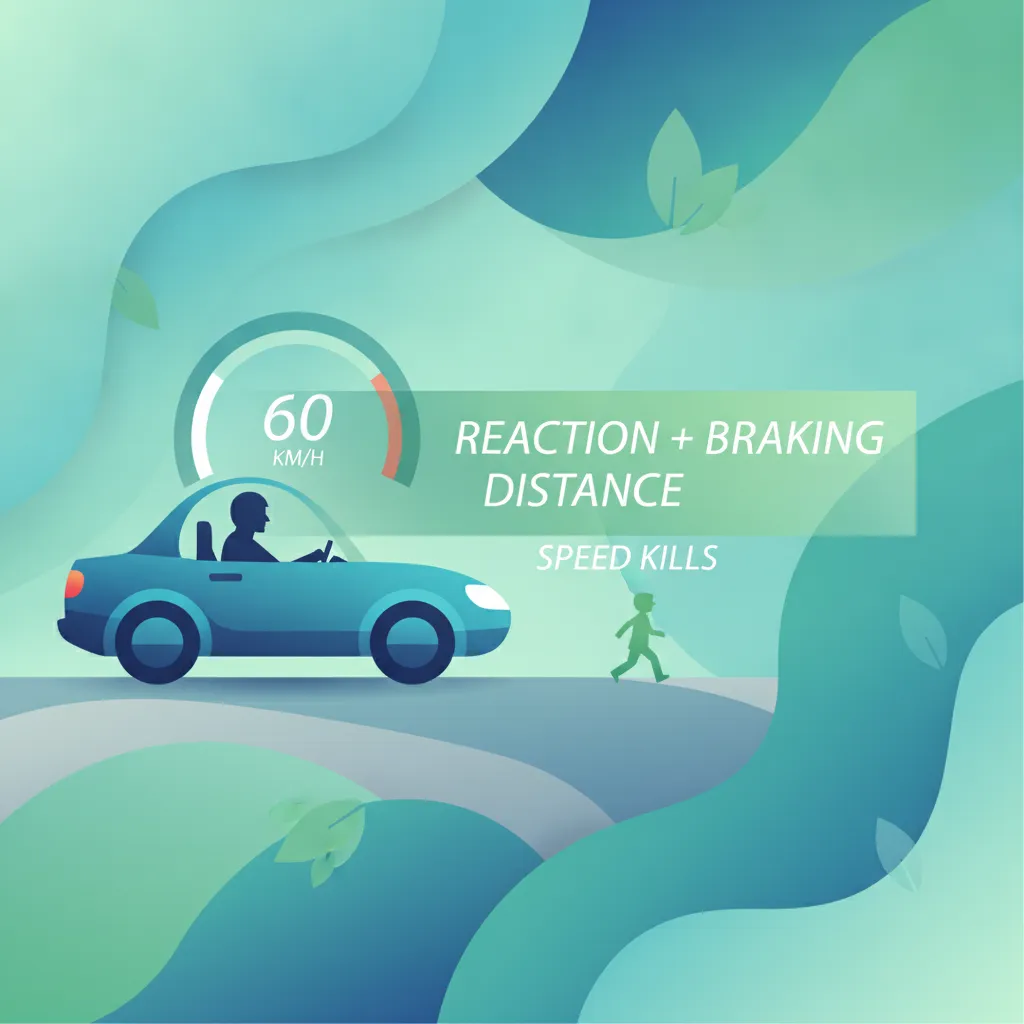
Total stopping distance is calculated as the sum of your reaction distance and the physical braking distance of the car. This lesson explains how reaction time is affected by driver focus and how speed exponentially increases the braking distance. You will learn how tire condition and slippery road surfaces degrade braking adhesion, requiring drivers to recognize and counteract these physical limits.

Adverse weather reduces tyre traction and limits visibility, dramatically raising the risk of multi-car accidents on highways. This lesson details speed reductions required during rainfall, techniques for avoiding aquaplaning, and demisting windshields for visibility. You will learn how to maintain extra stopping distance on snow-covered roads and the correct headlight adjustments to make during fog.

The physical composition of a road surface directly influences vehicle traction, braking performance, and tyre wear. This lesson explains how asphalt, cobblestones, and gravel impact your vehicle's handling, especially during wet or icy conditions. You will learn to recognize reduced friction signs, manage tyre adhesion, and adjust your speed to ensure stability and control on all road types.
This lesson covers the mechanical and physical adaptations required to drive a passenger coach in rain, heavy fog, snow, and crosswinds. Drivers will learn to recognize signs of aquaplaning and understand the dramatic traction loss associated with wet or icy roads. It also details French winter equipment regulations (Loi Montagne) requiring snow tires or chains in designated mountainous regions.

In this lesson, learners explore the fundamental principles governing load distribution in goods vehicles, focusing on how cargo placement affects the centre of gravity and overall vehicle stability. The content emphasizes the importance of achieving longitudinal and lateral balance to prevent adverse vehicle dynamics such as excessive sway or unintended pivoting. By understanding weight transfer phenomena and the impact of cargo positioning on the vehicle’s pivot point, drivers can make informed decisions to ensure safe loading.
Find clear answers to common questions learners have about Load Management and Securement. Learn how the lesson is structured, which driving theory objectives it supports, and how it fits into the overall learning path of units and curriculum progression in France. These explanations help you understand key concepts, lesson flow, and exam focused study goals.
Excessive weight shifts the vehicle's center of gravity and significantly increases your braking distance. During the theory exam, remember that heavy loads require you to anticipate traffic hazards much earlier than usual.
Exceeding the GVWR is illegal, can lead to fines, and puts severe stress on your tyres and suspension. It drastically reduces your ability to steer or brake effectively, making it a major safety hazard.
Yes, loads on roof racks must be securely fastened and must not exceed the vehicle's maximum roof load capacity. Additionally, they must not obscure your vision or extend beyond the legal dimensions of the vehicle.
Yes, towing a trailer significantly changes the driving dynamics of your Category B vehicle. You must account for the trailer's weight and ensure the total combination weight does not exceed the allowed limits for your specific licence.
Ready to focus your study? Use the practice search to find exactly the French driving theory questions you need for the Code de la route and permis de conduire ETG. Refine your knowledge on specific topics or challenging rules to boost your confidence and exam readiness.