
This lesson details the serious legal consequences, financial penalties, and point deductions associated with traffic violations for professional passenger vehicle drivers. By understanding these regulations, you will learn to navigate the complexities of French transport law and maintain your professional driving license. This is a critical step in your preparation for the passenger vehicle theory exam.

Lesson content overview
Operating passenger transport vehicles—such as buses, coaches, and minibuses under categories D1, D, D1E, or DE—carries an elevated level of legal and moral responsibility. Under French traffic law (Code de la Route), professional drivers are held to a significantly higher standard of conduct than private motorists.
This lesson provides a comprehensive examination of the legal consequences, heavy monetary fines, licence point deductions, and potential criminal liabilities that arise from infractions committed while operating passenger vehicles in France. Understanding these enforcement mechanisms is critical not only for passing your French Passenger Vehicle Licence Theory exam but also for protecting your professional career and ensuring the safety of your passengers and other road users.
The regulatory framework governing passenger transport in France is designed to prevent accidents through strict deterrence. Because a single passenger vehicle can transport dozens of individuals, any operational or driving error carries exponential risk.
The French penal and traffic systems apply the Principle of Proportionality to professional driving. This means that penalties scale upward based on the potential mass, passenger capacity, and hazard level of the vehicle. For example, an infraction that results in a minor fine for a Category B (passenger car) driver can result in heavy fines, vehicle impoundment, and professional disqualification for a Category D driver.
Furthermore, professional drivers operate under a standard of strict liability regarding certain safety checks. Excuses such as "I was unaware of the vehicle's actual weight" or "the passengers unbuckled their seatbelts without my knowledge" are rarely accepted as mitigating factors by French enforcement authorities (Gendarmerie or Police Nationale).
In France, all drivers share a single, unified driver’s licence (permis de conduire), which has a maximum capacity of 12 points. There is no separate "professional point pool."
Any points deducted for infractions committed while driving a commercial or passenger vehicle are subtracted from your unified driver's licence. If you lose your licence due to point exhaustion (resulting in an invalidation under Lettre 48SI), you lose the right to drive both commercial passenger vehicles and your personal private car.
This unified system highlights the high stakes of professional driving. A series of minor professional infractions can quickly lead to the revocation of your livelihood.
Every passenger vehicle has strict design limitations regarding its maximum allowable weight, known in France as the Gross Vehicle Weight (GVW) or Poids Total Autorisé en Charge (PTAC). Overloading a vehicle significantly alters its handling, increases braking distance, stresses the suspension and braking systems, and increases the likelihood of a tyre blowout.
French law distinguishes between two types of overloading, though both carry severe penalties:
For passenger overloading, the driver is penalised per excess passenger. For cargo overloading, the penalty escalates based on the percentage of excess weight.
In addition to financial penalties, any overload exceeding 5% of the vehicle’s authorized limit will result in the immediate immobilisation of the vehicle. The driver will not be permitted to resume the route until the excess weight (either passengers or luggage) has been safely discharged and transferred to another authorized vehicle.
Driver fatigue is one of the leading causes of catastrophic accidents in passenger transport. To combat this, the European Union and French domestic laws strictly regulate driving and rest times (Temps de Conduite et de Service).
Professional drivers must adhere to the following limits:
To monitor compliance, all modern passenger vehicles with more than 9 seats must be equipped with a functional smart tachograph (chronotachygraphe). This device records speed, distance, driving times, and rest periods, mapped directly to the driver's personal tachograph card.
Tachograph tampering in France can carry a prison sentence of up to one year, a fine of up to €30,000, and a temporary or permanent ban from exercising the profession of driver.
As a professional driver, you are responsible for the physical safety of your passengers from the moment they prepare to board until they safely exit the vehicle.
Since 2003, all passengers in coaches equipped with seatbelts are legally required to wear them.
Before departure, verbally announce the legal obligation to wear seatbelts over the vehicle's public address (PA) system.
Ensure safety pictograms indicating the mandatory use of seatbelts are clearly visible at every seating position.
Conduct a visual check of the passenger cabin whenever possible before starting the engine.
If a passenger over the age of 18 is caught not wearing a seatbelt during a roadside check, the passenger themselves is personally liable for a Class 4 fine. However, if the passenger is a minor (under 18), the driver or the accompanying adult may be held legally and financially responsible. Furthermore, if the driver fails to provide the required safety information, the transport operator can face significant administrative and safety audits.
Passengers may only board or alight at officially designated bus stops, terminals, or marked laybys. Stopping on the roadway, near intersections, or along sidewalks that are not marked as official stops is strictly prohibited.
Allowing a passenger to exit at an unauthorized location—such as in the middle of traffic during a congestion delay—creates extreme danger, particularly from passing cyclists or motorcycles. Doing so constitutes a severe safety violation and can result in prosecution for endangering the lives of others (mise en danger d'autrui).
Professional transport services must maintain transparency and accessible communications. Drivers must ensure that:
Failure to maintain these communication standards reduces passenger safety awareness and is penalised under administrative transport regulations.
Certain driving rules are specific to passenger vehicles due to their physical footprint and their role in municipal traffic flow.
Bus lanes (voies de bus) are designed to ensure public transport operates efficiently and on schedule.
While scheduled municipal buses are permitted and required to use these lanes, private coaches, long-distance tourist buses, or vehicles from other categories may only use them if explicitly authorized by local municipal decrees (indicated by additional signage). Illegally driving in a restricted bus lane disrupts urban transit networks and is heavily penalised.
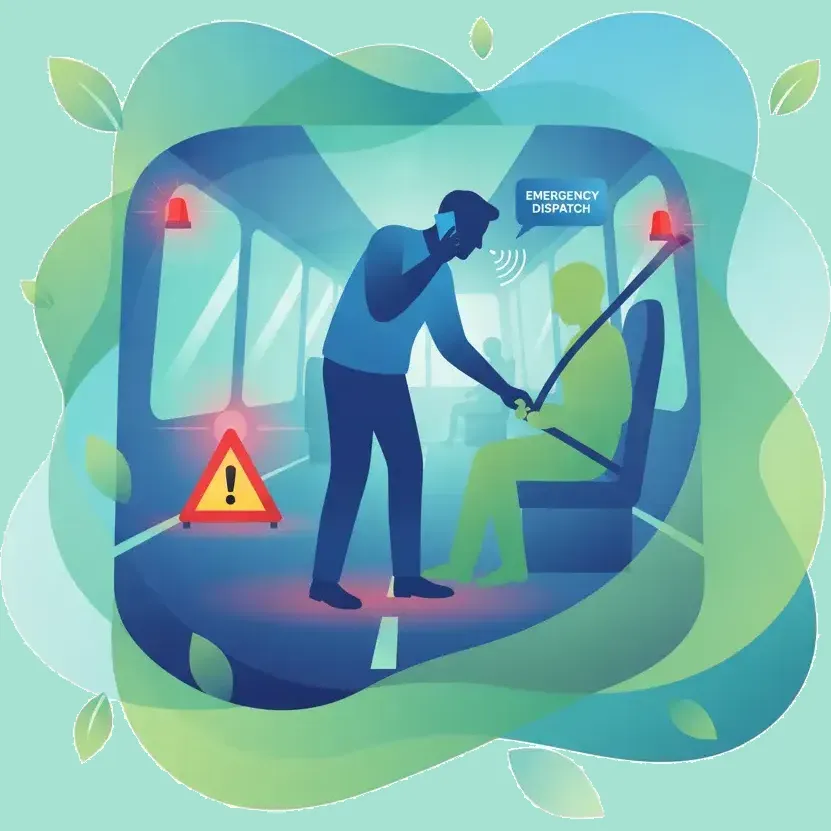
Due to their massive size, a stalled or stationary bus on a public road presents a major collision hazard. If your vehicle breaks down, is involved in an accident, or is forced to make an emergency stop on the roadway, you must immediately activate the vehicle's hazard warning lights (feux de détresse).
In addition to hazard lights, drivers must deploy the heavy-vehicle warning triangle at a safe distance behind the vehicle (typically 30 metres on standard roads, or further on fast-moving dual carriageways) to give approaching traffic ample warning. Failing to do so during an unexpected stop is a serious traffic violation.
For vehicles equipped with manual transmissions, proper gear management is essential to prevent mechanical failures and maintain vehicle stability.
The process of manually adjusting the engine speed (RPM) to match the transmission speed during a downshift, preventing sudden engine braking or wheel lock.
Downshifting abruptly at high speed without proper engine speed coordination can lock the drive wheels, damage the driveline, and cause the vehicle to skid—endangering all onboard. While improper gear shifting itself may not always trigger an automated speed camera, causing an accident or losing control due to negligent transmission use is prosecuted as reckless or dangerous driving.
The following table outlines key passenger vehicle infractions, their legal classifications, and the operational rationale behind their strict enforcement.
| Rule / Infraction | Legal Status | Rationale | Correct Application | Incorrect Application |
|---|---|---|---|---|
| Overloading (Passenger & Cargo) | Mandatory | Prevents loss of control, tyre failure, and extended braking distances. | Strictly adhere to capacities listed on the carte grise. | Allowing "just one or two" extra passengers or cargo bags. |
| Driving Hours Violations | Mandatory | Mitigates severe fatigue risks and driver micro-sleeps. | Track driving hours via digital tachograph; take regular rests. | Continuing to drive past the 4.5-hour continuous limit to meet a schedule. |
| Seatbelt Enforcement | Mandatory | Prevents severe impact injuries and passenger ejection. | Check passenger compliance and announce the rule before departure. | Starting the journey without verifying that passengers are buckled. |
| Emergency Hazard Lights | Mandatory | Alerts other motorists to a major stationary obstruction. | Activate hazard lights immediately upon breaking down on the road. | Stopping on a narrow carriage road without warning lights to save battery. |
| Restricted Bus Lane Use | Mandatory (for authorized only) | Optimises city transit flow and reduces urban bottlenecks. | Only enter marked bus lanes if local municipal decrees permit your vehicle category. | Using a reserved bus lane to bypass heavy commuter traffic. |
| Boarding / Alighting Stops | Mandatory | Protects boarding and exiting passengers from moving traffic. | Open passenger doors only at marked, safe, designated bus stops. | Letting a passenger out at a red light because they are in a hurry. |
| Tachograph Maintenance | Mandatory | Guarantees transparent tracking of legal working limits. | Run daily system checks and keep 28 days of records accessible. | Operating a coach with a broken tachograph unit or manual logs. |
| Transmission Management | Mandatory | Prevents driveline failures and sudden wheel-traction losses. | Shift gears smoothly, matching engine speed to road speed. | Downshifting aggressively at high speeds, risking drive-wheel lock. |
To help you apply these principles in your professional career, consider the following real-world driving scenarios.
This lesson covers the strict legal penalties for French professional passenger vehicle drivers holding D1, D, D1E, or DE licences, including overloading consequences, driving hour limits, and tachograph requirements. Drivers face proportional penalties scaled to vehicle passenger capacity and strict liability standards that rarely accept ignorance as mitigation. Key violations include exceeding the 9-hour daily driving limit (with mandatory 4.5-hour breaks), failing seatbelt enforcement for minor passengers, improper bus lane use, and tachograph tampering which carries criminal charges. The unified 12-point French licence system means professional infractions jeopardise both commercial and personal driving privileges, making compliance essential for career longevity.
A short set of high-value points that capture the most important learning from this lesson.
Professional passenger vehicle drivers in France operate under strict liability, meaning ignorance or passenger actions rarely excuse infractions.
Exceeding vehicle passenger capacity or PTAC (Gross Vehicle Weight) triggers immediate vehicle immobilisation and financial penalties, regardless of circumstances.
Digital tachograph violations, including equipment malfunction or record falsification, carry criminal penalties including potential imprisonment up to one year.
Driver's licence points deducted for professional infractions are drawn from your unified 12-point licence, risking both your professional and personal driving rights.
Unauthorized use of reserved bus lanes, unless explicitly permitted by municipal decree, disrupts urban transit and results in immediate fines.
Explore all units and lessons included in this driving theory course.
Daily driving limit is 9 hours (extendable to 10 hours twice weekly), with a mandatory 45-minute break after 4.5 hours of continuous driving.
Passenger overloading fines are calculated per excess passenger; cargo overloading penalties scale by percentage above the PTAC.
For minor passengers (under 18) not wearing seatbelts, the driver bears legal and financial responsibility.
A stalled bus on a roadway requires immediate hazard light activation and warning triangle placement at approximately 30 metres distance.
Tachograph records must be available for the current day and the previous 28 days during any inspection.
Assuming proximity to home or destination justifies exceeding driving hour limits, which inspectors do not accept.
Believing that verbal passenger seatbelt announcements alone satisfy legal obligations without conducting visual cabin checks.
Assuming overloaded vehicles can proceed if the excess weight is minimal or the distance is short.
Assuming tachograph malfunctions excuse non-compliance rather than requiring immediate repair and manual logging.
Allowing passengers to board or alight at non-designated locations due to passenger convenience or time pressure.
Lesson content overview
A short set of high-value points that capture the most important learning from this lesson.
Professional passenger vehicle drivers in France operate under strict liability, meaning ignorance or passenger actions rarely excuse infractions.
Exceeding vehicle passenger capacity or PTAC (Gross Vehicle Weight) triggers immediate vehicle immobilisation and financial penalties, regardless of circumstances.
Digital tachograph violations, including equipment malfunction or record falsification, carry criminal penalties including potential imprisonment up to one year.
Driver's licence points deducted for professional infractions are drawn from your unified 12-point licence, risking both your professional and personal driving rights.
Unauthorized use of reserved bus lanes, unless explicitly permitted by municipal decree, disrupts urban transit and results in immediate fines.
Explore all units and lessons included in this driving theory course.
Daily driving limit is 9 hours (extendable to 10 hours twice weekly), with a mandatory 45-minute break after 4.5 hours of continuous driving.
Passenger overloading fines are calculated per excess passenger; cargo overloading penalties scale by percentage above the PTAC.
For minor passengers (under 18) not wearing seatbelts, the driver bears legal and financial responsibility.
A stalled bus on a roadway requires immediate hazard light activation and warning triangle placement at approximately 30 metres distance.
Tachograph records must be available for the current day and the previous 28 days during any inspection.
Assuming proximity to home or destination justifies exceeding driving hour limits, which inspectors do not accept.
Believing that verbal passenger seatbelt announcements alone satisfy legal obligations without conducting visual cabin checks.
Assuming overloaded vehicles can proceed if the excess weight is minimal or the distance is short.
Assuming tachograph malfunctions excuse non-compliance rather than requiring immediate repair and manual logging.
Allowing passengers to board or alight at non-designated locations due to passenger convenience or time pressure.
Explore search topics learners often look for when studying Penalties Specific to Passenger Vehicle Infractions. These topics reflect common questions about road rules, driving situations, safety guidance, and lesson level theory preparation for learners in France.
Browse additional driving theory lessons that cover connected traffic rules, road signs, and common driving situations related to this topic. Improve your understanding of how different rules interact across everyday traffic scenarios.
Learn the physiological impact of driving long-distance coaches and how to effectively manage rest periods. This guide covers legal fatigue regulations, the importance of driver wellness for passenger safety, and how to maintain focus during extended shifts while adhering to the French Code de la route professional transport standards.

This lesson addresses the physiological dangers of driver fatigue, a leading cause of severe commercial vehicle crashes. Drivers will learn to spot early physical warning signs of drowsiness, such as micro-sleeps, heavy eyelids, and slow reaction times. The lesson provides practical wellness tips, sleep hygiene guidelines, and structured rest-break strategies to maintain peak alertness throughout a shift.

This lesson teaches the fundamental rules of ergonomics to preserve the driver's health and ensure a smooth ride for passengers. Drivers will learn to adjust their seats and steering wheels to prevent physical strain during long shifts, directly reducing fatigue. It also explains how to manage heating, ventilation, and air conditioning systems to maintain an ideal temperature and dynamic stability throughout the cabin space.

This lesson focuses on identifying the signs of driver fatigue and understanding its impact on reaction times, decision-making, and overall safety. Learners will be introduced to legal limits on continuous driving and required rest periods as stipulated by French regulations. The content also provides practical strategies for managing fatigue, such as scheduling regular breaks, employing alertness techniques, and recognizing when to cease driving.

Fatigue and digital distractions are primary causes of motorway collisions, leading to severe lack of reaction time. This lesson teaches you to recognize early signs of drowsiness, such as heavy eyelids, frequent yawning, and wandering thoughts. It also highlights the strict bans on hand-held phone use or earphone kits, explaining the points penalties and safety risks associated with distracted driving.

This lesson equips riders with the skills to identify the early warning signs of physical and mental exhaustion, such as drifting attention or slow reflexes. You will study effective scheduling strategies for long-distance journeys, emphasizing the rule of taking active rests at least every two hours. Finally, the lesson explains the extreme dangers of cognitive and auditory distractions, focusing on French laws regarding Bluetooth intercoms.

This lesson focuses on passenger comfort and safety by teaching drivers how to control load transfers during acceleration and gear shifts. Smooth throttle control and progressive gear engagement reduce sudden cabin shifts, preventing standing passengers from falling. Candidates will also explore eco-driving techniques that reduce fuel consumption and wear on mechanical parts without compromising route timetables.

This lesson outlines the core operational roles that drivers must perform, from ensuring safe passenger boarding to maintaining precise vehicle control throughout the journey. It details the active risk assessments required to identify hazards on the road and handle unexpected delays safely. Additionally, candidates will understand the specific procedures for reporting accidents and communicating effectively with both passengers and operations hubs.

This lesson focuses on techniques for monitoring and managing passenger behavior to maintain a calm and safe environment during transit. Drivers will learn how to enforce seatbelt rules, manage noise levels, and de-escalate verbal conflicts between passengers. Proactive safety announcements and a confident, polite professional demeanor are highlighted as key tools to prevent behavioral issues before they compromise road safety.
Explore the mandatory safety protocols for handling vehicle breakdowns, accidents, and emergency evacuations in passenger transport. Understand the legal requirements for using hazard warning lights, securing a safe perimeter, and managing passenger safety during critical incidents on public roads according to French professional driving regulations.

This lesson details the emergency protocols for handling mechanical breakdowns or tire blowouts on public highways and motorways. Drivers will learn how to park the vehicle in the safest possible location, activate hazard warning lights, and deploy the reflective warning triangle. It teaches precise commands and steps for evacuating passengers quickly through safety exits, positioning them behind protective guardrails.
This lesson covers immediate response steps for critical on-board events, including passenger medical emergencies and engine compartment fires. Learners will study the location and proper application of fire extinguishers, safety hammers, and first aid kits. It also explains how to coordinate effectively with French emergency services (SAMU, Fire Brigade) and reassure passengers to maintain calm during an incident.
Find clear answers to common questions learners have about Penalties Specific to Passenger Vehicle Infractions. Learn how the lesson is structured, which driving theory objectives it supports, and how it fits into the overall learning path of units and curriculum progression in France. These explanations help you understand key concepts, lesson flow, and exam focused study goals.
In France, the responsibility for passenger safety is shared. As the driver, you must ensure all passengers are informed of the safety rules, and failure to enforce these can lead to administrative penalties and point deductions on your professional license.
Overloading is a serious offence that can lead to heavy fines and the immobilization of your vehicle. Repeated violations will result in significant point loss, potentially leading to the suspension of your D or DE license.
Yes, regulatory violations regarding driving and rest periods are strictly monitored. Depending on the severity of the infringement, you may face immediate fines and a mandatory reduction in your license points, which could jeopardize your career.
While the core traffic laws and penalties apply to all professional drivers, the specific nature of the vehicle and the number of passengers involved can increase the severity of fines in the event of an accident or safety breach.
Ready to focus your study? Use the practice search to find exactly the French driving theory questions you need for the Code de la route and permis de conduire ETG. Refine your knowledge on specific topics or challenging rules to boost your confidence and exam readiness.