
This lesson examines how the size and mass of your vehicle interact with France's road infrastructure. You will explore how to protect public assets while understanding the legal constraints that govern route planning for goods vehicles.
Lesson content overview
Operating a heavy goods vehicle (HGV) in the Category C (rigid truck) or Category CE (articulated vehicle) class involves much more than steering and navigating traffic. Professional drivers are responsible for managing some of the most physically demanding vehicles on the road. The sheer size, total mass, and concentrated axle loads of commercial vehicles exert massive, continuous stress on public road infrastructure.
For candidates preparing for the French Goods Vehicle Licence Theory Course (Category C & CE), mastering the relationship between heavy vehicles and infrastructure is a core legal and professional requirement. This lesson examines how heavy vehicles degrade road pavements, stress bridges, and navigate clearance limits in tunnels. It also details the French regulations designed to safeguard public assets and ensure traffic safety.
Heavy goods vehicles are the backbone of the European logistics network, but their physical impact on road assets is disproportionate compared to passenger cars. While a standard passenger car weighs around 1.5 to 2 tonnes, a fully loaded French articulated vehicle can legally weigh up to 44 tonnes.
This impact is governed by laws of physics (dynamic load distribution, friction, and shear stress) and managed through national policy (infrastructure funding, preventive maintenance schedules, and structural upgrades). When a vehicle is overloaded or improperly configured, the degradation of the road network accelerates exponentially. Professional drivers must understand this relationship to safely plan routes, distribute loads correctly, and strictly comply with legal weight and dimension limits.
Road pavement is engineered to flex slightly under vehicle weight and recover its shape once the load passes. However, repeated applications of high-tonnage loads eventually lead to permanent structural degradation of the road surface.
Road surface degradation generally falls into two categories:
In highway engineering, road wear is calculated using the Fourth Power Law. This principle states that the damage caused to a road pavement by a vehicle axle increases to the fourth power of its load.
For example, if you double the weight on an axle (from 5 tonnes to 10 tonnes), the damage caused to the road does not double; it increases by , which equals 16 times more damage.
Because pavement damage scales exponentially, even a minor axle overload of 10% to 15% can dramatically accelerate structural road failure, forcing local French authorities (such as the Conseil Départemental or DIR - Directions Interdépartementales des Routes) to close routes for unscheduled emergency repairs.
While French motorways (autoroutes) are engineered with thick concrete or heavy asphalt structures to handle high volumes of heavy traffic, secondary roads (routes départementales) are often built on thinner bases. An HGV navigating a narrow country road with excessive axle weight can cause immediate edge failure, crumbling the soft shoulders of the road and creating deep ruts that pose severe hazards to smaller vehicles.
Bridges are critical nodes in the French transport network. Unlike continuous pavements, bridges are freestanding structural spans designed with rigid weight limits based on material capabilities (steel, reinforced concrete, or stone masonry).
Bridges must support two types of loads generated by heavy vehicles:
In France, bridge structural health is protected through clear legal weight limits, communicated via standard regulatory signage. Drivers of Category C and CE vehicles must remain hyper-vigilant when approaching bridges, observing any posted restrictions.
Ignoring these signs is a major safety violation under the French Code de la route. If an HGV exceeds the posted bridge limit, the integrity of the bridge is immediately compromised, risking structural collapse or long-term structural fatigue.
Tunnels represent confined physical environments where vehicle dimensions are constrained by overhead and lateral structures, utility lines, ventilation fans, and lighting installations.
French tunnels are strictly monitored for height clearances. Signage at tunnel entrances indicates the maximum permissible vehicle height.
Professional drivers must always know the precise dimensions of their vehicle, including the trailer and load. It is common for drivers to make the dangerous mistake of assuming that if their vehicle's tractor unit fits, the trailer or cargo will automatically clear.
The Dynamic Suspension Margin: Many heavy goods vehicles are equipped with air suspension systems (suspensions pneumatiques). If the system malfunctions, or if the driver manually inflates the airbags to navigate an obstacle, the overall vehicle height can increase by several centimetres, potentially causing a collision inside a tunnel.
When an oversized vehicle enters a tunnel with insufficient clearance:
To protect the national road network from premature degradation, French traffic law strictly enforces regulations regarding Maximum Allowed Weights (Poids Maximal Autorisé - PMA) and Axle Loads (Charge à l'essieu).
The maximum weight allowed for any vehicle or combination depends directly on the number of axles it possesses. Under standard French regulations:
To distribute the total vehicle weight safely across the road surface, French law enforces strict limits on individual axles. The maximum allowable weight on a single axle varies by its function:
Check the Vehicle Documents: Consult the registration certificate (Carte Grise) to find the maximum allowed mass for each axle (item F.2 for PTAC and relevant technical data).
Inspect Load Distribution: Ensure that heavy cargo is placed directly over the axles, lower to the floor, and balanced laterally to avoid overloading any single side.
Utilize Weigh Stations: Prior to departing, use on-board weighing scales or commercial weighbridges (ponts-bascules) to confirm that no single axle or axle group exceeds its designated regulatory limit.
When cargo is indivisible (e.g., heavy industrial machinery or wind turbine blades) and cannot be transported within standard legal weight or dimension limits, operators must apply for a special permit from the French administration (DDTM - Direction Départementale des Territoires et de la Mer).
These operations are classified as Transports Exceptionnels and are categorized into three levels (Category 1, 2, and 3) based on their dimensions and weight. These vehicles must follow highly specific, pre-approved itineraries designed to bypass weak bridges, low tunnels, and vulnerable urban roadways.
Road infrastructure is constantly monitored by French public authorities to evaluate its structural health and carry out preventive maintenance.
Operating a large, high-tonnage vehicle requires constant vigilance. Professional drivers frequently run into challenges where poor planning or careless execution leads to severe infrastructure damage and legal penalties.
A common error among novice Category C/CE drivers is assuming that if the overall gross weight (PTAC) is within legal limits, the vehicle is fully compliant. If cargo shifts during transit or is loaded entirely toward the front or rear of the trailer, a single axle can easily exceed its 13-tonne limit. This results in heavy fines during roadside inspections by the DREAL (Direction Régionale de l'Environnement, de l'Aménagement et du Logement).
Some drivers trust their GPS navigation systems blindly. Standard consumer GPS apps do not account for HGV dimensions or bridge weight limits. An HGV driver who ignores a B13 weight limit sign and crosses a restricted bridge risks catastrophic failure of the bridge structure, immediate license suspension, and heavy criminal liabilities.
When driving a vehicle with a height close to the maximum limit (e.g., a 4.0-meter high trailer entering a 4.1-meter marked tunnel), drivers must reduce their speed. Speeding through a restricted tunnel creates vertical aerodynamic lift and trailer bounce over uneven expansion joints, causing the vehicle's top edge to collide with overhead concrete beams.
Entering roads restricted to local deliveries or agricultural vehicles with a 40-tonne articulated rig often leads to structural damage of soft road shoulders, destruction of low-hanging historical stone arches, and damage to underground utility networks (such as water mains and gas lines) located just beneath thin pavement surfaces.
The interaction between heavy vehicles and road infrastructure is highly dependent on environmental and structural variables:
| Context / Variable | Physical Effect on Infrastructure | Driver Mitigation Strategy |
|---|---|---|
| Heavy Rain / Flooding | Water saturates the road sub-base, reducing its bearing capacity. Dynamic heavy loads create high water pressure beneath the asphalt, tearing the surface apart and creating immediate potholes. | Reduce speeds, avoid driving on soft or unpaved shoulders, and strictly comply with local weight limits. |
| Extreme Summer Heat | Asphalt binders soften in temperatures above 30°C. Heavy axles can easily deform the pliable surface, creating severe rutting (orniérage). | Smooth out steering and braking maneuvers; avoid parking fully loaded rigs on soft asphalt for extended periods. |
| Freeze-Thaw Cycles | Water trapped in microscopic road cracks freezes, expands, and breaks the pavement. Passing heavy axles crush the loose road pieces, rapidly expanding small cracks into major potholes. | Exercise extreme caution over deteriorated road sections; report severe hazards to highway authorities. |
| Urban vs. Motorway Roads | Urban streets feature shallower foundations, tight turning radiuses, and complex underground utilities (pipes, subways) that cannot support continuous heavy axle loads. | Strictly follow designated heavy transit routes (itinéraires de déviation poids lourds) and avoid unauthorized shortcuts. |
An articulated CE vehicle combination with a total weight of 38 tonnes is navigating a route in a French department. The driver approaches a bridge marked with a B13 sign showing a limit of 30 tonnes.
A Category C driver loads a shipment of heavy steel coils onto a three-axle rigid truck. The total cargo weight is 15 tonnes, and the truck's empty weight is 10 tonnes, meaning the total weight is 25 tonnes (well within the vehicle's 26-tonne PTAC limit). However, the loader places all the steel coils at the very front of the cargo bed, directly behind the cab.
Heavy goods vehicles exert disproportionate stress on French road infrastructure through axle loads that degrade pavements exponentially under the Fourth Power Law, making even small overloads seriously damaging. Bridges are protected by static and dynamic load limits communicated through B13 and B13a signs, which professional drivers must observe strictly to prevent structural failure. Tunnels present dimensional constraints where vehicle height must account for suspension dynamics and speed-related bounce to avoid collisions with overhead infrastructure. French regulations enforce detailed weight limits by configuration (up to 44 tonnes for combinations) and specific axle limits (13 tonnes drive axle, 10 tonnes non-drive axle), with overweight permits required for indivisible exceptional loads. Professional drivers must combine knowledge of legal limits, environmental factors, and proper load distribution to protect infrastructure and maintain compliance.
A short set of high-value points that capture the most important learning from this lesson.
The Fourth Power Law states that road damage increases to the fourth power of axle load, meaning doubling axle weight causes 16 times more damage
French law sets specific weight limits: 19 tonnes (2-axle), 26 tonnes (3-axle), 32 tonnes (4-axle), and 44 tonnes (5+ axle combinations)
Individual axle limits are 13 tonnes for drive axles and 10 tonnes for non-drive axles, enforced separately from total vehicle weight
Bridges face both static loads (vehicle weight at rest) and dynamic loads (additional forces from motion), requiring careful observation of posted restrictions
Drivers must know exact vehicle dimensions because suspension changes or speed can alter effective height, risking tunnel collisions
Explore all units and lessons included in this driving theory course.
Watch for B13 (total mass limit) and B13a (axle mass limit) signs before bridges; these prohibit access if exceeded
A legal gross weight does not guarantee legal axle loads if cargo is improperly distributed
Tunnel clearance signs (B10a) show maximum vehicle height; always verify trailer and load dimensions together
Environmental factors like heavy rain, extreme heat, and freeze-thaw cycles significantly amplify road damage from heavy loads
Transports Exceptionnels permits are required for indivisible loads exceeding standard limits, with pre-approved routes mandatory
Assuming total gross weight (PTAC) compliance means individual axle loads are legal, leading to fines during roadside inspections
Following consumer GPS without verifying HGV-specific restrictions, potentially crossing weight-restricted bridges
Driving at normal speed through low-clearance tunnels, where trailer bounce over expansion joints can cause overhead collisions
Entering narrow secondary roads with full-weight articulated vehicles, causing immediate shoulder and surface damage
Failing to recheck load distribution after transit, as cargo shifting during travel can overload rear or front axles
Lesson content overview
A short set of high-value points that capture the most important learning from this lesson.
The Fourth Power Law states that road damage increases to the fourth power of axle load, meaning doubling axle weight causes 16 times more damage
French law sets specific weight limits: 19 tonnes (2-axle), 26 tonnes (3-axle), 32 tonnes (4-axle), and 44 tonnes (5+ axle combinations)
Individual axle limits are 13 tonnes for drive axles and 10 tonnes for non-drive axles, enforced separately from total vehicle weight
Bridges face both static loads (vehicle weight at rest) and dynamic loads (additional forces from motion), requiring careful observation of posted restrictions
Drivers must know exact vehicle dimensions because suspension changes or speed can alter effective height, risking tunnel collisions
Explore all units and lessons included in this driving theory course.
Watch for B13 (total mass limit) and B13a (axle mass limit) signs before bridges; these prohibit access if exceeded
A legal gross weight does not guarantee legal axle loads if cargo is improperly distributed
Tunnel clearance signs (B10a) show maximum vehicle height; always verify trailer and load dimensions together
Environmental factors like heavy rain, extreme heat, and freeze-thaw cycles significantly amplify road damage from heavy loads
Transports Exceptionnels permits are required for indivisible loads exceeding standard limits, with pre-approved routes mandatory
Assuming total gross weight (PTAC) compliance means individual axle loads are legal, leading to fines during roadside inspections
Following consumer GPS without verifying HGV-specific restrictions, potentially crossing weight-restricted bridges
Driving at normal speed through low-clearance tunnels, where trailer bounce over expansion joints can cause overhead collisions
Entering narrow secondary roads with full-weight articulated vehicles, causing immediate shoulder and surface damage
Failing to recheck load distribution after transit, as cargo shifting during travel can overload rear or front axles
Explore search topics learners often look for when studying Impact on Road Infrastructure. These topics reflect common questions about road rules, driving situations, safety guidance, and lesson level theory preparation for learners in France.
Browse additional driving theory lessons that cover connected traffic rules, road signs, and common driving situations related to this topic. Improve your understanding of how different rules interact across everyday traffic scenarios.
Learn how to plan professional transport routes while respecting French infrastructure limits. This guide details how to identify access restrictions, navigate urban delivery zones, and follow preferred heavy vehicle transit paths to ensure compliance with local regulations and avoid damaging sensitive road assets during transport operations.
This lesson provides guidance on selecting preferred routes for heavy vehicles, taking into account freight corridors, toll roads, and restricted zones. Learners will be introduced to practical tools for route optimization, including GPS systems tailored for goods vehicles, and strategies for minimizing travel time while adhering to legal constraints. Emphasis is placed on balancing delivery efficiency with compliance to French transport policies.
This lesson provides strategies for planning routes that accommodate oversized goods vehicles while complying with French road restrictions. Learners will learn how to identify prohibited routes, evaluate bridge and tunnel limitations, and obtain necessary access permits. The content also addresses the use of specialised GPS systems for heavy vehicle routing and the importance of contingency planning for detours, ensuring safe and efficient transport operations.
In this lesson, learners will explore the various access restrictions that apply to goods vehicles in France, such as low emission zones and weight-restricted areas. The focus is on understanding the process to obtain necessary access permits and authorisations, and how these restrictions influence route planning and operational decisions. Learners will also be introduced to specific regulations governing vehicle entry into city centres and environmentally sensitive zones.
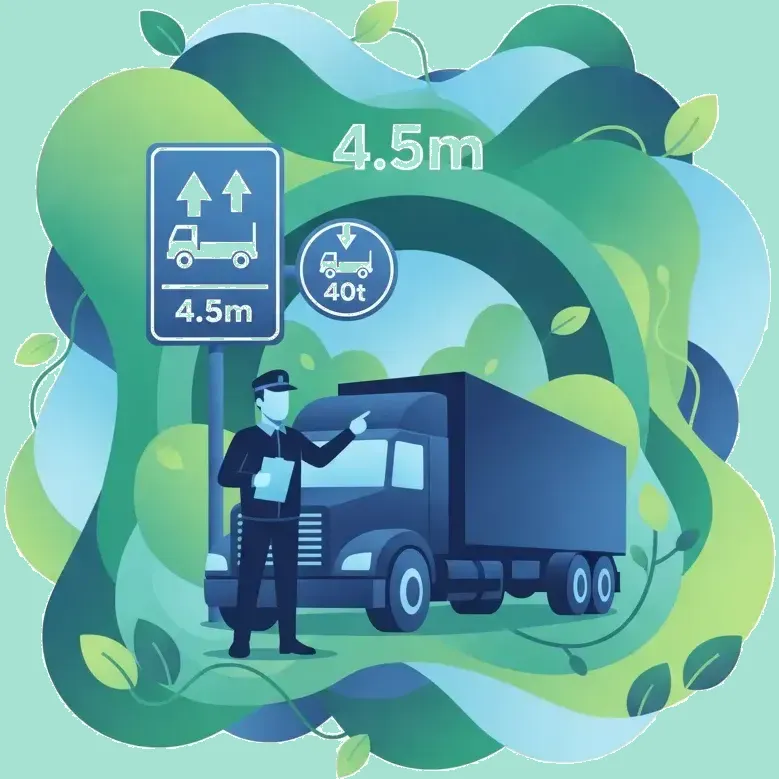
This lesson focuses on the weight and dimension restrictions that goods vehicles must adhere to while traveling on French roads. Learners will understand bridge caps, tunnel clearances, and other physical limitations imposed by infrastructure, and how these restrictions impact route planning and vehicle loading. The content also highlights legal load limits and the importance of compliance checks to avoid fines and roadblocks.

This lesson examines how goods vehicle drivers should approach and navigate roadworks zones and temporary traffic restrictions. Learners will be taught to recognize temporary speed limit signs, follow detour routes safely, and respect lane closures. The content also highlights the importance of maintaining safe distances from workers, adjusting for reduced lane width, and ensuring compliance with temporary regulations to avoid penalties.
Understand the mechanical relationship between cargo positioning and axle load limits. This lesson explains how proper load distribution prevents road surface degradation and ensures vehicle stability, covering center of gravity management and the legal requirements for balancing heavy loads to comply with French Code de la route standards.

In this lesson, learners explore the fundamental principles governing load distribution in goods vehicles, focusing on how cargo placement affects the centre of gravity and overall vehicle stability. The content emphasizes the importance of achieving longitudinal and lateral balance to prevent adverse vehicle dynamics such as excessive sway or unintended pivoting. By understanding weight transfer phenomena and the impact of cargo positioning on the vehicle’s pivot point, drivers can make informed decisions to ensure safe loading.

Carrying heavy loads or pulling trailers significantly alters a passenger vehicle's braking distances and stability characteristics. This lesson covers how to read weight limits (like gross vehicle weight ratings), distribute cargo weight evenly, and secure items inside the boot or on roof racks. You will learn to use specialized cargo straps and understand the risks of overloading your suspension and tyres.

This lesson focuses on methods to secure cargo effectively against shifts during transport, covering a range of anti-shift devices and techniques. Learners will be introduced to tie-down straps, chains, cargo nets, and other securing equipment, and will understand the criteria for selecting appropriate devices based on cargo weight and type. The material also discusses the legal requirements for cargo restraint in France and best practices for ensuring load stability throughout the journey.

This lesson covers the secure loading, distribution, and stowage of passenger luggage inside designated holding areas and overhead storage bins. Candidates will analyze how physical load distribution directly influences vehicle stability, braking distances, and center of gravity during maneuvers. By learning to secure loose cargo effectively, drivers prevent unexpected load shifts that could endanger passengers or degrade vehicle control.

In this lesson, the focus is on understanding weight limits for goods vehicles, including total gross vehicle weight and individual axle load restrictions. Learners will explore how French weight regulations define permissible loads and the consequences of exceeding these limits, such as increased wear on road surfaces and safety hazards. The lesson also discusses load balancing techniques to ensure optimal axle distribution, enhancing vehicle stability and compliance with legal standards.

In this lesson, drivers will learn about the relationship between a vehicle’s centre of gravity and its susceptibility to rollover incidents. The content covers how high-center-of-gravity loads, load shifts, and overloading can compromise lateral stability, especially during cornering or evasive maneuvers. Learners will gain insight into calculating safety margins and understanding the impact of cargo weight distribution on the overall stability of the vehicle.

In this lesson, drivers will learn how to calculate safe following distances based on vehicle speed, load, road conditions, and traffic density. The content explains the components of total stopping distance, including reaction time and braking distance, and how these are affected by factors such as wet road surfaces and heavy loads. Learners will also be introduced to French road safety guidelines for maintaining appropriate gaps to ensure sufficient time to react.
Find clear answers to common questions learners have about Impact on Road Infrastructure. Learn how the lesson is structured, which driving theory objectives it supports, and how it fits into the overall learning path of units and curriculum progression in France. These explanations help you understand key concepts, lesson flow, and exam focused study goals.
Excessive axle loads accelerate pavement deterioration, which leads to higher road maintenance costs and tighter future restrictions. As a professional driver, understanding this helps you distribute your load correctly and respect road-specific weight limits.
You must continuously monitor road signs indicating height (e.g., clearance for bridges) and width limits. Always consult your vehicle's specifications before entering urban zones or rural roads with potential infrastructure constraints.
While the physical infrastructure remains the same, your vehicle's category dictates different threshold limits for weight and turning clearance. You must always adhere to the specific limits posted for your vehicle's class and weight configuration.
Ignoring these signs is a major safety violation that can result in significant fines, damage to your vehicle, and destruction of public infrastructure. It is a common topic in the French licence theory exam, often presented as a risk assessment scenario.
Ready to focus your study? Use the practice search to find exactly the French driving theory questions you need for the Code de la route and permis de conduire ETG. Refine your knowledge on specific topics or challenging rules to boost your confidence and exam readiness.