
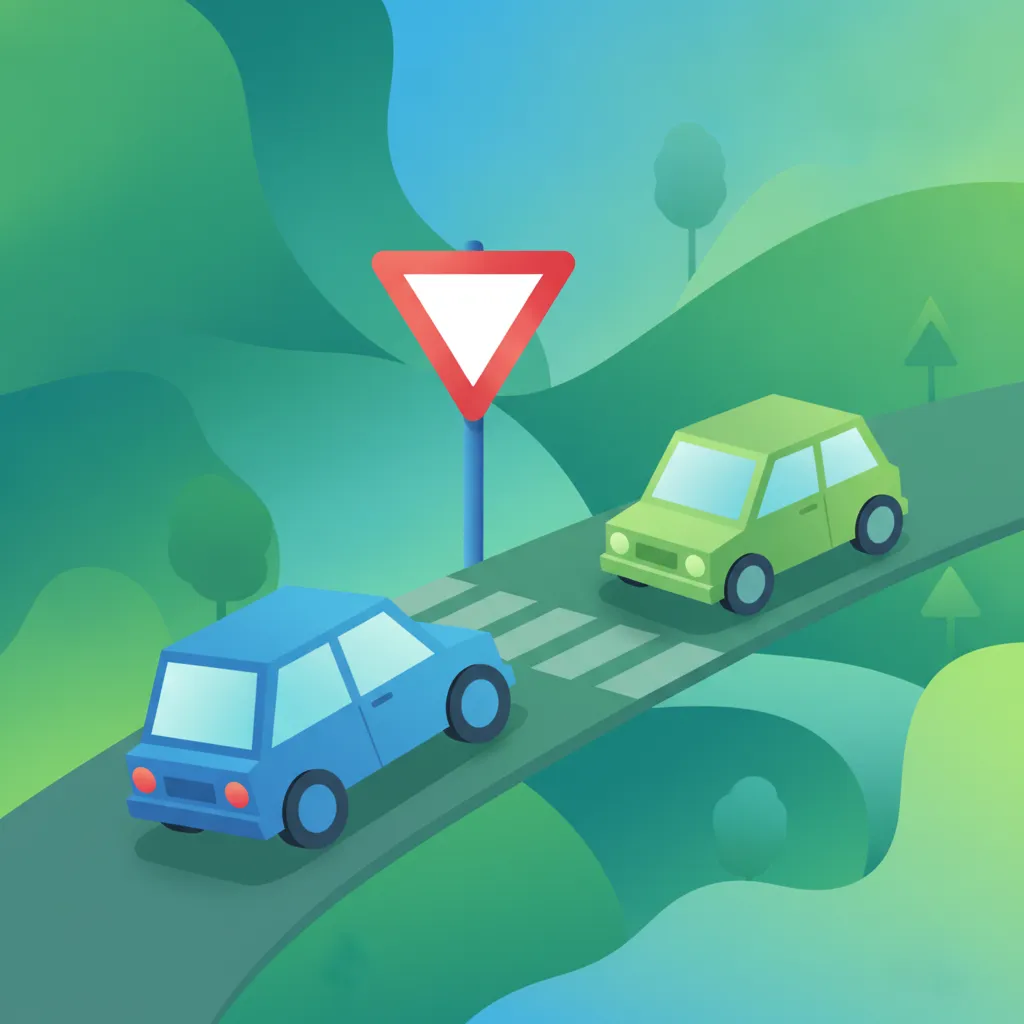
The Give Way sign, officially known as Zeichen 205 or "Vorfahrt gewähren" in Germany, is a fundamental priority sign in German road traffic. It compels drivers to grant priority to vehicles on the intersecting road. Unlike a Stop sign, a complete stop is not always mandatory, but you must be prepared to stop and only proceed when it is entirely safe and does not impede priority traffic.
Theory topic content overview
Read the full theory topic guide for Give Way Sign Rules with structured, easy-to-scan content built for learners in Germany. This detailed section explains the exact rule, meaning, traffic context, comparison points, and exam logic behind this German driving theory topic so you can study faster, understand the concept more clearly, and avoid common interpretation mistakes on the theory test.
The Give Way sign, officially known in Germany as Zeichen 205 or "Vorfahrt gewähren," is a fundamental priority traffic sign that instructs drivers to yield the right-of-way to other vehicles. Unlike a Stop sign (Zeichen 206), it does not always require a complete stop, but demands that you ensure priority traffic is neither endangered nor significantly hindered before proceeding.
This triangular sign, with its white background, red border, and inverted shape, is universally recognizable, but its precise application and interpretation are crucial for safe driving and mastering the German driving theory exam. It is one of the key tools to regulate Vorfahrt (priority) at intersections and junctions in Germany, overriding the general "rechts vor links" (right before left) rule where posted.
Understanding and correctly reacting to a Give Way sign is paramount for several reasons:
When you encounter a Give Way sign, your actions must follow a precise sequence to ensure safety and compliance with German traffic law:
StVO § 8 Abs. 2 explicitly states that "Wer die Vorfahrt zu beachten hat, muss rechtzeitig durch sein Fahrverhalten, insbesondere durch mäßige Geschwindigkeit, erkennen lassen, dass gewartet wird." (Whoever has to observe priority must indicate in good time through their driving behaviour, especially by moderate speed, that they are waiting.)
Your decision-making at a Give Way sign is not static; it depends on various factors:
This is a frequent point of confusion for German driving theory learners. While both signs relate to yielding priority, their core requirement differs significantly:
Give Way Sign (Zeichen 205 – Vorfahrt gewähren):
Stop Sign (Zeichen 206 – Halt! Vorfahrt gewähren):
The key difference lies in the mandatory stop. Failing to stop completely at a Stop sign is a serious offense, often called a "rolling stop," and is immediately penalised in practical driving tests in Germany.
The Give Way sign (Zeichen 205) is a direct application of the priority rules outlined in the German Straßenverkehrs-Ordnung (StVO). Specifically, StVO § 8 (Vorfahrt) governs how priority is determined at intersections and junctions. It explicitly states that the general "right before left" rule does not apply "wenn die Vorfahrt durch Verkehrszeichen besonders geregelt ist (Zeichen 205, 206, 301, 306)".
This means that wherever you see a Give Way sign, it immediately establishes that the intersecting road has priority over your path. The sign takes precedence over any other general priority rule. Always look for accompanying signs, such as supplementary signs (Zusatzzeichen) that might indicate a specific lane configuration or a "Vorfahrtstraße" (priority road) sign (Zeichen 301) on the main road itself, further clarifying the priority situation.
For the German driving license theory and beyond, remember that the Give Way sign (Vorfahrt gewähren, Zeichen 205) is not just a suggestion – it's a legal command to manage risk. Cultivate a "yield safely" mindset:
Your goal is not merely to avoid a crash, but to enter the traffic flow smoothly and without disturbing those who hold the right-of-way. This proactive and respectful approach to yielding is fundamental to safe driving in Germany.
The Give Way sign (Zeichen 205, Vorfahrt gewähren) is a fundamental German priority sign instructing drivers to yield to traffic on intersecting roads by slowing down, observing carefully, and proceeding only when neither endangering nor substantially hindering priority traffic. Unlike the Stop sign, a complete stop is not always mandatory, but you must be prepared to stop. StVO § 8 Abs. 2 explicitly requires drivers to signal through moderate speed that they are waiting. Key factors affecting your decision include the speed and distance of approaching vehicles, visibility conditions, road surface, and the presence of vulnerable road users such as cyclists and pedestrians. The sign always overrides the general 'rechts vor links' rule, and failing to yield correctly is a serious traffic offense under German law.
A short set of high-value points that capture the most important ideas from this theory explanation.
The Give Way sign (Zeichen 205, Vorfahrt gewähren) requires you to yield priority to traffic on the intersecting road without endangering or substantially hindering it
Unlike a Stop sign, a complete stop at a Give Way sign is not mandatory if the road is clear; a controlled slow-down and observation suffices
StVO § 8 Abs. 2 explicitly requires drivers to indicate through moderate speed and driving behaviour that they are waiting for priority traffic
At Give Way signs, cyclists and pedestrians must be actively watched, especially when turning, as German law demands special consideration for vulnerable road users
The inverted red-bordered triangle sign always overrides the general 'rechts vor links' (right before left) rule at intersections
The inverted white triangle with red border is Zeichen 205 (Vorfahrt gewähren), while the octagonal red STOP sign is Zeichen 206, which requires a mandatory full stop
Speed and distance of priority traffic are the most critical factors in your yielding decision; fast-approaching vehicles mean you must wait longer
Poor visibility, adverse weather, and poor road surface conditions all demand greater caution and may require a complete stop
If a priority vehicle has to brake, swerve, or adjust speed because of your entry, you have failed to yield correctly (neither gefährden nor wesentlich behindern)
On roundabouts marked with Zeichen 205 combined with Zeichen 215, you must yield to traffic already circulating inside the roundabout
Performing a 'rolling yield' without properly slowing down and thoroughly observing all priority traffic before proceeding
Confusing the Give Way sign (Zeichen 205) with the Stop sign (Zeichen 206) and either stopping unnecessarily or failing to stop completely where required
Forgetting to watch for cyclists and pedestrians, particularly when turning across bicycle paths or pedestrian crossings near the intersection
Overlooking the Give Way sign on unfamiliar roads or in busy environments, leading to dangerous priority violations
Assuming that getting through the intersection means you yielded correctly; if any priority vehicle adjusts its speed, you have committed an error
Start with a short, direct summary of Give Way Sign Rules before reading the full explanation below.
The Give Way sign (Vorfahrt gewähren, Zeichen 205) in Germany instructs drivers to yield priority to traffic on the road they are entering or crossing. You must slow down significantly, carefully observe approaching vehicles, and be ready to stop if necessary. You may only continue when doing so will not endanger or substantially hinder any priority traffic. This ensures a safe and uninterrupted flow of vehicles with the right-of-way.
Review the most important terms, rule signals, and traffic concepts linked to Give Way Sign Rules.
Explore related theory topic pages connected to Give Way Sign Rules and continue with the next useful rule explanation.
See the common search queries learners use when trying to understand Give Way Sign Rules in Germany.

Solidify your understanding of German road rules. Explore specific theory topics in detail, from priority rules to complex Autobahn situations. Review key concepts and prepare thoroughly for every aspect of your official driving license theory examination.
German Driving Theory TopicsTheory topic content overview
A short set of high-value points that capture the most important ideas from this theory explanation.
The Give Way sign (Zeichen 205, Vorfahrt gewähren) requires you to yield priority to traffic on the intersecting road without endangering or substantially hindering it
Unlike a Stop sign, a complete stop at a Give Way sign is not mandatory if the road is clear; a controlled slow-down and observation suffices
StVO § 8 Abs. 2 explicitly requires drivers to indicate through moderate speed and driving behaviour that they are waiting for priority traffic
At Give Way signs, cyclists and pedestrians must be actively watched, especially when turning, as German law demands special consideration for vulnerable road users
The inverted red-bordered triangle sign always overrides the general 'rechts vor links' (right before left) rule at intersections
The inverted white triangle with red border is Zeichen 205 (Vorfahrt gewähren), while the octagonal red STOP sign is Zeichen 206, which requires a mandatory full stop
Speed and distance of priority traffic are the most critical factors in your yielding decision; fast-approaching vehicles mean you must wait longer
Poor visibility, adverse weather, and poor road surface conditions all demand greater caution and may require a complete stop
If a priority vehicle has to brake, swerve, or adjust speed because of your entry, you have failed to yield correctly (neither gefährden nor wesentlich behindern)
On roundabouts marked with Zeichen 205 combined with Zeichen 215, you must yield to traffic already circulating inside the roundabout
Performing a 'rolling yield' without properly slowing down and thoroughly observing all priority traffic before proceeding
Confusing the Give Way sign (Zeichen 205) with the Stop sign (Zeichen 206) and either stopping unnecessarily or failing to stop completely where required
Forgetting to watch for cyclists and pedestrians, particularly when turning across bicycle paths or pedestrian crossings near the intersection
Overlooking the Give Way sign on unfamiliar roads or in busy environments, leading to dangerous priority violations
Assuming that getting through the intersection means you yielded correctly; if any priority vehicle adjusts its speed, you have committed an error
Start with a short, direct summary of Give Way Sign Rules before reading the full explanation below.
The Give Way sign (Vorfahrt gewähren, Zeichen 205) in Germany instructs drivers to yield priority to traffic on the road they are entering or crossing. You must slow down significantly, carefully observe approaching vehicles, and be ready to stop if necessary. You may only continue when doing so will not endanger or substantially hinder any priority traffic. This ensures a safe and uninterrupted flow of vehicles with the right-of-way.
Review the most important terms, rule signals, and traffic concepts linked to Give Way Sign Rules.
Explore related theory topic pages connected to Give Way Sign Rules and continue with the next useful rule explanation.
See the common search queries learners use when trying to understand Give Way Sign Rules in Germany.
Solidify your understanding of German road rules. Explore specific theory topics in detail, from priority rules to complex Autobahn situations. Review key concepts and prepare thoroughly for every aspect of your official driving license theory examination.
German Driving Theory TopicsUse this exam-focused revision tip to understand how Give Way Sign Rules is likely to appear in theory questions for learners in Germany. This section helps you identify the most testable part of the rule, avoid common traps, and remember the concept more effectively during German driving theory exam preparation.
In the German theory exam, pay close attention to scenarios involving the Give Way sign. A common trap is confusing it with a Stop sign, or misjudging when it's truly safe to proceed. Always consider the speed and distance of priority traffic; if they have to adjust, you've failed to yield correctly.
Read direct answers to the most common learner questions about Give Way Sign Rules in Germany. This FAQ focuses on rule confusion, practical meaning, comparison with similar concepts, and the exact uncertainties that appear most often in German driving theory revision and exam preparation.
The Give Way sign, or Zeichen 205 (Vorfahrt gewähren), instructs you to yield priority to traffic on the intersecting road. This means other vehicles have the right-of-way, and you must wait for them to pass before proceeding.
No, you do not always have to come to a complete stop. You must slow down and be prepared to stop, but you can proceed without stopping if the road is clear and you can do so safely without hindering priority traffic.
A Give Way sign (Zeichen 205) requires you to yield, but only to stop if necessary. A Stop sign (Zeichen 206) demands a complete stop at the stop line, regardless of whether there is traffic, before yielding and proceeding.
As you approach, reduce your speed, carefully check for traffic from both directions on the priority road, and be ready to brake. Only enter the intersection when it is safe and clear of priority traffic.
You must wait for the priority vehicle to pass. Entering the intersection if an approaching vehicle would be forced to brake or swerve is considered hindering and is against the rules.
These signs are commonly placed at intersections where a minor road meets a major road, at junctions with roundabouts, or where a specific street needs to grant priority to another.
Begin your targeted revision now. Use our practice search to quickly find specific German driving theory questions. Filter by StVO rules, road signs, or hazard perception to create your focused study plan. Master challenging areas and prepare confidently for your theoretical driving test.