
In Germany, roundabouts are designed to improve traffic flow and safety at intersections. The primary rule to remember is that traffic already circulating within the roundabout (Kreisfahrbahn) generally has priority over vehicles entering it. This priority is typically enforced by the combination of a 'Vorfahrt gewähren' (Yield, Zeichen 205) sign and a 'Kreisverkehr' (Roundabout, Zeichen 215) sign at each entrance.
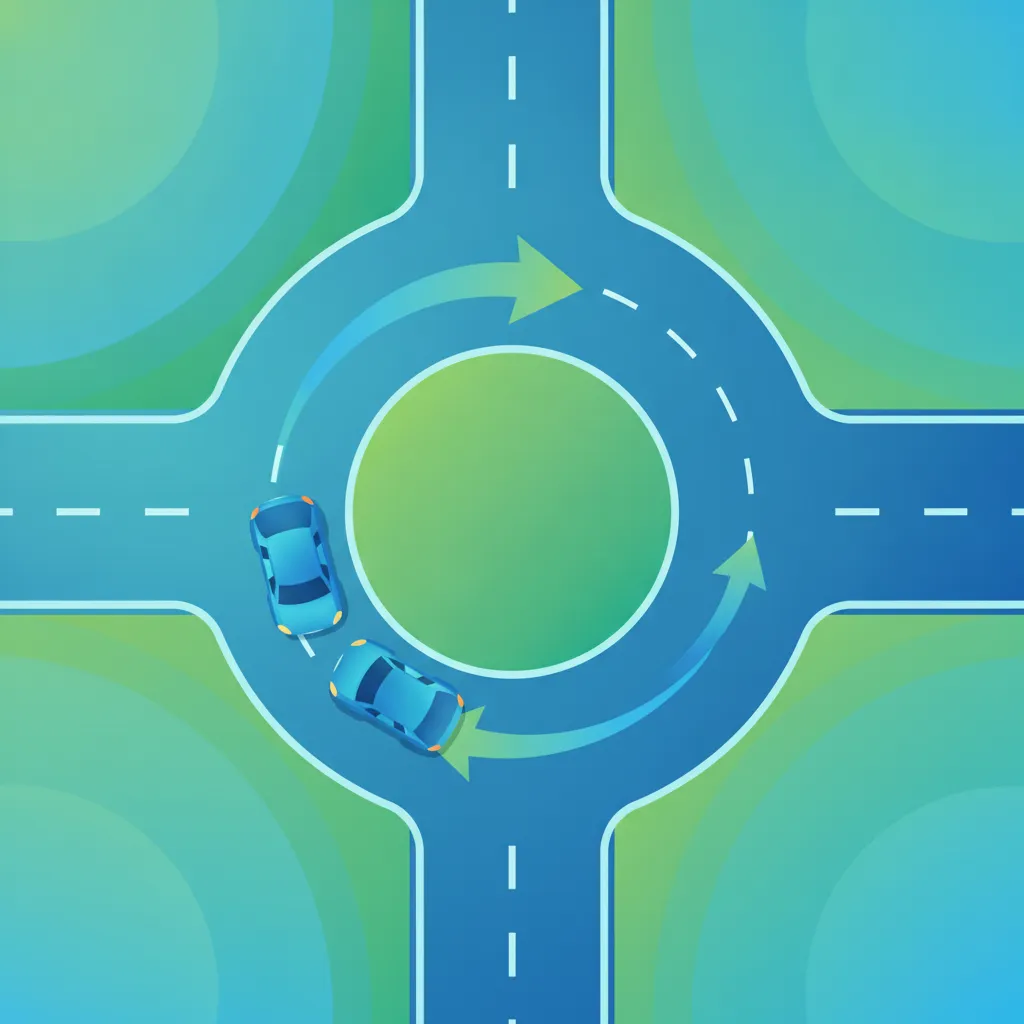
Theory topic content overview
Read the full theory topic guide for Roundabout Priority with structured, easy-to-scan content built for learners in Germany. This detailed section explains the exact rule, meaning, traffic context, comparison points, and exam logic behind this German driving theory topic so you can study faster, understand the concept more clearly, and avoid common interpretation mistakes on the theory test.
In Germany, roundabout priority rules (Kreisverkehr Vorfahrt) are designed for clarity and safety, primarily dictating that vehicles already circulating within the roundabout have priority over those wishing to enter. This fundamental principle is established by specific traffic signs and codified in the Straßenverkehrs-Ordnung (StVO).
The term "Kreisverkehr" specifically refers to a circular intersection marked by two crucial traffic signs at each entrance:
When these signs are present, the rule is clear: you must yield to traffic already on the Kreisfahrbahn (the circular carriageway).
Mastering roundabout priority is not just for smooth traffic flow; it's critical for road safety and passing your German driving theory test.
Navigating a German roundabout involves a precise sequence of actions and observations:
As you approach a marked Kreisverkehr, you will see Zeichen 205 and Zeichen 215.
Several factors influence safe roundabout navigation in Germany:
Understanding these distinctions is vital for the German theory test and safe driving:
Learners and even experienced drivers often make these mistakes:
The rules for roundabouts in Germany are clearly defined in StVO § 8 Absatz 1a. This section specifically states: "Ist an der Einmündung in einen Kreisverkehr Zeichen 215 (Kreisverkehr) unter dem Zeichen 205 (Vorfahrt gewähren) angeordnet, hat der Verkehr auf der Kreisfahrbahn Vorfahrt. Bei der Einfahrt in einen solchen Kreisverkehr ist die Benutzung des Fahrtrichtungsanzeigers unzulässig."
This legal text directly translates into the critical points for your theory exam:
These points are frequently tested, making a thorough understanding essential for your German driving license.
To master German roundabout priority, remember this simple mantra:
"Yield to those inside, no indicator when you glide, signal right when you leave the ride."
Always prioritize safety, observe carefully, and communicate your intentions clearly through signaling only when exiting. This approach will ensure you navigate roundabouts effectively and pass your German driving theory test with confidence.
German roundabouts (Kreisverkehr) are governed by a clear priority system where vehicles already circulating on the Kreisfahrbahn have priority over those entering, enforced by the mandatory combination of Zeichen 205 (Yield) and Zeichen 215 (Roundabout) signs at each entrance. The critical signaling rule is: no indicator when entering, right indicator when exiting - a distinction that is heavily tested in the German theory exam and directly specified in StVO §8 Absatz 1a. Safe navigation requires slowing on approach, yielding to circulating traffic from the left, maintaining lane discipline on multi-lane roundabouts, and checking for cyclists and pedestrians before exiting. Understanding these rules is essential for both road safety and passing the German driving theory test.
A short set of high-value points that capture the most important ideas from this theory explanation.
Traffic already circulating within the roundabout (Kreisfahrbahn) has priority over vehicles entering - this is the fundamental safety principle
The combination of Zeichen 205 (Vorfahrt gewähren) and Zeichen 215 (Kreisverkehr) signs establishes priority for circulating traffic at each entrance
You must NEVER use your turn signal when entering a German roundabout - this is explicitly forbidden by StVO §8(1a)
Always use your right turn signal when you intend to exit the roundabout to communicate your intentions to other road users
Choose the correct lane early on multi-lane roundabouts - right lane for earlier exits, left lane for later exits
StVO §8 Absatz 1a governs German roundabout rules: Zeichen 205 under Zeichen 215 means circulating traffic has priority and no indicator on entry
Zeichen 205 is the white triangle with red border (Yield); Zeichen 215 is the blue circle with three white arrows (Roundabout)
Yield to circulating traffic by looking left, stopping if necessary, and entering only when a safe gap exists
On multi-lane roundabouts, stay in your chosen lane - do not change lanes unnecessarily within the circle
Pedestrians at a marked crossing on your exit may have priority; always check mirrors and blind spots before leaving
Using the turn signal when entering the roundabout - this is the most common error and can confuse other drivers about your intentions
Failing to yield to vehicles already circulating, which is the primary cause of collisions at roundabouts
Forgetting to signal when exiting the roundabout, leaving other road users uncertain about your intended direction
Entering too fast without adequate speed reduction, reducing time available to observe and react to circulating traffic
Not checking blind spots for cyclists when exiting, especially those in adjacent cycle lanes alongside your vehicle
Start with a short, direct summary of Roundabout Priority before reading the full explanation below.
In Germany, vehicles already inside a roundabout (Kreisverkehr) have priority over those wishing to enter, provided the roundabout is marked with 'Vorfahrt gewähren' (Zeichen 205) and 'Kreisverkehr' (Zeichen 215) signs. Drivers entering must yield to circulating traffic. It is important to signal only when exiting the roundabout, not when entering.
Review the most important terms, rule signals, and traffic concepts linked to Roundabout Priority.
Explore related theory topic pages connected to Roundabout Priority and continue with the next useful rule explanation.
See the common search queries learners use when trying to understand Roundabout Priority in Germany.

Solidify your understanding of German road rules. Explore specific theory topics in detail, from priority rules to complex Autobahn situations. Review key concepts and prepare thoroughly for every aspect of your official driving license theory examination.
German Driving Theory TopicsTheory topic content overview
A short set of high-value points that capture the most important ideas from this theory explanation.
Traffic already circulating within the roundabout (Kreisfahrbahn) has priority over vehicles entering - this is the fundamental safety principle
The combination of Zeichen 205 (Vorfahrt gewähren) and Zeichen 215 (Kreisverkehr) signs establishes priority for circulating traffic at each entrance
You must NEVER use your turn signal when entering a German roundabout - this is explicitly forbidden by StVO §8(1a)
Always use your right turn signal when you intend to exit the roundabout to communicate your intentions to other road users
Choose the correct lane early on multi-lane roundabouts - right lane for earlier exits, left lane for later exits
StVO §8 Absatz 1a governs German roundabout rules: Zeichen 205 under Zeichen 215 means circulating traffic has priority and no indicator on entry
Zeichen 205 is the white triangle with red border (Yield); Zeichen 215 is the blue circle with three white arrows (Roundabout)
Yield to circulating traffic by looking left, stopping if necessary, and entering only when a safe gap exists
On multi-lane roundabouts, stay in your chosen lane - do not change lanes unnecessarily within the circle
Pedestrians at a marked crossing on your exit may have priority; always check mirrors and blind spots before leaving
Using the turn signal when entering the roundabout - this is the most common error and can confuse other drivers about your intentions
Failing to yield to vehicles already circulating, which is the primary cause of collisions at roundabouts
Forgetting to signal when exiting the roundabout, leaving other road users uncertain about your intended direction
Entering too fast without adequate speed reduction, reducing time available to observe and react to circulating traffic
Not checking blind spots for cyclists when exiting, especially those in adjacent cycle lanes alongside your vehicle
Start with a short, direct summary of Roundabout Priority before reading the full explanation below.
In Germany, vehicles already inside a roundabout (Kreisverkehr) have priority over those wishing to enter, provided the roundabout is marked with 'Vorfahrt gewähren' (Zeichen 205) and 'Kreisverkehr' (Zeichen 215) signs. Drivers entering must yield to circulating traffic. It is important to signal only when exiting the roundabout, not when entering.
Review the most important terms, rule signals, and traffic concepts linked to Roundabout Priority.
Explore related theory topic pages connected to Roundabout Priority and continue with the next useful rule explanation.
See the common search queries learners use when trying to understand Roundabout Priority in Germany.
Solidify your understanding of German road rules. Explore specific theory topics in detail, from priority rules to complex Autobahn situations. Review key concepts and prepare thoroughly for every aspect of your official driving license theory examination.
German Driving Theory TopicsUse this exam-focused revision tip to understand how Roundabout Priority is likely to appear in theory questions for learners in Germany. This section helps you identify the most testable part of the rule, avoid common traps, and remember the concept more effectively during German driving theory exam preparation.
A common mistake in the German theory exam is indicating when entering a roundabout. Remember: you only indicate (right turn signal) when you are about to exit. Signaling upon entry can confuse other drivers and is explicitly forbidden by StVO §8 (1a).
Read direct answers to the most common learner questions about Roundabout Priority in Germany. This FAQ focuses on rule confusion, practical meaning, comparison with similar concepts, and the exact uncertainties that appear most often in German driving theory revision and exam preparation.
In most standard German roundabouts, vehicles already circulating inside the roundabout have priority over those entering. This is indicated by the 'Vorfahrt gewähren' (Yield, Zeichen 205) and 'Kreisverkehr' (Roundabout, Zeichen 215) signs at the entry points.
No, according to German traffic law (StVO), you must not use your turn signal when entering a roundabout. You should only use your turn signal (right indicator) when you intend to exit the roundabout.
Generally, 'Rechts vor Links' does not apply in roundabouts that are marked with the 'Vorfahrt gewähren' (Zeichen 205) and 'Kreisverkehr' (Zeichen 215) signs. In these cases, the circulating traffic has priority.
Zeichen 205 (Vorfahrt gewähren) means 'Yield priority' and Zeichen 215 (Kreisverkehr) indicates a roundabout. When these two signs are displayed together at a roundabout entrance, they signify that traffic already in the roundabout has priority.
Approach with caution and reduce your speed. Observe traffic already in the roundabout and yield if necessary. Enter only when there is a sufficient gap to do so without hindering circulating vehicles.
The priority for cyclists and pedestrians at roundabouts can vary. If a separate cycle path or pedestrian crossing is present and marked, their specific priority rules will apply. Otherwise, general rules for crossing apply, and drivers must always be particularly attentive to vulnerable road users.
Begin your targeted revision now. Use our practice search to quickly find specific German driving theory questions. Filter by StVO rules, road signs, or hazard perception to create your focused study plan. Master challenging areas and prepare confidently for your theoretical driving test.