Learning how to interact with law enforcement is a crucial part of your driver training in Poland, as it helps you understand the legal procedures governing roadside controls. This guide clarifies how officers identify themselves, what behaviors are expected of you as a driver, and how traffic enforcement impacts your penalty points and record. Mastery of these rules ensures you remain compliant with the law and prepared for any roadside situation you may encounter.
Article content overview
Navigating a police traffic stop in Poland can be an intimidating experience for any driver, but understanding the legal framework and correct protocols can significantly reduce stress and ensure your safety. Whether you are a new driver or an experienced motorist, knowing how to interact with law enforcement is a critical skill that is frequently tested in the Polish driving theory exam. A proper understanding of your rights and responsibilities helps foster a smooth interaction, potentially transforming a tense situation into a quick, professional procedure.
In Poland, police officers are authorized to conduct traffic stops to verify documentation, check the technical condition of the vehicle, or enforce traffic safety rules. It is important to remember that not every officer has the authority to stop a vehicle in all conditions. While uniformed police officers in marked vehicles have the authority to pull you over both in urban areas and on open roads, plainclothes officers in unmarked cars have more restricted powers.
Under Polish law, a plainclothes officer can only stop you within a built-up area (obszar zabudowany). If you are signaled to stop by an individual in civilian clothes outside of these areas, you should proceed to the nearest well-lit, populated location or a safe parking area, put on your hazard lights, and contact the police via the 112 emergency number. This ensures that you are interacting with a legitimate officer rather than falling victim to potential criminal impersonation.
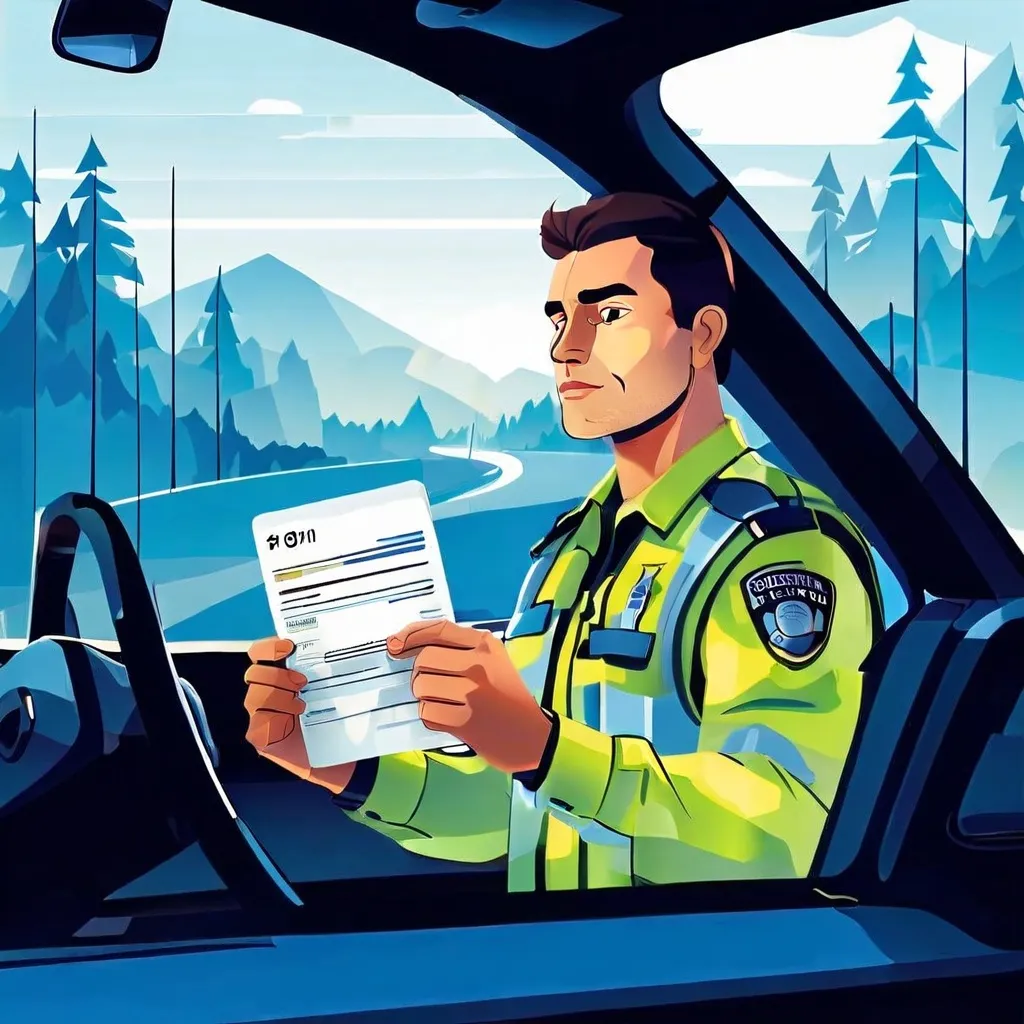
When an officer signals you to pull over—typically using a "lollipop" signal (lizak) or, at night, a red-light flashlight—you must immediately look for a safe place to stop. Once you have brought the vehicle to a halt, there are specific steps you should follow to demonstrate compliance and respect:
Never attempt to argue with an officer regarding the justification for a stop. If you believe the stop was unjustified, you have the right to file a formal complaint through the appropriate police channels later. Engaging in verbal altercations or aggressive behavior can lead to increased fines or additional charges.
A common misconception is that a police officer is always required to issue a fine (mandat) for every traffic violation. In reality, the Polish Code of Petty Offenses (Kodeks wykroczeń) grants officers the discretion to issue a warning (pouczenie) instead of a monetary fine. Your attitude plays a significant role in this; honesty, admitting to a mistake, and demonstrating a respectful demeanor can sometimes lead to a warning rather than a penalty. However, be aware that for severe violations, such as excessive speeding or reckless driving, officers are much more likely to apply the full scope of the law.
The Polish road safety system utilizes a strict penalty point system. Serious violations, such as overtaking at a pedestrian crossing, failing to yield to pedestrians, or driving under the influence, carry heavy penalties. Since 2022, the system has become more rigorous, and certain offenses now carry up to 15 penalty points in a single instance. Repeated violations, often referred to as "recydywa," can lead to the doubling of fines and, ultimately, the suspension or revocation of your driving license.
A legal principle in the Polish fine tariff where penalties for specific traffic offenses are doubled if the driver commits the same violation again within a two-year period.
In the context of the Polish driving theory exam, you must be prepared to answer questions regarding the hierarchy of commands at a traffic stop. Remember that the instructions of a police officer override all other road signs and signals. Understanding these procedural requirements is not just about passing a test; it is about ensuring that you are a safe, informed driver who understands how to cooperate with authorities to maintain public road safety.
This article covers the legal framework and correct procedures for handling a police traffic stop in Poland, including the distinction between uniformed and plainclothes officers' authority, standard conduct requirements for drivers, and the officer's discretionary power to issue warnings instead of fines. It explains the penalty point system, the recydywa repeat offense mechanism that doubles fines within two years, and provides essential Polish terminology such as 'lizak,' 'mandat,' and 'pouczenie.' Understanding these procedures is essential for both safe road conduct and passing the Polish driving theory exam, as police instructions always override other traffic controls.
A short set of high-value points that capture the most important ideas from this article.
A police officer's instructions at a traffic stop override all other road signs and signals
Plainclothes officers in unmarked vehicles can only conduct stops within built-up areas (obszar zabudowany)
During a stop, keep hands visible on the steering wheel and do not exit unless explicitly ordered
Officers have discretion to issue a warning (pouczenie) instead of a fine (mandat) based on the driver's attitude
Repeat traffic offenses (recydywa) within two years result in doubled fines and potential license suspension
The 'lizak' (lizak) is the circular disc used by Polish police to signal a vehicle to stop
If signaled to stop by civilian clothes outside a built-up area, proceed to a safe location and call 112
Serious violations such as excessive speeding can now carry up to 15 penalty points since 2022
Police instructions always take priority over road signs, traffic lights, and road markings
Honesty and a respectful demeanor may result in a warning rather than a fine for minor violations
Assuming any person in civilian clothes can legitimately order you to stop your vehicle
Exiting the vehicle without being instructed to do so, which can be perceived as threatening
Attempting to argue with the officer about the justification for the stop at the roadside
Believing that a fine (mandat) is always mandatory for every traffic violation
Not knowing what the 'lizak' signal means or failing to recognize a legitimate police stop request
Article content overview
A short set of high-value points that capture the most important ideas from this article.
A police officer's instructions at a traffic stop override all other road signs and signals
Plainclothes officers in unmarked vehicles can only conduct stops within built-up areas (obszar zabudowany)
During a stop, keep hands visible on the steering wheel and do not exit unless explicitly ordered
Officers have discretion to issue a warning (pouczenie) instead of a fine (mandat) based on the driver's attitude
Repeat traffic offenses (recydywa) within two years result in doubled fines and potential license suspension
The 'lizak' (lizak) is the circular disc used by Polish police to signal a vehicle to stop
If signaled to stop by civilian clothes outside a built-up area, proceed to a safe location and call 112
Serious violations such as excessive speeding can now carry up to 15 penalty points since 2022
Police instructions always take priority over road signs, traffic lights, and road markings
Honesty and a respectful demeanor may result in a warning rather than a fine for minor violations
Assuming any person in civilian clothes can legitimately order you to stop your vehicle
Exiting the vehicle without being instructed to do so, which can be perceived as threatening
Attempting to argue with the officer about the justification for the stop at the roadside
Believing that a fine (mandat) is always mandatory for every traffic violation
Not knowing what the 'lizak' signal means or failing to recognize a legitimate police stop request
Explore related topics, search based questions, and concepts that learners often look up when studying Handling Polish Police Traffic Stops. These themes reflect real search intent and help you understand how this topic connects to wider driving theory knowledge in Poland.
Find clear and practical answers to common questions learners often have about Handling Polish Police Traffic Stops. This section helps explain difficult points, remove confusion, and reinforce the key driving theory concepts that matter for learners in Poland.
No, you should remain in your vehicle with your hands on the steering wheel unless specifically instructed by the officer to exit.
Yes, but only in built-up areas and they must use appropriate signals or a flashlight. If you are unsure of their identity, you can drive to a safe, well-lit location and call 112 to verify.
The officer will issue a fine based on the tariff of penalties. In some cases, depending on the circumstances, the officer may choose to issue a formal warning (pouczenie) instead of a fine, especially if you are cooperative.
Recydywa refers to repeat offenses of the same type within a specific period, which results in the fine being doubled compared to the standard penalty.
An officer must provide their name, rank, and the reason for the stop. Non-uniformed officers must additionally present their service identification card without being asked.
After finding your specific article, continue your targeted learning by exploring related topics or diving deeper into practice questions. Our extensive library ensures you have all the resources needed to confidently prepare for your Polish driving license theory exam. Discover more guides and solidify your understanding of Polish road rules.