
Learning how speed affects physical stopping distances and casualty rates is essential for every driver. This guide breaks down why lower speeds in built-up areas are mandated by law and how you can apply these safety principles to your daily driving and your theory examination performance.
Article content overview
Understanding the direct relationship between speed and road safety is a fundamental requirement for every driver preparing for the Polish driving theory exam. Speed limits are not merely arbitrary numbers posted on signs; they are calculated safety thresholds designed to account for human reaction times, vehicle physics, and the specific needs of vulnerable road users in built-up areas. When you are behind the wheel, adhering to these limits is the most effective way to reduce the severity of potential accidents and ensure you remain in control of your vehicle.
The physics of driving is unforgiving. When you increase your speed, you exponentially increase the distance your vehicle travels before you can even begin to apply the brakes, as well as the distance required for the vehicle to come to a complete stop. This combination of reaction time and braking distance creates the "total stopping distance." If a pedestrian suddenly enters the road, even a small reduction in your speed can be the difference between a minor scare and a fatal collision.
In your theory exam, you will likely encounter questions regarding the hazards of driving too fast in urban environments. It is important to recognize that the legal speed limit is a maximum allowed speed, not a target. In poor weather conditions, heavy traffic, or near schools and residential zones, a prudent driver must reduce speed significantly below the posted limit to ensure safety.
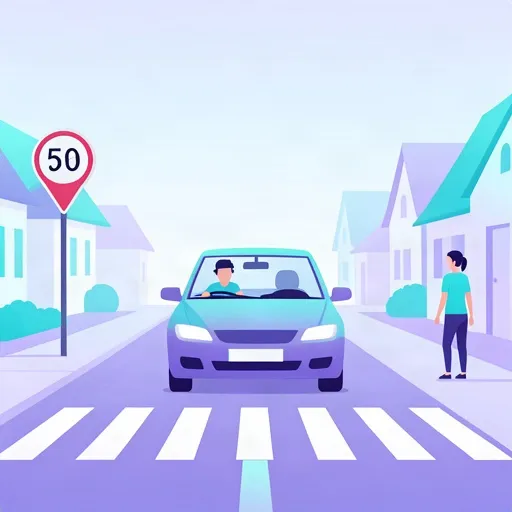
In Poland, the standard speed limit in built-up areas is 50 km/h. However, this limit is often lowered in specific zones to protect pedestrians and cyclists. Lowering speeds in these environments allows drivers more time to observe their surroundings and react to unpredictable movements, which is particularly crucial in areas with high pedestrian traffic.
Always remember that road signs indicating lower speed limits (such as 30 km/h zones) take precedence over the general built-up area limit. Ignoring these signs is a common cause of exam failure and real-world safety hazards.
Defensive driving is about anticipating hazards before they manifest into dangerous situations. When approaching a pedestrian crossing, you must be prepared to slow down or stop, even if the crossing appears clear at first glance. Polish traffic law requires drivers to exercise particular caution when passing or approaching vulnerable road users.
The practice of operating a vehicle in a way that prioritizes the safety of oneself and others by adjusting speed to road conditions, maintaining adequate distance, and being constantly prepared to react to potential hazards.
Recent studies, such as those conducted in Wales regarding the implementation of 20 mph (approx. 32 km/h) zones, demonstrate a clear trend: lower average speeds lead to a significant drop in casualty rates. While these specific policies are international, the underlying mechanics—that lower kinetic energy in a collision reduces the severity of injuries—are universal. Applying these principles to your driving in Poland helps you pass your exam by demonstrating that you understand the "why" behind traffic rules, not just the rules themselves.
This article explains why speed limits exist as calculated safety thresholds based on vehicle physics and human reaction time, emphasizing that the distance traveled before brakes are applied plus the braking distance itself creates the total stopping distance. It covers Polish speed regulations, specifically the 50 km/h built-up area limit and how lower zone limits take precedence, while stressing that defensive driving requires anticipating hazards and reducing speed below posted limits when conditions warrant. Key concepts include reaction distance, braking distance, kinetic energy, and the specific procedure for safely approaching pedestrian crossings. Understanding these principles helps learners grasp the reasoning behind traffic rules, which is essential for both safe driving and theory exam success.
A short set of high-value points that capture the most important ideas from this article.
Speed increases total stopping distance exponentially, meaning small speed reductions can dramatically reduce collision severity and save lives
In Poland, the standard speed limit in built-up areas is 50 km/h, but specific zones may impose lower limits that take precedence
Speed limits are maximum allowed speeds, not targets; prudent drivers reduce speed below the limit in poor conditions or near vulnerable road users
Defensive driving requires anticipating hazards and adjusting speed proactively, especially near pedestrian crossings and residential zones
Lower speeds reduce kinetic energy in collisions, which directly decreases injury severity for vulnerable road users
Road sign B-33 indicates a speed limit at a specific location; B-43 marks the beginning of a speed limit zone applying to all roads within it
Total stopping distance equals reaction distance (distance traveled before braking) plus braking distance (distance traveled while braking)
Drivers must stop for pedestrians at crossings who have already entered or show clear intent to cross
Speed limits of 30 km/h or lower in pedestrian zones take legal precedence over the general 50 km/h built-up area limit
Vulnerable road users include pedestrians, cyclists, and motorcyclists who face higher injury risk in collisions
Treating posted speed limits as targets to reach rather than maximum thresholds that conditions may require staying below
Failing to notice zone signs (B-43) that impose lower speed limits across a defined area
Not reducing speed sufficiently near schools, crossings, or residential zones with high pedestrian activity
Accelerating immediately after passing a pedestrian crossing without confirming the area ahead is clear
Underestimating braking distance by assuming higher speeds only slightly increase stopping requirements
Article content overview
A short set of high-value points that capture the most important ideas from this article.
Speed increases total stopping distance exponentially, meaning small speed reductions can dramatically reduce collision severity and save lives
In Poland, the standard speed limit in built-up areas is 50 km/h, but specific zones may impose lower limits that take precedence
Speed limits are maximum allowed speeds, not targets; prudent drivers reduce speed below the limit in poor conditions or near vulnerable road users
Defensive driving requires anticipating hazards and adjusting speed proactively, especially near pedestrian crossings and residential zones
Lower speeds reduce kinetic energy in collisions, which directly decreases injury severity for vulnerable road users
Road sign B-33 indicates a speed limit at a specific location; B-43 marks the beginning of a speed limit zone applying to all roads within it
Total stopping distance equals reaction distance (distance traveled before braking) plus braking distance (distance traveled while braking)
Drivers must stop for pedestrians at crossings who have already entered or show clear intent to cross
Speed limits of 30 km/h or lower in pedestrian zones take legal precedence over the general 50 km/h built-up area limit
Vulnerable road users include pedestrians, cyclists, and motorcyclists who face higher injury risk in collisions
Treating posted speed limits as targets to reach rather than maximum thresholds that conditions may require staying below
Failing to notice zone signs (B-43) that impose lower speed limits across a defined area
Not reducing speed sufficiently near schools, crossings, or residential zones with high pedestrian activity
Accelerating immediately after passing a pedestrian crossing without confirming the area ahead is clear
Underestimating braking distance by assuming higher speeds only slightly increase stopping requirements
Explore related topics, search based questions, and concepts that learners often look up when studying Speed Limits and Road Safety. These themes reflect real search intent and help you understand how this topic connects to wider driving theory knowledge in Poland.
Find clear and practical answers to common questions learners often have about Speed Limits and Road Safety. This section helps explain difficult points, remove confusion, and reinforce the key driving theory concepts that matter for learners in Poland.
In built-up areas, there is a higher density of vulnerable road users like pedestrians and cyclists. Lower speeds significantly reduce the stopping distance and the severity of impact in the event of a collision.
As speed increases, both the distance traveled during the driver's reaction time and the physical braking distance increase non-linearly. This means even a small reduction in speed can drastically shorten the total stopping distance.
Speed limits represent the maximum permissible speed under ideal conditions. Drivers are legally and morally required to reduce their speed below the limit when road, traffic, or weather conditions necessitate extra caution, such as near pedestrian crossings.
After finding your specific article, continue your targeted learning by exploring related topics or diving deeper into practice questions. Our extensive library ensures you have all the resources needed to confidently prepare for your Polish driving license theory exam. Discover more guides and solidify your understanding of Polish road rules.