
Parking incorrectly is one of the most frequent causes of errors in the Polish driving theory exam and a leading source of traffic fines. This article details the precise legal distances required when stopping or parking near pedestrian crossings, intersections, and transit stops. You will learn the logic behind these safety rules and how to apply them correctly to ensure compliance in any traffic situation.
Article content overview
Mastering the rules for stopping and parking in Poland is a fundamental step toward passing your official theory exam. Many learners underestimate the strictness of the Polish Road Traffic Act (Prawo o ruchu drogowym), often assuming that "just a moment" of parking is permitted even in restricted zones. In reality, the law is rigid regarding distances from critical infrastructure, and failing to respect these zones is one of the most common reasons for both failing the theory exam and receiving hefty fines from the police or municipal guards (Straż Miejska).
Before diving into specific zones, it is vital to distinguish between two terms that are often used interchangeably in casual conversation but carry distinct legal weight. Under Polish regulations, "stopping" (zatrzymanie) refers to the intentional immobilization of a vehicle for a duration not exceeding one minute or for longer, provided it is strictly necessary for the driver to board or alight passengers, or to load and unload goods. Conversely, "parking" (postój) is any intentional immobilization of the vehicle exceeding one minute that is not related to the aforementioned activities.
An intentional immobilization of a vehicle not exceeding 1 minute, or for a longer time necessary to board/alight passengers or load/unload goods.
Any intentional immobilization of a vehicle exceeding 1 minute that does not meet the criteria for stopping.
Be aware that signs prohibiting stopping (B-36) are much stricter than those prohibiting parking (B-35). If you see a B-36 sign, you cannot even pull over to drop off a passenger; doing so will result in a penalty.
The Polish law mandates specific buffer zones around high-traffic areas to ensure safety and visibility. These distances apply even if there are no vertical road signs prohibiting parking. You must be able to calculate these gaps mentally while driving or during your theory exam practice.
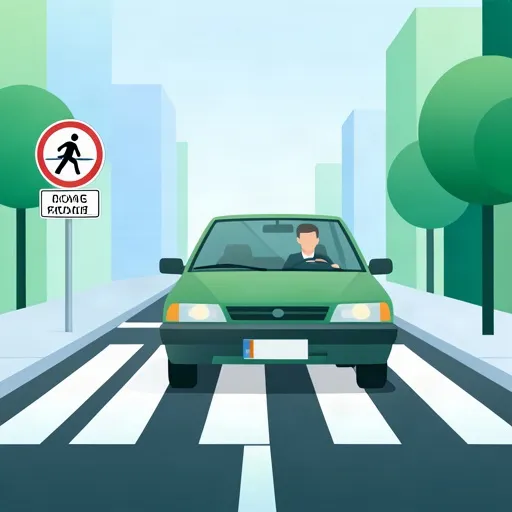
Parking or stopping is strictly forbidden on a pedestrian crossing, as well as on a bicycle crossing. More importantly, you are prohibited from stopping within 10 meters before these zones to ensure that drivers have a clear view of pedestrians stepping onto the road. On two-way streets with two lanes, this 10-meter restriction also applies to the area behind the crossing. The same 10-meter rule applies to intersections; parking too close to a junction significantly limits visibility for vehicles turning or entering the flow of traffic.
For bus and tram stops, the rule is even more specific. You must not stop or park your vehicle within 15 meters of the sign marking the stop. If the stop features a designated bay, the prohibition covers the entire length of that bay. Failing to leave this space clear is a common trap in theory exams, as students often forget that these rules apply regardless of whether a bus or tram is currently approaching.
The following table summarizes key locations where you must avoid stopping or parking to maintain compliance with Polish traffic laws:
| Location | Restriction Type | Distance Requirement |
|---|---|---|
| Pedestrian Crossing | No Stopping / No Parking | 10 meters before (and behind on 2-way roads) |
| Intersection | No Stopping / No Parking | 10 meters |
| Bus/Tram Stop | No Stopping / No Parking | 15 meters from the sign / full length of bay |
| Railway Crossing | No Parking | Up to the sign with one stripe |
| Residential Zone (D-40) | No Parking | Only in specifically marked spaces |
When you enter a residential zone, marked by the blue D-40 sign, the rules change entirely. In these areas, parking is permitted only in spaces specifically designated for that purpose. This is a common point of confusion; many drivers assume they can park anywhere along the curb as long as they don't block traffic, but in a D-40 zone, doing so is an immediate violation. Always look for white markings or vertical signs indicating permitted parking areas when navigating urban residential districts.
This article clarifies the legal distinction between stopping and parking under Polish traffic law, explaining that stopping is immobilization under 1 minute while parking exceeds this threshold. Critical distance requirements include 10 meters from pedestrian crossings and intersections, and 15 meters from bus and tram stops. The B-35 and B-36 road signs represent different levels of restriction, with B-36 prohibiting any stopping whatsoever. In residential zones marked D-40, parking is restricted to designated spaces only, making proper sign and marking recognition essential for both exam success and real-world compliance.
A short set of high-value points that capture the most important ideas from this article.
Under Polish law, stopping (zatrzymanie) means immobilization up to 1 minute; parking (postój) means immobilization exceeding 1 minute with no passenger or cargo purpose
You must maintain at least a 10-meter distance before any pedestrian crossing or intersection, even without prohibitive signs
The 10-meter rule also applies behind crossings on two-way two-lane streets
Bus and tram stops require a 15-meter clearance from the sign or the full length of a designated bay
B-36 (no stopping) signs prohibit even momentary immobilization, while B-35 (no parking) allows stops under 1 minute
The 10-meter rule protects visibility for drivers approaching crossings and intersections
Bus/tram stop prohibitions apply at all times regardless of whether a vehicle is approaching
In D-40 residential zones, parking is only permitted in specifically marked spaces
B-36 is stricter than B-35: no stopping at all, not even for passenger drop-off
The P-21 marking indicates a surface where parking or stopping is completely illegal
Assuming a quick stop to drop someone off is allowed near a B-36 sign, when in fact any immobilization violates this sign
Forgetting that the 10-meter prohibition extends to the area behind a crossing on two-way streets
Believing that bus stop rules only apply when a bus is actually present at the stop
Confusing stopping and parking terminology and misapplying the 1-minute threshold
Parking anywhere along the curb in a D-40 residential zone instead of only in marked spaces
Article content overview
A short set of high-value points that capture the most important ideas from this article.
Under Polish law, stopping (zatrzymanie) means immobilization up to 1 minute; parking (postój) means immobilization exceeding 1 minute with no passenger or cargo purpose
You must maintain at least a 10-meter distance before any pedestrian crossing or intersection, even without prohibitive signs
The 10-meter rule also applies behind crossings on two-way two-lane streets
Bus and tram stops require a 15-meter clearance from the sign or the full length of a designated bay
B-36 (no stopping) signs prohibit even momentary immobilization, while B-35 (no parking) allows stops under 1 minute
The 10-meter rule protects visibility for drivers approaching crossings and intersections
Bus/tram stop prohibitions apply at all times regardless of whether a vehicle is approaching
In D-40 residential zones, parking is only permitted in specifically marked spaces
B-36 is stricter than B-35: no stopping at all, not even for passenger drop-off
The P-21 marking indicates a surface where parking or stopping is completely illegal
Assuming a quick stop to drop someone off is allowed near a B-36 sign, when in fact any immobilization violates this sign
Forgetting that the 10-meter prohibition extends to the area behind a crossing on two-way streets
Believing that bus stop rules only apply when a bus is actually present at the stop
Confusing stopping and parking terminology and misapplying the 1-minute threshold
Parking anywhere along the curb in a D-40 residential zone instead of only in marked spaces
Explore related topics, search based questions, and concepts that learners often look up when studying Polish Parking and Stopping Rules. These themes reflect real search intent and help you understand how this topic connects to wider driving theory knowledge in Poland.
Find clear and practical answers to common questions learners often have about Polish Parking and Stopping Rules. This section helps explain difficult points, remove confusion, and reinforce the key driving theory concepts that matter for learners in Poland.
You must not stop or park your vehicle at a distance of less than 10 meters before a pedestrian crossing. On a two-way road with two lanes, this restriction also applies to the area immediately after the crossing.
The law prohibits stopping and parking within a distance of 10 meters from an intersection to ensure visibility and traffic flow for all road users.
You are prohibited from stopping your vehicle at a distance of less than 15 meters from the bus or tram stop sign or pole. If the stop has a designated bay, the prohibition applies to the entire length of the bay.
Yes. Stopping is defined as any immobilisation of the vehicle not resulting from traffic conditions that lasts no longer than one minute. Parking (postój) refers to any immobilisation of the vehicle that exceeds one minute.
After finding your specific article, continue your targeted learning by exploring related topics or diving deeper into practice questions. Our extensive library ensures you have all the resources needed to confidently prepare for your Polish driving license theory exam. Discover more guides and solidify your understanding of Polish road rules.