
Understanding where you are permitted to stop or park is a fundamental requirement for every driver in Poland. This guide breaks down the legal definitions from the Prawo o ruchu drogowym, helping you correctly identify prohibited zones, interpret signs like B-35 and B-36, and calculate safety distances near pedestrian crossings and intersections to excel on your theory test.
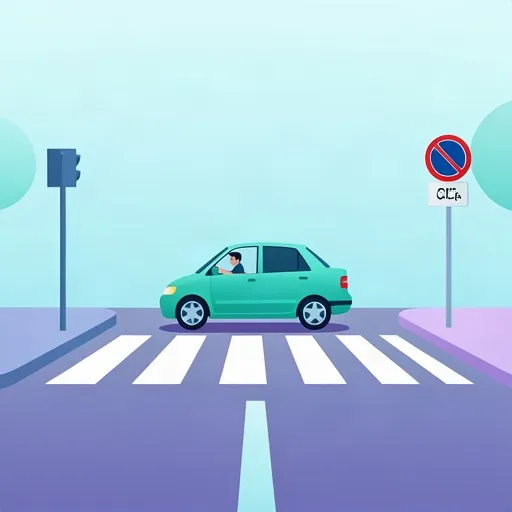
Article content overview
Mastering the rules regarding stopping and parking is a cornerstone of the Polish driving theory exam. Many learners fail to achieve a perfect score because they underestimate the complexity of the Polish Traffic Law (Prawo o ruchu drogowym). Whether you are driving in a bustling city center or on a quiet rural road, knowing exactly where you can legally leave your vehicle is not just a matter of avoiding a fine—it is about ensuring the safety of all road users and maintaining the fluidity of traffic.
In the context of the Polish theory exam, you must clearly distinguish between a "temporary stop" (zatrzymanie) and "parking" (postój). These two terms carry different legal implications and are subject to different restrictions. A temporary stop is defined as the immobilization of a vehicle not resulting from traffic conditions or regulations, lasting no longer than one minute. Anything exceeding this duration is legally classified as parking.
The immobilization of a vehicle not resulting from traffic conditions or regulations, lasting up to one minute, or any immobilization necessitated by traffic conditions.
The immobilization of a vehicle not resulting from traffic conditions or regulations, lasting longer than one minute.
Understanding this distinction is vital because some road signs, such as the "no stopping" sign, are significantly more restrictive than "no parking" signs. If you encounter a B-36 sign, you are forbidden from even momentarily stopping to drop off a passenger, whereas a B-35 sign allows for a quick stop under specific conditions.
One of the most frequent traps in the Polish theory exam involves calculating distances near intersections, pedestrian crossings, and bicycle paths. Polish law mandates a 10-meter clearance to ensure visibility and safety for all participants. If you park "on the edge" of these zones, you obstruct the view of other drivers and endanger pedestrians attempting to cross the street.
The 10-meter rule applies to both the front and, in some cases, the rear of the prohibited zone. On two-way streets, remember that the prohibition often extends behind a pedestrian crossing, not just before it. Failing to account for road directionality is a common reason for incorrect answers on the theory test.
Residential zones, marked by the D-40 sign, operate under a unique set of rules that frequently appear in exam questions. Unlike standard roads where you may park wherever it is not explicitly forbidden, in a residential zone, you are restricted to parking only in designated areas marked with appropriate signage or road markings.
Even if you do not see a "No Parking" sign, the D-40 sign itself acts as a blanket prohibition for parking outside of designated spaces. This is a common trap: students often assume that if a sidewalk is wide enough, it is acceptable to park there, but in a residential zone, this is an automatic violation.
To help you organize your study, refer to this table outlining common restricted areas and the rationale behind them.
| Location | Restriction Type | Primary Reason |
|---|---|---|
| Pedestrian Crossing | 10m before/after | Visibility & Safety |
| Intersection | 10m from junction | Visibility & Flow |
| Bus/Tram Stop | 15m from marker | Traffic/Public Transport flow |
| Railway Crossing | Up to sign | Safety |
| Narrow Sidewalk | Prohibited | Pedestrian access |
The theory exam often tests your knowledge of "hidden" rules. For instance, you might be asked if parking is allowed 20 meters from a bus stop. Since the rule is a 15-meter buffer, 20 meters is perfectly legal. Another trap involves the "end of restrictions" sign (B-42), which does not cancel out "No Stopping" or "No Parking" signs. Always check the specific signage on the road rather than assuming a general cancellation sign clears the way for parking.
Remember that illegal parking does not only result in a fine (mandat). In many cases, especially when the vehicle obstructs traffic or poses a safety hazard, authorities may authorize the removal of the vehicle at the owner's expense. Staying informed about the latest taryfikator (penalty tariff) is essential for every responsible driver in Poland.
This article clarifies the legal difference between stopping (zatrzymanie, up to one minute) and parking (postój, exceeding one minute), which determines which road signs restrict your actions. The B-35 sign prohibits parking but allows brief stops, while B-36 prohibits all stopping and parking. Critical distance rules require 10-meter clearances near intersections and pedestrian crossings, and 15 meters from bus and tram stops. In residential zones marked by D-40, parking is restricted to only designated areas regardless of sidewalk width. The theory exam commonly tests these distinctions, particularly directional awareness on two-way streets and the misconception that general cancellation signs override specific prohibition signs.
A short set of high-value points that capture the most important ideas from this article.
The legal distinction between stopping (zatrzymanie, up to 1 minute) and parking (postój, over 1 minute) determines which restrictions apply
B-36 sign prohibits both stopping and parking entirely, while B-35 only prohibits parking - a momentary stop is still permitted under B-35
A mandatory 10-meter clearance applies before and sometimes after pedestrian crossings and intersections to maintain visibility
In residential zones marked by D-40, parking is only permitted in specifically designated areas - this is a blanket restriction
Bus and tram stops require a 15-meter buffer zone measured from the stop marker
A stop lasting 1 minute or less is legally 'zatrzymanie'; anything longer is 'postój'
On two-way streets, the 10-meter prohibition behind a pedestrian crossing extends in both directions of traffic flow
The B-42 'end of restrictions' sign does NOT cancel out specific no-stopping or no-parking signs on posts nearby
In a residential zone (D-40), even a wide sidewalk without parking markings is not a legal parking spot
Distance from a bus/tram stop is measured from the stop marker, not the bus shelter structure
Confusing B-35 and B-36, assuming both prohibit any stopping when only B-36 does
Forgetting that the 10-meter rule extends behind pedestrian crossings, not just before them
Assuming that without an explicit 'No Parking' sign, parking is automatically allowed in a residential zone
Miscalculating bus stop distances - the rule is 15 meters, not 10 meters like intersections
Believing a general 'end of restrictions' sign (B-42) overrides specific no-parking signs posted on individual posts
Article content overview
A short set of high-value points that capture the most important ideas from this article.
The legal distinction between stopping (zatrzymanie, up to 1 minute) and parking (postój, over 1 minute) determines which restrictions apply
B-36 sign prohibits both stopping and parking entirely, while B-35 only prohibits parking - a momentary stop is still permitted under B-35
A mandatory 10-meter clearance applies before and sometimes after pedestrian crossings and intersections to maintain visibility
In residential zones marked by D-40, parking is only permitted in specifically designated areas - this is a blanket restriction
Bus and tram stops require a 15-meter buffer zone measured from the stop marker
A stop lasting 1 minute or less is legally 'zatrzymanie'; anything longer is 'postój'
On two-way streets, the 10-meter prohibition behind a pedestrian crossing extends in both directions of traffic flow
The B-42 'end of restrictions' sign does NOT cancel out specific no-stopping or no-parking signs on posts nearby
In a residential zone (D-40), even a wide sidewalk without parking markings is not a legal parking spot
Distance from a bus/tram stop is measured from the stop marker, not the bus shelter structure
Confusing B-35 and B-36, assuming both prohibit any stopping when only B-36 does
Forgetting that the 10-meter rule extends behind pedestrian crossings, not just before them
Assuming that without an explicit 'No Parking' sign, parking is automatically allowed in a residential zone
Miscalculating bus stop distances - the rule is 15 meters, not 10 meters like intersections
Believing a general 'end of restrictions' sign (B-42) overrides specific no-parking signs posted on individual posts
Explore related topics, search based questions, and concepts that learners often look up when studying Poland Parking Rules and Prohibitions. These themes reflect real search intent and help you understand how this topic connects to wider driving theory knowledge in Poland.
Find clear and practical answers to common questions learners often have about Poland Parking Rules and Prohibitions. This section helps explain difficult points, remove confusion, and reinforce the key driving theory concepts that matter for learners in Poland.
Zatrzymanie (stopping) is an immobilization of the vehicle resulting from road conditions or traffic regulations lasting less than one minute, or any time if related to embarking/disembarking passengers. Postój (parking) is any immobilization of the vehicle not resulting from traffic conditions lasting longer than one minute.
You are prohibited from stopping or parking on a pedestrian crossing and within a distance of less than 10 meters before it. On a two-way road with two lanes, this prohibition also applies to the area behind the crossing.
Sign B-35 represents a 'no parking' (zakaz postoju) order, while sign B-36 signifies 'no stopping' (zakaz zatrzymywania się), which is a stricter prohibition covering both parking and temporary stops.
Yes, in a residential zone marked with the D-40 sign, you are permitted to park only in areas specifically designated for this purpose, even if no other 'no parking' signs are present.
No, it is prohibited to park or stop your vehicle on an intersection and within a distance of less than 10 meters from the intersection.
After finding your specific article, continue your targeted learning by exploring related topics or diving deeper into practice questions. Our extensive library ensures you have all the resources needed to confidently prepare for your Polish driving license theory exam. Discover more guides and solidify your understanding of Polish road rules.