
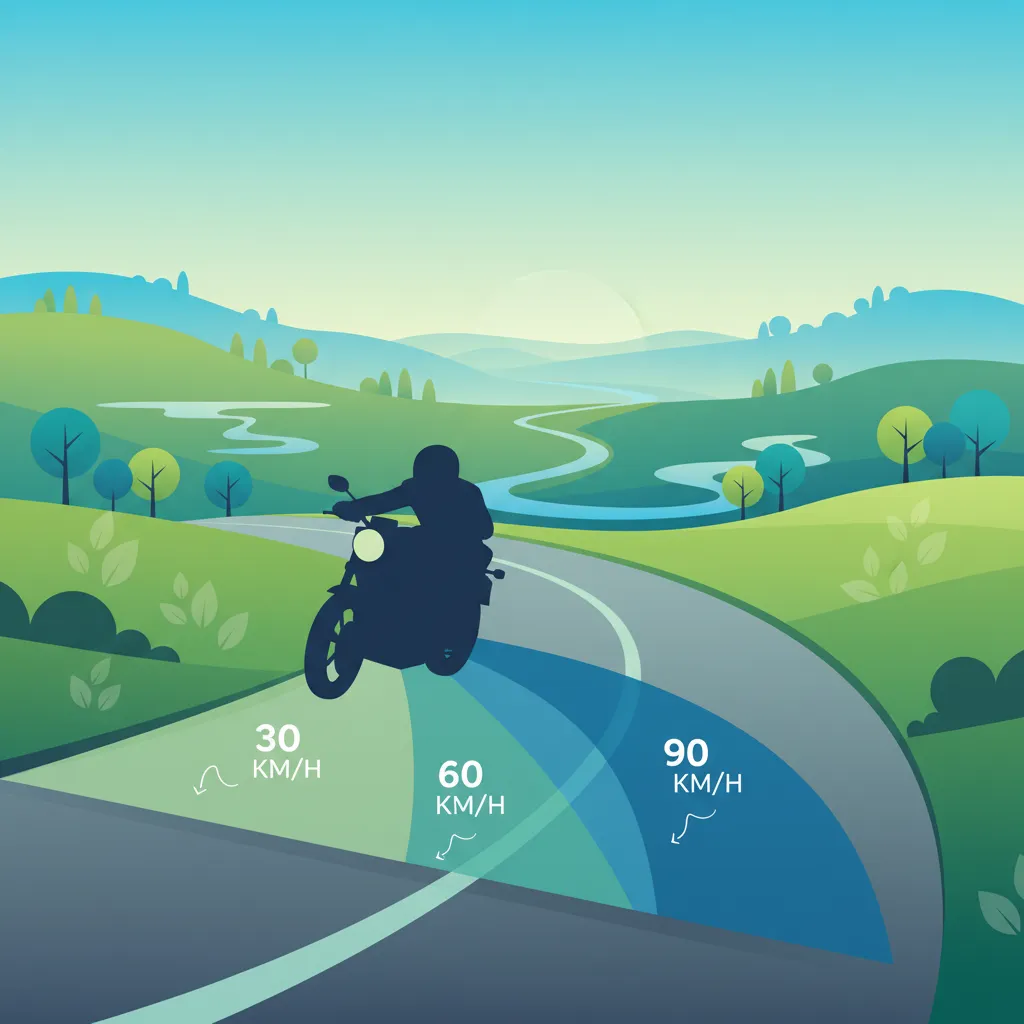
Mastering speed management is crucial for motorcycle safety in Poland. This unit covers legal speed limits, the physics of stopping distances, and effective braking techniques. You'll learn how different conditions affect your ability to stop safely, ensuring you're prepared for both the theory exam and real-world riding challenges on Polish roads.
Browse all lessons that make up Speed Management, Stopping Distances, and Braking. Each lesson focuses on specific topics, learning objectives, and core concepts, helping you build essential knowledge and follow a clear, structured progression toward your study goals in Poland.
This lesson provides a comprehensive overview of the statutory speed limits applicable to different categories of Polish roads, including urban areas, residential zones, rural roads, highways, and motorways. Learners will examine the visual cues of speed limit signs and learn how speed limit transitions affect rider behavior. The content also covers how enforcement mechanisms impact compliance and the importance of real-time speed adaptation to remain within legal thresholds.
In this lesson, learners study the physics behind stopping distances, breaking it down into perception-reaction time and braking distance components. The content explains how speed, vehicle mass, and road surface friction influence the total stopping distance. Learners will practice calculating stopping distances under different conditions and understand the importance of maintaining a safety margin by improving hazard perception and rider response.
This lesson explores how increasing speed amplifies kinetic energy, thereby affecting braking efficiency and required stopping distances. Learners will learn about brake fade due to heat, the differing contributions of front and rear brakes, and how ABS assists in maintaining stability on slippery surfaces. The lesson covers techniques for proper brake modulation, especially when decelerating from high speeds, to help riders apply appropriate braking techniques for safety.
In this lesson, learners examine how environmental conditions such as rain, wind, ice, and reduced visibility necessitate adjustments in riding speed. The content provides guidelines for assessing road surfaces, judging appropriate cornering speeds, and reducing speed proactively in adverse weather. Learners will understand the impact of temperature on tyre performance and the need to increase safety margins, mastering adaptive speed management to maintain control.
This lesson focuses on the principles of maintaining a safe following distance behind other road users, introducing the two-second and three-second rules as guidelines. Learners will learn how to estimate safe gaps based on speed, road conditions, and traffic density, and understand the importance of a reaction-time buffer to prevent rear-end collisions. The lesson also covers techniques for visual distance estimation, promoting safe tailgating avoidance.
Explore high-intent keywords and long-tail search topics learners use when researching Speed Management, Stopping Distances, and Braking. These terms reflect how people search for reliable study materials, structured explanations, and unit-level theory preparation support in Poland.
Find clear answers to the most common questions learners ask about Speed Management, Stopping Distances, and Braking. Understand how the unit is organized, what learning goals it supports, and how it contributes to your study progression with structured explanations and practical guidance tailored for learners in Poland.
In Poland, speed limits vary by road type. Generally, within built-up areas, the limit is 50 km/h (or 60 km/h during certain hours). Outside built-up areas, it's typically 90 km/h on regular roads and 120 km/h on expressways. On motorways, the limit is 140 km/h for motorcycles. Always pay attention to specific signage, as these limits can be adjusted.
Speed significantly increases stopping distance. Stopping distance consists of two parts: perception-reaction distance (the distance travelled before braking) and braking distance (the distance travelled while braking). As speed increases, both these components grow exponentially, primarily due to kinetic energy. Doubling your speed can quadruple your braking distance, making it crucial to ride at a speed appropriate for conditions.
Perception-reaction distance is the ground covered from the moment you perceive a hazard until you physically apply the brakes. Braking distance is the distance your motorcycle travels from the moment you apply the brakes until it comes to a complete stop. Both are critical components of your total stopping distance and are affected by speed and road conditions.
Adverse weather conditions drastically reduce tyre grip, which is essential for effective braking. Rain, snow, and ice significantly increase braking distances because the tyres have less traction with the road surface. It becomes much harder to brake hard without skidding, requiring you to reduce speed considerably and increase following distances.
Yes, engine braking is a valuable technique for motorcycles. By downshifting, you use the engine's resistance to help slow the motorcycle, which can supplement your primary brakes, especially on descents or when preparing to stop. It also helps maintain stability and control, particularly in slippery conditions, by preventing the rear wheel from locking up.
While it's difficult to practice exact stopping distances on public roads, focus on consistently maintaining safe following distances from the vehicle ahead. Observe how long it takes for other vehicles to stop in different situations and mentally note the distances involved. During theory study, practice calculating these distances under various scenarios to build an intuitive understanding for the exam.
All included lessons
Lessons in Speed Management, Stopping Distances, and Braking
See who benefits most from studying Speed Management, Stopping Distances, and Braking. This overview explains how the unit supports different learning needs, what level of knowledge is helpful before starting, and how it fits into the overall study path in Poland.
This unit is essential for all aspiring Category A motorcycle licence holders in Poland. It is particularly beneficial for learners who want to understand the physics behind safe riding, those preparing for the theory exam, and riders looking to improve their decision-making skills in complex traffic situations.

Dive into our curated curriculum designed for Polish driving license aspirants. Select a course, follow its guided modules, and master every aspect of traffic rules and road signs necessary to pass your theory exam with confidence.
Polish Theory CurriculumExplore all units and lessons included in this driving theory course.
Dive into our curated curriculum designed for Polish driving license aspirants. Select a course, follow its guided modules, and master every aspect of traffic rules and road signs necessary to pass your theory exam with confidence.
Polish Theory Curriculum