
This lesson is crucial for all aspiring Category A motorcyclists in Poland. It dives into the physics of how speed significantly impacts braking efficiency, building upon your understanding of stopping distances. You'll explore essential concepts like kinetic energy, brake fade, and the role of ABS, preparing you for safe deceleration and challenging questions on your Polish theory exam.
Lesson content overview
For every motorcyclist aiming for a Category A licence in Poland, comprehending how speed fundamentally impacts braking is not merely academic; it is vital for safety. This lesson delves into the intricate relationship between a motorcycle's velocity, the kinetic energy it possesses, and the effectiveness of its braking system. We will explore the physics governing deceleration, common pitfalls like brake fade, and the strategic use of front and rear brakes, including modern Anti-Lock Braking Systems (ABS). Mastering these concepts is crucial for maintaining control and stopping safely in diverse riding conditions.
At the heart of braking efficiency lies the concept of kinetic energy, which is the energy an object possesses due to its motion. For a moving motorcycle, this energy is determined by its mass (m) and its velocity (v), described by the formula Eₖ = ½ mv². This equation reveals a crucial insight: kinetic energy increases quadratically with speed.
This means that if you double your speed, the kinetic energy you need to dissipate when braking doesn't just double; it quadruples. For example, a motorcycle travelling at 100 km/h possesses four times the kinetic energy of the same motorcycle at 50 km/h. This exponential increase in energy directly translates to a proportionally greater demand on your brakes and, consequently, significantly longer stopping distances. Understanding this principle is fundamental to why the Prawo o ruchu drogowym (Polish Road Traffic Law) emphasizes adapting speed to conditions and adhering to legal limits.
The practical meaning of the kinetic energy-speed relationship is profound. Every increase in speed reduces your margin for error. Even small increments can drastically extend the distance required to bring your motorcycle to a complete halt. This makes anticipatory riding and appropriate speed management paramount, especially when navigating complex traffic situations, carrying a passenger, or transporting cargo.
Remember the Square Rule: Doubling your speed roughly quadruples the kinetic energy, leading to approximately four times the braking distance required. This is a critical factor in safe following distances and hazard perception.
Braking efficiency refers to how effectively a motorcycle's braking system converts its kinetic energy into thermal energy (heat) to slow down and stop. A highly efficient braking system can dissipate more energy over a shorter distance, resulting in quicker and safer stops. However, various factors can compromise this efficiency.
Modern motorcycle brakes primarily rely on friction between brake pads and discs. The coefficient of friction, the condition of the brake components, and the temperature generated during braking all play significant roles in how well the system performs. Optimal brake performance is legally mandated in Poland, with regulations requiring vehicles to be maintained in a roadworthy condition.
One of the most critical threats to braking efficiency is brake fade. This phenomenon occurs when brake components, such as pads or fluid, overheat due to prolonged or repeated heavy use. Brake fade manifests in two primary forms:
Brake fade is particularly dangerous on long descents or during sustained aggressive riding, as it progressively increases your stopping distance and can lead to a complete loss of braking power. To prevent fade, riders should employ techniques such as engine braking (downshifting to use engine resistance to slow down) and intermittent, firm brake applications rather than continuous, light pressure.
During deceleration, inertia causes a significant transfer of weight from the rear wheel to the front wheel of a motorcycle. This dynamic shift fundamentally alters the traction available at each wheel and dictates how braking force should be distributed.
As weight shifts forward, the front tire gains significantly more grip on the road surface, allowing it to handle a much larger proportion of the total braking force without locking up. Conversely, the rear tire experiences a reduction in load, meaning its traction decreases. This is why the front brake on a motorcycle is designed to provide the majority of the stopping power, typically accounting for 70-80% of total braking force in an effective stop on dry pavement.
Recognizing front brake dominance is crucial for safe riding. A firm, progressive application of the front brake lever is essential for achieving the shortest possible stopping distances. Misusing the front brake, such as grabbing it abruptly, can overwhelm the tire's grip and lead to a front-wheel lock-up, often resulting in a dangerous low-side crash.
The rear brake, while less powerful, still plays a vital role. It helps stabilize the motorcycle during braking, especially at lower speeds or on slippery surfaces where excessive front brake could be hazardous. On very low-traction surfaces like gravel or wet cobblestones, a slight, gentle application of the rear brake might be preferred initially to avoid an immediate front-wheel lock-up. However, relying solely on the rear brake at higher speeds is inefficient and can easily lead to a rear-wheel skid and loss of control. Riders must understand that under hard braking, the rear wheel can lift slightly, further reducing its effective braking contribution.
The Anti-Lock Braking System (ABS) is a pivotal safety technology designed to prevent wheel lock-up during heavy braking, particularly in emergency situations or on slippery surfaces. ABS works by continuously monitoring wheel speed. If it detects a wheel is about to lock, it rapidly modulates (releases and reapplies) brake pressure to that wheel multiple times per second.
The primary benefits of ABS include:
While ABS is an incredibly effective safety feature, it is important to understand its limitations. ABS does not eliminate brake fade; it only manages wheel lock-up. Riders must still practice proper brake modulation and anticipate its activation, especially in conditions where grip is minimal. While not universally mandatory for all motorcycles in Poland, ABS is becoming standard on many new bikes and is highly recommended for all riders taking the Polish Motorcycle Theory – Comprehensive Licence Preparation for Category A course.
Brake modulation is the art of applying and releasing brake pressure in a controlled, progressive manner to achieve optimal deceleration without exceeding the available tire grip or causing wheel lock-up. This skill is paramount for safe and effective braking, especially when decelerating from high speeds.
Proper brake modulation involves:
Abrupt or "panic" braking, especially on the front wheel, can easily lead to a loss of traction and a crash. Practice smooth, progressive application to build muscle memory.
Practicing brake modulation in a safe environment helps riders develop the fine motor skills and judgment needed to perform emergency stops effectively. It reduces the risk of wheel lock-up, minimizes the chances of brake fade by preventing constant heavy application, and ultimately contributes to a more stable and controlled deceleration.
Adhering to the Prawo o ruchu drogowym (Polish Road Traffic Law) is not just a legal obligation but a cornerstone of road safety, directly influencing how motorcyclists must manage speed and braking.
Rule 1: Speed Limits (Art. 86 of Prawo o ruchu drogowym)
Rule 2: Safe Braking Distance (Art. 84 § 4 of Prawo o ruchu drogowym)
Rule 3: Vehicle Technical Condition (Art. 61 § 1 of Prawo o ruchu drogowym)
Rule 4: Use of Braking Systems (Art. 84 § 5 of Prawo o ruchu drogowym)
Effective braking is not a one-size-fits-all skill. Motorcyclists must constantly adapt their braking approach to a variety of environmental, road, and traffic conditions.
| Condition | Variation in Braking Approach | Reasoning |
|---|---|---|
| Wet or Icy Road | Use gentler, highly progressive pressure on both brakes; increase reliance on the rear brake slightly; ensure ABS (if equipped) is active; significantly increase following distance. | Reduced coefficient of friction dramatically increases stopping distances and the risk of wheel lock-up. |
| Dry Asphalt, High Grip | The front brake can be applied more aggressively with firm, progressive pressure; the rear brake provides fine adjustment and stability. | Higher friction allows for greater braking forces without loss of traction, making the front brake highly effective. |
| Mountain Descent | Primarily use engine braking (downshift); apply intermittent, firm bursts of front and rear brakes; avoid continuous heavy braking to prevent fade. | Continuous braking generates excessive heat, leading to brake fade. Engine braking helps manage speed without overheating the friction brakes. |
| Urban Traffic (Stop-and-Go) | Employ light, frequent braking using both levers; maintain a safe following distance; anticipate stops well in advance. | Frequent deceleration demands smooth modulation to avoid excessive wear, maintain stability, and react to unpredictable city traffic. |
| Heavy Load/Passenger | Expect significantly longer stopping distances; adjust speed accordingly; increase the front-brake share due to the higher overall inertia. | Additional mass increases kinetic energy, requiring more braking force and a longer time/distance to stop. |
| Nighttime with Reduced Visibility | Reduce speed further because perception distance is lower; allow extra reaction time and stopping distance. | Limited visual cues mean hazards are seen later, demanding more time to react and brake safely. |
| Vulnerable Road Users (Pedestrians, Cyclists) | Apply brakes earlier; anticipate sudden stops or unpredictable movements; maintain greater clearance. | Vulnerable users may unpredictably enter the rider’s path, requiring immediate and decisive braking capability. |
| ABS vs. Non-ABS Equipped Bike | With ABS, you can apply maximum brake force and maintain steering control. Without ABS, lighter, smoother inputs are needed to avoid lock-up. | ABS electronically prevents wheel lock-up, optimizing braking force. Non-ABS bikes rely entirely on rider skill to prevent skids. |
Even experienced riders can fall prey to common braking errors. Recognizing these pitfalls is the first step towards safer riding.
Mastering the interaction between speed and braking is fundamental for safety on Polish roads and for successfully passing the Category A motorcycle theory exam. Remember these core principles:
By internalizing these principles and consistently applying proper techniques, you will significantly enhance your safety and control on any motorcycle, navigating the challenges of Polish roads with confidence.
To deepen your understanding and prepare effectively for your Polish Category A motorcycle theory exam, explore these related topics and practice questions.
This lesson explains how speed affects motorcycle braking through the physics of kinetic energy, showing that doubling speed quadruples both energy and required stopping distance. It covers brake fade caused by overheating, the critical role of weight transfer giving front brake dominance (70-80% of stopping force), and how ABS prevents wheel lock-up while maintaining steering control. Effective braking requires smooth, progressive modulation rather than abrupt input, with technique adapted to conditions like wet roads, mountain descents, or heavy loads. Polish traffic law (Prawo o ruchu drogowym) mandates speed limits and safe following distances that directly relate to these braking principles, making this knowledge essential for both exam success and real-world safety.
A short set of high-value points that capture the most important learning from this lesson.
Kinetic energy increases with the square of speed (Eₖ = ½mv²), meaning doubling speed quadruples braking distance required.
Brake fade occurs when heat degrades pad friction or boils brake fluid, causing progressive loss of stopping power on long descents.
Weight transfer during deceleration gives the front brake dominance, providing approximately 70-80% of total braking force on dry pavement.
ABS prevents wheel lock-up by rapidly modulating brake pressure, but it does not eliminate brake fade or replace rider skill.
Smooth, progressive brake modulation maintains maximum deceleration without exceeding available tire grip.
Explore all units and lessons included in this driving theory course.
The kinetic energy-to-speed relationship (square rule) is fundamental: small speed increases demand disproportionately longer stopping distances.
Brake fade has two forms: pad fade (friction material degradation) and fluid fade (vapor bubbles in overheated brake fluid).
Front brake provides the majority of stopping power due to weight transfer; rear brake adds stability but not primary stopping force.
On slippery surfaces, reduce brake pressure significantly and increase following distance to prevent immediate wheel lock-up.
Engine braking helps prevent brake fade on long descents by reducing continuous friction brake use.
Assuming stopping distance doubles linearly with speed rather than understanding the quadratic kinetic energy relationship.
Applying continuous heavy braking on mountain descents, leading to dangerous brake fade from excessive heat buildup.
Grabbing the front brake abruptly on low-traction surfaces, causing instant front-wheel lock-up and potential crash.
Over-relying on the rear brake at higher speeds, which is inefficient and can lead to rear-wheel skid.
Applying brakes while leaned over in a turn, which reduces available tire grip for cornering and risks losing traction.
Lesson content overview
A short set of high-value points that capture the most important learning from this lesson.
Kinetic energy increases with the square of speed (Eₖ = ½mv²), meaning doubling speed quadruples braking distance required.
Brake fade occurs when heat degrades pad friction or boils brake fluid, causing progressive loss of stopping power on long descents.
Weight transfer during deceleration gives the front brake dominance, providing approximately 70-80% of total braking force on dry pavement.
ABS prevents wheel lock-up by rapidly modulating brake pressure, but it does not eliminate brake fade or replace rider skill.
Smooth, progressive brake modulation maintains maximum deceleration without exceeding available tire grip.
Explore all units and lessons included in this driving theory course.
The kinetic energy-to-speed relationship (square rule) is fundamental: small speed increases demand disproportionately longer stopping distances.
Brake fade has two forms: pad fade (friction material degradation) and fluid fade (vapor bubbles in overheated brake fluid).
Front brake provides the majority of stopping power due to weight transfer; rear brake adds stability but not primary stopping force.
On slippery surfaces, reduce brake pressure significantly and increase following distance to prevent immediate wheel lock-up.
Engine braking helps prevent brake fade on long descents by reducing continuous friction brake use.
Assuming stopping distance doubles linearly with speed rather than understanding the quadratic kinetic energy relationship.
Applying continuous heavy braking on mountain descents, leading to dangerous brake fade from excessive heat buildup.
Grabbing the front brake abruptly on low-traction surfaces, causing instant front-wheel lock-up and potential crash.
Over-relying on the rear brake at higher speeds, which is inefficient and can lead to rear-wheel skid.
Applying brakes while leaned over in a turn, which reduces available tire grip for cornering and risks losing traction.
Explore search topics learners often look for when studying Speed Influence on Braking Efficiency. These topics reflect common questions about road rules, driving situations, safety guidance, and lesson level theory preparation for learners in Poland.
Browse additional driving theory lessons that cover connected traffic rules, road signs, and common driving situations related to this topic. Improve your understanding of how different rules interact across everyday traffic scenarios.
Explore advanced concepts in motorcycle braking, including managing brake fade, understanding ABS functionality and limitations, and optimizing performance from high speeds. Essential for Polish Category A theory. Learn about the physics and practical application of effective deceleration.

This lesson covers the principles of motorcycle braking, differentiating between the front and rear brake systems and their respective contributions to stopping power. It explains how anti-lock braking system (ABS) works to prevent wheel lock-up and improve control on slippery surfaces. Learners will explore the optimal brake balance, techniques for progressive deceleration, and the factors influencing stopping distances under various road conditions, ensuring riders can maintain reliable braking performance.

This lesson explores how riders can use engine braking to manage speed without over-relying on the mechanical brakes, especially during downhill scenarios. It teaches the proper use of downshifts combined with clutch modulation to achieve controlled deceleration while maintaining stability. The lesson also covers optimal gear selection for hill climbing and fuel efficiency, explaining how rpm management affects engine load and overall power delivery for enhanced safety.
In this lesson, learners study the physics behind stopping distances, breaking it down into perception-reaction time and braking distance components. The content explains how speed, vehicle mass, and road surface friction influence the total stopping distance. Learners will practice calculating stopping distances under different conditions and understand the importance of maintaining a safety margin by improving hazard perception and rider response.
In this lesson, learners explore the complexities of winter riding, including snow-covered roads, ice patches, and the impact of low temperatures on both the rider and the motorcycle. The content addresses the use of ABS and traction control on slippery surfaces and the need for appropriate tyre pressure. Learners will also learn about appropriate clothing layers, frostbite prevention, and how to adjust riding technique for safe cornering and braking on ice.
In this lesson, learners examine how environmental conditions such as rain, wind, ice, and reduced visibility necessitate adjustments in riding speed. The content provides guidelines for assessing road surfaces, judging appropriate cornering speeds, and reducing speed proactively in adverse weather. Learners will understand the impact of temperature on tyre performance and the need to increase safety margins, mastering adaptive speed management to maintain control.

This lesson introduces the core operations of the throttle, clutch, and gearbox, explaining how throttle input modulates engine power and how clutch engagement allows seamless gear changes. Learners will study the gear ratio system, the sequential shifting pattern, and the importance of locating the neutral position correctly. The content also covers techniques for smooth acceleration, proper timing for upshifts and downshifts, and the concept of rev matching to maintain vehicle stability during transitions.

This lesson focuses on the specific challenges of riding in rain, detailing how wet road surfaces reduce tyre grip and increase braking distances. Learners will learn about hydroplaning risk, the importance of deep tyre tread, and the need for smooth throttle and brake modulation to maintain stability. The content also covers visibility concerns, such as proper headlamp use and the selection of waterproof clothing, so riders can safely navigate wet conditions.

This lesson outlines strategies for planning escape routes and adopting protective positioning to avoid potential collisions. Learners will study the concept of a defensive riding line that maximizes visibility and provides an optimal safety corridor. The content emphasizes maintaining adequate distance buffers, choosing lanes that reduce exposure to hazards, and preparing for emergency maneuvers such as swift swerves, allowing riders to react quickly in critical situations.

This lesson covers the braking mechanisms specific to large passenger vehicles, focusing on air brake systems and retarders. Learners will understand the components and operation of service and parking brakes, as well as the function of ABS and ESC. It also addresses strategies for emergency braking and the importance of regular maintenance for optimal performance.
This lesson provides insight into the suspension system of a motorcycle, describing how front forks and rear swingarms absorb road irregularities and influence handling. It discusses the importance of correct tire pressure for grip and stability, and outlines procedures for monitoring and adjusting pressure according to load. Learners will learn how passenger weight and cargo distribution affect the motorcycle’s center of gravity and how to compensate through suspension preload adjustments.
Understand the legal framework in Poland concerning motorcycle braking distances, speed limits, and the critical role of weight transfer. This lesson clarifies how 'Prawo o ruchu drogowym' applies to safe deceleration and rider responsibilities for maintaining braking efficiency.
In this lesson, learners study the physics behind stopping distances, breaking it down into perception-reaction time and braking distance components. The content explains how speed, vehicle mass, and road surface friction influence the total stopping distance. Learners will practice calculating stopping distances under different conditions and understand the importance of maintaining a safety margin by improving hazard perception and rider response.
This lesson covers the principles of motorcycle braking, differentiating between the front and rear brake systems and their respective contributions to stopping power. It explains how anti-lock braking system (ABS) works to prevent wheel lock-up and improve control on slippery surfaces. Learners will explore the optimal brake balance, techniques for progressive deceleration, and the factors influencing stopping distances under various road conditions, ensuring riders can maintain reliable braking performance.

This lesson breaks down the physics of stopping a vehicle. It defines reaction distance (the distance traveled before applying the brakes) and braking distance (the distance traveled while braking). The content explains how factors like speed, road condition, and tire grip influence the total stopping distance, and introduces proper braking techniques.

This lesson focuses on the principles of maintaining a safe following distance behind other road users, introducing the two-second and three-second rules as guidelines. Learners will learn how to estimate safe gaps based on speed, road conditions, and traffic density, and understand the importance of a reaction-time buffer to prevent rear-end collisions. The lesson also covers techniques for visual distance estimation, promoting safe tailgating avoidance.
In this lesson, learners examine the specific actions required at stop signs and give-way intersections under Polish traffic regulations. The content explains the legal requirement for a full stop before the stop line, incorporating a visual scan of all directions before proceeding. It also covers the give-way protocol, where riders must yield to traffic already in the intersection or on the main road, emphasizing the need for correct positioning and observation.
In this lesson, learners examine the core legal obligations that apply to motorcyclists operating on Polish roads, including the mandatory use of helmets, periodic vehicle inspections, and the necessity of valid insurance and registration. The content details the classification of traffic offences and explains the associated penalty system, including fines, demerit points, and potential licence suspension. Additionally, the lesson outlines procedural requirements for accident reporting and interaction with law enforcement, providing a comprehensive view of a rider’s legal responsibilities.
This lesson explores how riders can use engine braking to manage speed without over-relying on the mechanical brakes, especially during downhill scenarios. It teaches the proper use of downshifts combined with clutch modulation to achieve controlled deceleration while maintaining stability. The lesson also covers optimal gear selection for hill climbing and fuel efficiency, explaining how rpm management affects engine load and overall power delivery for enhanced safety.
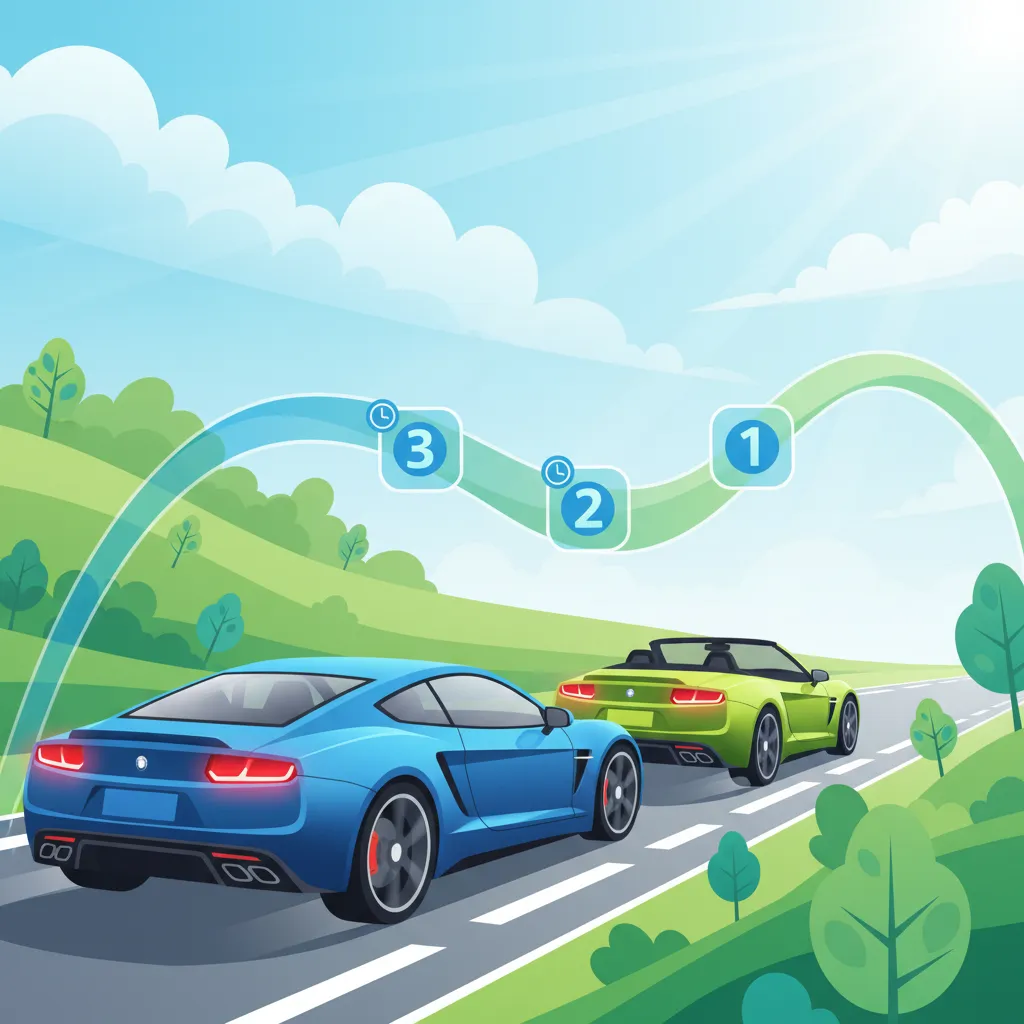
This lesson provides practical methods for maintaining a safe buffer zone behind the vehicle in front. It explains the 'two-second rule' as a minimum following distance in good conditions and how to increase it to three or more seconds in adverse weather. This skill is critical for allowing enough time to react and brake safely to avoid rear-end collisions.

This lesson examines the variety of pavement markings that define lane structures, traffic flow, and special zones on Polish roads. Learners will study solid and broken lines, lane division markings, and the distinct symbols for bicycle lanes, bus lanes, and tram tracks, all of which affect motorcyclist positioning. The lesson also addresses surface texture indicators that signal changing road conditions, enabling riders to maintain correct lane discipline.
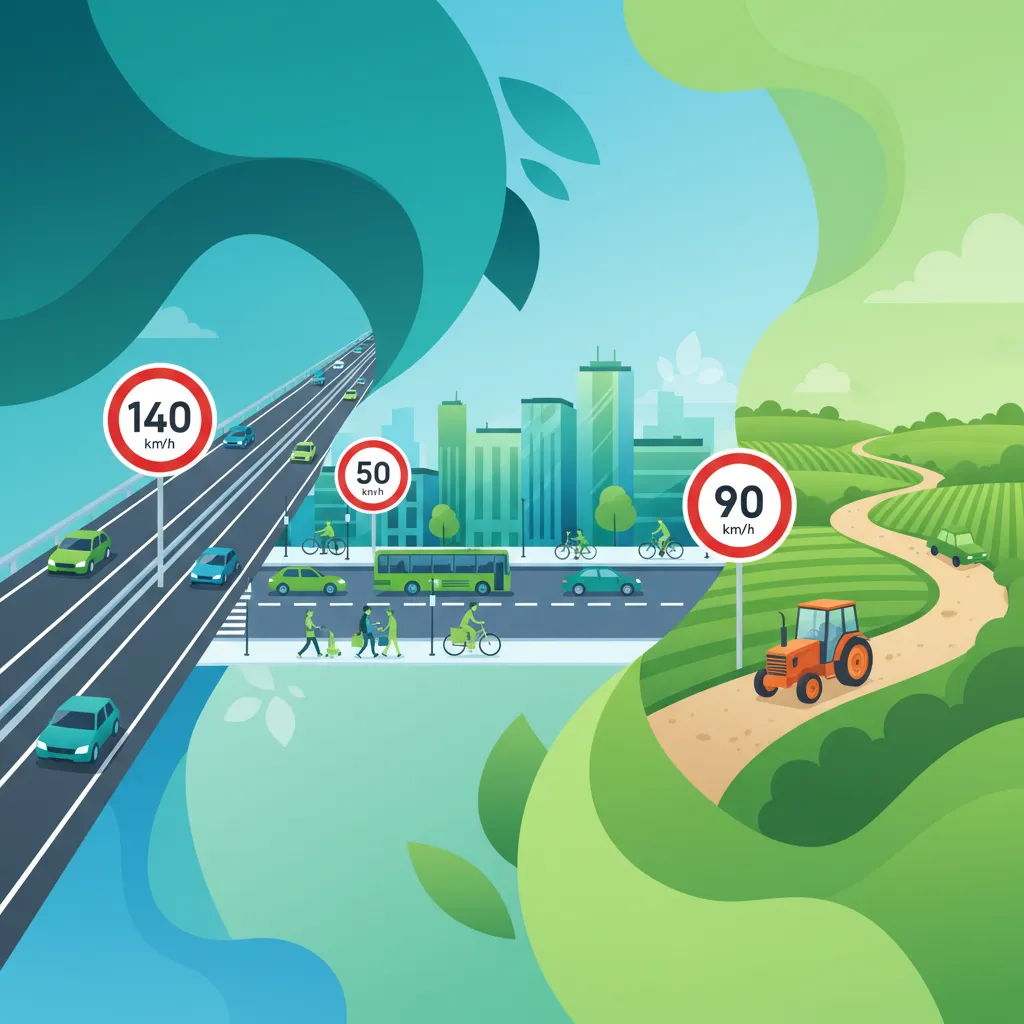
This lesson provides a comprehensive overview of the statutory speed limits applicable to different categories of Polish roads, including urban areas, residential zones, rural roads, highways, and motorways. Learners will examine the visual cues of speed limit signs and learn how speed limit transitions affect rider behavior. The content also covers how enforcement mechanisms impact compliance and the importance of real-time speed adaptation to remain within legal thresholds.
Find clear answers to common questions learners have about Speed Influence on Braking Efficiency. Learn how the lesson is structured, which driving theory objectives it supports, and how it fits into the overall learning path of units and curriculum progression in Poland. These explanations help you understand key concepts, lesson flow, and exam focused study goals.
Not necessarily. ABS primarily helps prevent wheel lock-up, maintaining steering control during hard braking, especially on slippery surfaces. While it can help you brake harder without skidding, the overall stopping distance might be similar or even slightly longer than an expert rider without ABS on dry pavement, as it's designed for control, not minimal distance.
Brake fade occurs when intense or prolonged braking causes brakes to overheat, reducing their effectiveness. For Category A motorcyclists, this means your brakes might feel less responsive or require greater effort to achieve the same deceleration, especially during long descents or repeated hard braking. Recognizing the signs of fade is crucial for maintaining safety and adjusting your riding.
During braking, weight shifts forward, increasing the load on the front wheel and thus its grip on the road. This allows the front brake to provide significantly more stopping power than the rear. For Category A riders, mastering the progressive application of the front brake, combined with appropriate rear brake use, is key to efficient and stable braking.
Progressive braking is the technique of gradually increasing braking pressure rather than applying it suddenly. For Category A riders, this smooth application allows the motorcycle's suspension to settle, transfers weight more effectively to the front wheel, and provides maximum stopping power while maintaining stability and preventing wheel lock-up, especially without ABS.
Build custom practice sessions tailored precisely to your needs. Focus on areas requiring improvement, review specific Polish road signs, or master complex traffic rules to ensure full preparation for your official driving license exam.