
Giving way means allowing another road user to proceed first to prevent conflict and ensure smooth traffic flow. In Poland, these rules are governed by specific signs, road markings, and general traffic principles. Correctly identifying situations that require you to yield is a core skill for every driver, vital for both road safety and passing your driving test.
Theory topic content overview
Read the full theory topic guide for Polish Give Way Rules with structured, easy-to-scan content built for learners in Poland. This detailed section explains the exact rule, meaning, traffic context, comparison points, and exam logic behind this Polish driving theory topic so you can study faster, understand the concept more clearly, and avoid common interpretation mistakes on the theory test.
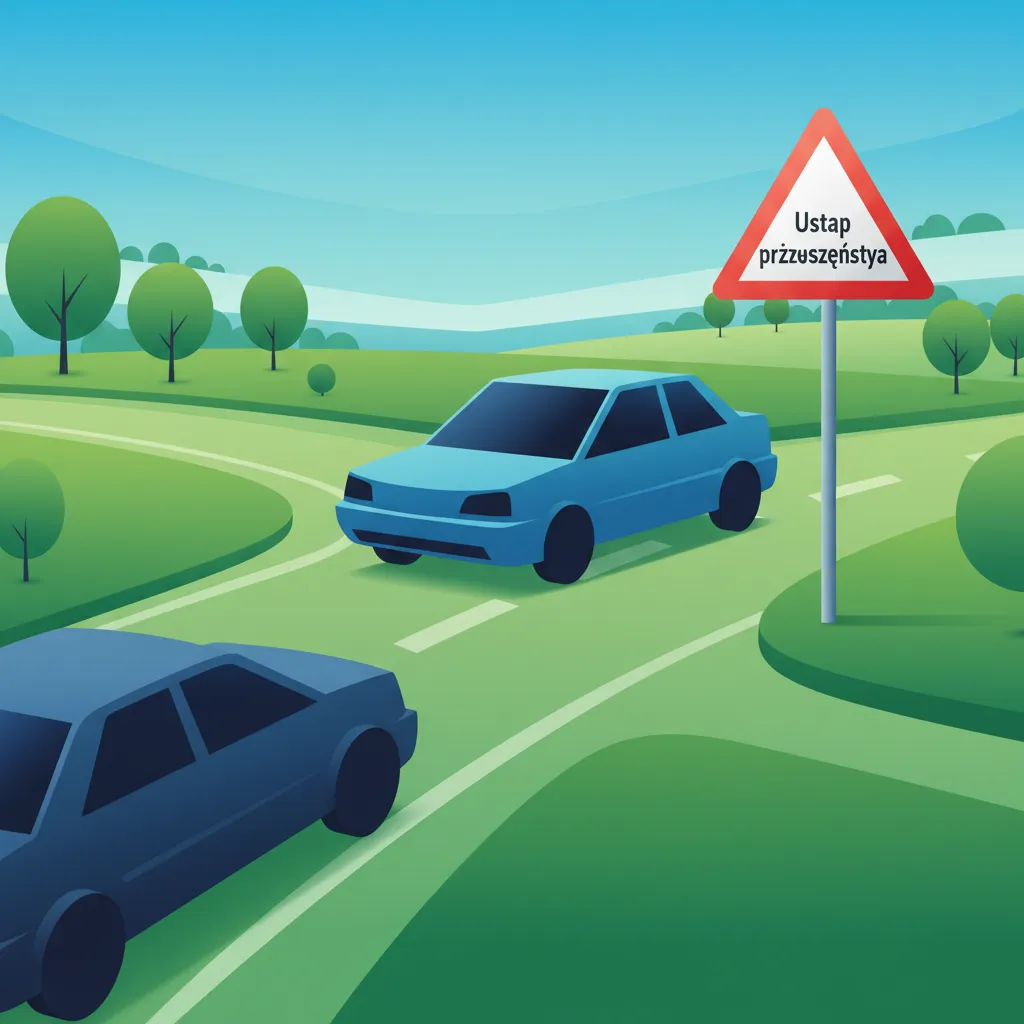
To give way (in Polish, ustąpić pierwszeństwa) means to allow another road user who has priority to proceed first. This is a fundamental principle of safe driving in Poland, designed to prevent conflicts, collisions, and ensure the smooth flow of traffic. When you are required to give way, you must adjust your speed, and if necessary, stop your vehicle completely, to ensure you do not impede the movement of the priority road user.
The essence of giving way is active assessment and responsible action. It's not just about waiting; it's about identifying potential conflicts and taking preventative measures to avoid them.
Understanding and correctly applying ustąp pierwszeństwa rules is paramount for several reasons:
Prawo o ruchu drogowym). Violating these rules can lead to fines, penalty points, and potentially serious legal consequences.Correctly giving way is a three-step process:
A-7 Ustąp pierwszeństwa, B-20 Stop), road markings, traffic lights, or recognize general rules like the "rule of the right" at unmarked intersections.B-20 Stop sign is present, or if it's the only way to safely yield.Polish traffic rules specify numerous situations where you must give way:
Skrzyżowania)A-7 Ustąp pierwszeństwa (Give Way Sign): This triangular sign indicates you are approaching a non-priority road. You must yield to all traffic on the intersecting priority road. You do not have to stop if the way is clear, but you must be prepared to.B-20 Stop Sign: This octagonal sign requires you to come to a complete stop before entering the intersection, usually before a stop line or at a place ensuring visibility. Only after stopping and checking for traffic on the priority road can you proceed, yielding to all priority traffic.D-1 sign): If you are on a priority road (indicated by the D-1 sign), vehicles on intersecting roads will generally have A-7 or B-20 signs, meaning they must give way to you.Zasada Prawej Ręki): At intersections without signs, traffic lights, or traffic police, the rule of the right applies. You must give way to any vehicle approaching from your right. This is a crucial default rule in Polish traffic.Przejścia dla pieszych)D-6 sign and/or white stripes on the road), you must give way to pedestrians who are already on the crossing or are clearly entering it.D-6a sign indicates a "suggested pedestrian crossing" or "crossing point." While you should exercise extreme caution, pedestrians do not automatically have priority here in the same way as at a standard marked crossing.Tramwaje)Włączanie się do ruchu)Ronda)A-7 Ustąp pierwszeństwa sign placed at each entry). Always check the signage.Pojazdy uprzywilejowane)A critical distinction for Polish drivers and theory exam candidates is understanding the precise difference between the A-7 Ustąp pierwszeństwa sign and the B-20 Stop sign:
A-7 Ustąp pierwszeństwa (Give Way): This sign requires you to yield to traffic on the priority road. You must slow down and be prepared to stop, but you are not legally required to come to a complete halt if the way is clear and you can safely proceed without impeding priority traffic.B-20 Stop (Stop): This sign demands a full and complete stop before the stop line, or at a point where you have a clear view of the priority road. You must remain stopped until it is safe to proceed, yielding to all priority traffic. Failing to stop completely is a serious violation.Other key distinctions:
zasada prawej ręki (rule of the right) is the default at unmarked intersections. However, traffic signs (A-7, B-20, D-1) always override the rule of the right. Always obey signs first.Let's look at common situations:
A-7 Ustąp pierwszeństwa Sign: You see the triangular sign. Slow down and check traffic coming from both left and right on the intersecting road. If a car is approaching from the left at a speed that would cause you to impede them, you must stop and wait. If the road is clear, you can proceed without stopping.A-7 Ustąp pierwszeństwa sign. You must yield to all vehicles already circulating within the roundabout. Wait for a safe gap in the traffic flow before entering.Many learners find give way rules challenging. Here are frequent errors:
Stop and Ustąp pierwszeństwa: Not coming to a complete stop at a B-20 Stop sign, or stopping unnecessarily at an A-7 sign when the way is clear.The Polish Traffic Law (Ustawa Prawo o ruchu drogowym) meticulously defines these priority rules. The Polish driving theory exam places significant emphasis on your ability to:
A-7 Ustąp pierwszeństwa and B-20 Stop signs.zasada prawej ręki (rule of the right) at unsigned intersections.Many exam questions will present visual scenarios (photos or videos) and ask you to identify who has priority and what action you should take.
To confidently apply give way rules in Polish traffic, remember this framework:
Mastering ustąp pierwszeństwa is a cornerstone of responsible and safe driving in Poland, ensuring both your safety and the safety of all other road users.
Give way rules (ustąp pierwszeństwa) form a cornerstone of Polish traffic law, requiring drivers to identify priority situations and yield appropriately through speed adjustment or stopping. The critical distinction between the triangular A-7 'Ustąp pierwszeństwa' sign (yield if needed) and the octagonal B-20 'Stop' sign (complete halt required) appears frequently on the Polish theory exam. Priority at intersections is established through signs, the rule of the right at unsigned junctions, traffic lights, or special vehicle rules for trams and emergency vehicles. Pedestrian crossings carry mandatory yielding duties, with extended protections for disabled persons. Drivers should use the Predict-Prepare-Proceed framework to systematically assess and safely navigate all give way situations.
A short set of high-value points that capture the most important ideas from this theory explanation.
To 'give way' (ustąp pierwszeństwa) means adjusting your speed or stopping to allow priority road users to proceed first without impeding their movement
The A-7 'Ustąp pierwszeństwa' sign requires yielding but not necessarily stopping if the way is clear; the B-20 'Stop' sign requires a complete halt before proceeding
At unmarked intersections without signs or lights, the 'zasada prawej ręki' (rule of the right) applies—you must give way to traffic approaching from your right
Pedestrians already on or clearly entering a marked crossing have priority, and drivers must stop for disabled or mobility-impaired persons even outside designated crossings
Trams generally have priority at intersections, except when reversing or when specific traffic signs override their priority
Rule of the right applies only at unsigned intersections; any traffic sign (A-7, B-20, D-1) overrides this default rule
B-20 Stop always requires a full and complete stop at the stop line or visible point, regardless of traffic density
Extended pedestrian priority applies to disabled persons crossing anywhere, not just at marked D-6 crossings
Vehicles already circulating in a roundabout have priority over vehicles entering; check for A-7 signs at each entry point
Emergency vehicles with blue flashing lights and siren always have unconditional priority—pull over and stop if necessary
Confusing Stop and Give Way signs by not coming to a complete stop at B-20 or stopping unnecessarily at A-7 when the way is clear
Misjudging the speed and distance of priority vehicles, causing them to brake or swerve
Forgetting the rule of the right at unmarked intersections on smaller roads where signs are absent
Failing to notice pedestrians who are about to step onto a crossing or not acknowledging the special priority for vulnerable road users
Assuming trams always have priority without considering exceptions like reversing trams or intersections where signs give priority to vehicles
Start with a short, direct summary of Polish Give Way Rules before reading the full explanation below.
To 'give way' in Polish traffic means to yield to other road users who have priority, allowing them to proceed first. This typically involves slowing down or stopping your vehicle to ensure you do not impede their movement. Key situations requiring you to give way include specific traffic signs like 'Ustąp pierwszeństwa' (Give Way) and 'Stop', at many intersections, when encountering pedestrians at designated crossings, and when merging onto another road.
Review the most important terms, rule signals, and traffic concepts linked to Polish Give Way Rules.
Explore related theory topic pages connected to Polish Give Way Rules and continue with the next useful rule explanation.
See the common search queries learners use when trying to understand Polish Give Way Rules in Poland.

Continue your preparation by exploring specific Polish driving theory topics in detail. Review each section to reinforce your understanding of traffic rules, road signs, and safe driving practices. Our comprehensive explanations are structured to support your learning journey and help you confidently approach the official driving licence theory exam.
Polish Driving Theory TopicsTheory topic content overview
A short set of high-value points that capture the most important ideas from this theory explanation.
To 'give way' (ustąp pierwszeństwa) means adjusting your speed or stopping to allow priority road users to proceed first without impeding their movement
The A-7 'Ustąp pierwszeństwa' sign requires yielding but not necessarily stopping if the way is clear; the B-20 'Stop' sign requires a complete halt before proceeding
At unmarked intersections without signs or lights, the 'zasada prawej ręki' (rule of the right) applies—you must give way to traffic approaching from your right
Pedestrians already on or clearly entering a marked crossing have priority, and drivers must stop for disabled or mobility-impaired persons even outside designated crossings
Trams generally have priority at intersections, except when reversing or when specific traffic signs override their priority
Rule of the right applies only at unsigned intersections; any traffic sign (A-7, B-20, D-1) overrides this default rule
B-20 Stop always requires a full and complete stop at the stop line or visible point, regardless of traffic density
Extended pedestrian priority applies to disabled persons crossing anywhere, not just at marked D-6 crossings
Vehicles already circulating in a roundabout have priority over vehicles entering; check for A-7 signs at each entry point
Emergency vehicles with blue flashing lights and siren always have unconditional priority—pull over and stop if necessary
Confusing Stop and Give Way signs by not coming to a complete stop at B-20 or stopping unnecessarily at A-7 when the way is clear
Misjudging the speed and distance of priority vehicles, causing them to brake or swerve
Forgetting the rule of the right at unmarked intersections on smaller roads where signs are absent
Failing to notice pedestrians who are about to step onto a crossing or not acknowledging the special priority for vulnerable road users
Assuming trams always have priority without considering exceptions like reversing trams or intersections where signs give priority to vehicles
Start with a short, direct summary of Polish Give Way Rules before reading the full explanation below.
To 'give way' in Polish traffic means to yield to other road users who have priority, allowing them to proceed first. This typically involves slowing down or stopping your vehicle to ensure you do not impede their movement. Key situations requiring you to give way include specific traffic signs like 'Ustąp pierwszeństwa' (Give Way) and 'Stop', at many intersections, when encountering pedestrians at designated crossings, and when merging onto another road.
Review the most important terms, rule signals, and traffic concepts linked to Polish Give Way Rules.
Explore related theory topic pages connected to Polish Give Way Rules and continue with the next useful rule explanation.
See the common search queries learners use when trying to understand Polish Give Way Rules in Poland.
Continue your preparation by exploring specific Polish driving theory topics in detail. Review each section to reinforce your understanding of traffic rules, road signs, and safe driving practices. Our comprehensive explanations are structured to support your learning journey and help you confidently approach the official driving licence theory exam.
Polish Driving Theory TopicsUse this exam-focused revision tip to understand how Polish Give Way Rules is likely to appear in theory questions for learners in Poland. This section helps you identify the most testable part of the rule, avoid common traps, and remember the concept more effectively during Polish driving theory exam preparation.
A common exam trap involves confusing the 'Stop' sign with the 'Ustąp pierwszeństwa' sign. Remember, 'Stop' always means a complete halt, while 'Ustąp pierwszeństwa' requires you to slow down and stop only if needed to yield safely. Always check for pedestrians, especially those with reduced mobility, as they often have extended priority rights in Poland.
Read direct answers to the most common learner questions about Polish Give Way Rules in Poland. This FAQ focuses on rule confusion, practical meaning, comparison with similar concepts, and the exact uncertainties that appear most often in Polish driving theory revision and exam preparation.
The 'Ustąp pierwszeństwa' sign (A-7, triangular) requires you to give way to traffic on the road you are joining or crossing. You must slow down and, if necessary, stop to ensure you do not force priority traffic to change speed or direction.
Both signs require you to give way. However, the 'Stop' sign (B-20) specifically mandates that you must come to a complete stop before the stop line, or if none, at a place where you can safely observe priority traffic without obstructing it. The 'Ustąp pierwszeństwa' sign (A-7) does not require a full stop unless necessary to give way safely.
Pedestrians have priority when they are on a designated pedestrian crossing or when they are entering one. Drivers must slow down and stop if necessary to allow them to cross safely. Special rules apply for persons with visibly reduced mobility, for whom drivers must exercise particular caution and stop even if they are crossing outside a designated area.
No. When reversing, a tram driver does not automatically have priority over other vehicles and road users. They must ensure the maneuver can be performed safely without hindering others.
At intersections without signs, markings, or traffic lights, the general rule is to give way to vehicles approaching from your right. This is known as the 'right-hand rule' or 'zasada prawej ręki'.
Yes, generally, vehicles already circulating within a roundabout have priority over vehicles entering it, unless otherwise indicated by road signs. Always check the signage at the entrance to a roundabout for specific priority instructions.
Failing to give way correctly can result in a traffic offense, a fine, and penalty points. More importantly, it is a common cause of collisions, posing a significant risk to safety on Polish roads.
Build custom practice sessions tailored precisely to your needs. Focus on areas requiring improvement, review specific Polish road signs, or master complex traffic rules to ensure full preparation for your official driving license exam.