
In Poland, a priority road (droga z pierwszeństwem) is a designated route where traffic has precedence over vehicles entering from side roads. This system is crucial for organizing traffic flow, especially at intersections. Drivers must correctly identify these roads and understand their obligations to ensure safety and comply with Polish traffic regulations.
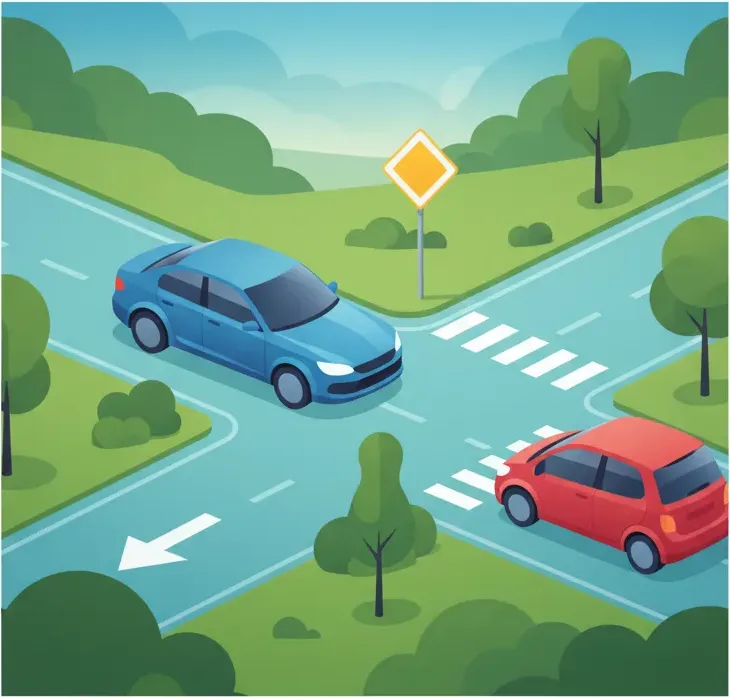
Theory topic content overview
Read the full theory topic guide for Priority Roads with structured, easy-to-scan content built for learners in Poland. This detailed section explains the exact rule, meaning, traffic context, comparison points, and exam logic behind this Polish driving theory topic so you can study faster, understand the concept more clearly, and avoid common interpretation mistakes on the theory test.
In Poland, understanding priority roads (known as droga z pierwszeństwem) is fundamental for safe driving and crucial for success in your Polish driving theory exam. These roads are specifically designated to streamline traffic flow, giving certain vehicles precedence at intersections.
Droga z Pierwszeństwem) in Poland?A priority road is a designated route where drivers generally have the right of way (pierwszeństwo przejazdu) over vehicles approaching from intersecting roads, private driveways, or unpaved roads. The primary purpose of this system is to maintain smooth and efficient traffic flow on main arteries, reducing congestion and the potential for collisions at conflict points.
When you are driving on a droga z pierwszeństwem, it means you typically do not need to yield to traffic entering from the sides, unless specific overriding conditions are present (which we will cover). Conversely, drivers entering or crossing a priority road are obligated to ustąpić pierwszeństwa (give way) to traffic already on it.
Correctly identifying and understanding priority road rules in Poland is essential for several reasons:
In Poland, priority roads are clearly marked using specific traffic signs. Recognising these signs instantly is a key skill.
D-1 Sign: Main Priority Road IndicatorThe most important sign indicating a priority road is sign D-1: "Priority Road" (Droga z pierwszeństwem). This is a yellow diamond-shaped sign with a white border. When you see this sign, you are on a priority road.
D-1 sign is usually placed at the beginning of a priority road and after major intersections where priority might otherwise be ambiguous.D-1 sign is repeated, often accompanied by a supplementary panel (e.g., tabliczka T-6) that graphically illustrates the actual intersection layout and which specific road lines are priority. This clarifies priority, especially at complex junctions.Koniec drogi z pierwszeństwem). This is the same yellow diamond sign, but with a thick black diagonal stripe crossing it, indicating the end of the preferential status. From this point onwards, general priority rules (like the right-hand rule, or other signs) will apply.Drivers on side roads approaching a priority road will encounter signs obliging them to yield:
Ustąp pierwszeństwa): An inverted white triangle with a red border. This sign explicitly instructs drivers to yield to traffic on the intersecting road, which is typically a priority road.Stop): A red octagon with the word "STOP" in white. This sign requires drivers to come to a complete stop before the stop line (or edge of the intersecting road if no line is present) and then give way to all traffic on the intersecting road.Road markings also play a role:
linia bezwzględnego zatrzymania) indicates where to stop for a B-20 sign. A dashed white line (linia warunkowego zatrzymania) is used with an A-7 sign. These lines reinforce the obligation to yield or stop.At an intersection involving a priority road, the rules are generally straightforward:
D-1, you generally have pierwszeństwo przejazdu over vehicles entering from side roads not marked D-1. You can typically proceed without stopping, provided the intersection is clear and safe.A-7 (Give Way) or B-20 (Stop) sign, you must yield. This means you must slow down or stop completely, allowing all vehicles on the priority road to pass before you proceed.Crucially, the priority granted by a D-1 sign is not absolute. Other traffic controls can override it:
sygnalizacja świetlna): Active traffic lights always take precedence over traffic signs. If a D-1 road has a red light, you must stop, even though you are on a priority road.osoba kierująca ruchem): Signals given by a police officer or other authorised traffic controller always override both traffic lights and road signs. You must obey the controller's instructions regardless of the priority signs.pojazdy uprzywilejowane): Vehicles using blue flashing lights and/or a siren (e.g., ambulance, police, fire brigade) have priority and you must give way to them, even if you are on a priority road and they are not.Zasada Ograniczonego ZaufaniaA critical concept in Polish driving theory related to priority is the zasada ograniczonego zaufania (principle of limited trust). This principle states that even when you have the right of way, you should never blindly assume other road users will obey the rules. You must always be prepared to react to potential breaches of traffic regulations by others.
pierwszeństwo przejazdu does not give you the right to proceed without caution or to cause danger. It means you are entitled to proceed, but you must still monitor the situation, be aware of your surroundings, and be ready to brake or take evasive action if another driver or pedestrian makes a mistake.A-7 or B-20 sign. If the tram is already on the priority road, it maintains its priority. Always observe specific signage and signals regarding trams.D-1 sign. As you approach an intersection, you see a car waiting at the side road, facing an A-7 sign. You have the right of way, but you should still glance at the driver to ensure they acknowledge your presence and are prepared to yield.B-20 (Stop) sign. You must come to a complete stop before the intersecting road, check for traffic from both directions on the priority road, and only proceed when it is safe and clear.D-1 sign visible), but as you approach an intersection, the traffic lights are red. You must stop at the red light. The traffic light overrides the D-1 sign in this instance.D-1 road for some time, but suddenly you see a D-2 sign. From this point onward, your road is no longer a priority road. At the next intersection, you will need to apply general right-of-way rules, such as the right-hand rule, unless other signs dictate otherwise.Learners frequently make mistakes related to priority roads, especially in the context of the Polish theory exam:
zasada ograniczonego zaufania. Drivers assume they always have the right to proceed when on a priority road, ignoring potentially careless actions of others.D-1 sign with other warning or informational signs, or failing to register its presence.To navigate Polish roads safely and pass your driving exam, remember these key points about priority roads:
D-1 diamond sign to know if you are on a priority road, and for A-7 or B-20 if you need to yield.D-1).zasada ograniczonego zaufania: Even when you have pierwszeństwo przejazdu, be vigilant, anticipate potential errors from others, and be prepared to react.Polish priority roads (droga z pierwszeństwem) are marked with the yellow diamond D-1 sign and give drivers the right of way over traffic from intersecting roads. Drivers on side roads must yield using A-7 or B-20 signs. However, D-1 priority is overridden by traffic lights, police officers directing traffic, and emergency vehicles. The zasada ograniczonego zaufania (principle of limited trust) requires all drivers to remain cautious and ready to react, even when they legally have right of way. Understanding the hierarchy of traffic controls and correctly identifying priority road signs are essential for road safety and passing the Polish driving theory exam.
A short set of high-value points that capture the most important ideas from this theory explanation.
Priority roads in Poland are designated routes marked with a yellow diamond D-1 sign where traffic has precedence over vehicles from intersecting roads
The D-1 sign can be overridden by active traffic lights, a traffic controller's signals, or emergency vehicles with blue lights and sirens
The D-2 sign (yellow diamond with black diagonal stripe) marks the end of a priority road, after which general right-of-way rules apply
The zasada ograniczonego zaufania requires you to remain vigilant even when you have right of way, as other drivers may fail to yield
Side road drivers approaching a priority road must obey A-7 (Give Way) or B-20 (Stop) signs and yield to all traffic on the priority road
D-1 is the yellow diamond 'Priority Road' sign; D-2 is the same sign with a black diagonal stripe meaning 'End of Priority Road'
A-7 (inverted white triangle with red border) means 'Give Way'; B-20 (red octagon with STOP) requires a complete stop before proceeding
Traffic lights always override D-1 signs at intersections
Emergency vehicles with blue flashing lights take priority over all road signs including D-1
Trams on a priority road maintain that priority; trams entering from a non-priority road must yield to D-1 traffic
Assuming you can always proceed without slowing when on a priority road, ignoring the zasada ograniczonego zaufania
Failing to stop completely at a B-20 sign, treating it like an A-7 Give Way sign
Believing D-1 priority is absolute and ignoring active traffic lights or a traffic controller's signals
Not reducing speed or adjusting driving when visibility is reduced or hazards are present on a priority road
Misunderstanding tram priority rules and failing to recognize when a tram must yield versus when it maintains priority
Start with a short, direct summary of Priority Roads before reading the full explanation below.
A priority road in Poland is a road where drivers generally have the right of way over traffic approaching from intersecting roads. These roads are clearly marked with specific traffic signs, most notably the yellow diamond sign (D-1). Drivers on a priority road must still remain attentive, while those entering from side roads are typically required to yield (ustąp pierwszeństwa).
Review the most important terms, rule signals, and traffic concepts linked to Priority Roads.
Explore related theory topic pages connected to Priority Roads and continue with the next useful rule explanation.
See the common search queries learners use when trying to understand Priority Roads in Poland.

Continue your preparation by exploring specific Polish driving theory topics in detail. Review each section to reinforce your understanding of traffic rules, road signs, and safe driving practices. Our comprehensive explanations are structured to support your learning journey and help you confidently approach the official driving licence theory exam.
Polish Driving Theory TopicsTheory topic content overview
A short set of high-value points that capture the most important ideas from this theory explanation.
Priority roads in Poland are designated routes marked with a yellow diamond D-1 sign where traffic has precedence over vehicles from intersecting roads
The D-1 sign can be overridden by active traffic lights, a traffic controller's signals, or emergency vehicles with blue lights and sirens
The D-2 sign (yellow diamond with black diagonal stripe) marks the end of a priority road, after which general right-of-way rules apply
The zasada ograniczonego zaufania requires you to remain vigilant even when you have right of way, as other drivers may fail to yield
Side road drivers approaching a priority road must obey A-7 (Give Way) or B-20 (Stop) signs and yield to all traffic on the priority road
D-1 is the yellow diamond 'Priority Road' sign; D-2 is the same sign with a black diagonal stripe meaning 'End of Priority Road'
A-7 (inverted white triangle with red border) means 'Give Way'; B-20 (red octagon with STOP) requires a complete stop before proceeding
Traffic lights always override D-1 signs at intersections
Emergency vehicles with blue flashing lights take priority over all road signs including D-1
Trams on a priority road maintain that priority; trams entering from a non-priority road must yield to D-1 traffic
Assuming you can always proceed without slowing when on a priority road, ignoring the zasada ograniczonego zaufania
Failing to stop completely at a B-20 sign, treating it like an A-7 Give Way sign
Believing D-1 priority is absolute and ignoring active traffic lights or a traffic controller's signals
Not reducing speed or adjusting driving when visibility is reduced or hazards are present on a priority road
Misunderstanding tram priority rules and failing to recognize when a tram must yield versus when it maintains priority
Start with a short, direct summary of Priority Roads before reading the full explanation below.
A priority road in Poland is a road where drivers generally have the right of way over traffic approaching from intersecting roads. These roads are clearly marked with specific traffic signs, most notably the yellow diamond sign (D-1). Drivers on a priority road must still remain attentive, while those entering from side roads are typically required to yield (ustąp pierwszeństwa).
Review the most important terms, rule signals, and traffic concepts linked to Priority Roads.
Explore related theory topic pages connected to Priority Roads and continue with the next useful rule explanation.
See the common search queries learners use when trying to understand Priority Roads in Poland.
Continue your preparation by exploring specific Polish driving theory topics in detail. Review each section to reinforce your understanding of traffic rules, road signs, and safe driving practices. Our comprehensive explanations are structured to support your learning journey and help you confidently approach the official driving licence theory exam.
Polish Driving Theory TopicsUse this exam-focused revision tip to understand how Priority Roads is likely to appear in theory questions for learners in Poland. This section helps you identify the most testable part of the rule, avoid common traps, and remember the concept more effectively during Polish driving theory exam preparation.
A common trap in the Polish theory exam involves scenarios where priority is overridden by traffic lights or a traffic controller, or where a driver on a priority road fails to apply the 'zasada ograniczonego zaufania'. Always look for all signs and signals, and never assume others will automatically yield to you, even when you have the right of way.
Read direct answers to the most common learner questions about Priority Roads in Poland. This FAQ focuses on rule confusion, practical meaning, comparison with similar concepts, and the exact uncertainties that appear most often in Polish driving theory revision and exam preparation.
Based on Polish traffic law, a priority road grants precedence to its traffic over vehicles from intersecting roads, ensuring smoother flow and clarity at junctions.
In Poland, priority roads are primarily indicated by the yellow diamond-shaped sign (D-1 "droga z pierwszeństwem") at their start and after major intersections. This sign confirms your right of way.
While you generally have precedence, you must still be attentive and ready to yield if traffic signals, a traffic controller, or specific signs like "Stop" (B-20) or "Give Way" (A-7) override the priority rule at a specific junction.
Drivers from side roads must slow down and give way to all traffic already on the priority road before entering or crossing it. This is usually enforced by a "Give Way" sign (A-7) or a "Stop" sign (B-20).
Yes, a priority road ends when indicated by the yellow diamond sign with a black diagonal stripe through it (D-2 "koniec drogi z pierwszeństwem"). After this sign, standard right-of-way rules apply unless otherwise indicated.
Even on a priority road, drivers must apply the "zasada ograniczonego zaufania" (principle of limited trust), meaning you should anticipate potential rule breaches by other road users and be prepared to react safely to prevent collisions, rather than blindly assuming others will yield.
Build custom practice sessions tailored precisely to your needs. Focus on areas requiring improvement, review specific Polish road signs, or master complex traffic rules to ensure full preparation for your official driving license exam.