
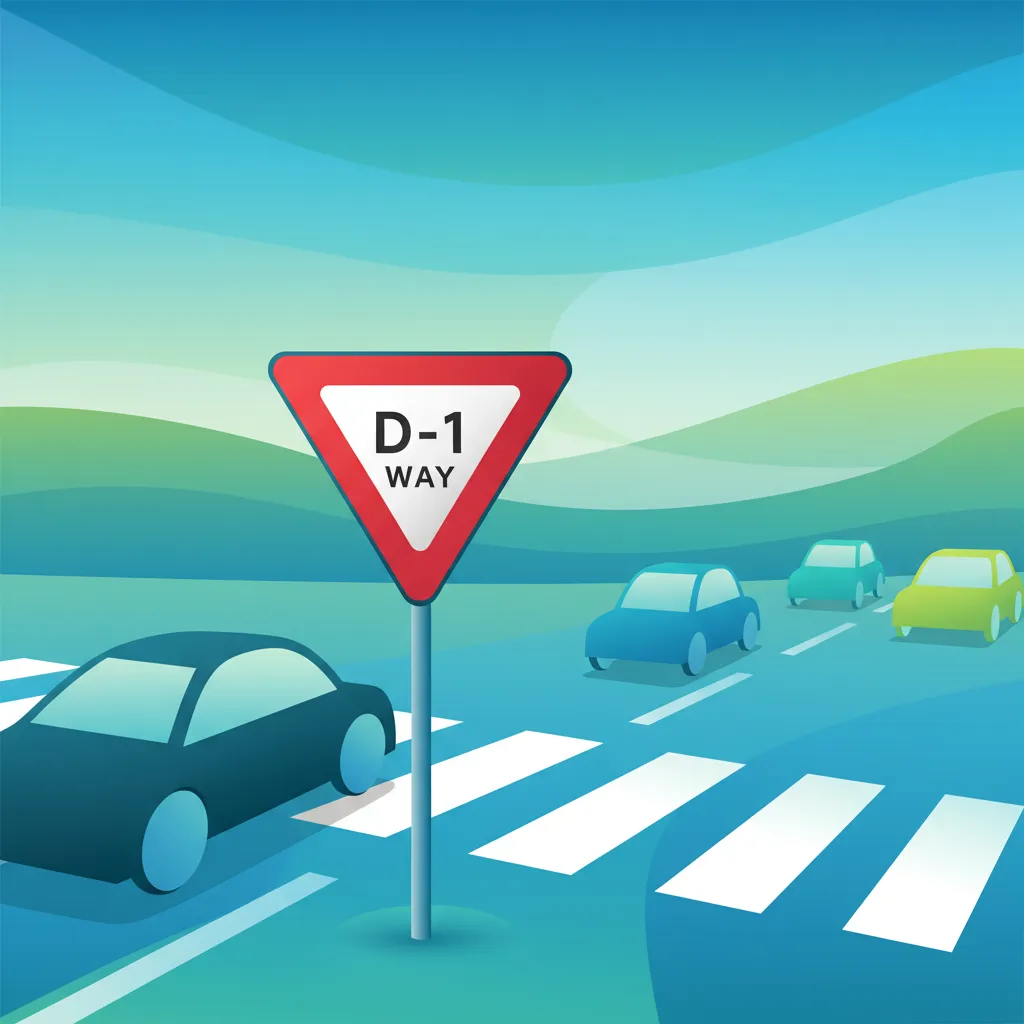
The Give Way sign, known as D-1 in Poland, is a fundamental regulatory sign that instructs drivers to yield priority to other traffic. This means you must be prepared to slow down or stop, allowing vehicles already on the priority road or those approaching from specific directions to proceed first. Correctly interpreting and acting upon the D-1 sign is crucial for safe driving and passing your Polish driving theory exam.
Theory topic content overview
Read the full theory topic guide for Give Way Sign D-1 with structured, easy-to-scan content built for learners in Poland. This detailed section explains the exact rule, meaning, traffic context, comparison points, and exam logic behind this Polish driving theory topic so you can study faster, understand the concept more clearly, and avoid common interpretation mistakes on the theory test.
The Give Way sign, officially designated as D-1 in Polish traffic law, is a fundamental regulatory sign in Poland that instructs drivers to yield priority to other traffic. Its official Polish name is "Ustąp pierwszeństwa przejazdu".
Visually, the D-1 sign is an equilateral triangle with a red border, white background, and a downward-pointing tip. It is always accompanied by a dashed white give way line (P-13) on the road surface, indicating precisely where you should yield.
The core meaning of the Give Way sign is that your vehicle does not have the right of way and you must allow vehicles on the intersecting road, or those otherwise having priority, to proceed first. You are obligated to slow down, be prepared to stop, and only continue when doing so will not force other road users to alter their speed or direction.
Understanding and correctly interpreting the Give Way sign is paramount for several reasons, especially for drivers in Poland:
When you encounter a Give Way (D-1) sign in Polish traffic, your actions should follow a clear sequence:
Your decision at a Give Way sign is rarely instantaneous. Several factors require careful assessment:
A common area of confusion for new drivers in Poland is the difference between the Give Way (D-1) sign and the Stop (B-20) sign. While both require yielding priority, the Stop sign (B-20) demands an absolute, complete stop before the stop line, even if the road appears clear.
Here's the distinction:
| Feature | Give Way (D-1) "Ustąp pierwszeństwa przejazdu" | Stop (B-20) "Stop" |
|---|---|---|
| Obligation | Yield priority; be prepared to stop. | Must come to a complete stop. |
| Physical Stop | Only if necessary to yield or if road is not clear. | Always required, regardless of traffic. |
| Road Markings | Dashed white line (P-13). | Solid white line (P-12). |
| Shape | Downward-pointing triangle. | Red octagon. |
| Common Use | Minor roads joining major ones, some roundabouts. | High-risk junctions, railway crossings. |
Failing to make a complete stop at a B-20 sign is a clear violation in Poland, whereas at a D-1 sign, the violation is failing to yield priority, which may involve not stopping when a stop was required to yield.
Learners often struggle with the practical application of the Give Way sign, leading to common errors:
The Polish legal framework for priority, derived from the Prawo o ruchu drogowym (Road Traffic Law), places significant emphasis on the driver's responsibility to prevent dangerous situations. The phrase "Ustąp pierwszeństwa przejazdu" literally translates to "Yield the right of way of passage," underscoring that the other party's passage should be unhindered.
The Polish theory exam questions related to D-1 often focus on:
Remember that perceived safety is not actual safety. If there's any doubt whether your action would force another driver to react, you have not yielded.
Think of the Give Way (D-1) sign as an explicit instruction: Do not interfere with others' current path or speed. Your entry onto the priority road must be invisible to those who have the right of way. If you are unsure, or if your action would cause another driver to even consider braking or swerving, then you have not yielded correctly. Always prioritize safety and err on the side of caution.
The Give Way sign (D-1) in Poland, officially called 'Ustąp pierwszeństwa przejazdu', instructs drivers to yield priority to all traffic on the intersecting road without necessarily coming to a complete stop. The D-1 sign features a red triangle pointing down and is paired with dashed P-13 road markings, distinguishing it clearly from the Stop sign (B-20) which demands an absolute full stop. Drivers must slow down, observe all directions for vehicles, cyclists, pedestrians, and trams, and only proceed when their entry will not force any priority traffic to alter speed or direction. The key exam distinction is that D-1 allows proceeding without stopping if clear, while B-20 always requires a complete stop regardless of traffic conditions.
A short set of high-value points that capture the most important ideas from this theory explanation.
The D-1 Give Way sign requires you to yield priority to other traffic, but unlike a Stop sign, a complete stop is not always mandatory
When approaching a D-1 sign, you must check all directions including left, right, ahead, and for cyclists, pedestrians, and trams
If your entry onto the priority road would force any other driver to change speed or direction, you have not yielded correctly
Environmental factors like poor visibility, wet roads, or multi-lane intersections demand increased caution and slower approach
At roundabouts preceded by D-1, you must yield to all traffic already circulating before entering
D-1 sign is a red-bordered downward-pointing triangle with dashed P-13 road markings
Stop sign (B-20) is an octagon requiring absolute complete stop, while D-1 only requires stop if necessary to yield
Trams in Poland have priority at D-1 signs unless traffic lights indicate otherwise
A vehicle that seems far away can still be traveling fast enough to reach you before you clear the intersection
Perceived safety is not actual safety - if you are unsure whether your action affects priority traffic, wait
Making a rolling stop at D-1 when a full stop is needed to safely observe traffic, conflating it with Stop sign rules
Only checking one direction for traffic, especially when turning, and missing vehicles or cyclists from other angles
Underestimating the speed of approaching vehicles, particularly on roads outside built-up areas
Overlooking vulnerable road users like cyclists on adjacent paths or pedestrians about to cross
Assuming other drivers will yield to them instead of taking full personal responsibility for yielding
Start with a short, direct summary of Give Way Sign D-1 before reading the full explanation below.
The Give Way sign (D-1 in Poland, 'Ustąp pierwszeństwa przejazdu') indicates that you must yield priority to traffic on the intersecting road. This means you must slow down, be ready to stop, and only proceed when it is safe and you will not force other vehicles to change their speed or direction. Unlike a Stop sign, a full stop is not always required, but the obligation to give way is absolute.
Review the most important terms, rule signals, and traffic concepts linked to Give Way Sign D-1.
Explore related theory topic pages connected to Give Way Sign D-1 and continue with the next useful rule explanation.
See the common search queries learners use when trying to understand Give Way Sign D-1 in Poland.

Continue your preparation by exploring specific Polish driving theory topics in detail. Review each section to reinforce your understanding of traffic rules, road signs, and safe driving practices. Our comprehensive explanations are structured to support your learning journey and help you confidently approach the official driving licence theory exam.
Polish Driving Theory TopicsTheory topic content overview
A short set of high-value points that capture the most important ideas from this theory explanation.
The D-1 Give Way sign requires you to yield priority to other traffic, but unlike a Stop sign, a complete stop is not always mandatory
When approaching a D-1 sign, you must check all directions including left, right, ahead, and for cyclists, pedestrians, and trams
If your entry onto the priority road would force any other driver to change speed or direction, you have not yielded correctly
Environmental factors like poor visibility, wet roads, or multi-lane intersections demand increased caution and slower approach
At roundabouts preceded by D-1, you must yield to all traffic already circulating before entering
D-1 sign is a red-bordered downward-pointing triangle with dashed P-13 road markings
Stop sign (B-20) is an octagon requiring absolute complete stop, while D-1 only requires stop if necessary to yield
Trams in Poland have priority at D-1 signs unless traffic lights indicate otherwise
A vehicle that seems far away can still be traveling fast enough to reach you before you clear the intersection
Perceived safety is not actual safety - if you are unsure whether your action affects priority traffic, wait
Making a rolling stop at D-1 when a full stop is needed to safely observe traffic, conflating it with Stop sign rules
Only checking one direction for traffic, especially when turning, and missing vehicles or cyclists from other angles
Underestimating the speed of approaching vehicles, particularly on roads outside built-up areas
Overlooking vulnerable road users like cyclists on adjacent paths or pedestrians about to cross
Assuming other drivers will yield to them instead of taking full personal responsibility for yielding
Start with a short, direct summary of Give Way Sign D-1 before reading the full explanation below.
The Give Way sign (D-1 in Poland, 'Ustąp pierwszeństwa przejazdu') indicates that you must yield priority to traffic on the intersecting road. This means you must slow down, be ready to stop, and only proceed when it is safe and you will not force other vehicles to change their speed or direction. Unlike a Stop sign, a full stop is not always required, but the obligation to give way is absolute.
Review the most important terms, rule signals, and traffic concepts linked to Give Way Sign D-1.
Explore related theory topic pages connected to Give Way Sign D-1 and continue with the next useful rule explanation.
See the common search queries learners use when trying to understand Give Way Sign D-1 in Poland.
Continue your preparation by exploring specific Polish driving theory topics in detail. Review each section to reinforce your understanding of traffic rules, road signs, and safe driving practices. Our comprehensive explanations are structured to support your learning journey and help you confidently approach the official driving licence theory exam.
Polish Driving Theory TopicsUse this exam-focused revision tip to understand how Give Way Sign D-1 is likely to appear in theory questions for learners in Poland. This section helps you identify the most testable part of the rule, avoid common traps, and remember the concept more effectively during Polish driving theory exam preparation.
Many Polish theory exam questions test your judgment at Give Way signs. Pay close attention to scenarios where you might mistakenly believe the road is clear or fail to consider the speed of approaching vehicles. Remember, 'ustąp pierwszeństwa' means ensuring other drivers don't have to react to your presence. Always check thoroughly, especially for two-wheelers.
Read direct answers to the most common learner questions about Give Way Sign D-1 in Poland. This FAQ focuses on rule confusion, practical meaning, comparison with similar concepts, and the exact uncertainties that appear most often in Polish driving theory revision and exam preparation.
The Give Way sign (D-1) means you must give priority to other traffic before proceeding, slowing down or stopping if necessary to ensure their uninterrupted passage. You must not enter the intersection if it would force other drivers to brake or swerve.
In Poland, the Give Way sign is officially designated as D-1, and its full meaning is 'Ustąp pierwszeństwa przejazdu', which translates to 'Yield right of way'.
No, a full stop is not always required. You must only stop if there is approaching traffic you need to yield to, or if visibility is poor. If the road is clear and safe to proceed, you can do so without stopping.
A Give Way sign (D-1) requires you to yield priority, stopping only if necessary. A Stop sign (B-20) requires you to come to a complete stop before the stop line, regardless of whether there is traffic, and then yield.
You must yield to all traffic on the intersecting road that would be forced to slow down or change direction if you were to proceed. This includes vehicles already in the intersection or approaching from the priority road.
Yes, Give Way signs are very common throughout Poland, both in urban areas and on rural roads. They are frequently used at intersections where minor roads merge into major ones, or where traffic flow requires clear priority guidance.
Failing to yield at a Give Way sign is a serious traffic offense in Poland, punishable by a fine and penalty points. More importantly, it can lead to dangerous situations and collisions.
Build custom practice sessions tailored precisely to your needs. Focus on areas requiring improvement, review specific Polish road signs, or master complex traffic rules to ensure full preparation for your official driving license exam.