
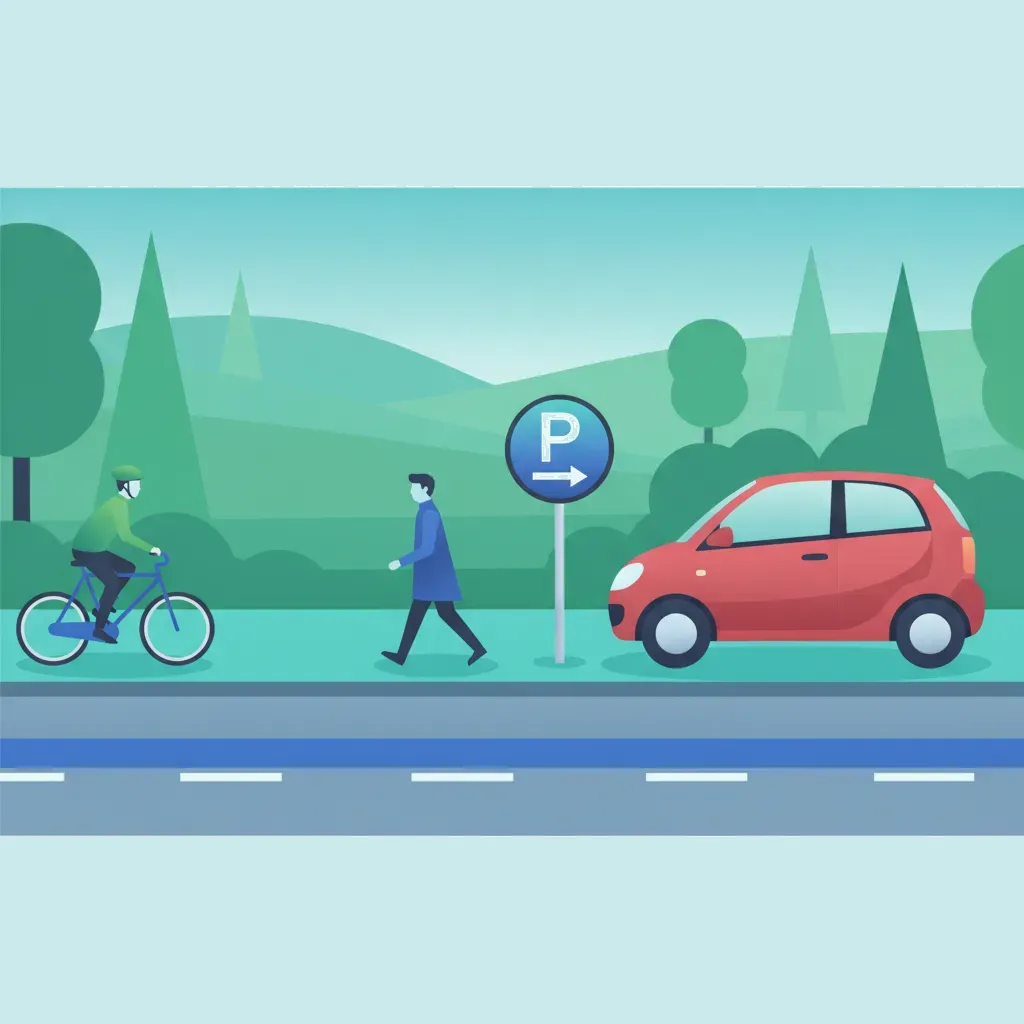
Safe parking ensures your vehicle does not obstruct visibility, block traffic, or endanger other road users. This section explains the key considerations for parking responsibly in Switzerland, covering how to select suitable locations and position your vehicle to contribute to overall road safety. Pay close attention to how your parked vehicle impacts pedestrians, cyclists, and emergency vehicle access.
Theory topic content overview
Read the full theory topic guide for Parking Safety with structured, easy-to-scan content built for learners in Switzerland. This detailed section explains the exact rule, meaning, traffic context, comparison points, and exam logic behind this Swiss driving theory topic so you can study faster, understand the concept more clearly, and avoid common interpretation mistakes on the theory test.
Safe parking goes beyond simply finding an available space. It's the practice of positioning your vehicle in a way that actively prevents hazards, maintains clear visibility for all road users, and ensures the smooth flow of traffic. In Switzerland, where urban spaces can be compact and diverse road users share the infrastructure, responsible parking is a critical element of road safety. It means ensuring your parked car doesn't become an obstacle or a danger, whether you're there for a moment or for an extended period.
The importance of safe parking practices in Switzerland cannot be overstated, both for daily driving and for your theory exam.
Safe parking is a proactive process involving careful observation and decision-making.
Parkplätze) or areas where parking is explicitly allowed.Fussgängerstreifen), bus stops, tram tracks, or corners where your vehicle could create a blind spot.Rettungsgasse) should one be needed.Handbremse) firmly and, if on a slope, put the vehicle in gear (first gear if facing uphill, reverse if facing downhill) and turn the wheels towards the kerb to prevent rolling.Several factors dictate what constitutes safe parking:
Understanding the nuances of parking rules is vital for safe driving in Switzerland.
Parkieren) vs. Stopping (Halten)Swiss traffic law differentiates between Halten (stopping) and Parkieren (parking).
Halten) generally refers to a brief stop for loading/unloading passengers or goods, where you remain in the immediate vicinity of your vehicle and can move it if necessary. Even during Halten, you must not obstruct traffic or cause danger.Parkieren) implies leaving your vehicle for a longer period, often out of immediate reach, or for any duration that exceeds the definition of Halten. The stricter rules of Parkieren apply here.Verzweigung) or bend (Kurve) can severely limit visibility for drivers trying to merge or turn.Gehweg) or cycle paths (Veloweg), even partially, is a common error that endangers pedestrians and cyclists. Swiss regulations are stringent on ensuring clear pathways.halten in a "second position" next to another parked vehicle, as this completely blocks the lane and creates a severe hazard, particularly for emergency vehicles.Rettungsgasse (rescue corridor) on motorways also implicitly underlines the need for clear passages elsewhere.Bushaltestelle) in a busy urban area like Zürich. Even for a quick drop-off (Halten), you must ensure you are not within the marked bus stop zone and that your stop does not delay public transport or force passengers to step into the road. Parking for longer periods is strictly prohibited in these areas.Fussgängerstreifen (Pedestrian Crossing): You see a parking space just before a pedestrian crossing. Even if it looks convenient, Swiss law dictates you must maintain a clear distance (typically 5 metres before) to ensure pedestrians are visible to approaching traffic and that your vehicle doesn't obscure the view for drivers or pedestrians.In Switzerland, parking regulations are a key component of the Strassenverkehrsgesetz (Road Traffic Act) and associated ordinances. The emphasis is consistently on preventing obstruction and ensuring safety for all road users, particularly vulnerable ones.
Parkplätze and Blue Zones: Swiss towns often use "Blue Zones" (Blaue Zone) for limited-time parking, requiring a parking disc (Parkscheibe). These are designed to encourage turnover and manage urban space efficiently. Parking outside these designated areas, or exceeding time limits without a valid disc, is not only illegal but can contribute to parking scarcity that forces others into unsafe spots.Rettungsgasse): While specifically for motorways, the principle of not obstructing emergency services is pervasive. Parking where you block a driveway or access route directly contradicts this fundamental safety principle.The core principle of parking safety in Switzerland is to view your vehicle not in isolation, but as part of the wider traffic ecosystem. Before you parkieren (park) or halten (stop), ask yourself:
By adopting this proactive, hazard-prevention mindset, you ensure your parked vehicle contributes to, rather than detracts from, overall road safety in Switzerland.
Parking safety in Switzerland extends well beyond simply stopping your vehicle—it requires actively assessing how your parked car impacts visibility, traffic flow, and the safety of vulnerable road users. Swiss traffic law makes a clear legal distinction between Halten (brief stopping) and Parkieren (extended parking), with stricter rules applying to parking. Key considerations include maintaining specific clearance distances from crossings, junctions, and bus stops, ensuring emergency vehicle access, and avoiding obstruction of pedestrians and cyclists. Practical steps include using indicators, positioning correctly within marked bays or parallel to kerbs, and using the Dutch Reach method when exiting. In Swiss urban and alpine contexts, always factor in narrow roads, the presence of trams, and the need for rescue corridors when choosing where to park.
A short set of high-value points that capture the most important ideas from this theory explanation.
Safe parking is a proactive hazard-prevention process, not just finding an available space
Switzerland legally distinguishes between Halten (brief stopping) and Parkieren (extended parking), with different rules applying to each
Your parked vehicle affects visibility, traffic flow, and emergency vehicle access for all road users
Always consider vulnerable road users—pedestrians, cyclists, and public transport—before committing to a parking spot
The "Dutch Reach" method for exiting your vehicle helps prevent collisions with cyclists
Maintain at least 5 metres clearance before pedestrian crossings (Fussgängerstreifen)
Never park on pavements (Gehweg) or cycle paths (Veloweg) unless explicitly permitted
On slopes, engage the handbrake, select appropriate gear, and turn wheels toward the kerb
Blue Zones (Blaue Zone) require a parking disc (Parkscheibe) and have time limits
Consider the space needed for large vehicles like buses and delivery trucks on narrow Swiss roads
Assuming that absence of 'No Parking' signs automatically means parking is allowed
Parking too close to junctions or bends where your vehicle creates blind spots for other drivers
Obstructing pedestrian flow by parking partially on pavements or cycle paths
Double parking or stopping in a second position, which completely blocks the lane
Forgetting to secure the vehicle on slopes by not engaging the handbrake or selecting the correct gear
Start with a short, direct summary of Parking Safety before reading the full explanation below.
Safe parking involves choosing a location where your vehicle does not create hazards or obstruct traffic flow. This means considering visibility for other drivers, ensuring adequate space for pedestrians and cyclists, and preventing blockages for emergency services. In Switzerland, drivers must always assess the immediate environment before and after parking to ensure their vehicle is securely positioned and does not compromise road safety.
Review the most important terms, rule signals, and traffic concepts linked to Parking Safety.
Explore related theory topic pages connected to Parking Safety and continue with the next useful rule explanation.
See the common search queries learners use when trying to understand Parking Safety in Switzerland.

Continue your preparation by exploring specific Swiss traffic rules, road signs, and essential driving concepts. Strengthen your knowledge of official legislation and practical application to ensure complete readiness for your driving licence theory examination.
Explore Swiss Driving Theory TopicsTheory topic content overview
A short set of high-value points that capture the most important ideas from this theory explanation.
Safe parking is a proactive hazard-prevention process, not just finding an available space
Switzerland legally distinguishes between Halten (brief stopping) and Parkieren (extended parking), with different rules applying to each
Your parked vehicle affects visibility, traffic flow, and emergency vehicle access for all road users
Always consider vulnerable road users—pedestrians, cyclists, and public transport—before committing to a parking spot
The "Dutch Reach" method for exiting your vehicle helps prevent collisions with cyclists
Maintain at least 5 metres clearance before pedestrian crossings (Fussgängerstreifen)
Never park on pavements (Gehweg) or cycle paths (Veloweg) unless explicitly permitted
On slopes, engage the handbrake, select appropriate gear, and turn wheels toward the kerb
Blue Zones (Blaue Zone) require a parking disc (Parkscheibe) and have time limits
Consider the space needed for large vehicles like buses and delivery trucks on narrow Swiss roads
Assuming that absence of 'No Parking' signs automatically means parking is allowed
Parking too close to junctions or bends where your vehicle creates blind spots for other drivers
Obstructing pedestrian flow by parking partially on pavements or cycle paths
Double parking or stopping in a second position, which completely blocks the lane
Forgetting to secure the vehicle on slopes by not engaging the handbrake or selecting the correct gear
Start with a short, direct summary of Parking Safety before reading the full explanation below.
Safe parking involves choosing a location where your vehicle does not create hazards or obstruct traffic flow. This means considering visibility for other drivers, ensuring adequate space for pedestrians and cyclists, and preventing blockages for emergency services. In Switzerland, drivers must always assess the immediate environment before and after parking to ensure their vehicle is securely positioned and does not compromise road safety.
Review the most important terms, rule signals, and traffic concepts linked to Parking Safety.
Explore related theory topic pages connected to Parking Safety and continue with the next useful rule explanation.
See the common search queries learners use when trying to understand Parking Safety in Switzerland.
Continue your preparation by exploring specific Swiss traffic rules, road signs, and essential driving concepts. Strengthen your knowledge of official legislation and practical application to ensure complete readiness for your driving licence theory examination.
Explore Swiss Driving Theory TopicsUse this exam-focused revision tip to understand how Parking Safety is likely to appear in theory questions for learners in Switzerland. This section helps you identify the most testable part of the rule, avoid common traps, and remember the concept more effectively during Swiss driving theory exam preparation.
Remember that parking safely is not just about avoiding a ticket, but about proactively preventing dangerous situations. The Swiss theory exam often presents scenarios where you need to identify unsafe parking locations or actions that create hazards for others. Always think about visibility, obstruction, and the safety of vulnerable road users like cyclists and pedestrians.
Read direct answers to the most common learner questions about Parking Safety in Switzerland. This FAQ focuses on rule confusion, practical meaning, comparison with similar concepts, and the exact uncertainties that appear most often in Swiss driving theory revision and exam preparation.
Safe parking means positioning your vehicle in a way that it does not create hazards, obstruct visibility, block traffic, or endanger other road users. This includes considering space for pedestrians, cyclists, and emergency vehicles.
Parking safety is crucial in Swiss driving theory as improper parking can lead to dangerous situations, fines, and impede emergency services. The theory exam often tests your understanding of legal and safe parking locations and practices.
You should avoid parking too close to intersections, pedestrian crossings, driveways, or bus stops, and never in a way that completely blocks a lane or creates an unsafe blind spot for others. Parking in curves must also leave ample space.
Poor parking can force cyclists or pedestrians into the roadway, increasing their risk of accidents. Drivers must ensure they leave sufficient space on sidewalks and bike paths and check surroundings when opening doors.
In Switzerland, you must never park in a manner that obstructs access for emergency vehicles. This includes keeping clear of designated emergency lanes or areas where your vehicle might impede their passage, especially in curves.
Yes, you should always signal your intentions clearly when preparing to park. This helps alert other drivers to your maneuver, preventing confusion and potential collisions as you slow down or change position.
'Dooring' is when a driver or passenger opens a car door into the path of an oncoming cyclist or pedestrian. Safe parking includes checking mirrors and surroundings thoroughly before opening your door to prevent such incidents.
Unsafe or illegal parking in Switzerland can result in substantial fines (e.g., CHF 100 for improper signaling or obstruction), towing of your vehicle, and potentially legal proceedings if it leads to a hazardous situation or impedes emergency services.
Pinpoint specific Swiss traffic rules, road signs, or driving situations you need to master. Use the practice search to start a focused revision session now and build confidence for your official driving theory exam.