
Speed limits are fundamental traffic regulations in Switzerland, designed to maintain safety and efficiency across various road environments. While signs indicate the legal maximum, effective driving requires you to constantly adjust your speed based on visibility, road conditions, traffic density, and potential hazards. Understanding this distinction is key to responsible driving and successfully navigating Swiss roads.
Theory topic content overview
Read the full theory topic guide for Swiss Speed Limits with structured, easy-to-scan content built for learners in Switzerland. This detailed section explains the exact rule, meaning, traffic context, comparison points, and exam logic behind this Swiss driving theory topic so you can study faster, understand the concept more clearly, and avoid common interpretation mistakes on the theory test.
Speed limits in Switzerland are fundamental legal maximums, but mastering safe driving speeds goes far beyond simply knowing the numbers. For both your Swiss driving exam and real-world safety, understanding speed adaptation (Geschwindigkeit den Verhältnissen anpassen) is paramount. This means constantly adjusting your speed to prevailing conditions, ensuring you can always react to hazards and stop safely, even if it's well below the posted maximum.
A speed limit defines the absolute maximum legal speed a vehicle is permitted to travel on a particular stretch of road or within a designated area. These limits are set by law (primarily through the Road Traffic Rules Ordinance – VRV and Road Signs and Signals Ordinance – SSV in Switzerland) to enhance road safety, manage traffic flow, and reduce environmental impact.
In Switzerland, speed limits are clearly indicated by circular signs with a red border and black numbers on a white background. These signs mark the beginning of a speed limit zone, and the limit remains valid until a new speed limit sign is encountered, or a "End of speed limit" sign (Ende der Höchstgeschwindigkeit) is displayed.
The concept of "speed adaptation" is central to Swiss driving theory and practice. It means that while a speed limit is a legal maximum, it is rarely a recommended speed for all conditions. Driving too fast, even if below the limit, is a serious offence if it endangers others or prevents you from reacting safely.
Here are the general maximum speed limits that apply in Switzerland unless otherwise indicated by signage:
Innerorts): 50 km/h
Ortstafel (place-name sign) and is often reinforced by the "Höchstgeschwindigkeit 50 generell" sign (2.30.1), though it can be omitted on minor access roads.Ausserorts): 80 km/h
Ortstafel.Autostrassen): 100 km/h
Autobahnen): 120 km/h
Tempo-30-Zonen (30 km/h Zones): These zones are designated by specific signs (Tempo-30-Zone, 2.59.1) and are common in residential areas, near schools, or in areas with high pedestrian and cyclist activity. Within these zones, the default Rechtsvortritt (right-of-way from the right) often applies at unmarked intersections, meaning you must be extra vigilant.Begegnungszonen (Encounter Zones): Marked by "Begegnungszone" signs (2.59.2), these are shared spaces where pedestrians have priority over vehicles, and drivers must exercise extreme caution. The maximum speed is 20 km/h.Regardless of the posted speed limit, you must always adapt your speed to the prevailing conditions. Consider these factors:
Sicherheitsabstand) to avoid sudden braking and potential collisions.Fussgängerstreifen), or areas with cyclists, your speed must be adapted to protect these users.The most common point of confusion for Swiss driving theory learners is the difference between the maximum legal speed and the safe adapted speed.
Geschwindigkeitsüberschreitung).Nichtanpassen der Geschwindigkeit) if it leads to a dangerous situation.Remember: The speed limit signs indicate the ceiling, not the floor, and certainly not the target.
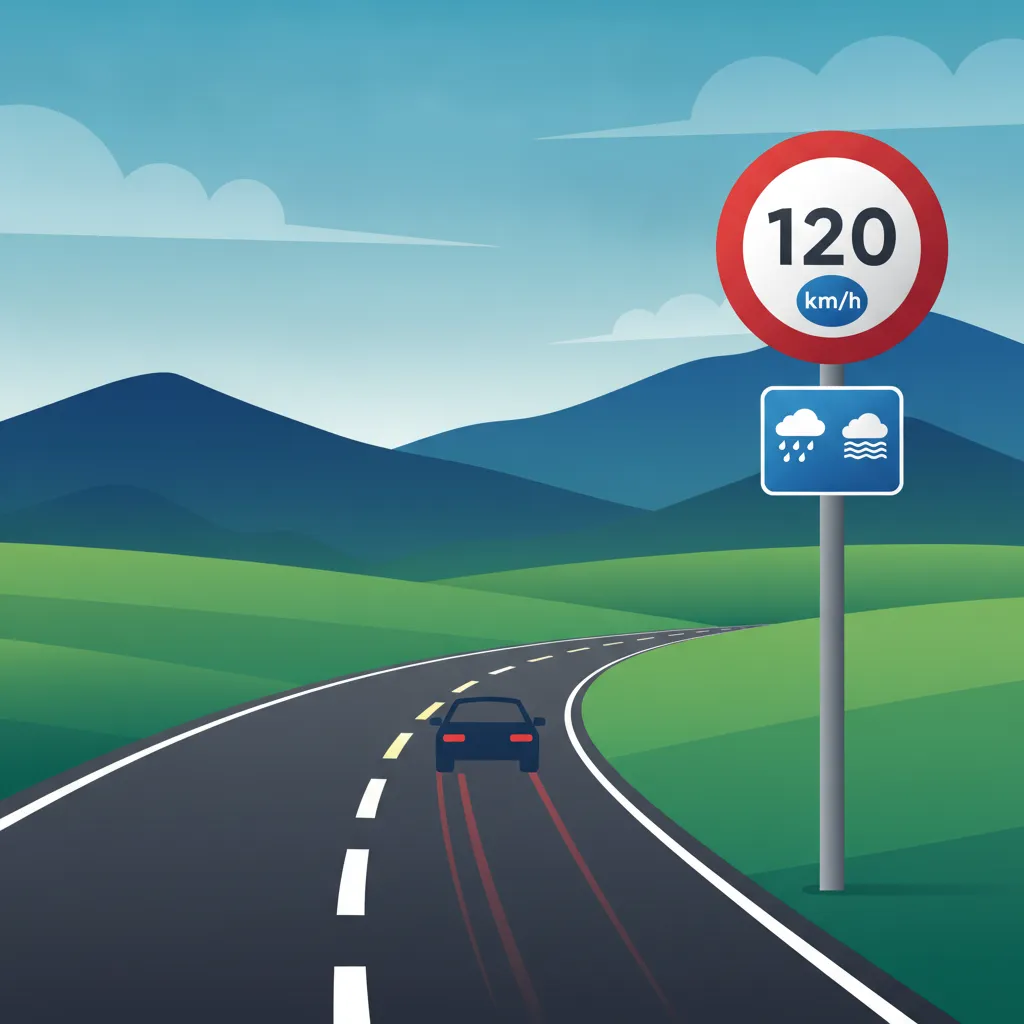
Tempo-30-Zone: As you pass the Tempo-30-Zone sign, you must immediately reduce your speed to 30 km/h. Be especially prepared for Rechtsvortritt at unmarked intersections and expect children to be playing near the road. Your speed should be low enough to stop quickly if a child runs into the road.Autobahn in Heavy Rain: Even if the Autobahn limit is 120 km/h, heavy rain will significantly reduce visibility and tire grip. You must reduce your speed to maybe 80-100 km/h, or even lower, depending on the severity of the rain, to maintain control and a safe following distance. Dynamic signs may also lower the limit.Ausserorts Road: On a rural road (Ausserorts), the limit might be 80 km/h. However, a blind bend with no clear view of what's around it demands a much lower speed to allow you to stop if there's an obstacle, an oncoming vehicle, or an animal.Rechtsvortritt in Tempo-30-Zonen: Failing to anticipate right-of-way at unmarked intersections within 30 km/h zones is a frequent error.To drive safely and pass your Swiss driving licence theory exam, embed this principle: always adjust your speed so you can react to any foreseeable hazard and stop within the distance you can clearly see ahead. Speed limits are legal boundaries, but your active judgment of conditions determines your true safe speed. Prioritize adaptability and caution over speed, especially when facing challenging Swiss road or weather conditions.
Swiss speed limits establish legal maximums (50 km/h in built-up areas, 80 km/h outside, 100 km/h on expressways, 120 km/h on motorways) that are indicated by circular signs with red borders. However, the core principle of Swiss driving theory is speed adaptation: regardless of the posted limit, drivers must constantly adjust speed based on visibility, road conditions, traffic density, and hazards. Special zones like Tempo-30-Zonen and Begegnungszonen have specific lower limits with additional rules, and the fog rule requires a maximum 50 km/h when visibility drops below 50 metres. The distinction between maximum legal speed and safe adapted speed is frequently tested in the Swiss theory exam and is essential for safe driving.
A short set of high-value points that capture the most important ideas from this theory explanation.
Speed limits in Switzerland are absolute legal maximums, not recommended speeds or targets to always reach
Speed adaptation (Geschwindigkeit den Verhältnissen anpassen) is mandatory regardless of posted limits—drive only as fast as conditions allow you to react and stop safely
Swiss speed limits: 50 km/h innerorts (built-up), 80 km/h ausserorts (rural), 100 km/h autostrassen (expressways), 120 km/h autobahnen (motorways)
Special zones have distinct rules: Tempo-30-Zonen require 30 km/h with Rechtsvortritt at unmarked intersections; Begegnungszonen require 20 km/h with pedestrian priority
When visibility drops below 50 metres in fog on any Swiss road, you must not exceed 50 km/h
Memorize the four standard speed limits in order: 50 → 80 → 100 → 120 km/h for innerorts, ausserorts, autostrassen, autobahnen
The fog rule is specific and absolute: visibility under 50m means max 50 km/h on any road type
Tempo-30-Zonen override standard innerorts rules and reinstate Rechtsvortritt at unmarked intersections
Speed limit signs mark a ceiling, not a target or a mandatory minimum—always assess conditions
Dynamic/electronic speed limits on motorways must be obeyed immediately when displayed
Treating the speed limit as a speed target and believing you should drive at the limit whenever possible
Forgetting that Rechtsvortritt (priority from the right) applies at unmarked intersections within Tempo-30-Zonen
Not reducing speed appropriately for weather conditions, especially sudden fog, rain, or snow on mountain roads
Underestimating stopping distances by not understanding how speed and adverse conditions multiply braking distance
Confusing the maximum legal speed with the safe adapted speed—failing to slow down when conditions demand it is also an offence
Start with a short, direct summary of Swiss Speed Limits before reading the full explanation below.
Speed limits in Switzerland define the absolute maximum legal speed for different road types, such as 50 km/h in built-up areas or 120 km/h on motorways. However, these limits are not always the safest speed. Drivers must always adapt their speed to prevailing conditions like weather, traffic, and visibility, ensuring they can react to hazards and stop safely, a principle central to Swiss road safety.
Review the most important terms, rule signals, and traffic concepts linked to Swiss Speed Limits.
Explore related theory topic pages connected to Swiss Speed Limits and continue with the next useful rule explanation.
See the common search queries learners use when trying to understand Swiss Speed Limits in Switzerland.

Continue your preparation by exploring specific Swiss traffic rules, road signs, and essential driving concepts. Strengthen your knowledge of official legislation and practical application to ensure complete readiness for your driving licence theory examination.
Explore Swiss Driving Theory TopicsTheory topic content overview
A short set of high-value points that capture the most important ideas from this theory explanation.
Speed limits in Switzerland are absolute legal maximums, not recommended speeds or targets to always reach
Speed adaptation (Geschwindigkeit den Verhältnissen anpassen) is mandatory regardless of posted limits—drive only as fast as conditions allow you to react and stop safely
Swiss speed limits: 50 km/h innerorts (built-up), 80 km/h ausserorts (rural), 100 km/h autostrassen (expressways), 120 km/h autobahnen (motorways)
Special zones have distinct rules: Tempo-30-Zonen require 30 km/h with Rechtsvortritt at unmarked intersections; Begegnungszonen require 20 km/h with pedestrian priority
When visibility drops below 50 metres in fog on any Swiss road, you must not exceed 50 km/h
Memorize the four standard speed limits in order: 50 → 80 → 100 → 120 km/h for innerorts, ausserorts, autostrassen, autobahnen
The fog rule is specific and absolute: visibility under 50m means max 50 km/h on any road type
Tempo-30-Zonen override standard innerorts rules and reinstate Rechtsvortritt at unmarked intersections
Speed limit signs mark a ceiling, not a target or a mandatory minimum—always assess conditions
Dynamic/electronic speed limits on motorways must be obeyed immediately when displayed
Treating the speed limit as a speed target and believing you should drive at the limit whenever possible
Forgetting that Rechtsvortritt (priority from the right) applies at unmarked intersections within Tempo-30-Zonen
Not reducing speed appropriately for weather conditions, especially sudden fog, rain, or snow on mountain roads
Underestimating stopping distances by not understanding how speed and adverse conditions multiply braking distance
Confusing the maximum legal speed with the safe adapted speed—failing to slow down when conditions demand it is also an offence
Start with a short, direct summary of Swiss Speed Limits before reading the full explanation below.
Speed limits in Switzerland define the absolute maximum legal speed for different road types, such as 50 km/h in built-up areas or 120 km/h on motorways. However, these limits are not always the safest speed. Drivers must always adapt their speed to prevailing conditions like weather, traffic, and visibility, ensuring they can react to hazards and stop safely, a principle central to Swiss road safety.
Review the most important terms, rule signals, and traffic concepts linked to Swiss Speed Limits.
Explore related theory topic pages connected to Swiss Speed Limits and continue with the next useful rule explanation.
See the common search queries learners use when trying to understand Swiss Speed Limits in Switzerland.
Continue your preparation by exploring specific Swiss traffic rules, road signs, and essential driving concepts. Strengthen your knowledge of official legislation and practical application to ensure complete readiness for your driving licence theory examination.
Explore Swiss Driving Theory TopicsUse this exam-focused revision tip to understand how Swiss Speed Limits is likely to appear in theory questions for learners in Switzerland. This section helps you identify the most testable part of the rule, avoid common traps, and remember the concept more effectively during Swiss driving theory exam preparation.
In the Swiss theory exam, don't just memorize the maximum speed limits. Crucially, understand when and why you must adapt your speed below these limits. Questions often test your judgment in adverse conditions like rain, fog, or heavy traffic, emphasizing that the 'safe speed' is not always the 'maximum legal speed'.
Read direct answers to the most common learner questions about Swiss Speed Limits in Switzerland. This FAQ focuses on rule confusion, practical meaning, comparison with similar concepts, and the exact uncertainties that appear most often in Swiss driving theory revision and exam preparation.
In Switzerland, the general speed limits are 50 km/h in built-up areas, 80 km/h outside built-up areas, 100 km/h on expressways (Autostrassen), and 120 km/h on motorways (Autobahnen), unless otherwise indicated by signs.
A Tempo-30 zone (or 30 km/h zone) is a specific area, usually residential or school zones, where the maximum speed limit is 30 km/h. These zones are designed to increase safety for pedestrians and cyclists and often feature right-of-way rules at intersections.
You must adapt your speed to prevailing conditions such as weather (rain, snow, ice), poor visibility (fog), heavy traffic, or road hazards. The posted limit is the maximum, not a recommendation for all circumstances; driving safely often means going slower.
Yes, for new drivers (less than 3 years with licence) and in conditions like heavy rain or snow, maximum speeds can be reduced. For example, in fog with visibility under 50m, the speed limit on all roads is 50 km/h.
Speed limits reduce the risk and severity of accidents by providing drivers more time to react, shortening stopping distances, and reducing the kinetic energy involved in collisions. They also promote a more predictable and uniform traffic flow.
Yes, excessive speeding (e.g., 40 km/h over the limit in built-up areas, 80 km/h over on motorways) in Switzerland can lead to severe penalties, including very high fines, prison sentences, licence disqualification, and even vehicle confiscation and sale.
Pinpoint specific Swiss traffic rules, road signs, or driving situations you need to master. Use the practice search to start a focused revision session now and build confidence for your official driving theory exam.