
A 'Stop' sign (known as 'Signal Stop', sign 3.01, in Swiss traffic law) is one of the most critical regulatory signs, commanding drivers to bring their vehicle to a full and complete stop. Unlike a 'Kein Vortritt' (Give Way) sign, the stop sign demands an absolute halt, regardless of whether other traffic is visible. This page explains where to stop, how to assess traffic safely, and why strict adherence is vital for road safety and passing your Swiss driving theory exam.
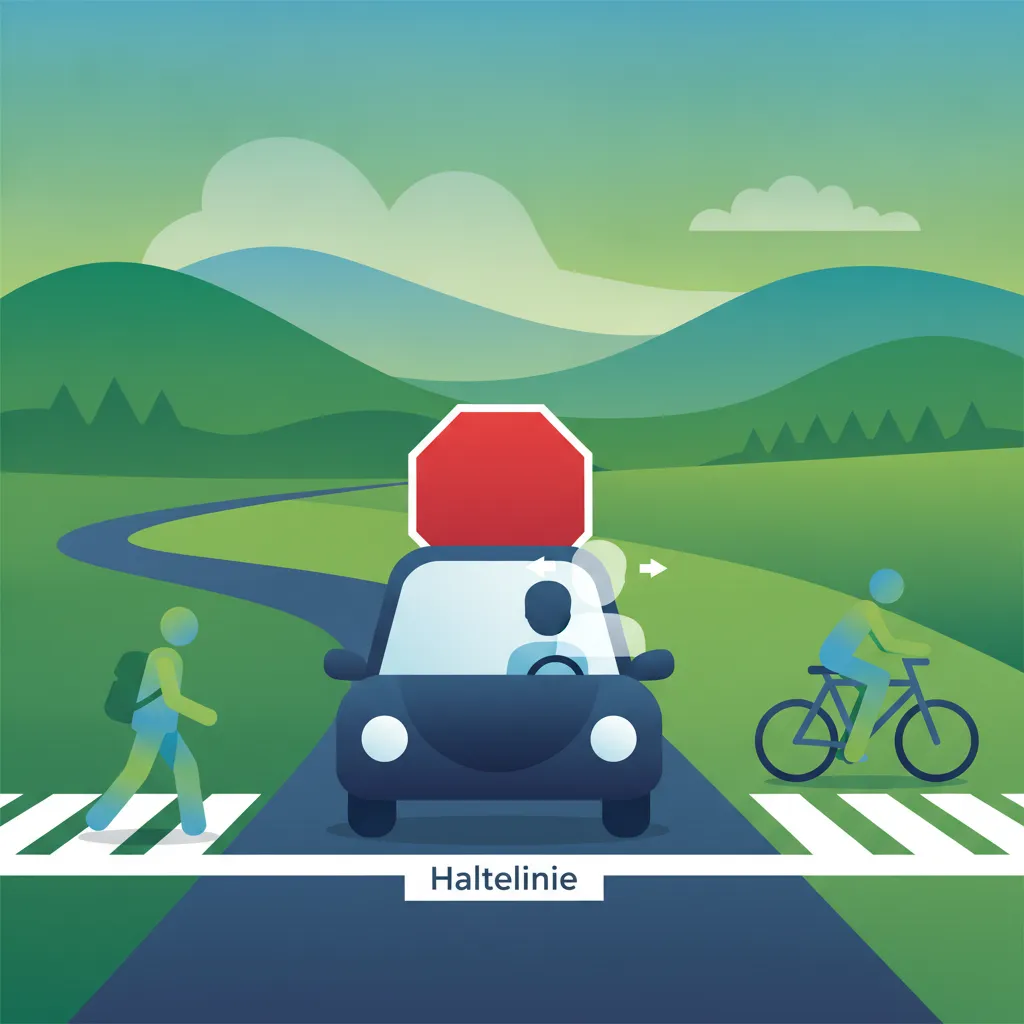
Theory topic content overview
Read the full theory topic guide for Stop Sign Rules with structured, easy-to-scan content built for learners in Switzerland. This detailed section explains the exact rule, meaning, traffic context, comparison points, and exam logic behind this Swiss driving theory topic so you can study faster, understand the concept more clearly, and avoid common interpretation mistakes on the theory test.
A Stop sign, officially known as Signal Stop (Sign 3.01) in Swiss traffic law, is one of the most fundamental and strictly enforced regulatory signs. It commands drivers to bring their vehicle to a complete and absolute halt before proceeding. This mandatory stop is crucial for road safety, ensuring that drivers can thoroughly assess traffic and grant priority to all other road users before entering or crossing an intersection.
In Switzerland, the octagonal red Stop sign (Signal 3.01) requires an unconditional halt. This is not merely a slowdown or a brief pause; it means your vehicle's wheels must come to a full, unmoving stop. The primary purpose is to eliminate potential collisions at junctions where visibility may be restricted, or where the intersection itself presents a high risk due to converging traffic flows.
Drivers must halt:
After stopping, you must grant Vortritt (priority) to all vehicles, cyclists, and pedestrians on the intersecting road before you may proceed.
The strict requirement for a complete stop at a Signal Stop sign is vital for several reasons, particularly within the context of Swiss roads and the driving theory exam:
Approaching and correctly executing a stop at a Signal Stop (Sign 3.01) involves a clear sequence of actions:
Note on Traffic Lights: According to Art. 36 para 3 of the Swiss SSV (Ordinance on Road Signs and Signals), if a Stop sign is present at an intersection controlled by traffic lights, you only need to obey the Stop sign if the traffic lights are not functioning (e.g., flashing yellow or completely off). Otherwise, the traffic lights take precedence.
A critical point for Swiss driving theory and practical driving is understanding the difference between a Stop sign (Signal Stop, 3.01) and a Give Way sign (Kein Vortritt, 3.02). Many learners confuse these, but their obligations are distinct:
Haltelinie or intersection edge. You must stop, regardless of traffic. Only proceed after ensuring the road is clear and granting priority.Failing to make a complete stop at a Signal Stop is a serious infringement, whereas a "rolling yield" is acceptable at a Kein Vortritt sign if the conditions allow.
You are driving on a narrow country road in a mountainous region and approach an intersection marked with a Signal Stop (3.01). Due to a bend in the road and dense foliage, visibility to your left is very poor.
Action: You must stop completely at the Haltelinie (if present) or at the point where you can gain the best view of the main road. Then, inch forward slowly and carefully, checking thoroughly to your left and right, possibly several times, before accelerating onto the main road, ensuring no vehicle is approaching from the blind spots.
You are driving in a Swiss town and encounter a Signal Stop (3.01) at a busy urban intersection where there are also marked pedestrian crossings.
Action: Stop completely at the Haltelinie. First, check for pedestrians and cyclists crossing in front of you or from the intersecting road, granting them priority. Then, check for vehicle traffic from both directions on the cross street. Only proceed when all road users with priority have passed or are at a safe distance.
You approach a Signal Stop (3.01). Below it, there's an auxiliary sign, "Richtung der Hauptstrasse" (Direction of Main Road, Sign 5.09), indicating the main road curves to your left.
Action: Perform your mandatory complete stop at the Haltelinie. The auxiliary sign clarifies which path is the main road. You must grant priority to all vehicles on the main road, whether they are continuing on it or leaving it via the intersection, as indicated by the wide stroke on the auxiliary sign. You then proceed once the priority vehicles have passed.
Learners frequently make mistakes with Stop signs (Signal Stop) during their theory exam and practical driving in Switzerland:
Haltelinie means you have entered the intersection, potentially obstructing traffic or pedestrians, and is incorrect.Haltelinie or intersection that you cannot see oncoming traffic safely, then having to inch forward, can also be problematic. Find the right balance between stopping safely before the line and being able to assess the situation.The Signal Stop (Sign 3.01) is a non-negotiable command in Switzerland. Remember the phrase: "Stop fully, then check thoroughly, then grant priority absolutely." Mastering this rule is not just about passing your Swiss driving theory exam; it's about internalizing a critical safety habit that protects yourself and all other road users at high-risk intersections throughout Switzerland. Always ensure your wheels come to a complete standstill before assessing the situation and moving off.
The Signal Stop (Sign 3.01) is a mandatory regulatory sign requiring drivers to bring their vehicle to a complete, absolute halt before the Haltelinie or at the intersection edge, regardless of whether traffic is visible. Unlike a Give Way sign, stopping is non-negotiable and wheels must be fully stationary. After stopping, drivers must thoroughly assess all approaching traffic, cyclists, and pedestrians, granting Vortritt to all users on the intersecting road before proceeding safely. This rule is heavily emphasized in the Swiss theory exam, where scenarios testing the distinction between a full stop and a rolling stop are common.
A short set of high-value points that capture the most important ideas from this theory explanation.
Signal Stop (Sign 3.01) requires an absolute, complete halt—your wheels must stop completely, not just slow down significantly
Stop before the Haltelinie (stop line, Sign 6.10) if present; otherwise at the point with the best view of the intersecting road without entering it
After stopping, you must grant Vortritt (priority) to all vehicles, cyclists, and pedestrians on the intersecting road before proceeding
A Stop sign differs fundamentally from a Give Way (Kein Vortritt) sign—the latter only requires stopping if traffic would actually be impeded
If traffic lights at a Stop sign intersection are not functioning, you must obey the Stop sign (Art. 36 para 3 SSV)
Octagonal red Stop sign = Signal Stop (Sign 3.01) — absolute halt is mandatory regardless of visible traffic
Haltelinie (Sign 6.10) is the thick white stop line marking exactly where you must halt; Wartelinie (white triangles) belongs to Give Way signs only
No stop line present = stop at the intersection edge where you can see best without encroaching on cross-traffic
Stop sign = full mandatory halt; Give Way sign = grant priority but may proceed without stopping if the way is clear
Stop sign drivers always yield priority; they cannot claim priority even after completing their stop
Performing a 'rolling stop'—slowing down significantly but not bringing the vehicle to a complete standstill, which fails Swiss Stop sign requirements
Stopping with wheels over or past the Haltelinie, which means the vehicle has already entered the intersection incorrectly
Incomplete observation after stopping—checking only one direction or failing to look for cyclists and pedestrians crossing
Confusing Signal Stop with Kein Vortritt and attempting to proceed if the road seems clear without first making an absolute halt
Stopping so far back from the Haltelinie that visibility is compromised, requiring unsafe creeping forward to see oncoming traffic
Start with a short, direct summary of Stop Sign Rules before reading the full explanation below.
In Switzerland, a 'Stop' sign (Signal Stop) means you must bring your vehicle to a complete, absolute halt before the 'Haltelinie' (stop line) or, if absent, at the intersection's edge. You must then carefully assess all approaching traffic, including pedestrians and cyclists, and only proceed when the road is completely clear and it is safe to do so without hindering anyone with priority.
Review the most important terms, rule signals, and traffic concepts linked to Stop Sign Rules.
Explore related theory topic pages connected to Stop Sign Rules and continue with the next useful rule explanation.
See the common search queries learners use when trying to understand Stop Sign Rules in Switzerland.

Continue your preparation by exploring specific Swiss traffic rules, road signs, and essential driving concepts. Strengthen your knowledge of official legislation and practical application to ensure complete readiness for your driving licence theory examination.
Explore Swiss Driving Theory TopicsTheory topic content overview
A short set of high-value points that capture the most important ideas from this theory explanation.
Signal Stop (Sign 3.01) requires an absolute, complete halt—your wheels must stop completely, not just slow down significantly
Stop before the Haltelinie (stop line, Sign 6.10) if present; otherwise at the point with the best view of the intersecting road without entering it
After stopping, you must grant Vortritt (priority) to all vehicles, cyclists, and pedestrians on the intersecting road before proceeding
A Stop sign differs fundamentally from a Give Way (Kein Vortritt) sign—the latter only requires stopping if traffic would actually be impeded
If traffic lights at a Stop sign intersection are not functioning, you must obey the Stop sign (Art. 36 para 3 SSV)
Octagonal red Stop sign = Signal Stop (Sign 3.01) — absolute halt is mandatory regardless of visible traffic
Haltelinie (Sign 6.10) is the thick white stop line marking exactly where you must halt; Wartelinie (white triangles) belongs to Give Way signs only
No stop line present = stop at the intersection edge where you can see best without encroaching on cross-traffic
Stop sign = full mandatory halt; Give Way sign = grant priority but may proceed without stopping if the way is clear
Stop sign drivers always yield priority; they cannot claim priority even after completing their stop
Performing a 'rolling stop'—slowing down significantly but not bringing the vehicle to a complete standstill, which fails Swiss Stop sign requirements
Stopping with wheels over or past the Haltelinie, which means the vehicle has already entered the intersection incorrectly
Incomplete observation after stopping—checking only one direction or failing to look for cyclists and pedestrians crossing
Confusing Signal Stop with Kein Vortritt and attempting to proceed if the road seems clear without first making an absolute halt
Stopping so far back from the Haltelinie that visibility is compromised, requiring unsafe creeping forward to see oncoming traffic
Start with a short, direct summary of Stop Sign Rules before reading the full explanation below.
In Switzerland, a 'Stop' sign (Signal Stop) means you must bring your vehicle to a complete, absolute halt before the 'Haltelinie' (stop line) or, if absent, at the intersection's edge. You must then carefully assess all approaching traffic, including pedestrians and cyclists, and only proceed when the road is completely clear and it is safe to do so without hindering anyone with priority.
Review the most important terms, rule signals, and traffic concepts linked to Stop Sign Rules.
Explore related theory topic pages connected to Stop Sign Rules and continue with the next useful rule explanation.
See the common search queries learners use when trying to understand Stop Sign Rules in Switzerland.
Continue your preparation by exploring specific Swiss traffic rules, road signs, and essential driving concepts. Strengthen your knowledge of official legislation and practical application to ensure complete readiness for your driving licence theory examination.
Explore Swiss Driving Theory TopicsUse this exam-focused revision tip to understand how Stop Sign Rules is likely to appear in theory questions for learners in Switzerland. This section helps you identify the most testable part of the rule, avoid common traps, and remember the concept more effectively during Swiss driving theory exam preparation.
Many learners confuse the 'Stop' sign with a 'Give Way' sign. Remember: a 'Stop' sign means a *full, absolute halt* before the line or intersection, even if it feels unnecessary. The Swiss theory exam frequently tests this distinction, often showing scenarios where a 'rolling stop' would be incorrect. Always confirm your wheels have completely stopped.
Read direct answers to the most common learner questions about Stop Sign Rules in Switzerland. This FAQ focuses on rule confusion, practical meaning, comparison with similar concepts, and the exact uncertainties that appear most often in Swiss driving theory revision and exam preparation.
The primary difference is that a 'Stop' sign requires a complete, absolute halt of your vehicle, even if the road appears clear. A 'Give Way' sign (Kein Vortritt), however, only requires you to slow down and give priority, allowing you to proceed without stopping if the road is clear.
You must stop immediately before the 'Haltelinie' (stop line) painted on the road. If there is no stop line, you must stop at a point where you have a clear view of the intersecting road, just before entering the flow of traffic, ensuring you do not obstruct pedestrians or cyclists.
No, a 'rolling stop' is a violation. A 'Stop' sign requires your vehicle to come to a complete, momentary standstill, with your wheels ceasing to rotate, regardless of traffic conditions. Failure to do so can lead to penalties.
After stopping at a 'Stop' sign, you must grant priority to all other road users on the intersecting road, including vehicles, cyclists, and pedestrians. You may only proceed when it is completely safe and clear to do so, without forcing others to change speed or direction.
According to Swiss law (Art. 36 SSV), if a 'Stop' sign is at an intersection with working traffic lights, you must follow the traffic light signals. The 'Stop' sign only becomes relevant if the traffic lights are not functioning or are switched off.
On roads with multiple lanes going in the same direction, 'Stop' signs are typically repeated on the left side of the road, in addition to the standard placement on the right, to ensure all drivers clearly see the sign.
Pinpoint specific Swiss traffic rules, road signs, or driving situations you need to master. Use the practice search to start a focused revision session now and build confidence for your official driving theory exam.