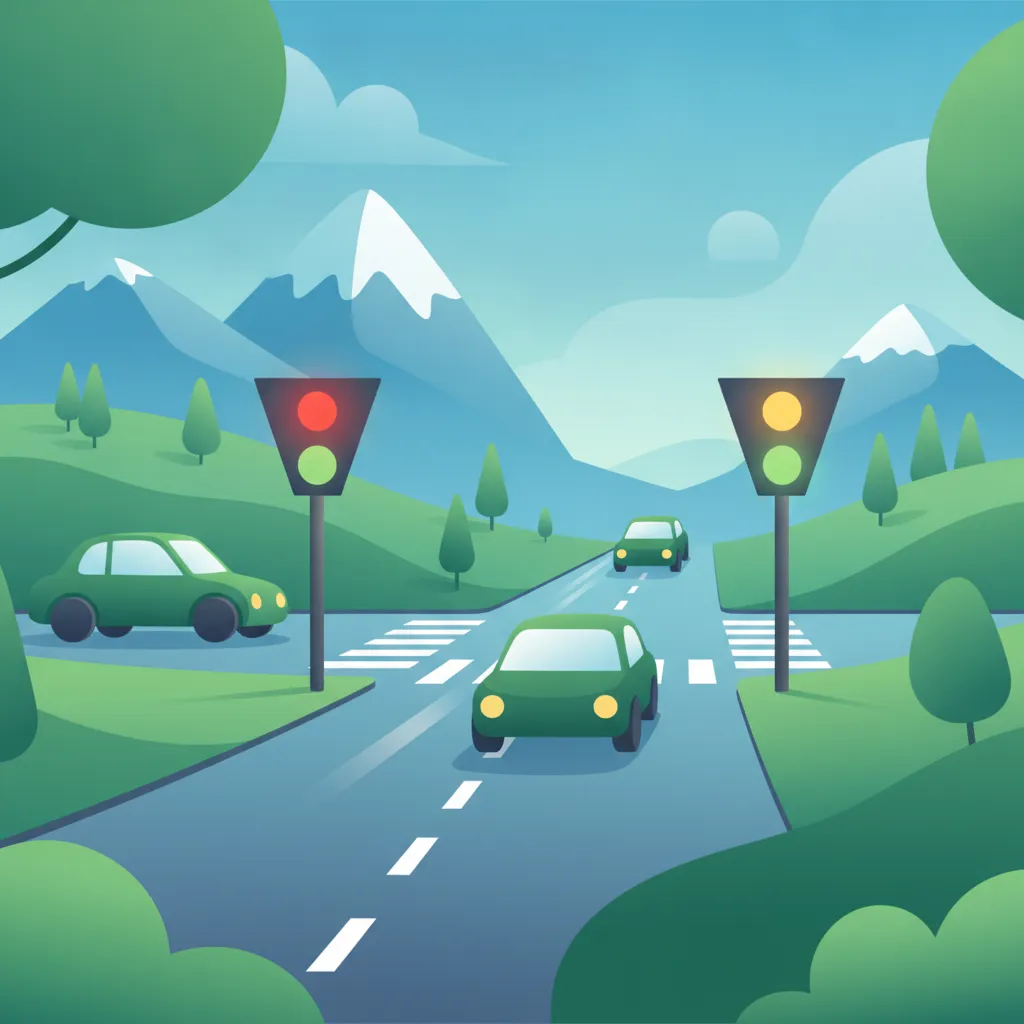
Traffic lights are essential for managing vehicle and pedestrian movement at intersections across Switzerland. They override all other priority rules, making their correct interpretation critical for safe driving. This page explains the specific meanings of red, yellow, and green signals, including special arrows and pedestrian signals, to ensure you know exactly how to react.
Theory topic content overview
Read the full theory topic guide for Traffic Light Signals with structured, easy-to-scan content built for learners in Switzerland. This detailed section explains the exact rule, meaning, traffic context, comparison points, and exam logic behind this Swiss driving theory topic so you can study faster, understand the concept more clearly, and avoid common interpretation mistakes on the theory test.
Traffic lights, known as Lichtsignale in Switzerland, are fundamental for managing the flow of vehicles and pedestrians at intersections (Verzweigungen) and other busy points on the road network. They are designed to prevent collisions and ensure orderly movement. For drivers in Switzerland, understanding the precise meaning and hierarchy of these signals is absolutely paramount, as they always take precedence over all other priority rules, priority signs, and road markings. This unique characteristic is a cornerstone of safe driving and a frequent focus of the Swiss theory exam.
Correctly interpreting traffic light signals is not just about avoiding fines; it's a direct safety imperative. In Switzerland, where diverse road users (cars, motorcycles, cyclists, pedestrians, public transport) share complex infrastructure, Lichtsignale provide clear, unambiguous instructions. Misunderstanding them can lead to dangerous situations, especially at busy intersections or when turning. The Swiss theory test heavily emphasizes these rules, particularly the subtle distinctions for turning movements and the absolute priority of the signals themselves.
Swiss traffic lights follow the universal red, yellow, and green sequence, but with specific nuances and rules for each phase and type of signal.
Rotes Licht) – Halt (Stop)A solid red light means STOP. You must stop your vehicle immediately before the stop line (if present), or before the intersection if there is no line. You are not permitted to proceed until the light turns green.
schwarzer Konturpfeil): If a black contour arrow appears within a red light, the stop command (Haltegebot) applies only to the direction indicated by the arrow. Traffic not affected by the arrow may have a green signal.Rotes Blinklicht): In Switzerland, a red flashing light is typically used only at railway crossings (Bahnübergängen). It signifies an immediate and mandatory stop, indicating an approaching train.Gelbes Licht) – Prepare or CautionThe yellow light serves different purposes depending on the preceding signal:
Gelbes Blinklicht): A flashing yellow light is not part of the standard sequence. It serves as a warning, urging drivers to exercise extreme caution (besondere Vorsicht). When a light is flashing yellow, it means the traffic light is not regulating priority for that direction, and you must apply other priority rules (e.g., "right before left" or priority signs) and be especially vigilant for other traffic and pedestrians.Grünes Licht) – ProceedA solid green light permits you to proceed, provided the intersection is clear and it is safe to do so. However, a crucial distinction in Switzerland applies to turning movements:
Vortritt lassen) to:
Gegenverkehr) if turning left.Fussgänger) and users of similar devices (e.g., cyclists) crossing the road you are turning into.
This is a major difference from some other countries and a key exam point.Grüne Pfeile): A green arrow permits traffic to proceed only in the direction indicated.
Traffic lights often include specific signals for vulnerable road users:
Lichter mit Fussgängersymbol): These signals direct pedestrians. A green symbol allows crossing, while a flashing green, yellow, or red symbol indicates that pedestrians must leave the roadway immediately or not enter it.Lichter mit Fahrradsymbol): These signals apply to cyclists and moped riders, following the same red, yellow, and green rules as vehicle lights.Understanding these distinctions is vital for both safety and passing the Swiss theory exam:
Lichtsignale) always override Vortrittssignale (like "Stop" or "Give Way" signs) and road markings. If a traffic light is active, ignore the signs. If the light is off or flashing yellow, then apply the signs or general "right before left" rule.Konturpfeil): These arrows specify that a signal (red or yellow) applies only to the particular lane or direction indicated, allowing other traffic flows to continue.Rechtsabbiegen für Radfahrer gestattet): Under specific conditions, and only where clearly indicated by the sign "Rechtsabbiegen für Radfahrer gestattet" (5.18) next to a red light, cyclists and moped riders may turn right on a red light, but they must yield to all other traffic that has priority.The most important principle to remember regarding traffic lights in Switzerland is: Lichtsignale (traffic lights) take absolute precedence over all other priority rules and signs. Always be prepared to stop at a yellow or red light, and when proceeding on green, especially when turning, remain vigilant for other road users who may have priority or be vulnerable. Drive defensively and anticipate changes, ensuring you understand the specific Swiss rules for green lights and green arrows when turning.
Swiss traffic lights follow a red-yellow-green sequence but require understanding several country-specific nuances. A red light always means stop before the line or intersection, while yellow has different meanings depending on context—prepare to stop after green, or prepare to go when shown with red. A green light permits proceeding only when safe, and critically, turning on plain green requires yielding to oncoming vehicles and pedestrians. Green arrows provide directional guidance but only guarantee priority when shown without a flashing yellow; with flashing yellow, you must still yield. Flashing yellow signals indicate the intersection is unregulated, requiring you to apply other priority rules and exercise extreme caution. Contour arrows specify that a signal applies only to the indicated direction, allowing other traffic flows to continue unimpeded.
A short set of high-value points that capture the most important ideas from this theory explanation.
Traffic lights (Lichtsignale) always take absolute precedence over all other priority rules, signs, and road markings in Switzerland
A plain green light does not grant priority when turning—you must yield to oncoming traffic and pedestrians crossing your intended lane
A green arrow without flashing yellow guarantees conflict-free passage with priority; a green arrow with flashing yellow still requires you to yield
Flashing yellow means the traffic light is not regulating priority—apply right-before-left or priority signs instead
Contour arrows (Konturpfeil) on red or yellow signals apply the stop or caution command only to the indicated direction, allowing other lanes to proceed
Red light with contour arrow = stop only in that direction; other lanes may have green
Yellow after green = prepare to stop safely; yellow with red = prepare to go
Steady yellow = phase change; flashing yellow = caution and non-regulated intersection
Plain green when turning left or right = always yield to oncoming traffic and pedestrians
Green arrow guarantees priority only when shown without a flashing yellow light
Assuming a green light automatically grants right of way when turning, without yielding to oncoming traffic or pedestrians
Confusing a green arrow with flashing yellow (must still yield) with a green arrow without flashing yellow (guaranteed priority)
Ignoring flashing yellow lights and proceeding without applying other priority rules or exercising extra caution
Believing traffic lights and priority signs apply simultaneously—when lights are active, they override all other priority rules
Misinterpreting contour arrows and stopping when not required, or proceeding when the arrow indicates you must stop
Start with a short, direct summary of Traffic Light Signals before reading the full explanation below.
Traffic lights in Switzerland regulate traffic flow by assigning right of way at intersections. A red light means "Halt" (stop) immediately, a yellow light signals an impending change (prepare to stop safely or get ready to go), and a green light allows you to proceed, provided the intersection is clear and safe. These signals take absolute precedence over other priority rules and signs.
Review the most important terms, rule signals, and traffic concepts linked to Traffic Light Signals.
Explore related theory topic pages connected to Traffic Light Signals and continue with the next useful rule explanation.
See the common search queries learners use when trying to understand Traffic Light Signals in Switzerland.

Continue your preparation by exploring specific Swiss traffic rules, road signs, and essential driving concepts. Strengthen your knowledge of official legislation and practical application to ensure complete readiness for your driving licence theory examination.
Explore Swiss Driving Theory TopicsTheory topic content overview
A short set of high-value points that capture the most important ideas from this theory explanation.
Traffic lights (Lichtsignale) always take absolute precedence over all other priority rules, signs, and road markings in Switzerland
A plain green light does not grant priority when turning—you must yield to oncoming traffic and pedestrians crossing your intended lane
A green arrow without flashing yellow guarantees conflict-free passage with priority; a green arrow with flashing yellow still requires you to yield
Flashing yellow means the traffic light is not regulating priority—apply right-before-left or priority signs instead
Contour arrows (Konturpfeil) on red or yellow signals apply the stop or caution command only to the indicated direction, allowing other lanes to proceed
Red light with contour arrow = stop only in that direction; other lanes may have green
Yellow after green = prepare to stop safely; yellow with red = prepare to go
Steady yellow = phase change; flashing yellow = caution and non-regulated intersection
Plain green when turning left or right = always yield to oncoming traffic and pedestrians
Green arrow guarantees priority only when shown without a flashing yellow light
Assuming a green light automatically grants right of way when turning, without yielding to oncoming traffic or pedestrians
Confusing a green arrow with flashing yellow (must still yield) with a green arrow without flashing yellow (guaranteed priority)
Ignoring flashing yellow lights and proceeding without applying other priority rules or exercising extra caution
Believing traffic lights and priority signs apply simultaneously—when lights are active, they override all other priority rules
Misinterpreting contour arrows and stopping when not required, or proceeding when the arrow indicates you must stop
Start with a short, direct summary of Traffic Light Signals before reading the full explanation below.
Traffic lights in Switzerland regulate traffic flow by assigning right of way at intersections. A red light means "Halt" (stop) immediately, a yellow light signals an impending change (prepare to stop safely or get ready to go), and a green light allows you to proceed, provided the intersection is clear and safe. These signals take absolute precedence over other priority rules and signs.
Review the most important terms, rule signals, and traffic concepts linked to Traffic Light Signals.
Explore related theory topic pages connected to Traffic Light Signals and continue with the next useful rule explanation.
See the common search queries learners use when trying to understand Traffic Light Signals in Switzerland.
Continue your preparation by exploring specific Swiss traffic rules, road signs, and essential driving concepts. Strengthen your knowledge of official legislation and practical application to ensure complete readiness for your driving licence theory examination.
Explore Swiss Driving Theory TopicsUse this exam-focused revision tip to understand how Traffic Light Signals is likely to appear in theory questions for learners in Switzerland. This section helps you identify the most testable part of the rule, avoid common traps, and remember the concept more effectively during Swiss driving theory exam preparation.
Many Swiss theory exam questions test your understanding of traffic light sequence and priority. Remember that traffic lights override ALL other priority rules and signs. Pay close attention to turning rules at green lights – a green light itself doesn't automatically grant priority over oncoming traffic or pedestrians when turning, unless a specific green arrow indicates otherwise without a flashing yellow light.
Read direct answers to the most common learner questions about Traffic Light Signals in Switzerland. This FAQ focuses on rule confusion, practical meaning, comparison with similar concepts, and the exact uncertainties that appear most often in Swiss driving theory revision and exam preparation.
A red light means "Halt" (stop) and you must stop your vehicle before the stop line or intersection. You must remain stopped until the light changes to green, unless a specific black contour arrow indicates otherwise for a particular direction.
If the yellow light appears after green, you must stop if it's safe to do so before the intersection. If it appears together with red, it signals that the light is about to turn green, and you should prepare to proceed.
A green light gives permission to proceed, but you must still ensure the intersection is clear and that it's safe to move. If turning, you must yield to oncoming traffic and pedestrians crossing the road, unless a green arrow without a flashing yellow light is shown.
Yes, traffic lights (Lichtsignale) always take absolute precedence over general priority rules (like 'right before left'), 'give way' signs, and road markings.
A green arrow allows traffic to proceed in the indicated direction. If a yellow flashing light appears simultaneously with the green arrow, you must still yield to oncoming traffic and pedestrians when turning.
A steady flashing yellow light acts as a warning, urging drivers to exercise particular caution. This usually indicates that the traffic light system is temporarily out of service, and you should revert to standard priority rules, such as 'right before left'.
Black contour arrows within a red or yellow light mean that the signal's command (stop or prepare to stop) applies only to traffic intending to move in the direction of that arrow. Other directions might have different signals.
Pinpoint specific Swiss traffic rules, road signs, or driving situations you need to master. Use the practice search to start a focused revision session now and build confidence for your official driving theory exam.