
Prohibition signs are a fundamental part of traffic regulation in Switzerland, clearly indicating actions that drivers are strictly not allowed to perform. Recognizing and obeying these signs, often characterized by a red circle, is essential for maintaining road safety and avoiding penalties. This page covers their purpose, common types, and how they apply in various Swiss traffic situations.
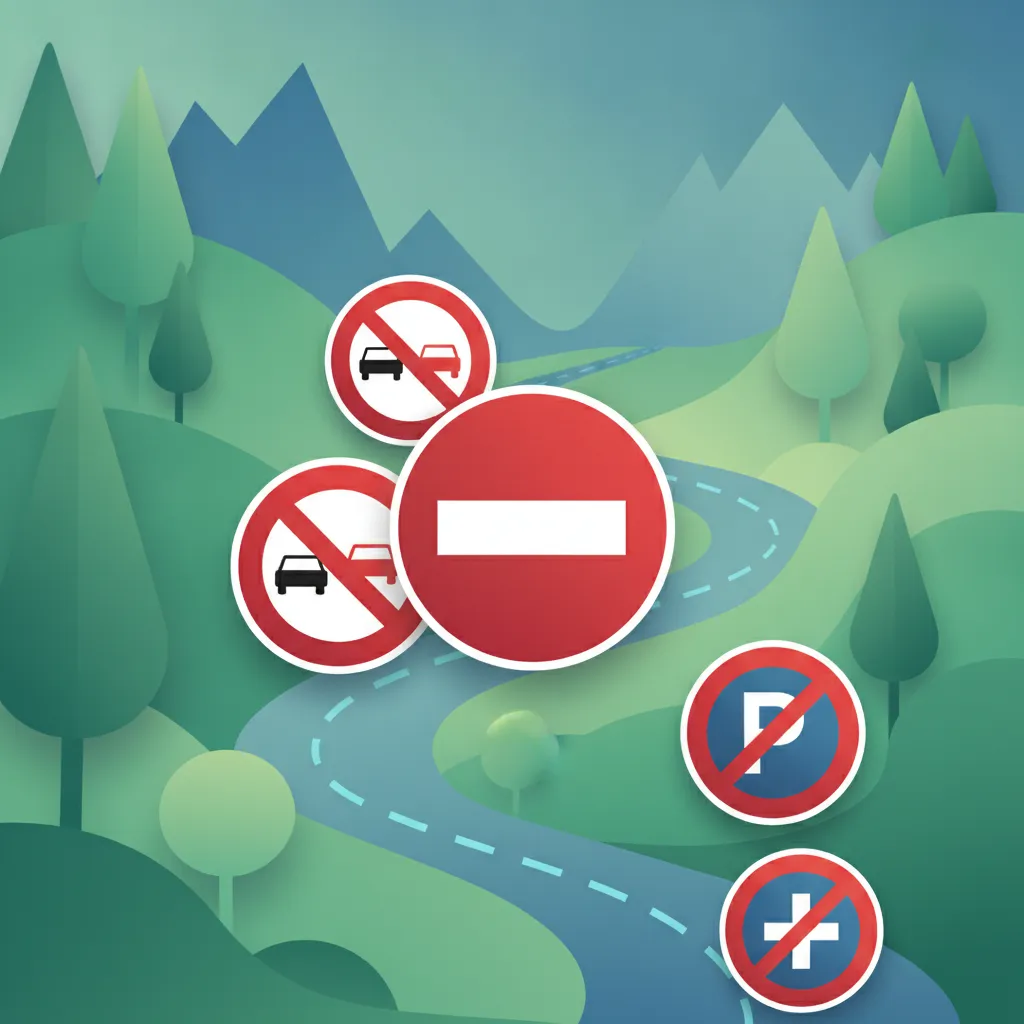
Theory topic content overview
Read the full theory topic guide for Prohibition Signs with structured, easy-to-scan content built for learners in Switzerland. This detailed section explains the exact rule, meaning, traffic context, comparison points, and exam logic behind this Swiss driving theory topic so you can study faster, understand the concept more clearly, and avoid common interpretation mistakes on the theory test.
Prohibition signs, known in Switzerland as Verbotssignale, are a fundamental category of traffic signs that explicitly forbid specific actions or maneuvers. They are instantly recognisable and serve as a crucial component of traffic regulation, ensuring safety and predictable flow on Swiss roads. Understanding these signs is not just a matter of compliance but a cornerstone of hazard prevention and successful navigation of the Swiss driving theory exam.
Verbotssignale are designed to communicate what drivers must not do at a particular location or on a specific stretch of road. Their primary purpose is to prevent dangerous situations, regulate access, and manage traffic flow effectively.
Key characteristics of prohibition signs:
Einfahrt verboten), have a white bar on a red circle.For drivers in Switzerland, understanding and obeying Verbotssignale is paramount for several reasons:
Einfahrt verboten), protect vulnerable road users (e.g., specific vehicle prohibitions), and manage complex traffic situations. They are direct instructions to prevent high-risk behaviors.Strassenverkehrsgesetz, SVG, and Signalisationsverordnung, SSV) mandates strict adherence to these signs. Violations are met with fixed fines (Ordnungsbussenverordnung) and can impact your driving licence. For instance, failing to observe Allgemeines Fahrverbot in beiden Richtungen (2.01) or Einfahrt verboten (2.02) can incur a fixed fine of 100 CHF.Zusatztafeln) modify their scope.The consistent design of prohibition signs across Switzerland helps drivers quickly identify restrictions:
Überholverbot (no overtaking) sign shows two cars with a red diagonal line.Swiss traffic law categorises numerous Verbotssignale, each addressing a specific restriction:
These signs restrict vehicle movement broadly:
Allgemeines Fahrverbot in beiden Richtungen (2.01): This sign, a red circle with a white horizontal bar, indicates that traffic is forbidden in both directions for all vehicles. You cannot enter or proceed past this sign.Einfahrt verboten (2.02): A red circle with a white vertical bar, this sign prohibits entry for all vehicles from the direction it faces, but traffic from the opposite direction is permitted (typically found at the entrance to a one-way street, which would have an Einbahnstrasse (4.08) sign at the other end).Many signs restrict access based on vehicle type, ensuring certain roads are suitable only for particular traffic:
Verbot für Motorwagen (2.03): Prohibits motor vehicles (cars).Verbot für Motorräder (2.04): Prohibits motorcycles.Verbot für Lastwagen (2.07): Prohibits lorries/trucks.Verbot für Anhänger (2.09): Prohibits vehicles with trailers.Verbot für Fahrräder 2.05), mopeds (Verbot für Motorfahrräder 2.06), agricultural vehicles, etc., are also common.These signs forbid particular maneuvers or actions:
Überholverbot (No Overtaking): Prohibits overtaking other motor vehicles (may have specific versions for lorries). This is crucial on mountain passes, winding roads, or near intersections where visibility is limited.Wendeverbot (No U-Turn): Prohibits making a U-turn.Halteverbot (No Stopping): A red circle with a red diagonal cross, this sign forbids stopping for any reason other than traffic flow (e.g., waiting at traffic lights, congestion). It means you cannot stop to pick up/drop off passengers or load/unload goods.Parkierungsverbot (No Parking): A red circle with a single red diagonal line, this sign forbids parking. Stopping is generally allowed for brief loading/unloading or passenger pickup/drop-off, provided the driver remains with the vehicle and it does not obstruct traffic.These signs typically prohibit vehicles exceeding a specified height, width, length, or weight from entering a road, tunnel, or bridge.
Zusatztafeln)Prohibition signs in Switzerland are frequently accompanied by Zusatztafeln, small rectangular panels below the main sign that clarify or modify its meaning. These are critical for precise interpretation:
Anfangstafel (5.05): An arrow pointing upwards indicates the start of the prohibition.Wiederholungstafel (5.04): Arrows pointing up and down indicate the prohibition continues.Endetafel (5.06): An arrow pointing downwards indicates the end of the prohibition.Richtungstafel (5.07) can also define the directional scope.Example: A Halteverbot sign with a Zusatztafel reading "Mon-Fri 07:00-19:00" means stopping is only forbidden during those specific hours on weekdays.
Swiss road signs have distinct visual codes. It's vital not to confuse Verbotssignale with others:
Gebotssignale): While both are regulatory, mandatory signs (blue circle, white symbol, e.g., Fahrtrichtung rechts - 2.32) tell you what you must do, whereas prohibition signs tell you what you must not do.Gefahrensignale): Warning signs (red triangle, black symbol on white background, e.g., Gefährliches Gefälle - 1.05) alert you to a hazard, prompting caution, but don't explicitly forbid an action unless combined with a prohibition sign.Vortrittssignale): Signs like Stop (3.01) and Kein Vortritt (3.02) dictate right-of-way. While they compel you to halt or yield (effectively prohibiting immediate progress), they are a distinct category.Consider these common scenarios where prohibition signs directly influence your driving in Switzerland:
Einfahrt verboten (2.02). This means you absolutely cannot enter from your current direction, likely indicating a one-way system. Attempting to enter would be illegal and dangerous.Halteverbot sign. This means even a brief stop to drop off a passenger is forbidden. You must find an appropriate parking spot or keep moving. If it was Parkierungsverbot, you could briefly stop to unload, but not leave your vehicle unattended.Überholverbot sign. This restriction is crucial due to limited visibility and narrowness, preventing head-on collisions. You must remain behind the vehicle in front, even if it's slow, until the prohibition is lifted.Swiss theory exam candidates often trip up on:
Zusatztafeln. A sign without its panel is only half understood.Halteverbot and Parkierungsverbot: This is a very common mistake. Remember: Halteverbot (diagonal cross) means no stopping AT ALL (except traffic reasons), while Parkierungsverbot (single diagonal line) allows brief stops with the driver present.Ende der Geschwindigkeitsbeschränkung), the next major intersection, or a specific Endetafel. Do not assume they magically disappear.Einfahrt verboten reinforces the gravity.The Signalisationsverordnung (SSV) is the definitive Swiss ordinance for road signs and signals. It details every sign, its meaning, and its legal basis. When you see a Verbotssignal, you are not just being advised; you are being legally mandated. Non-compliance is typically met with a fixed fine under the Ordnungsbussenverordnung. This robust legal framework ensures uniformity and safety across all Swiss cantons and linguistic regions.
Prohibition signs are unambiguous commands. For safe and legal driving in Switzerland, always:
By mastering Verbotssignale, you contribute to your own safety, the safety of others, and ensure smooth, lawful passage on Switzerland's diverse road network.
Swiss prohibition signs (Verbotssignale) are legally binding traffic signs that use a red circular border with a black symbol to indicate forbidden actions, such as Einfahrt verboten (no entry) or Überholverbot (no overtaking). The critical distinction between Halteverbot (no stopping) and Parkierungsverbot (no parking) is that Halteverbot forbids all stops except traffic reasons, while Parkierungsverbot permits brief stops if the driver remains with the vehicle. Supplementary panels (Zusatztafeln) frequently modify these prohibitions by specifying time restrictions, applicable vehicle types, or the geographic extent of the restriction. Prohibitions remain in effect until explicitly cancelled by a cancellation sign, the next major intersection, or a directional Endetafel. For the Swiss theory exam, questions often test understanding of these conditions and distinctions rather than just basic sign recognition.
A short set of high-value points that capture the most important ideas from this theory explanation.
Prohibition signs (Verbotssignale) are legally binding commands indicated by a red circle with a black symbol on white background
In Switzerland, ignoring prohibition signs like Einfahrt verboten or Überholverbot can result in fixed fines and licence penalties under the Signalisationsverordnung (SSV)
Supplementary panels (Zusatztafeln) often modify the prohibition's scope by specifying time, vehicle type, or distance conditions
Prohibitions remain active until explicitly cancelled by a cancellation sign, the next major intersection, or an Endetafel
Verbotssignale must be distinguished from mandatory signs (Gebotssignale) which tell you what you must do, and warning signs (Gefahrensignale) which only alert to hazards
Halteverbot (red diagonal cross) means no stopping at all except for traffic reasons; Parkierungsverbot (single red diagonal line) allows brief stops with the driver remaining present
Zusatztafeln like An Anfangstafel (arrow up), Wiederholungstafel (arrows up and down), and Endetafel (arrow down) indicate where a prohibition starts, continues, or ends
Vehicle-specific prohibition signs (2.03-2.09) prohibit specific vehicle types such as motorcars, motorcycles, lorries, or vehicles with trailers
The red diagonal bar across a symbol visually indicates 'no' or 'forbidden', while Einfahrt verboten uses a white bar on a red circle
Prohibition signs typically apply from the sign location forward until cancelled by another sign or at the next intersection
Ignoring supplementary panels (Zusatztafeln) that modify the prohibition's conditions, leading to incorrect assumptions about when or where restrictions apply
Confusing Halteverbot with Parkierungsverbot: one forbids all stopping while the other allows brief stops with the driver present
Assuming a prohibition ends without seeing a cancellation sign, an Endetafel, or reaching the next intersection
Confusing Verbotssignale with Gebotssignale (mandatory signs), which have a blue background and tell you what to do instead of what not to do
Misinterpreting the scope of vehicle-specific prohibitions without checking if supplementary panels provide exceptions for certain vehicle types
Start with a short, direct summary of Prohibition Signs before reading the full explanation below.
Prohibition signs are traffic signs that forbid specific actions, such as entering a road or overtaking, and are legally binding for all road users in Switzerland. They typically feature a red circle with a black symbol, clearly communicating what is not permitted. Understanding and adhering to these Verbotssignale is crucial for preventing accidents and ensuring predictable traffic behaviour, and they are frequently tested in the Swiss driving theory exam.
Review the most important terms, rule signals, and traffic concepts linked to Prohibition Signs.
Explore related theory topic pages connected to Prohibition Signs and continue with the next useful rule explanation.
See the common search queries learners use when trying to understand Prohibition Signs in Switzerland.

Continue your preparation by exploring specific Swiss traffic rules, road signs, and essential driving concepts. Strengthen your knowledge of official legislation and practical application to ensure complete readiness for your driving licence theory examination.
Explore Swiss Driving Theory TopicsTheory topic content overview
A short set of high-value points that capture the most important ideas from this theory explanation.
Prohibition signs (Verbotssignale) are legally binding commands indicated by a red circle with a black symbol on white background
In Switzerland, ignoring prohibition signs like Einfahrt verboten or Überholverbot can result in fixed fines and licence penalties under the Signalisationsverordnung (SSV)
Supplementary panels (Zusatztafeln) often modify the prohibition's scope by specifying time, vehicle type, or distance conditions
Prohibitions remain active until explicitly cancelled by a cancellation sign, the next major intersection, or an Endetafel
Verbotssignale must be distinguished from mandatory signs (Gebotssignale) which tell you what you must do, and warning signs (Gefahrensignale) which only alert to hazards
Halteverbot (red diagonal cross) means no stopping at all except for traffic reasons; Parkierungsverbot (single red diagonal line) allows brief stops with the driver remaining present
Zusatztafeln like An Anfangstafel (arrow up), Wiederholungstafel (arrows up and down), and Endetafel (arrow down) indicate where a prohibition starts, continues, or ends
Vehicle-specific prohibition signs (2.03-2.09) prohibit specific vehicle types such as motorcars, motorcycles, lorries, or vehicles with trailers
The red diagonal bar across a symbol visually indicates 'no' or 'forbidden', while Einfahrt verboten uses a white bar on a red circle
Prohibition signs typically apply from the sign location forward until cancelled by another sign or at the next intersection
Ignoring supplementary panels (Zusatztafeln) that modify the prohibition's conditions, leading to incorrect assumptions about when or where restrictions apply
Confusing Halteverbot with Parkierungsverbot: one forbids all stopping while the other allows brief stops with the driver present
Assuming a prohibition ends without seeing a cancellation sign, an Endetafel, or reaching the next intersection
Confusing Verbotssignale with Gebotssignale (mandatory signs), which have a blue background and tell you what to do instead of what not to do
Misinterpreting the scope of vehicle-specific prohibitions without checking if supplementary panels provide exceptions for certain vehicle types
Start with a short, direct summary of Prohibition Signs before reading the full explanation below.
Prohibition signs are traffic signs that forbid specific actions, such as entering a road or overtaking, and are legally binding for all road users in Switzerland. They typically feature a red circle with a black symbol, clearly communicating what is not permitted. Understanding and adhering to these Verbotssignale is crucial for preventing accidents and ensuring predictable traffic behaviour, and they are frequently tested in the Swiss driving theory exam.
Review the most important terms, rule signals, and traffic concepts linked to Prohibition Signs.
Explore related theory topic pages connected to Prohibition Signs and continue with the next useful rule explanation.
See the common search queries learners use when trying to understand Prohibition Signs in Switzerland.
Continue your preparation by exploring specific Swiss traffic rules, road signs, and essential driving concepts. Strengthen your knowledge of official legislation and practical application to ensure complete readiness for your driving licence theory examination.
Explore Swiss Driving Theory TopicsUse this exam-focused revision tip to understand how Prohibition Signs is likely to appear in theory questions for learners in Switzerland. This section helps you identify the most testable part of the rule, avoid common traps, and remember the concept more effectively during Swiss driving theory exam preparation.
In the Swiss theory exam, pay close attention to prohibition signs, especially those combined with supplementary panels. Questions often test not just the general meaning, but the specific conditions (e.g., time, vehicle type) under which a prohibition is active or lifted. Look for the small details that modify the main rule.
Read direct answers to the most common learner questions about Prohibition Signs in Switzerland. This FAQ focuses on rule confusion, practical meaning, comparison with similar concepts, and the exact uncertainties that appear most often in Swiss driving theory revision and exam preparation.
A prohibition sign (Verbotssignal) is a type of traffic sign that indicates a specific action or maneuver is forbidden. These signs are legally enforceable and designed to ensure road safety and regulate traffic flow according to Swiss legislation.
In Switzerland, most prohibition signs are easily recognizable by their circular shape with a red border and a black symbol or number indicating the forbidden action or restriction. Some specific signs like 'Einfahrt verboten' also follow this general design.
Common examples include 'Allgemeines Fahrverbot in beiden Richtungen' (No entry in both directions), 'Einfahrt verboten' (No entry), 'Überholverbot' (No overtaking), 'Parkierverbot' (No parking), and signs prohibiting specific vehicle types or exceeding certain speeds.
Ignoring a prohibition sign in Switzerland can lead to serious consequences, including traffic fines (Ordnungsbussen), points on your driving license, or even a driving ban, depending on the severity of the violation and potential danger caused. It also increases the risk of accidents.
Prohibition signs typically apply continuously, but their scope can be clarified or limited by supplementary panels (Zusatztafeln). These panels might specify times of day, certain vehicle types, or distance over which the prohibition applies. Always check for additional information.
The 'Einfahrt verboten' (No Entry) sign (2.02) is a specific Swiss prohibition sign that forbids entry for all vehicles from that direction, while traffic from the opposite direction may still be allowed. It is usually found at the entrance to a one-way street.
No, while they enforce a type of restriction, 'Stop' (3.01) and 'Kein Vortritt' (3.02 - No Priority/Give Way) are officially classified as priority signs (Vortrittssignale) in Switzerland. They oblige drivers to yield or stop to grant priority, rather than generally forbidding an action.
Pinpoint specific Swiss traffic rules, road signs, or driving situations you need to master. Use the practice search to start a focused revision session now and build confidence for your official driving theory exam.