
Reaction distance is the crucial phase where your vehicle continues moving after you perceive a hazard but before you initiate braking. In Switzerland, understanding this concept is vital for anticipating risks and maintaining safe following distances, especially given varied road conditions and traffic situations. This section explains the factors influencing your reaction time and why it's a key component of total stopping distance.
Theory topic content overview
Read the full theory topic guide for Reaction Distance Explained with structured, easy-to-scan content built for learners in Switzerland. This detailed section explains the exact rule, meaning, traffic context, comparison points, and exam logic behind this Swiss driving theory topic so you can study faster, understand the concept more clearly, and avoid common interpretation mistakes on the theory test.
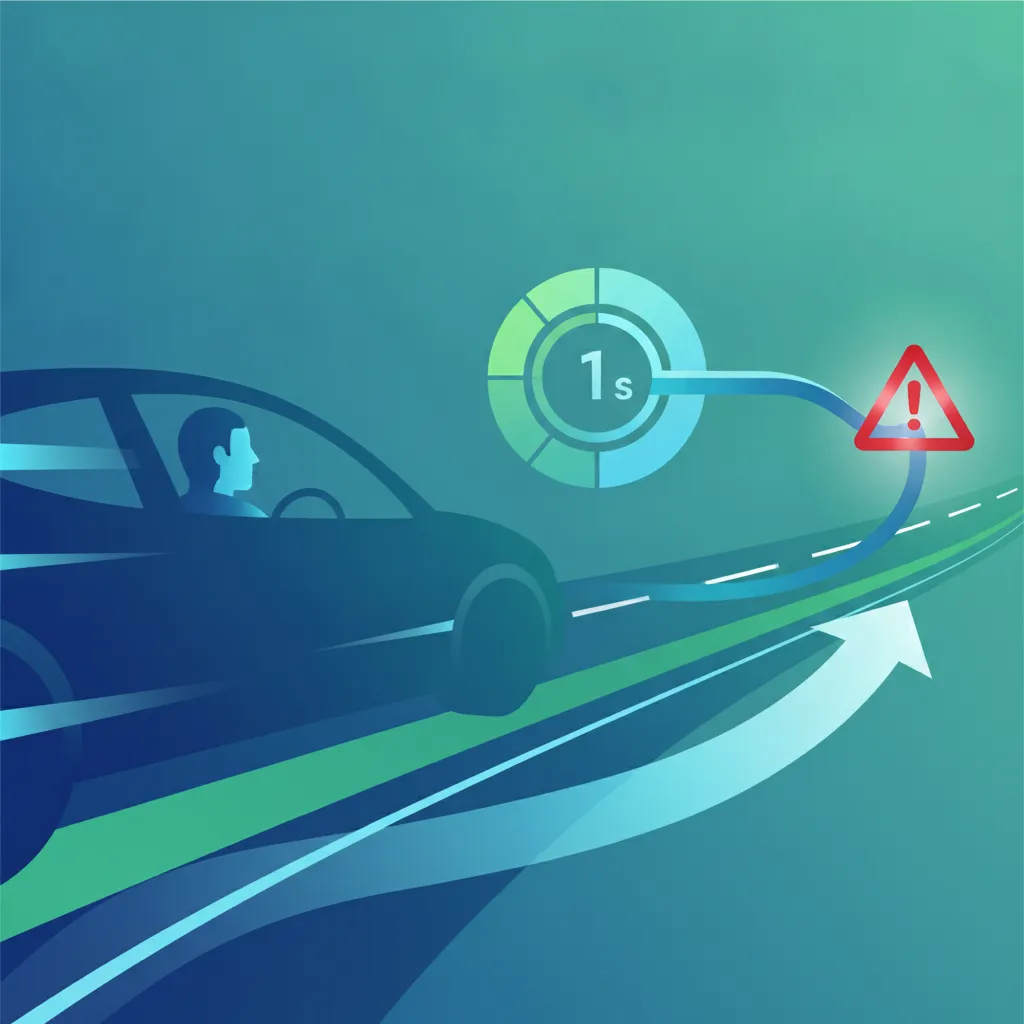
Reaction distance is the crucial stretch your vehicle covers from the moment you perceive a hazard until you actually begin to apply the brakes. It's the invisible yet impactful distance traveled while your brain and body process an unexpected event. This period is often referred to as 'reaction time'.
For any driver, even one who is alert and focused, there is an unavoidable delay between seeing a danger and physically reacting to it. During this critical time, your vehicle continues to travel at its current speed, unaffected by any braking. This makes reaction distance a fundamental component of safe driving and hazard anticipation in Switzerland.
The reaction time itself can be broken down into three phases:
Understanding reaction distance is not just an academic exercise for the Swiss driving theory exam; it's a matter of daily safety on our diverse roads. From winding alpine passes to busy urban centres and high-speed motorways, conditions in Switzerland can change rapidly.
The most significant factor influencing reaction distance is speed. Since your vehicle maintains its speed during your reaction time, a higher speed directly translates to a much longer distance covered before braking even begins.
Consider the standard assumption of approximately one second for an alert driver's reaction time:
This demonstrates a linear relationship: doubling your speed roughly doubles your reaction distance. This effect compounds rapidly, making safe speed management absolutely vital, particularly when driving in Switzerland where speed limits vary and conditions can change.
Beyond speed, numerous other factors can significantly increase your reaction time, and therefore your reaction distance:
A common point of confusion for new drivers and in the Swiss theory test is differentiating between reaction distance and other components of stopping distance.
It's crucial to understand that reaction distance occurs first. You cannot begin to reduce your speed or stop your vehicle until your reaction time has elapsed.
Let's look at how reaction distance plays out in typical Swiss driving situations:
Learners and even experienced drivers often make these critical errors regarding reaction distance:
In Swiss traffic, where varied landscapes, urban density, and efficient motorways demand constant attention, understanding reaction distance is fundamental.
Always assume a minimum reaction time of one second, even when fully alert. This "invisible distance" travels every time you drive. To ensure safety and pass your Swiss driving theory exam, internalise these principles:
By mastering the concept of reaction distance, you take a significant step towards becoming a responsible and safe driver on all Swiss roads.
Reaction distance is the distance a vehicle travels during the time it takes a driver to perceive a hazard and physically begin braking, typically around one second for an alert driver. This distance grows directly with speed—doubling speed roughly doubles reaction distance—and is a separate component from braking distance, which begins only after braking starts. Factors like distraction, fatigue, alcohol, poor visibility, and stress can significantly extend reaction time beyond the baseline, increasing collision risk. In Switzerland's varied conditions, from motorways to alpine descents and tunnels, understanding and accounting for reaction distance is essential for maintaining safe following distances and passing the theory exam.
A short set of high-value points that capture the most important ideas from this theory explanation.
Reaction distance is the distance your vehicle travels during the one-second perception-reaction time before you begin braking, and it increases linearly with speed
The reaction time consists of three phases: perception (seeing the hazard), decision (choosing an action), and physical reaction (moving foot to brake)
At 60 km/h, you travel approximately 16.7 metres before braking begins; at 100 km/h, this increases to about 27.8 metres
Reaction distance and braking distance are distinct components of total stopping distance—reaction distance occurs first before any speed reduction
Phone use can increase reaction time by 30–50%, making it comparable to driving with high blood alcohol levels according to BFU and TCS studies
Always assume a minimum one-second reaction time regardless of how alert you feel
Doubling your speed roughly doubles your reaction distance, making speed management critical for safety
Distractions, fatigue, alcohol, poor visibility, and stress all significantly extend reaction time beyond the baseline one second
Reaction distance occurs before braking distance—both must be considered together to calculate total stopping distance
In Swiss tunnels, adjusting from bright light to darkness temporarily reduces perception and can extend reaction time
Assuming you can react instantly and underestimating the unavoidable human reaction delay
Confusing reaction distance with braking distance or total stopping distance on theory exams
Believing a short following distance is acceptable without accounting for the distance traveled during reaction time before brakes engage
Not adjusting following distance when conditions like rain, fatigue, or complex traffic naturally increase reaction time
Thinking hands-free phone use eliminates distraction risk—studies show reaction time still increases significantly
Start with a short, direct summary of Reaction Distance Explained before reading the full explanation below.
Reaction distance is the distance your vehicle covers from the moment you notice a hazard until you actually start braking. This period involves perception, decision-making, and physical reaction. Even for an alert driver, this takes about one second. Since your vehicle is still moving at its current speed during this time, higher speeds significantly increase the distance traveled before any braking occurs, directly impacting your ability to avoid collisions in Swiss traffic.
Review the most important terms, rule signals, and traffic concepts linked to Reaction Distance Explained.
Explore related theory topic pages connected to Reaction Distance Explained and continue with the next useful rule explanation.
See the common search queries learners use when trying to understand Reaction Distance Explained in Switzerland.

Continue your preparation by exploring specific Swiss traffic rules, road signs, and essential driving concepts. Strengthen your knowledge of official legislation and practical application to ensure complete readiness for your driving licence theory examination.
Explore Swiss Driving Theory TopicsTheory topic content overview
A short set of high-value points that capture the most important ideas from this theory explanation.
Reaction distance is the distance your vehicle travels during the one-second perception-reaction time before you begin braking, and it increases linearly with speed
The reaction time consists of three phases: perception (seeing the hazard), decision (choosing an action), and physical reaction (moving foot to brake)
At 60 km/h, you travel approximately 16.7 metres before braking begins; at 100 km/h, this increases to about 27.8 metres
Reaction distance and braking distance are distinct components of total stopping distance—reaction distance occurs first before any speed reduction
Phone use can increase reaction time by 30–50%, making it comparable to driving with high blood alcohol levels according to BFU and TCS studies
Always assume a minimum one-second reaction time regardless of how alert you feel
Doubling your speed roughly doubles your reaction distance, making speed management critical for safety
Distractions, fatigue, alcohol, poor visibility, and stress all significantly extend reaction time beyond the baseline one second
Reaction distance occurs before braking distance—both must be considered together to calculate total stopping distance
In Swiss tunnels, adjusting from bright light to darkness temporarily reduces perception and can extend reaction time
Assuming you can react instantly and underestimating the unavoidable human reaction delay
Confusing reaction distance with braking distance or total stopping distance on theory exams
Believing a short following distance is acceptable without accounting for the distance traveled during reaction time before brakes engage
Not adjusting following distance when conditions like rain, fatigue, or complex traffic naturally increase reaction time
Thinking hands-free phone use eliminates distraction risk—studies show reaction time still increases significantly
Start with a short, direct summary of Reaction Distance Explained before reading the full explanation below.
Reaction distance is the distance your vehicle covers from the moment you notice a hazard until you actually start braking. This period involves perception, decision-making, and physical reaction. Even for an alert driver, this takes about one second. Since your vehicle is still moving at its current speed during this time, higher speeds significantly increase the distance traveled before any braking occurs, directly impacting your ability to avoid collisions in Swiss traffic.
Review the most important terms, rule signals, and traffic concepts linked to Reaction Distance Explained.
Explore related theory topic pages connected to Reaction Distance Explained and continue with the next useful rule explanation.
See the common search queries learners use when trying to understand Reaction Distance Explained in Switzerland.
Continue your preparation by exploring specific Swiss traffic rules, road signs, and essential driving concepts. Strengthen your knowledge of official legislation and practical application to ensure complete readiness for your driving licence theory examination.
Explore Swiss Driving Theory TopicsUse this exam-focused revision tip to understand how Reaction Distance Explained is likely to appear in theory questions for learners in Switzerland. This section helps you identify the most testable part of the rule, avoid common traps, and remember the concept more effectively during Swiss driving theory exam preparation.
Many Swiss theory test questions involve scenarios where reaction time is affected. Always assume at least one second of reaction time, and remember that distractions, fatigue, or alcohol drastically increase this. Don't confuse reaction distance with braking distance; they are distinct components of total stopping distance.
Read direct answers to the most common learner questions about Reaction Distance Explained in Switzerland. This FAQ focuses on rule confusion, practical meaning, comparison with similar concepts, and the exact uncertainties that appear most often in Swiss driving theory revision and exam preparation.
Reaction time involves three main phases: perceiving a hazard, processing the information and deciding on an action, and finally, the physical movement to apply the brakes.
Reaction distance increases directly with speed. If you double your speed, your reaction distance also doubles, because the vehicle covers more ground in the same amount of reaction time.
While it varies, a commonly used average for an alert driver's reaction time to an unexpected hazard is about one second. However, this can be longer under various conditions.
Factors like fatigue, distractions (e.g., mobile phone use), alcohol or drug impairment, stress, and poor visibility (fog, heavy rain) all significantly extend a driver's reaction time on Swiss roads.
No, reaction distance is the distance traveled before braking starts. Braking distance is the distance traveled after the brakes are applied until the vehicle stops. Together, they make up the total stopping distance.
The Swiss theory test often assesses your understanding of how different factors influence stopping ability. Knowing how reaction distance is affected by speed, distractions, and conditions is crucial for hazard perception questions and safe driving principles.
The best way to minimize reaction distance is to maintain full concentration on the road, avoid distractions, drive at appropriate speeds, and ensure you are well-rested and unimpaired.
Pinpoint specific Swiss traffic rules, road signs, or driving situations you need to master. Use the practice search to start a focused revision session now and build confidence for your official driving theory exam.