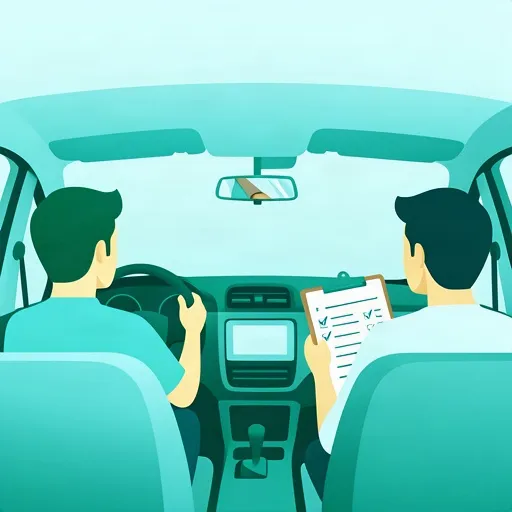
Preparing for the Turkish practical driving exam requires more than just mechanical skill; it demands consistent observation, precise signaling, and calm decision-making. This article breaks down the core examiner expectations, such as proper speed management and hazard awareness, helping you align your real-world performance with official MEB regulatory standards. Mastering these habits is the key to transforming your theory knowledge into a confident and successful driving performance.
Article content overview
Passing the MTSK (Motorlu Taşıt Sürücüleri Kursu) practical driving test is a significant milestone for any driver candidate in Türkiye. While you may have mastered the theory through your e-sınav preparation, the practical examination evaluates your ability to translate those rules into safe, consistent behavioral habits behind the wheel. Examiners are not just looking for mechanical operation; they are looking for a candidate who demonstrates maturity, spatial awareness, and strict adherence to traffic legislation in real-world conditions.
The most common reason for failure in the Turkish driving test is a lack of consistent environmental observation. Examiners expect you to demonstrate "active scanning," which means frequently checking your mirrors, monitoring blind spots, and scanning for potential hazards well before you arrive at an intersection or a pedestrian crossing. A quick glance is not enough; you must prove that your decisions are based on a full awareness of the surrounding traffic, cyclists, and pedestrians.
If you fail to check your mirrors before changing lanes or starting a maneuver, it is documented as a safety error. Remember that in urban traffic, you must always anticipate the movements of others. By continuously assessing your environment, you gain the necessary time to react, ensuring that your driving is defensive rather than reactive.
In the Turkish driving environment, correct signal timing is a core competency that examiners monitor closely. You must signal your intent—whether turning, parking, or pulling over—well in advance to inform other road users of your next move. However, signaling too early can be as confusing as signaling too late. Aim to activate your indicator in a way that provides clear, timely notice without causing ambiguity for vehicles waiting at intersections.
Speed management is equally vital. You must maintain a speed that is appropriate for the road conditions, weather, and the specific traffic rules in effect. Driving too slowly can be just as hazardous as speeding, especially on main roads. You should always aim to stay within the legal speed limits while maintaining a safe "following distance" from the vehicle in front of you. This distance allows for the necessary reaction time if the car ahead brakes suddenly.
The park maneuver is often the most stressful part of the practical test, yet it is fundamentally a test of your spatial awareness and ability to control the vehicle at low speeds. During the exam, focus on the process: check your mirrors, position the car correctly, and execute the move with deliberate, controlled movements. If you feel you have miscalculated, it is safer to perform a minor correction than to rush the maneuver and risk a collision or curb strike.
When dealing with rural roads or obstacles such as tractors or heavy machinery, patience is your best asset. Never attempt to force a pass if you do not have a clear view or sufficient space. Wait for a safe opportunity and only proceed when it is legally permitted and safe to do so.
The MTSK examiner is evaluating your "driving personality" as much as your technical execution. A calm, composed driver is less likely to make impulsive errors under pressure. If you make a small mistake, do not let it ruin your focus for the rest of the test. Take a deep breath, verify your safety, and continue to follow the rules of the road.
Candidates who treat the test as a dialogue with the road—consistently signaling, checking, and adjusting—are far more likely to succeed. Your goal is to show the examiner that you are a predictable and safe driver who understands the responsibility of holding a Turkish driver's license.
The Turkish practical driving test (MTSK) evaluates candidates on behavioral habits rather than mechanical skill alone. Success requires demonstrating active environmental observation through consistent mirror checks and blind spot monitoring, proper signal timing that informs other road users without causing ambiguity, and speed management appropriate to road conditions while maintaining safe following distance. The exam also assesses your driving personality—examiners look for calm, predictable behavior and the ability to recover from small mistakes without losing focus. Mastering these habits bridges the gap between theory knowledge and real-world safe driving performance.
A short set of high-value points that capture the most important ideas from this article.
Examiners evaluate 'active scanning'—frequent mirror checks, blind spot monitoring, and hazard anticipation—not just quick glances
Signal timing matters: activate indicators early enough to inform others but not so early that it causes confusion
Speed must be appropriate for conditions—driving too slowly on main roads can be as hazardous as speeding
Your 'driving personality' matters: calm, composed behavior and consistent rule-following demonstrates maturity to examiners
Maneuvers test spatial awareness at low speeds; focus on deliberate, controlled movements rather than rushing
Always complete your maneuver before turning off your indicator—forgetting to cancel a signal leads to point deductions
Maintain safe following distance (takip mesafesi) to allow reaction time if the vehicle ahead brakes
Never force a pass on rural roads without clear visibility—wait for a legally permitted and safe opportunity
A small mistake during the test should not derail your focus; verify safety and continue following traffic rules
Çevre kontrolü (active environmental observation) including mirrors and blind spots is the foundation of passing
Failing to check mirrors before changing lanes or starting a maneuver, which is documented as a safety error
Signaling too early or failing to cancel the indicator after completing a turn or lane change
Rushing through parking maneuvers instead of making minor corrections for safety
Driving at inappropriate speeds—either too fast for conditions or excessively slow on main roads
Letting a single mistake disrupt focus and composure for the remainder of the test
Article content overview
A short set of high-value points that capture the most important ideas from this article.
Examiners evaluate 'active scanning'—frequent mirror checks, blind spot monitoring, and hazard anticipation—not just quick glances
Signal timing matters: activate indicators early enough to inform others but not so early that it causes confusion
Speed must be appropriate for conditions—driving too slowly on main roads can be as hazardous as speeding
Your 'driving personality' matters: calm, composed behavior and consistent rule-following demonstrates maturity to examiners
Maneuvers test spatial awareness at low speeds; focus on deliberate, controlled movements rather than rushing
Always complete your maneuver before turning off your indicator—forgetting to cancel a signal leads to point deductions
Maintain safe following distance (takip mesafesi) to allow reaction time if the vehicle ahead brakes
Never force a pass on rural roads without clear visibility—wait for a legally permitted and safe opportunity
A small mistake during the test should not derail your focus; verify safety and continue following traffic rules
Çevre kontrolü (active environmental observation) including mirrors and blind spots is the foundation of passing
Failing to check mirrors before changing lanes or starting a maneuver, which is documented as a safety error
Signaling too early or failing to cancel the indicator after completing a turn or lane change
Rushing through parking maneuvers instead of making minor corrections for safety
Driving at inappropriate speeds—either too fast for conditions or excessively slow on main roads
Letting a single mistake disrupt focus and composure for the remainder of the test
Explore related topics, search based questions, and concepts that learners often look up when studying Turkish Practical Driving Test Tips. These themes reflect real search intent and help you understand how this topic connects to wider driving theory knowledge in Turkey.
Find clear and practical answers to common questions learners often have about Turkish Practical Driving Test Tips. This section helps explain difficult points, remove confusion, and reinforce the key driving theory concepts that matter for learners in Turkey.
Common reasons include failing to perform consistent environment checks (observation), incorrect signaling timing, improper speed control, and poor hazard perception during maneuvers.
Observation, or 'çevre kontrolü', is a critical evaluation criterion. Examiners expect you to constantly monitor your surroundings, including mirrors and blind spots, throughout the entire duration of the test.
Not necessarily. While safe speed is vital, you must drive at a speed appropriate for the traffic flow and road conditions as per MEB regulations. Driving excessively slowly can be seen as an inability to control the vehicle efficiently.
Approach maneuvers by prioritizing safety over speed. Focus on your observation, use your signals early, and complete the movement smoothly. If you make a minor error, take a breath, correct it calmly, and continue with safe vehicle control.
After finding the specific Turkish driving theory articles you need, dive deeper into related topics or challenge your knowledge with practice questions. Enhance your understanding of trafik işaretleri, road rules, and vehicle safety to ensure you are fully prepared for the official ehliyet sınavı.