Understanding the precise legal meaning of 'Trafik Tanzim İşaretleri' is essential for passing your Turkish driving license theory exam. This guide clarifies the distinct rules for access-prohibiting signs versus those that manage standing and parking, ensuring you can confidently answer theory questions. Master these concepts to ensure safety on the road and accuracy in your MTSK assessment.
Article content overview
Mastering the Trafik Tanzim İşaretleri (Traffic Regulation Signs) is a cornerstone of preparing for the Turkish MTSK e-sınav. Many students struggle to differentiate between signs that prohibit physical access and those that regulate vehicle standing or parking. Confusing these categories is a frequent cause of errors in the theory exam, as the legal consequences of ignoring these signs differ significantly in real-world Turkish traffic.
The Karayolları Trafik Yönetmeliği (Highway Traffic Regulation) provides a strict classification for signs that restrict driver behavior. "No Entry" signs are categorized as access prohibitions, meaning they restrict the physical movement of a vehicle into a specific road segment or area. Conversely, "No Parking" and "No Standing" signs are categorized as stationing prohibitions. They do not prevent you from driving through a street, but they strictly regulate what you can do once you arrive at the curb.
Understanding this distinction is vital for the MTSK e-sınav. When you encounter an access-prohibiting sign, your only legal option is to choose an alternative route. When you see a parking prohibition sign, you are generally permitted to traverse the road, provided you do not stop or park in violation of the posted time or space restrictions.
A common pitfall in the Turkish driving theory exam involves the nuance between "parking" (park etmek) and "stopping" (duraklama). In Turkish traffic law, duraklama refers to the brief period required for boarding/alighting passengers or loading/unloading goods, while park etmek refers to leaving the vehicle stationary for a longer duration.
Many questions in the MTSK e-sınav present a scenario where a "No Parking" sign is displayed. Students often mistakenly believe this sign prohibits all forms of standing. However, unless the sign specifically indicates "No Stopping" (Duraklamak ve Park Etmek Yasaktır), you may legally perform a quick stop to drop off a passenger. Misinterpreting these definitions often leads to incorrect answers regarding traffic flow and vehicle management.
| Sign Type | Primary Legal Effect | Scope of Restriction |
|---|---|---|
| No Entry | Prohibits access to the road | Vehicle movement |
| No Parking | Prohibits parking duration | Vehicle stationing |
| No Stopping | Prohibits any stationary act | Vehicle stationing |
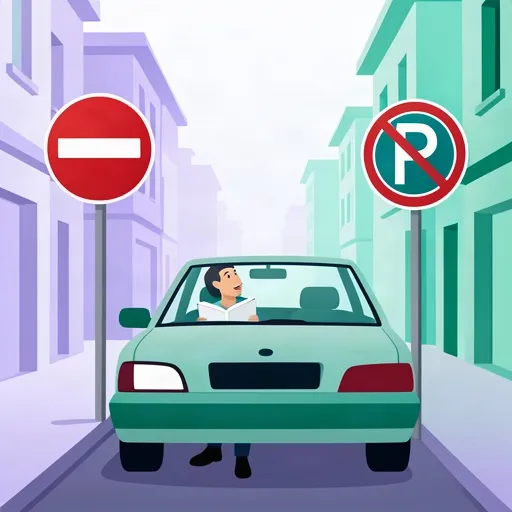
To excel in the MTSK e-sınav, you must pay close attention to the specific visual elements of the Trafik Tanzim İşaretleri. Prohibitory signs are typically circular with a red border. When you see a red circle with a horizontal white bar, it is an absolute prohibition of entry. Do not search for exceptions or "if-then" conditions in your head; for the purpose of the exam, it is a closed zone.
When the exam features questions about the "No Parking" sign, look for secondary symbols. Sometimes these signs include time intervals or arrows pointing in specific directions. Recognizing these extra details ensures you aren't fooled by general knowledge and instead apply the specific regulatory logic required by the Karayolları Trafik Yönetmeliği.
This guide distinguishes between No Entry (B-44) signs, which prohibit all vehicle access to a road segment, and No Parking (B-39) signs, which restrict long-term vehicle stationing while potentially allowing brief stopping for passenger transit or goods loading. The critical distinction lies in understanding duraklama (temporary stopping) versus park etmek (long-term parking) under Turkish traffic law, as this nuance frequently appears in MTSK e-sınav questions. Learners should always check for secondary plates indicating time restrictions or directional limitations, and remember that for exam purposes, circular red-bordered prohibition signs carry absolute legal force with no exceptions.
A short set of high-value points that capture the most important ideas from this article.
No Entry signs (B-44) prohibit all vehicle access to a road or zone, requiring an alternative route
No Parking signs (B-39) restrict long-term vehicle stationing but may still allow brief stopping for passenger transit
Turkish traffic law distinguishes between duraklama (temporary stopping) and park etmek (long-term parking) as separate legal concepts
Sign shape and color patterns indicate the category of restriction: circular red-bordered signs always signal a regulation or prohibition
Secondary plates with time intervals or arrows on parking signs are frequently tested details in the MTSK e-sınav
No Entry = access prohibition; No Parking = stationing prohibition — these are fundamentally different restriction categories
Duraklama (stopping) is permitted under a No Parking sign unless a No Stopping restriction is explicitly posted
A red circle with a horizontal white bar means absolute prohibition of entry — no exceptions apply for exam purposes
Many No Parking signs in Turkey are only active during specific hours or days, indicated by secondary plates
Signs always override standard road rules when they contradict them in Turkish traffic law
Assuming a No Parking sign prohibits all stopping, including brief duraklama for passenger boarding
Confusing No Entry signs with mandatory direction signs (Mecburi İstikamet) due to similar appearances
Ignoring secondary time plates or directional arrows that modify when or where parking restrictions apply
Failing to differentiate between parking prohibition and stopping prohibition when answering scenario-based questions
Searching for exceptions to absolute prohibition signs when the exam requires a strict interpretation
Article content overview
A short set of high-value points that capture the most important ideas from this article.
No Entry signs (B-44) prohibit all vehicle access to a road or zone, requiring an alternative route
No Parking signs (B-39) restrict long-term vehicle stationing but may still allow brief stopping for passenger transit
Turkish traffic law distinguishes between duraklama (temporary stopping) and park etmek (long-term parking) as separate legal concepts
Sign shape and color patterns indicate the category of restriction: circular red-bordered signs always signal a regulation or prohibition
Secondary plates with time intervals or arrows on parking signs are frequently tested details in the MTSK e-sınav
No Entry = access prohibition; No Parking = stationing prohibition — these are fundamentally different restriction categories
Duraklama (stopping) is permitted under a No Parking sign unless a No Stopping restriction is explicitly posted
A red circle with a horizontal white bar means absolute prohibition of entry — no exceptions apply for exam purposes
Many No Parking signs in Turkey are only active during specific hours or days, indicated by secondary plates
Signs always override standard road rules when they contradict them in Turkish traffic law
Assuming a No Parking sign prohibits all stopping, including brief duraklama for passenger boarding
Confusing No Entry signs with mandatory direction signs (Mecburi İstikamet) due to similar appearances
Ignoring secondary time plates or directional arrows that modify when or where parking restrictions apply
Failing to differentiate between parking prohibition and stopping prohibition when answering scenario-based questions
Searching for exceptions to absolute prohibition signs when the exam requires a strict interpretation
Explore related topics, search based questions, and concepts that learners often look up when studying No Entry vs No Parking Signs. These themes reflect real search intent and help you understand how this topic connects to wider driving theory knowledge in Turkey.
Find clear and practical answers to common questions learners often have about No Entry vs No Parking Signs. This section helps explain difficult points, remove confusion, and reinforce the key driving theory concepts that matter for learners in Turkey.
A 'No Entry' sign prohibits the physical passage of a vehicle into a specific road or area, whereas a 'No Parking' sign allows you to pass through but restricts your ability to leave the vehicle stationary for extended periods.
Not necessarily. 'No Parking' (Park Yapılmaz) generally allows for short-term loading and unloading, provided you remain with the vehicle, whereas 'No Stopping and No Parking' (Duraklama ve Park Etme Yasaktır) prohibits any form of stationary vehicle presence.
Exam questions often present scenarios where a driver must decide whether they are permitted to enter a street or stop at the curb; confusing these signs leads to incorrect answers regarding traffic flow and legal compliance.
The official meanings and legal standing for all traffic signs in Turkey are established under the Karayolları Trafik Yönetmeliği (Highway Traffic Regulation).
After finding the specific Turkish driving theory articles you need, dive deeper into related topics or challenge your knowledge with practice questions. Enhance your understanding of trafik işaretleri, road rules, and vehicle safety to ensure you are fully prepared for the official ehliyet sınavı.