Understanding the specific nuances of prohibition signs is essential for both safe driving and passing your Turkish driving license theory exam. This article explores the legal definitions and conditions behind no-overtaking and no-parking mandates, ensuring you can interpret road signs accurately under pressure. Gain the theoretical confidence needed to identify these restrictions and avoid the common pitfalls that candidates often face during the official assessment.
Article content overview
Mastering the various traffic prohibition signs is a cornerstone of preparing for the Turkish MTSK e-sınav. In the Turkish driving theory curriculum, prohibition signs are represented by circular borders, often with a red surround, signaling specific actions that are strictly forbidden. Understanding the legal nuances between "No Overtaking" and "No Parking" is not just about passing the exam; it is essential for maintaining safety and order on Turkish roads.
In Turkish traffic law, overtaking regulations are designed to prevent accidents on high-risk stretches of road. A common point of confusion for students involves distinguishing between signs that prohibit overtaking for all vehicles versus those that target specific categories, such as heavy goods vehicles.
When you encounter this sign in a testing scenario, remember that the prohibition applies to the entire stretch of road until the next intersection or until a cancellation sign is reached. A frequent exam trap involves questions about whether you can pass a tractor or a bicycle. Under Turkish legislation, overtaking a two-wheeled vehicle that does not have a sidecar is permitted even when this sign is present, provided it can be done safely.
The distinction between stopping and parking is a recurring theme in MTSK e-sınav questions. While "stopping" refers to a temporary pause for loading/unloading or passenger movement, "parking" implies a longer duration of leaving the vehicle unattended or stationary.
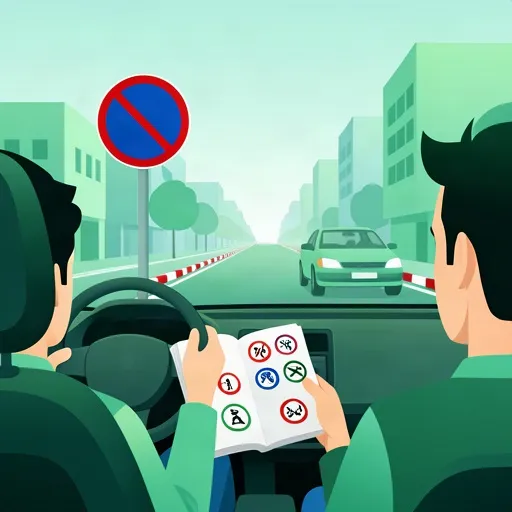
The primary confusion for candidates arises when they fail to differentiate between B39 and B40. In the theory exam, look closely at the interior of the sign. A single red diagonal line represents a 'No Parking' zone, while the crossed red lines (an 'X') indicate that even a momentary stop is a violation of traffic law.
To clarify these concepts for your study sessions, consider how these signs function in different urban and rural environments across Türkiye.
| Sign Meaning | Scope of Restriction | Exam Application |
|---|---|---|
| No Overtaking | Prohibits passing other cars | Focuses on road safety and passing motor vehicles |
| No Parking | Prohibits stationary storage | Allows for immediate loading/unloading |
| No Stopping/Parking | Total prohibition | Tests knowledge of critical traffic flow zones |
A significant portion of exam failures stems from misinterpreting the duration and scope of these prohibitions. For example, many candidates incorrectly assume that the presence of a sign only applies to the immediate point of the sign; in reality, these restrictions continue until the next intersection or until a sign indicating the end of the restriction is encountered.
Turkish prohibition signs use red circular borders to signal forbidden actions, with the interior symbol indicating the specific restriction type. The No Overtaking sign (B26) prohibits passing motor vehicles but allows overtaking two-wheeled mopeds and motorcycles without sidecars. No Parking (B39) permits brief stops for passenger movement, while No Stopping/Parking (B40) prohibits any pause except emergencies. These restrictions apply along the full road stretch until a cancellation sign or the next intersection, and road markings can independently reinforce the same rules. In the MTSK e-sınav, carefully observe the interior symbol pattern to distinguish B39 from B40 and note whether supplemental plates modify the sign's scope.
A short set of high-value points that capture the most important ideas from this article.
No Overtaking (B26) prohibits passing motor vehicles but two-wheeled mopeds and motorcycles without sidecars are excepted if done safely
Prohibition signs apply to the full road stretch until the next intersection or a cancellation sign, not just the immediate sign location
No Parking (B39) forbids longer-term vehicle storage but permits brief stops for passenger loading/unloading that do not obstruct traffic
No Stopping/Parking (B40) with crossed red lines prohibits even momentary stops except in genuine emergencies
Road markings like solid white center lines legally reinforce No Overtaking rules even when no sign is visible
B39 with a single red diagonal line means No Parking only; B40 with crossed red X lines means No Stopping and No Parking
A "stop" is a temporary pause; "parking" means leaving the vehicle stationary for a duration beyond immediate boarding needs
Check supplemental plates below signs for time limits, vehicle type restrictions, or other conditions
Two-wheeled mopeds and motorcycles without sidecars are not subject to the No Overtaking prohibition
The restriction zone begins at the sign and continues until explicitly cancelled, regardless of intersections passed
Assuming prohibition signs only apply at the exact point of the sign rather than along the entire stretch until cancelled
Confusing B39 and B40 by misreading the interior line pattern (single diagonal vs crossed X)
Believing the No Overtaking sign prohibits passing bicycles or tractors, which are not motor vehicles
Interpreting No Parking as prohibiting all stops including brief passenger pick-ups, which B39 actually allows
Overlooking road markings that independently establish prohibition rules without a visible sign
Article content overview
A short set of high-value points that capture the most important ideas from this article.
No Overtaking (B26) prohibits passing motor vehicles but two-wheeled mopeds and motorcycles without sidecars are excepted if done safely
Prohibition signs apply to the full road stretch until the next intersection or a cancellation sign, not just the immediate sign location
No Parking (B39) forbids longer-term vehicle storage but permits brief stops for passenger loading/unloading that do not obstruct traffic
No Stopping/Parking (B40) with crossed red lines prohibits even momentary stops except in genuine emergencies
Road markings like solid white center lines legally reinforce No Overtaking rules even when no sign is visible
B39 with a single red diagonal line means No Parking only; B40 with crossed red X lines means No Stopping and No Parking
A "stop" is a temporary pause; "parking" means leaving the vehicle stationary for a duration beyond immediate boarding needs
Check supplemental plates below signs for time limits, vehicle type restrictions, or other conditions
Two-wheeled mopeds and motorcycles without sidecars are not subject to the No Overtaking prohibition
The restriction zone begins at the sign and continues until explicitly cancelled, regardless of intersections passed
Assuming prohibition signs only apply at the exact point of the sign rather than along the entire stretch until cancelled
Confusing B39 and B40 by misreading the interior line pattern (single diagonal vs crossed X)
Believing the No Overtaking sign prohibits passing bicycles or tractors, which are not motor vehicles
Interpreting No Parking as prohibiting all stops including brief passenger pick-ups, which B39 actually allows
Overlooking road markings that independently establish prohibition rules without a visible sign
Explore related topics, search based questions, and concepts that learners often look up when studying Prohibition Signs and Parking Rules. These themes reflect real search intent and help you understand how this topic connects to wider driving theory knowledge in Turkey.
Find clear and practical answers to common questions learners often have about Prohibition Signs and Parking Rules. This section helps explain difficult points, remove confusion, and reinforce the key driving theory concepts that matter for learners in Turkey.
A 'No Parking' (Park Yapılmaz) sign prohibits parking the vehicle for any duration, whereas a 'No Stopping' (Duraklamak ve Park Etmek Yasaktır) sign prohibits both stopping and parking, except for immediate loading or unloading of passengers.
The 'No Overtaking' (Öndeki Taşıtı Geçmek Yasaktır) sign generally prohibits motor vehicles from overtaking other motor vehicles, with the exception of two-wheeled motorcycles and mopeds under specific conditions, as dictated by Turkish traffic legislation.
Carefully read the question to identify if it refers to a specific road environment, such as a tunnel or narrow bridge, as these often have pre-existing restrictions that supersede or complement standard sign rules.
Unless indicated by an additional panel sign showing the distance, prohibition signs generally apply from the point they are placed until the next intersection or until an end-of-restriction sign is reached.
After finding the specific Turkish driving theory articles you need, dive deeper into related topics or challenge your knowledge with practice questions. Enhance your understanding of trafik işaretleri, road rules, and vehicle safety to ensure you are fully prepared for the official ehliyet sınavı.