Understanding how to determine priority at intersections without signs or signals is a fundamental requirement for every driver in Turkey. This guide breaks down the legal priority order, focusing on major road status versus minor roads and the correct application of the right-hand rule. By mastering these concepts, you will build the confidence needed to handle unpredictable urban traffic and successfully answer theory test questions.
Article content overview
Navigating intersections in Turkey without traffic lights or road signs is a common challenge for new drivers. These areas are legally classified as "unmarked" or uncontrolled intersections, where the responsibility for safety falls entirely on the drivers' knowledge of the Highway Traffic Law. Mastering these rules is not only vital for passing your MTSK e-sınav but is also a critical defensive driving skill to prevent accidents in busy urban environments.
The most important concept to grasp for the Turkish driving theory exam is that traffic priority is determined by a clear hierarchy. Before applying general rules, you must always look for regulatory signage. If no signs or signals exist, the road status itself determines who goes first.
An intersection where there are no traffic signals, traffic police officers, or traffic signs (such as 'Yield' or 'Stop' signs) to regulate the flow of vehicles.
In Turkish traffic legislation, vehicles traveling on a main road or a paved road always have priority over those coming from a secondary or stabilized (gravel) road. This rule applies regardless of which side the other vehicle is approaching from. If you are entering a major road from a minor one, you must yield to all traffic already present on the primary route.
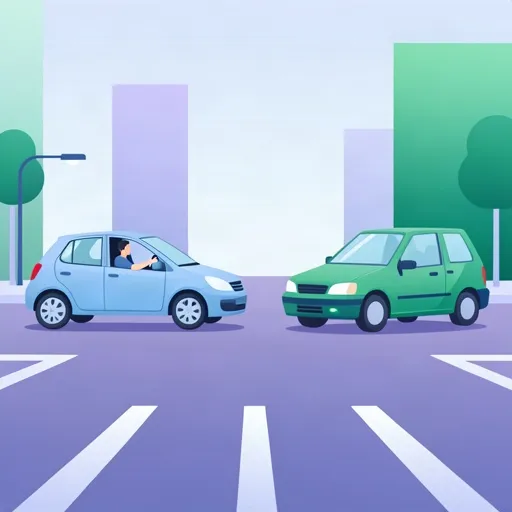
When two vehicles arrive at an intersection of equal status—meaning both roads are of the same type and no signs indicate otherwise—the standard "Right-Hand Rule" applies. According to this rule, the driver must yield to the vehicle approaching from their right side.
Common Exam Trap: Learners often assume that large vehicles like buses or trucks have automatic priority at intersections. In Turkey, vehicle size does not grant priority. You must follow the same right-of-way rules for all vehicles, including heavy goods vehicles, unless they are emergency vehicles on official duty.
Understanding how these rules manifest in real-world driving is essential for answering MTSK exam questions correctly. You might face scenarios involving turning vehicles, where the logic of priority can be slightly more complex.
When two vehicles are at an intersection and both intend to turn left, they should generally pass behind each other to avoid blocking the intersection. If a vehicle is turning right, it usually has priority over a vehicle turning left, provided they are on the same road hierarchy.
| Scenario | Priority Rule |
|---|---|
| Emergency vehicle present | Always the highest priority |
| Major road vs Minor road | Minor road must yield |
| Equal status roads | Yield to the vehicle on the right |
| Turning vehicle | Yield to oncoming traffic going straight |
The MTSK e-exam frequently uses animated or static images of intersections to test your ability to apply these laws instantly. If you encounter a question where two vehicles are at an unmarked intersection of equal status, look for the vehicle on the right. If the image depicts one vehicle on a stabilized road and the other on asphalt, always prioritize the asphalt road.
At uncontrolled intersections in Turkey, drivers must follow a specific priority hierarchy: first check for signs, then determine if one road is a main road (anayol) versus a secondary road (tali yol), and finally apply the right-hand rule only when both roads are equal. The right-hand rule requires yielding to the vehicle on your right, but this only applies when road status is identical. A critical exam point is that vehicle size never grants priority—buses and trucks follow the same rules as any other vehicle. Emergency vehicles with active sirens and lights always have absolute priority, trumping all other rules.
A short set of high-value points that capture the most important ideas from this article.
Priority hierarchy at uncontrolled intersections: check for signs first, then road type, then apply the right-hand rule for equal roads
Vehicles on a main road (asphalt/anayol) always have priority over vehicles entering from a secondary or stabilized road (tali yol)
When two roads are equal in status, the driver must yield to the vehicle approaching from their right side
Vehicle size does not grant priority; buses, trucks, and cars follow identical right-of-way rules
Emergency vehicles with active sirens and lights have absolute priority regardless of any other rule
Main road (anayol) vs. minor road (tali yol) determines priority when signs are absent
Right-hand rule applies only when both roads have equal status (both paved or both gravel)
First check for Yield/Stop signs before applying road hierarchy or right-hand rules
Large vehicles like buses and trucks do not have automatic priority at intersections
Emergency vehicles on official duty override all other priority rules
Assuming that large vehicles such as buses or trucks have inherent priority at intersections due to their size
Applying the right-hand rule when one road is clearly a main road and the other is a secondary road
Forgetting to check for emergency vehicles before determining other priority rules
Confusing left-turn priority rules, especially when both vehicles are turning in the same direction
Believing that approaching from the right always grants priority, without first assessing road status
Article content overview
A short set of high-value points that capture the most important ideas from this article.
Priority hierarchy at uncontrolled intersections: check for signs first, then road type, then apply the right-hand rule for equal roads
Vehicles on a main road (asphalt/anayol) always have priority over vehicles entering from a secondary or stabilized road (tali yol)
When two roads are equal in status, the driver must yield to the vehicle approaching from their right side
Vehicle size does not grant priority; buses, trucks, and cars follow identical right-of-way rules
Emergency vehicles with active sirens and lights have absolute priority regardless of any other rule
Main road (anayol) vs. minor road (tali yol) determines priority when signs are absent
Right-hand rule applies only when both roads have equal status (both paved or both gravel)
First check for Yield/Stop signs before applying road hierarchy or right-hand rules
Large vehicles like buses and trucks do not have automatic priority at intersections
Emergency vehicles on official duty override all other priority rules
Assuming that large vehicles such as buses or trucks have inherent priority at intersections due to their size
Applying the right-hand rule when one road is clearly a main road and the other is a secondary road
Forgetting to check for emergency vehicles before determining other priority rules
Confusing left-turn priority rules, especially when both vehicles are turning in the same direction
Believing that approaching from the right always grants priority, without first assessing road status
Explore related topics, search based questions, and concepts that learners often look up when studying Uncontrolled Intersection Priority Rules. These themes reflect real search intent and help you understand how this topic connects to wider driving theory knowledge in Turkey.
Find clear and practical answers to common questions learners often have about Uncontrolled Intersection Priority Rules. This section helps explain difficult points, remove confusion, and reinforce the key driving theory concepts that matter for learners in Turkey.
An uncontrolled intersection is a junction where there are no traffic lights, stop signs, or yield signs to regulate the flow of traffic.
In Turkey, drivers must generally yield to traffic approaching from the right. Additionally, vehicles on minor or secondary roads must always yield to traffic on major or arterial roads.
No, specific emergency vehicles with sirens and warning lights active have absolute priority over all other traffic, regardless of the intersection rules.
The exam often presents scenario-based questions where you must identify the correct order of vehicle movement at a junction based on their position and the road type.
After finding the specific Turkish driving theory articles you need, dive deeper into related topics or challenge your knowledge with practice questions. Enhance your understanding of trafik işaretleri, road rules, and vehicle safety to ensure you are fully prepared for the official ehliyet sınavı.