
Commercial delivery vehicles frequently create hidden dangers by obstructing visibility at pedestrian crossings and intersections, often in violation of the Turkish Highway Traffic Law. This guide explores the defensive driving techniques required to identify these risks and anticipate the movement of vulnerable road users like pedestrians and cyclists. You will learn how to apply legal knowledge of stopping and parking regulations to navigate complex urban environments safely.
Article content overview
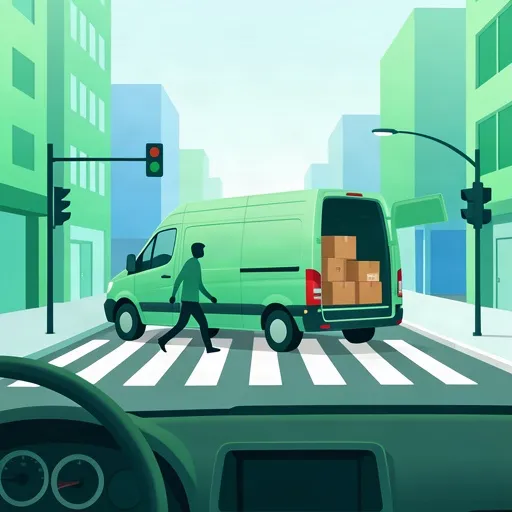
This article covers the critical skill of hazard perception when encountering delivery vans in Turkish urban traffic, focusing on blind spot scenarios created by illegally parked commercial vehicles near pedestrian crossings and intersections. The key defensive driving principle is that you must anticipate pedestrians or cyclists emerging from behind obstructions, even when the delivery vehicle itself is in violation of parking rules. The Turkish Highway Traffic Law (Karayolları Trafik Kanunu) requires all drivers to maintain speeds allowing emergency stops when visibility is compromised. A five-step defensive procedure—scanning, slowing, assuming sudden movement, increasing following distance, and using the horn cautiously—provides a systematic approach for both the MTSK e-sınav and real-world driving. The most dangerous error is attempting to overtake large vehicles at intersections where sight lines are blocked, as this eliminates your ability to detect oncoming traffic or pedestrians.
A short set of high-value points that capture the most important ideas from this article.
Delivery vans blocking pedestrian crossings and intersections create blind spot hazards where pedestrians may emerge suddenly without warning
Even when a delivery driver violates parking regulations, you remain legally and ethically responsible for avoiding a collision
The law prohibits stopping or parking in locations that obscure traffic signs or pedestrian pathways regardless of commercial necessity
Reducing speed when approaching obstructed intersections allows sufficient reaction time for hidden hazards like cyclists or children
Never overtake a large vehicle at an intersection where your view of oncoming traffic is blocked
Commercial necessity does not exempt delivery drivers from traffic safety regulations under Turkish law
When a van blocks a crossing, treat it as if a pedestrian could appear at any moment
Defensive driving means anticipating violations by others, not assuming they will follow the rules
Keep increased following distance when driving behind obstructing vans to allow for sudden maneuvers
The No Stopping or Parking sign (TT-28) means complete prohibition, not just long-term parking
Assuming that because a delivery van is stationary it poses no immediate hazard to other road users
Believing commercial vehicles have special parking privileges that excuse sight-line obstructions
Attempting to overtake large vehicles near intersections without verifying the opposite lane is clear
Maintaining normal speed when approaching crossings obscured by parked delivery vehicles
Failing to increase lateral distance when passing a van that is double-parked at a corner
Article content overview
A short set of high-value points that capture the most important ideas from this article.
Delivery vans blocking pedestrian crossings and intersections create blind spot hazards where pedestrians may emerge suddenly without warning
Even when a delivery driver violates parking regulations, you remain legally and ethically responsible for avoiding a collision
The law prohibits stopping or parking in locations that obscure traffic signs or pedestrian pathways regardless of commercial necessity
Reducing speed when approaching obstructed intersections allows sufficient reaction time for hidden hazards like cyclists or children
Never overtake a large vehicle at an intersection where your view of oncoming traffic is blocked
Commercial necessity does not exempt delivery drivers from traffic safety regulations under Turkish law
When a van blocks a crossing, treat it as if a pedestrian could appear at any moment
Defensive driving means anticipating violations by others, not assuming they will follow the rules
Keep increased following distance when driving behind obstructing vans to allow for sudden maneuvers
The No Stopping or Parking sign (TT-28) means complete prohibition, not just long-term parking
Assuming that because a delivery van is stationary it poses no immediate hazard to other road users
Believing commercial vehicles have special parking privileges that excuse sight-line obstructions
Attempting to overtake large vehicles near intersections without verifying the opposite lane is clear
Maintaining normal speed when approaching crossings obscured by parked delivery vehicles
Failing to increase lateral distance when passing a van that is double-parked at a corner
Explore related topics, search based questions, and concepts that learners often look up when studying Navigating Delivery Vans in Turkey. These themes reflect real search intent and help you understand how this topic connects to wider driving theory knowledge in Turkey.
Find clear and practical answers to common questions learners often have about Navigating Delivery Vans in Turkey. This section helps explain difficult points, remove confusion, and reinforce the key driving theory concepts that matter for learners in Turkey.
No, commercial loading or unloading does not grant immunity from traffic laws. Delivery vehicles must not obstruct traffic flow or sight lines at intersections and pedestrian crossings.
The primary hazard is that the van obscures your view of pedestrians, especially children, who might step into the road suddenly from behind the vehicle.
You must treat the situation with extreme caution. Reduce your speed significantly and be prepared to stop instantly, as you cannot verify if a vehicle or pedestrian is approaching from the obstructed area.
After finding the specific Turkish driving theory articles you need, dive deeper into related topics or challenge your knowledge with practice questions. Enhance your understanding of trafik işaretleri, road rules, and vehicle safety to ensure you are fully prepared for the official ehliyet sınavı.