
Learn the official Turkish traffic regulations regarding roundabout entry, lane positioning, and the critical importance of yielding to pedestrians and motorcyclists. This guide clarifies how to behave at circular junctions to avoid common exam traps and ensure you maintain legal compliance throughout the MTSK e-sınav process.
Article content overview
Mastering the rules of roundabouts is a cornerstone of the Turkish driving theory exam (MTSK e-sınav). Circular intersections are designed to improve traffic flow, but they frequently become sites of confusion and potential accidents if drivers do not strictly adhere to traffic laws. In Turkey, navigation at roundabouts requires a clear understanding of priority, lane discipline, and the heightened responsibility one holds toward vulnerable road users, such as motorcyclists and pedestrians.
The fundamental rule at any roundabout in Turkey is that traffic already circulating within the junction possesses priority over traffic attempting to enter. When approaching a circular intersection, you must reduce your speed and observe the traffic flow. If a vehicle is already inside the roundabout, you must wait at the entrance, often marked by a "Give Way" sign or specific road markings, until there is a safe gap to merge.
Failure to yield to traffic already within the roundabout is one of the most common reasons for errors in the MTSK e-sınav. Many exam questions present scenarios where a driver enters the junction without verifying that the way is clear, leading to a collision with a vehicle that had the legal right of way. Always treat the entry point as a location requiring full vigilance.
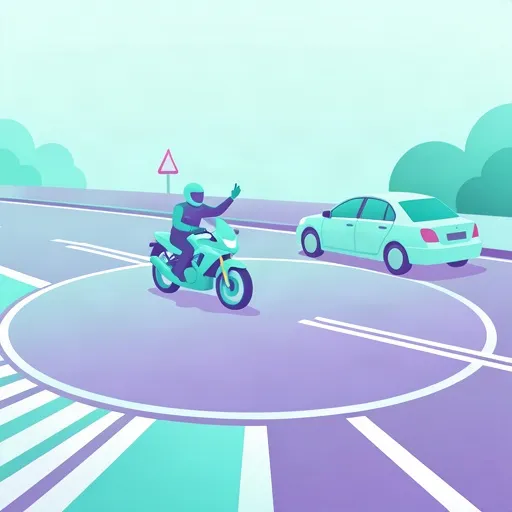
Motorcyclists and pedestrians are the most at-risk groups at circular intersections. Because roundabouts often involve multiple entry and exit points, the visual field is complex. Drivers must use their mirrors and perform shoulder checks specifically to identify two-wheeled vehicles that may be filtering through traffic or occupying a blind spot.
Always be aware that motorcyclists may be positioned closer to the edge or the center of the lane than a standard car. Never attempt to overtake a motorcycle while within the roundabout; maintain your lane and distance until you have safely exited the intersection.
Pedestrians crossing at or near roundabouts also demand your full attention. Even if a pedestrian is not at a marked crosswalk, if they have entered the road, they may have right-of-way considerations depending on the local layout. Always scan the exits of the roundabout for pedestrians who may be crossing the street you are about to enter.
Proper lane positioning is vital for a smooth transition through a roundabout. If the roundabout has multiple lanes, you must choose your lane based on your intended exit. Generally, for the first or second exit (right or straight), you should remain in the outer lane. For exits to the left or full U-turns, you should use the inner lane, ensuring you signal your intention clearly to other drivers.
The Turkish theory exam often tests your knowledge of how to handle signals and lane changes. A common trap involves assuming that just because you are in a "priority" position, you do not need to look for motorcycles. In the eyes of the law, every driver has a duty of care to prevent an accident, regardless of who technically has the right of way.
| Situation | Action Required |
|---|---|
| Entering Roundabout | Yield to traffic inside, signal if necessary. |
| Exiting Roundabout | Signal right immediately after passing the exit before yours. |
| Lane Change | Mirror check, shoulder check, signal, and maneuver. |
| Pedestrians | Always yield if they have started crossing the road. |
This article covers the essential Turkish traffic regulations for navigating roundabouts, emphasizing that circulating traffic always has priority and that drivers must yield at entry points marked by Give Way signs. It highlights the heightened responsibility toward vulnerable road users, particularly motorcyclists who may occupy unconventional lane positions and pedestrians crossing near exits. Proper lane discipline based on your intended exit and correct signaling at both entry and exit are critical for both exam success and road safety. The step-by-step procedure provided serves as a practical checklist for safe roundabout navigation in Turkey.
A short set of high-value points that capture the most important ideas from this article.
Traffic already circulating inside a roundabout always has priority over vehicles attempting to enter
Motorcyclists may be positioned near lane edges or the center, making dedicated mirror and shoulder checks essential
Choose your lane before entering based on your intended exit: outer lane for right/straight, inner lane for left or U-turn
Drivers bear a duty of care to prevent accidents regardless of who technically holds right-of-way
Always signal when entering and exiting a roundabout to communicate your intentions to other road users
Yield signs at roundabout entries require full vigilance before merging into circulating traffic
Never overtake a motorcycle while inside the roundabout; maintain your lane until you exit
Signal right immediately after passing the exit before yours when leaving the roundabout
Pedestrians may have right-of-way at roundabout exits even outside marked crosswalks if they have entered the road
Perform shoulder checks specifically to detect motorcycles that may be in your blind spot
Entering a roundabout without verifying that circulating traffic has cleared the junction
Assuming that having priority means you do not need to actively look for motorcycles
Selecting the wrong lane based on your intended exit and then attempting to cut across lanes
Failing to signal when exiting, leaving following traffic uncertain about your intentions
Not reducing speed sufficiently before reaching the roundabout entry point
Article content overview
A short set of high-value points that capture the most important ideas from this article.
Traffic already circulating inside a roundabout always has priority over vehicles attempting to enter
Motorcyclists may be positioned near lane edges or the center, making dedicated mirror and shoulder checks essential
Choose your lane before entering based on your intended exit: outer lane for right/straight, inner lane for left or U-turn
Drivers bear a duty of care to prevent accidents regardless of who technically holds right-of-way
Always signal when entering and exiting a roundabout to communicate your intentions to other road users
Yield signs at roundabout entries require full vigilance before merging into circulating traffic
Never overtake a motorcycle while inside the roundabout; maintain your lane until you exit
Signal right immediately after passing the exit before yours when leaving the roundabout
Pedestrians may have right-of-way at roundabout exits even outside marked crosswalks if they have entered the road
Perform shoulder checks specifically to detect motorcycles that may be in your blind spot
Entering a roundabout without verifying that circulating traffic has cleared the junction
Assuming that having priority means you do not need to actively look for motorcycles
Selecting the wrong lane based on your intended exit and then attempting to cut across lanes
Failing to signal when exiting, leaving following traffic uncertain about your intentions
Not reducing speed sufficiently before reaching the roundabout entry point
Explore related topics, search based questions, and concepts that learners often look up when studying Roundabout Rules for Turkey. These themes reflect real search intent and help you understand how this topic connects to wider driving theory knowledge in Turkey.
Find clear and practical answers to common questions learners often have about Roundabout Rules for Turkey. This section helps explain difficult points, remove confusion, and reinforce the key driving theory concepts that matter for learners in Turkey.
No, vehicles already circulating inside the roundabout generally have priority over those attempting to enter, unless traffic signs specifically indicate otherwise.
Yes, you must always yield to pedestrians crossing at designated crossings or where they have priority, especially when exiting a roundabout.
Motorcyclists are vulnerable road users; you must maintain sufficient lateral distance, avoid cutting them off, and be extra vigilant as they may be harder to see in your blind spots while turning.
Yes, you must use your right turn signal as you approach your intended exit to inform other road users of your movement.
After finding the specific Turkish driving theory articles you need, dive deeper into related topics or challenge your knowledge with practice questions. Enhance your understanding of trafik işaretleri, road rules, and vehicle safety to ensure you are fully prepared for the official ehliyet sınavı.