Understanding where you are legally permitted to park is a fundamental skill for every driver in Turkey. This guide breaks down the specific distances mandated by law for stopping near junctions, bus stops, and crossings, helping you distinguish between permissible short-term stops and prohibited parking scenarios that often appear as trick questions on the official theory exam.
Article content overview
Understanding where you are legally permitted to park is a fundamental skill for every driver in Turkey. Whether you are navigating dense urban environments or driving on rural roads, the rules governing parking and stopping are strictly enforced to maintain traffic flow and ensure pedestrian safety. For candidates preparing for the MTSK e-sınav, distinguishing between permissible short-term stops and prohibited parking zones is essential, as these scenarios frequently appear in trick questions that challenge your knowledge of Turkish road law.
Under Turkish traffic legislation, it is vital to clarify the difference between "stopping" (duraklama) and "parking" (park etme). Stopping is defined as the temporary immobilization of a vehicle for the purpose of passenger boarding or luggage loading, provided the driver remains at the wheel and the duration is as short as possible. Parking, conversely, refers to the immobilization of a vehicle for a period longer than what is required for immediate passenger transfer or when the driver leaves the vehicle unattended.
The intentional immobilization of a vehicle for a duration no longer than is necessary for passenger boarding/alighting or loading/unloading luggage, with the driver present.
The immobilization of a vehicle for a period exceeding what is necessary for immediate boarding or loading, or any duration where the vehicle is left unattended.
One of the most common topics in the Turkish driving theory exam involves distance requirements near intersections. To prevent visual obstructions and ensure safe turning maneuvers for larger vehicles, law prohibits parking within 5 meters of a junction. This distance is measured from the point where the curbs of the intersecting roads begin to curve. Failing to respect this buffer zone is a frequent cause of accidents, as it obscures the line of sight for drivers attempting to merge into or cross the traffic flow.
When you encounter questions on the MTSK e-sınav regarding these distances, remember that the restriction applies to the "intersection area." If you park too close to the corner, you are not only violating traffic rules but also creating a significant hazard for cyclists and pedestrians who need to cross the street safely.
Public transport priority is a cornerstone of Turkish traffic etiquette. Parking or even stopping at a marked bus stop is strictly prohibited unless you are a public transport vehicle currently in operation. The regulation extends 15 meters in front of and behind the bus stop sign. This rule ensures that buses can pull flush to the curb, allowing passengers to enter and exit safely without having to step directly into the flow of traffic.
Many exam questions try to trick you by asking if you can "stop" at a bus stop to pick up a friend. In Turkey, the answer is no. Unless otherwise marked or permitted, the bus stop area is a strictly prohibited zone for private vehicles.
To help you categorize these rules for your study sessions, the following table summarizes the minimum required distances for parking near various traffic infrastructure points.
| Location Type | Prohibited Distance |
|---|---|
| Intersection/Junction | 5 meters |
| Bus/Tram Stop | 15 meters |
| Pedestrian Crossing | 5 meters |
| Fire Hydrant Access | 5 meters |
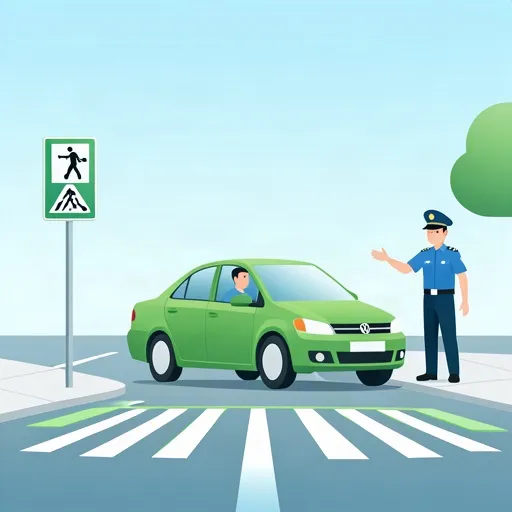
The Turkish theory exam often uses scenarios to test if you understand the "why" behind the law. You might be presented with an image of a road and asked to identify which vehicle is parked illegally. Common traps include vehicles parked right at the edge of a pedestrian crossing or within the 5-meter exclusion zone of a junction. Always look for the presence of road markings, such as yellow-black curb paint or "No Parking" signs, which further clarify these restrictions in high-density areas.
Article content overview
Explore related topics, search based questions, and concepts that learners often look up when studying Turkish Parking and Stopping Rules. These themes reflect real search intent and help you understand how this topic connects to wider driving theory knowledge in Turkey.
Find clear and practical answers to common questions learners often have about Turkish Parking and Stopping Rules. This section helps explain difficult points, remove confusion, and reinforce the key driving theory concepts that matter for learners in Turkey.
According to Turkish traffic legislation, parking is prohibited within 5 meters of an intersection or corner.
You are generally prohibited from parking at bus stops; however, stopping for the immediate loading or unloading of passengers is allowed, provided you do not obstruct public transport or cause a hazard.
In the exam, 'stopping' is defined as the temporary cessation of movement for passenger or cargo operations, while 'parking' is leaving the vehicle stationary for a longer duration. Prohibitions are stricter for parking than for temporary stopping.
No, parking is prohibited on or within 5 meters of pedestrian or school crossings to ensure visibility and safety for those using the crossing.
After finding the specific Turkish driving theory articles you need, dive deeper into related topics or challenge your knowledge with practice questions. Enhance your understanding of trafik işaretleri, road rules, and vehicle safety to ensure you are fully prepared for the official ehliyet sınavı.