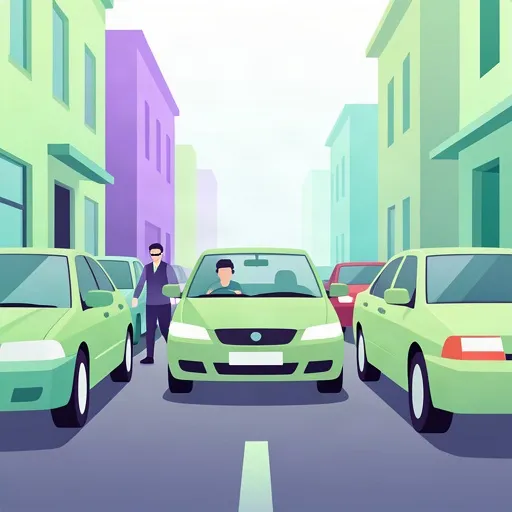
Drivers in Türkiye must remain acutely aware of the dangers posed by pedestrians emerging from between parked cars in crowded urban and residential environments. This guide explains how to apply defensive driving principles to minimize risks and ensure compliance with Turkish traffic regulations. You will learn the necessary speed management techniques and proactive observation skills required to handle these unpredictable road situations safely.
Article content overview
Driving in Turkish residential neighborhoods presents a unique set of challenges that every learner must master for the MTSK e-sınav. Among the most frequent hazard awareness scenarios is the sudden appearance of pedestrians—often children or elderly individuals—stepping into the road from between parked cars. Because visibility is severely restricted in these environments, failing to anticipate these movements is a common cause of accidents and a frequent trap in the Turkish driving theory exam.
In Turkish urban traffic, residential streets are often lined with cars parked on both sides, creating a "canyon" effect that hides potential hazards. Defensive driving requires you to constantly scan the gaps between these vehicles. As a driver, you must operate under the assumption that a pedestrian could enter the road at any moment, even if you do not see them initially. Adjusting your speed to a level that allows for an immediate, controlled stop is not just a suggestion; it is a fundamental pillar of Turkish traffic legislation and the primary expectation of theory examiners.
According to the Turkish traffic rules, drivers are legally obligated to prioritize the safety of vulnerable road users. When driving through narrow streets or areas with high pedestrian activity, you must maintain a speed that is significantly lower than the general urban limit. Even if the speed limit sign indicates a higher speed, local traffic conditions—such as restricted visibility due to parked cars—mandate that you slow down.
The Turkish theory exam often tests your ability to identify environmental clues that signal danger. For instance, if you see a ball rolling into the street, a parked car with its lights on, or a delivery vehicle stopped on the side of the road, these are "active" indicators that a pedestrian may be nearby. You must be prepared to brake proactively rather than reactively.
In the hazard awareness section of the Turkish driving license theory exam, you will likely encounter animated scenarios requiring you to identify risks before they escalate into collisions. Questions often focus on your reaction time and your ability to choose the correct defensive action. You will be evaluated on your decision-making process: did you scan the gaps between cars, did you reduce your speed early enough, and did you maintain a safe lateral distance from the parked line of vehicles?
| Condition | Risk Level | Recommended Driver Action |
|---|---|---|
| Empty residential street | Low | Scan intersections, maintain moderate speed. |
| Street with parked cars | High | Reduce speed, cover the brake, scan gaps. |
| School zone nearby | Very High | Minimum speed, total focus on sidewalk activity. |
This article teaches hazard awareness skills essential for the Turkish driving theory exam, focusing on pedestrians emerging from between parked vehicles in residential areas. The key defensive driving principle is to constantly scan gaps between parked cars while maintaining speed that allows instant stopping. Turkish traffic legislation obligates drivers to adjust speed based on local visibility conditions, not just posted limits. The MTSK exam tests your ability to identify high-risk indicators and take proactive safety measures, including the 5-step scanning procedure covering full road width assessment, mirror checks, speed reduction, brake hovering, and immediate yielding readiness.
A short set of high-value points that capture the most important ideas from this article.
In Turkish residential streets with parked cars, operate under the assumption that a pedestrian could enter the road at any moment from between vehicles
The posted speed limit is a maximum, not a target—you must reduce speed based on local visibility conditions and pedestrian activity
Active environmental clues such as a ball rolling into the street or a parked car with lights on signal that pedestrians may be nearby
Your scanning must cover the entire road width including gaps between parked vehicles and the adjacent sidewalk
In the MTSK exam, you are evaluated on whether you scanned gaps, reduced speed early, and maintained safe lateral distance from parked vehicles
Drivers are legally obligated under Turkish traffic rules to prioritize safety of vulnerable road users in high-visibility-restriction zones
When visibility is restricted by parked cars, maintain speed that allows an immediate controlled stop
Hover your foot over the brake pedal when approaching areas with parked vehicles and obscured visibility
School zones near residential streets require minimum speed and total focus on sidewalk activity
Proactive braking based on environmental clues is expected over reactive braking in the exam scenario
Assuming the posted speed limit is the appropriate speed regardless of local conditions and visibility restrictions
Scanning only ahead at eye level and failing to check the gaps between and behind parked vehicles
Braking reactively after seeing a pedestrian rather than reducing speed proactively in anticipation
Not checking mirrors before applying brakes, which is required before making any defensive maneuver
Failing to recognize environmental warning signs like delivery vehicles or car lights on as pedestrian proximity indicators
Article content overview
A short set of high-value points that capture the most important ideas from this article.
In Turkish residential streets with parked cars, operate under the assumption that a pedestrian could enter the road at any moment from between vehicles
The posted speed limit is a maximum, not a target—you must reduce speed based on local visibility conditions and pedestrian activity
Active environmental clues such as a ball rolling into the street or a parked car with lights on signal that pedestrians may be nearby
Your scanning must cover the entire road width including gaps between parked vehicles and the adjacent sidewalk
In the MTSK exam, you are evaluated on whether you scanned gaps, reduced speed early, and maintained safe lateral distance from parked vehicles
Drivers are legally obligated under Turkish traffic rules to prioritize safety of vulnerable road users in high-visibility-restriction zones
When visibility is restricted by parked cars, maintain speed that allows an immediate controlled stop
Hover your foot over the brake pedal when approaching areas with parked vehicles and obscured visibility
School zones near residential streets require minimum speed and total focus on sidewalk activity
Proactive braking based on environmental clues is expected over reactive braking in the exam scenario
Assuming the posted speed limit is the appropriate speed regardless of local conditions and visibility restrictions
Scanning only ahead at eye level and failing to check the gaps between and behind parked vehicles
Braking reactively after seeing a pedestrian rather than reducing speed proactively in anticipation
Not checking mirrors before applying brakes, which is required before making any defensive maneuver
Failing to recognize environmental warning signs like delivery vehicles or car lights on as pedestrian proximity indicators
Explore related topics, search based questions, and concepts that learners often look up when studying Pedestrian Safety and Parked Vehicles. These themes reflect real search intent and help you understand how this topic connects to wider driving theory knowledge in Turkey.
Find clear and practical answers to common questions learners often have about Pedestrian Safety and Parked Vehicles. This section helps explain difficult points, remove confusion, and reinforce the key driving theory concepts that matter for learners in Turkey.
Parked cars create blind spots where pedestrians, particularly children, may suddenly emerge. Maintaining a safe lateral distance and reducing speed allows you more time to react.
Drivers must always be prepared to stop for pedestrians, especially in residential zones and near marked crossings. The law requires you to maintain a speed that allows for a sudden, safe stop.
Focus on scanning the road sides for movement behind obstacles, anticipating pedestrian behavior in high-pedestrian traffic areas, and adjusting your speed proactively before a hazard fully develops.
After finding the specific Turkish driving theory articles you need, dive deeper into related topics or challenge your knowledge with practice questions. Enhance your understanding of trafik işaretleri, road rules, and vehicle safety to ensure you are fully prepared for the official ehliyet sınavı.