Drivers in Turkey must adhere to strict legal obligations when approaching pedestrian crossings, especially in high-risk zones like school areas. This guide explains the nuances of yielding to vulnerable road users and identifies the behavioral expectations tested in the e-sınav to help you avoid common mistakes.
Article content overview
In the context of the Turkish driving theory exam, or MTSK e-sınav, one of the most critical topics a candidate must master is the legal obligation regarding pedestrian priority. According to Turkish traffic legislation, the right-of-way is not merely a suggestion but a strict legal requirement that dictates how drivers must behave at signaled and non-signaled crossings. Failing to grasp these regulations can lead to point deductions during your practical driving evaluation or incorrect answers in your theory test.
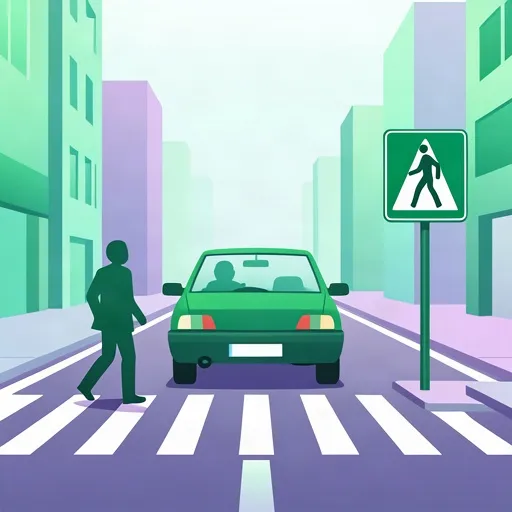
Recent updates to the Turkish Highway Traffic Law have placed a renewed emphasis on pedestrian safety, particularly at crossings where there is no traffic light. As a driver, you are legally required to slow down as you approach a pedestrian or school crossing, even if you do not immediately see someone standing at the edge of the road. If a pedestrian has started to cross or is waiting to cross at a designated area, you must come to a complete stop and allow them to pass safely.
The e-sınav often presents scenarios where a vehicle approaches a crossing without lights. A common mistake is assuming that if there is no traffic light, the driver has the absolute right-of-way. In reality, the absence of signals means the driver bears the full responsibility of observing for vulnerable road users and yielding to their movement. You must demonstrate hazard perception by observing the pavement and the sidewalks well in advance of the marked crossing area.
At intersections where traffic signals are present, the rule is clearer but equally demanding of your attention. When the light is green for your vehicle, you may proceed, but you must still remain cautious of pedestrians who may have started crossing while the signal was changing. Furthermore, if you are turning into a side street, you must yield to any pedestrians who are crossing that street, even if they do not have a designated crosswalk, as they are considered vulnerable users of the road.
School zones are classified as high-risk areas in the Turkish driving theory curriculum. When driving through these areas, your speed must be significantly reduced to allow for sudden reactions. Children are often unpredictable, and they may step into the road without checking for traffic. In your theory exam, questions regarding school bus safety or children crossing near school zones will always expect you to choose the answer that prioritizes extreme caution, reduced speed, and heightened observation.
Always remember that in Turkey, if a school bus is loading or unloading students and its 'DUR' (STOP) sign is activated, all traffic behind the bus must come to a complete stop. Passing a school bus while its stop sign is active is a severe traffic violation.
The theory exam is designed to test your ability to make safe decisions in split-second scenarios. When reviewing your study material, focus on the logic of "observation, speed reduction, and yielding." You will rarely be tested on complex legal jargon; instead, you will be tested on whether you recognize when a pedestrian or a vulnerable road user—such as a person with a disability or a cyclist—should be granted safe passage.
Article content overview
Explore related topics, search based questions, and concepts that learners often look up when studying Pedestrian Rules and Right of Way. These themes reflect real search intent and help you understand how this topic connects to wider driving theory knowledge in Turkey.
Find clear and practical answers to common questions learners often have about Pedestrian Rules and Right of Way. This section helps explain difficult points, remove confusion, and reinforce the key driving theory concepts that matter for learners in Turkey.
Yes, under Turkish traffic law, drivers are legally required to stop and yield to pedestrians who are at or are about to enter a pedestrian crossing, even if there are no traffic lights or crossing wardens present.
School crossings are considered high-risk zones. Drivers must exercise increased caution and prioritize the safety of students, often requiring a total stop if a student is intending to cross, regardless of the presence of specific signage.
Yes, questions regarding the driver's responsibility toward pedestrians, hazard perception in urban zones, and correct yielding procedures are core components of the Turkish e-sınav theory exam.
Drivers must wait for the pedestrian to complete their crossing fully before moving their vehicle, regardless of whether the vehicle has the right of way in that specific traffic lane.
After finding the specific Turkish driving theory articles you need, dive deeper into related topics or challenge your knowledge with practice questions. Enhance your understanding of trafik işaretleri, road rules, and vehicle safety to ensure you are fully prepared for the official ehliyet sınavı.