Understanding how to safely navigate around cyclists, pedestrians, and animals is a critical component of defensive driving and the Turkish driving theory exam. This guide clarifies the behavioral expectations mandated by the Karayolları Trafik Kanunu and explains why speed adjustment is just as important as lateral distance. You will learn the principles of risk management that help you avoid common hazards in real-world traffic.
Article content overview
Navigating the roads of Türkiye requires more than just knowledge of speed limits and signal protocols; it demands a high level of situational awareness regarding vulnerable road users. Whether you are driving in a bustling urban environment like Istanbul or on narrow rural roads in Anatolia, the Karayolları Trafik Kanunu (Highway Traffic Law) places a significant emphasis on the safety of pedestrians, cyclists, and animals. Maintaining adequate lateral clearance is a cornerstone of defensive driving and is frequently tested in the MTSK e-sınav.
When you prepare for your Turkish driving license theory exam, it is crucial to distinguish between mandatory following distances for motor vehicles and the lateral clearance required when overtaking. While following distance is primarily about reaction time and braking distance, lateral clearance is about providing a safety buffer for those who lack the protection of a vehicle frame. Failure to maintain this space is a common cause of accidents and is a frequent topic in exam questions focused on hazard awareness.
The fundamental rule when passing a cyclist, pedestrian, or animal on a narrow road is to reduce your speed and increase your lateral distance as much as the road geometry allows. In Türkiye, while specific numerical distances in meters may vary based on road conditions, the overarching legal requirement is that the driver must provide a "safe" buffer that accounts for the vulnerability of the other road user. If the road is too narrow to provide this clearance safely, the law dictates that you must wait behind the road user until it is safe to pass.
Speed management is intrinsically linked to this safety buffer. As identified in the official MTSK curriculum, your reaction time and the vehicle's stopping distance are variables that change with your speed. By slowing down before initiating a pass, you increase your own perception and reaction time, allowing you to stop or adjust your trajectory if a cyclist swerves or an animal moves unexpectedly into your path.
Many MTSK questions focus on the relationship between speed and the ability to control the vehicle in hazardous situations. When you increase your following or passing distance, you are essentially buying time. This time is what allows a driver to process the environment, recognize a potential hazard, and apply the brakes effectively. In the context of passing vulnerable users, lower speeds translate to less kinetic energy, which significantly reduces the severity of potential impacts.
Always remember that your stopping distance consists of your reaction time plus your braking distance. If you pass a cyclist at a high speed, you drastically reduce your ability to react to sudden maneuvers, making the passing distance effectively insufficient regardless of the physical space between your vehicles.
To excel in the theory exam, you must understand the expectations for different types of road users. Pedestrians, particularly children and the elderly, may exhibit unpredictable behavior near the roadway. Similarly, livestock or stray animals often appear on rural roads in Türkiye, requiring drivers to be extra vigilant.
| User Type | Priority Behavior | Strategy for Passing |
|---|---|---|
| Cyclist | Maintain wide lateral space | Slow down, warn with a brief signal if necessary, pass only when clear |
| Pedestrian | Yield at designated crossings | Never pass a vehicle stopped at a pedestrian crossing |
| Animals | Expect unpredictable movement | Slow down immediately, stop if needed, do not use loud horns |
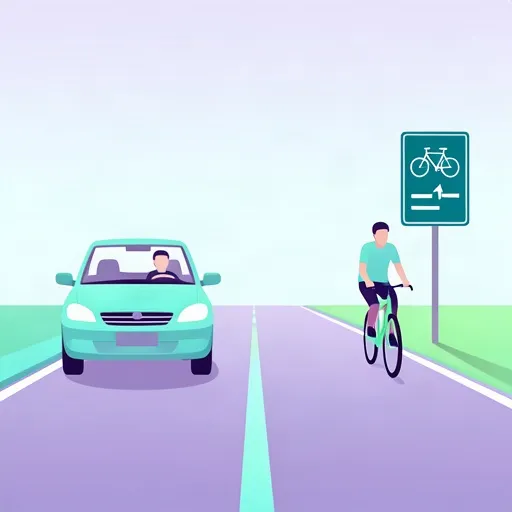
The Turkish driving theory exam often uses situational scenarios to test your judgment. You may be presented with an image or a description of a narrow road with a cyclist and asked to identify the safest course of action. The correct answer almost always involves a combination of reducing speed, checking mirrors, and yielding until sufficient space is available to pass safely. Avoid the trap of thinking that you must always maintain a high average speed; safety and legal compliance regarding vulnerable road users are prioritized over traffic flow in these specific assessment modules.
Safe passing of vulnerable road users in Türkiye requires both lateral clearance and speed reduction as mandated by the Karayolları Trafik Kanunu, with the legal standard being a safe buffer that accounts for the vulnerability of the other road user. Lower speeds directly increase your ability to perceive hazards, react, and stop, while lateral clearance provides physical protection for users without vehicle frames. Different vulnerable users require tailored approaches: cyclists need wide lateral space and slowing, pedestrians at crossings require complete yielding, and animals demand immediate speed reduction due to unpredictable behavior. The MTSK e-sınav tests whether you prioritize safety and legal compliance over maintaining traffic flow when encountering these situations.
A short set of high-value points that capture the most important ideas from this article.
Lateral clearance is a distinct legal requirement from following distance, specifically protecting vulnerable road users who lack vehicle protection
When road geometry prevents safe lateral clearance, you must wait behind the road user rather than attempt to pass
Lower speed before passing directly increases your reaction time and reduces braking distance, making the maneuver safer regardless of physical space
Speed reduction and lateral distance work together as a combined safety strategy, not as substitutes for each other
The Karayolları Trafik Kanunu prioritizes safety and legal compliance over traffic flow when passing vulnerable users
Your stopping distance equals reaction time plus braking distance—both increase with higher speed
Never pass a vehicle that has stopped at a pedestrian crossing; the pedestrian may be crossing in front of it
Animals on rural roads require immediate speed reduction and possible stopping; honking can startle them into your path
The law requires a safe buffer but specific distances vary with conditions; judgment based on vulnerability is the standard
MTSK exam scenarios test whether you will reduce speed and yield, not whether you can maintain speed while passing
Assuming sufficient lateral distance alone makes a pass safe without reducing speed first
Attempting to pass stopped vehicles at pedestrian crossings when a pedestrian is likely crossing ahead
Passing cyclists or pedestrians at high speed assuming they will stay in place
Using the horn to alert animals instead of slowing down or stopping, which may cause unpredictable movement
Failing to check mirrors and blind spots before and during the passing maneuver
Article content overview
A short set of high-value points that capture the most important ideas from this article.
Lateral clearance is a distinct legal requirement from following distance, specifically protecting vulnerable road users who lack vehicle protection
When road geometry prevents safe lateral clearance, you must wait behind the road user rather than attempt to pass
Lower speed before passing directly increases your reaction time and reduces braking distance, making the maneuver safer regardless of physical space
Speed reduction and lateral distance work together as a combined safety strategy, not as substitutes for each other
The Karayolları Trafik Kanunu prioritizes safety and legal compliance over traffic flow when passing vulnerable users
Your stopping distance equals reaction time plus braking distance—both increase with higher speed
Never pass a vehicle that has stopped at a pedestrian crossing; the pedestrian may be crossing in front of it
Animals on rural roads require immediate speed reduction and possible stopping; honking can startle them into your path
The law requires a safe buffer but specific distances vary with conditions; judgment based on vulnerability is the standard
MTSK exam scenarios test whether you will reduce speed and yield, not whether you can maintain speed while passing
Assuming sufficient lateral distance alone makes a pass safe without reducing speed first
Attempting to pass stopped vehicles at pedestrian crossings when a pedestrian is likely crossing ahead
Passing cyclists or pedestrians at high speed assuming they will stay in place
Using the horn to alert animals instead of slowing down or stopping, which may cause unpredictable movement
Failing to check mirrors and blind spots before and during the passing maneuver
Explore related topics, search based questions, and concepts that learners often look up when studying Safe Passing Distances in Turkey. These themes reflect real search intent and help you understand how this topic connects to wider driving theory knowledge in Turkey.
Find clear and practical answers to common questions learners often have about Safe Passing Distances in Turkey. This section helps explain difficult points, remove confusion, and reinforce the key driving theory concepts that matter for learners in Turkey.
The primary goal is to ensure sufficient time and space for reaction, braking, and avoiding collisions if a vulnerable road user makes an unexpected movement.
While the law emphasizes 'sufficient lateral clearance,' the focus in the MTSK exam is on reducing speed and ensuring enough space to prevent accidents caused by turbulence or sudden swerves.
Higher speeds require greater stopping distances; therefore, lowering your speed when passing vulnerable users reduces the risk and gives you more control to react to potential hazards.
After finding the specific Turkish driving theory articles you need, dive deeper into related topics or challenge your knowledge with practice questions. Enhance your understanding of trafik işaretleri, road rules, and vehicle safety to ensure you are fully prepared for the official ehliyet sınavı.