
This lesson explores the essential physics of center of gravity and its critical role in maintaining vehicle stability for heavy goods vehicles. You will learn how load height and distribution directly influence handling during cornering, braking, and emergency maneuvers, helping you prepare for your professional C-category theory test.

Lesson content overview
Operating a heavy goods vehicle (HGV) requires far more than just basic steering and shifting gears. For professional drivers aiming for C1, C, C1E, or CE licenses under the Turkey Professional Goods Vehicle Theory Course, mastering vehicle physics is a fundamental safety requirement.
Among these physical forces, the Center of Gravity (CoG)—known in Turkish as ağırlık merkezi—is the single most critical factor determining whether a loaded truck safely negotiates a bend or ends up in a catastrophic rollover. This lesson explores the dynamics of vehicle stability, how static and dynamic forces interact on Turkish roads, and the strict load management rules you must follow to stay safe and compliant.
The Center of Gravity is the theoretical, single point at which the entire combined weight of the vehicle and its cargo is concentrated and acts vertically downward toward the earth.
The specific point in a body or system around which its mass or weight is evenly distributed or balanced. In heavy vehicles, the position of the CoG changes constantly depending on how the vehicle is loaded.
In a light passenger car, the CoG is low and stays relatively consistent. In a commercial goods vehicle, however, the CoG is highly variable. When a truck is empty, its CoG is low, determined primarily by the heavy chassis, engine, and transmission. Once you load cargo, the CoG shifts upward and potentially outward, depending entirely on how that cargo is positioned.
To understand vehicle handling, a professional driver must distinguish between two states of gravity:
Lateral stability is your vehicle’s natural resistance to tipping over sideways. This stability is governed by a delicate relationship between two physical dimensions:
When a vehicle enters a curve, centrifugal force pushes the vehicle outward, away from the direction of the turn. This force acts upon the vehicle's CoG.
If the vehicle has a low CoG, the lateral force is easily absorbed by the tires and suspension, keeping the tires firmly on the asphalt.
If the vehicle has a high CoG, the lateral force pulls the top-heavy mass outward with greater leverage. If the lateral force pushes the vector of the CoG outside the track width of the tires, the vehicle will lift its inside wheels and roll over.
The Rollover Risk Factor: Double-deck trailers, high-cube containers, and tankers carrying liquid cargo have inherently high or unstable CoGs. They require much lower cornering speeds than standard flatbed or box trailers, even if the total weight is well within legal limits.
When a heavy goods vehicle is in motion, forces are constantly shifting weight across the axles and wheels. This phenomenon is known as Dynamic Load Transfer.
When you apply the brakes, momentum causes the vehicle's weight to plunge forward. This places massive downward pressure on the front axle while relieving pressure on the rear axle.
During cornering, weight transfers from the inner wheels to the outer wheels. The higher your vehicle's CoG, the more dramatic this transfer becomes.
If you make sudden steering corrections (such as an evasive maneuver to avoid a hazard), the rapid side-to-side weight transfer can overwhelm the suspension. This "slingshot" effect often results in an immediate rollover before the driver has time to react.
Under the Turkish Highway Traffic Regulation (Karayolları Trafik Yönetmeliği), drivers and transport operators must strictly adhere to vehicle weight, height, and cargo-securing rules to ensure road safety. Failing to manage your CoG not only risks lives but also results in heavy administrative fines and vehicle impoundment.
A primary rule for managing CoG is complying with maximum vehicle height limits.
In Turkey, the standard maximum height limit for vehicles on public roads is generally 4.00 metres. However, depending on your vehicle class and cargo type, specific limits may apply. Exceeding these limits raises your CoG to dangerous levels, making the vehicle highly susceptible to crosswinds and overhead bridge collisions.
Keeping your load within legal limits is not just about the total weight; it is about how that weight is distributed across your axles (dingil ağırlığı).
Tankers transporting liquids present a unique challenge to dynamic stability due to the "free surface effect."
When a tanker is not completely full, the liquid cargo can move freely. When cornering, the liquid sloshes to the outer side of the tank, shifting the dynamic CoG laterally and suddenly. When braking, the liquid surges forward, pushing the vehicle ahead even after the brakes are fully applied.
When driving tankers or carrying unbaffled liquid containers, always allow for much larger stopping distances and reduce your speed significantly before entering any curve. Smooth, progressive control inputs are non-negotiable.
Understanding the theory of CoG is meant to prevent real-world accidents. Professional drivers must be vigilant in the following high-risk environments:
Roundabouts (dönel kavşak) are prime locations for heavy vehicle rollovers. Drivers often enter at safe speeds but accelerate too early while exiting. The sudden change in steering direction causes a violent lateral load transfer that can roll a top-heavy vehicle even at speeds as low as 20 km/h.
Strong crosswinds (particularly on bridges, viaducts, and open highways in central Turkey) exert immense lateral force on high-sided vehicles. A high CoG makes the vehicle behave like a sail, amplifying the wind's power to push the vehicle out of its lane or tip it over.
When delivering to construction sites or navigating rural roads with steep cambers, the slope of the road naturally shifts the static CoG toward the downhill side. On a steep lateral slope, even a stationary truck can tip over if loaded poorly.
To protect yourself and other road users, integrate these stability checks into your professional driving routine:
Analyze the Cargo Profile: Before loading, determine the weight and physical characteristics of the goods. Always place the heaviest items at the bottom of the load space to keep the CoG as low as possible.
Distribute Weight Evenly: Position the load symmetrically from left to right and distribute it across the axles according to your vehicle's technical specifications.
Secure the Load Properly: Use tension straps, lashings, or load binders. An unsecured load will slide during cornering, causing a sudden, uncontrollable shift in your CoG.
Execute Progressive Braking: Never slam on the brakes. Apply gradual, progressive pressure to minimize forward dynamic load transfer.
Manage Your Speed in Curves: Always slow down before entering a turn. Braking inside a curve combines lateral forces with longitudinal deceleration, creating the worst-case scenario for lateral stability.
This lesson covers the physics of center of gravity and its critical role in heavy goods vehicle stability, essential for passing the Turkish professional license theory exam (MTSK e-sınav). It distinguishes between static CoG (when parked) and dynamic CoG (in motion), explaining how lateral stability deteriorates when the CoG rises above the track width. Key hazards include dynamic load transfer during braking and cornering, rollover risks on roundabouts, and the dangerous free surface effect in liquid tankers. Turkey's strict cargo regulations under the Karayolları Trafik Yönetmeliği require compliance with height limits (typically 4.00m) and balanced axle distribution. Safe practice centers on loading strategy, progressive braking, and speed management before entering curves.
A short set of high-value points that capture the most important learning from this lesson.
The Center of Gravity (CoG) is the point where total vehicle and cargo weight acts downward; lowering it improves stability while raising it increases rollover risk.
Lateral stability depends on track width versus CoG height—when the lateral force vector falls outside the tire track width, the vehicle will tip over.
Dynamic load transfer causes weight to shift front-to-back during braking/acceleration and side-to-side during cornering, amplifying instability with a high CoG.
Turkish regulations mandate maximum vehicle heights (typically 4.00m) and require symmetric axle weight distribution for road safety.
Liquid cargo in tankers creates a free surface effect that suddenly shifts the CoG during turns or braking, requiring extra caution and longer stopping distances.
Explore all units and lessons included in this driving theory course.
Low CoG is always safer—place heaviest cargo at the bottom of the load space.
Brake progressively before turns, never inside them—combining lateral forces with deceleration is the worst-case scenario for rollover.
High-sided vehicles (double-deck trailers, tankers, high-cube containers) have inherently high CoGs and need significantly reduced cornering speeds.
Axle load must be balanced left-to-right and distributed according to vehicle specifications—uneven loading compromises lateral stability.
The free surface effect in partially filled liquid tankers can shift CoG suddenly even on gentle curves or routine braking.
Assuming a legally loaded vehicle is automatically stable—the CoG position matters independently of total weight.
Entering roundabouts or sharp curves at speeds that feel safe for cars, forgetting that a high CoG drastically lowers the rollover threshold for trucks.
Believing that strong brakes alone prevent accidents—abrupt braking transfers massive weight forward, lifting rear tires and risking jackknife on articulated vehicles.
Loading cargo unevenly side-to-side to save time, not realizing this compresses one suspension side and dramatically reduces resistance to tipping when turning the opposite direction.
Underestimating wind effects on high-sided vehicles, particularly on bridges and viaducts where crosswinds can push a top-heavy vehicle out of its lane or tip it over.
Lesson content overview
A short set of high-value points that capture the most important learning from this lesson.
The Center of Gravity (CoG) is the point where total vehicle and cargo weight acts downward; lowering it improves stability while raising it increases rollover risk.
Lateral stability depends on track width versus CoG height—when the lateral force vector falls outside the tire track width, the vehicle will tip over.
Dynamic load transfer causes weight to shift front-to-back during braking/acceleration and side-to-side during cornering, amplifying instability with a high CoG.
Turkish regulations mandate maximum vehicle heights (typically 4.00m) and require symmetric axle weight distribution for road safety.
Liquid cargo in tankers creates a free surface effect that suddenly shifts the CoG during turns or braking, requiring extra caution and longer stopping distances.
Explore all units and lessons included in this driving theory course.
Low CoG is always safer—place heaviest cargo at the bottom of the load space.
Brake progressively before turns, never inside them—combining lateral forces with deceleration is the worst-case scenario for rollover.
High-sided vehicles (double-deck trailers, tankers, high-cube containers) have inherently high CoGs and need significantly reduced cornering speeds.
Axle load must be balanced left-to-right and distributed according to vehicle specifications—uneven loading compromises lateral stability.
The free surface effect in partially filled liquid tankers can shift CoG suddenly even on gentle curves or routine braking.
Assuming a legally loaded vehicle is automatically stable—the CoG position matters independently of total weight.
Entering roundabouts or sharp curves at speeds that feel safe for cars, forgetting that a high CoG drastically lowers the rollover threshold for trucks.
Believing that strong brakes alone prevent accidents—abrupt braking transfers massive weight forward, lifting rear tires and risking jackknife on articulated vehicles.
Loading cargo unevenly side-to-side to save time, not realizing this compresses one suspension side and dramatically reduces resistance to tipping when turning the opposite direction.
Underestimating wind effects on high-sided vehicles, particularly on bridges and viaducts where crosswinds can push a top-heavy vehicle out of its lane or tip it over.
Explore search topics learners often look for when studying Center of Gravity and Vehicle Stability. These topics reflect common questions about road rules, driving situations, safety guidance, and lesson level theory preparation for learners in Turkey.
Browse additional driving theory lessons that cover connected traffic rules, road signs, and common driving situations related to this topic. Improve your understanding of how different rules interact across everyday traffic scenarios.
Learn the legal and physical requirements for securing goods on a commercial vehicle in Turkey. This guide covers tensioning techniques, load binders, and regulatory standards to prevent load shifting during transport and ensure vehicle stability on public roads according to Turkish Highway Traffic Regulations.

This lesson provides a detailed overview of cargo securing techniques and the legal requirements for securing loads on goods vehicles. It covers the proper use of straps, chains, tarpaulins, and other securing methods to prevent cargo shift during transit. Learners will learn how to assess the need for additional restraints based on cargo type, weight, and dynamic transport conditions.

This lesson explains the legal guidelines and safety physics for carrying passengers and securing cargo inside or on top of a vehicle. It details how excess weight or poorly distributed cargo negatively affects vehicle handling, braking, and fuel efficiency. Drivers will learn the legal payload limits specified under Turkish Category B regulations.

This lesson focuses on the importance of maintaining safe following distances for goods vehicles, taking into account longer braking distances and increased load. Learners will learn how to calculate appropriate gaps based on speed, road conditions, and vehicle dynamics. The lesson emphasizes safe following practices to prevent rear-end collisions and improve overall traffic safety in Turkey.

This lesson provides an overview of the regulations governing the transport of hazardous materials and dangerous goods in Turkey. Learners will become familiar with international (ADR) and national requirements for labeling, placarding, load securing, and documentation. The lesson also covers specific route restrictions and safety procedures that must be followed during transit.

This lesson focuses on the various access restrictions imposed on heavy goods vehicles within Turkish road networks. Learners will understand the reasons for restrictions such as low bridge clearances, tunnel usage, construction zones, and urban delivery area limitations. The lesson also covers how to recognize and comply with legal notices and signage indicating restricted commercial zones.

This lesson focuses on the essential principles of load planning and weight distribution for goods vehicles. Learners will understand how to assess cargo weight, determine optimal placement, and maintain a low centre of gravity to ensure vehicle stability. The lesson emphasizes legal load limits, the dangers of overloading, and the impact of uneven load distribution on handling and braking.

This lesson focuses on speed regulation for goods vehicles, highlighting how vehicle weight, load, and road conditions influence safe operating speeds. Learners will understand legal speed limits for various road types and the necessity of adapting speed to traffic flow and environmental conditions. The lesson also emphasizes the importance of maintaining appropriate speed to ensure vehicle control.

This lesson focuses on traffic signs and road markings that are specifically relevant to goods vehicles in Turkey. Learners will become familiar with signs indicating prohibited routes, weight limits, height restrictions, hazardous material transport, and lane usage regulations. The lesson emphasizes the importance of accurately interpreting these signs to ensure compliance with traffic laws.
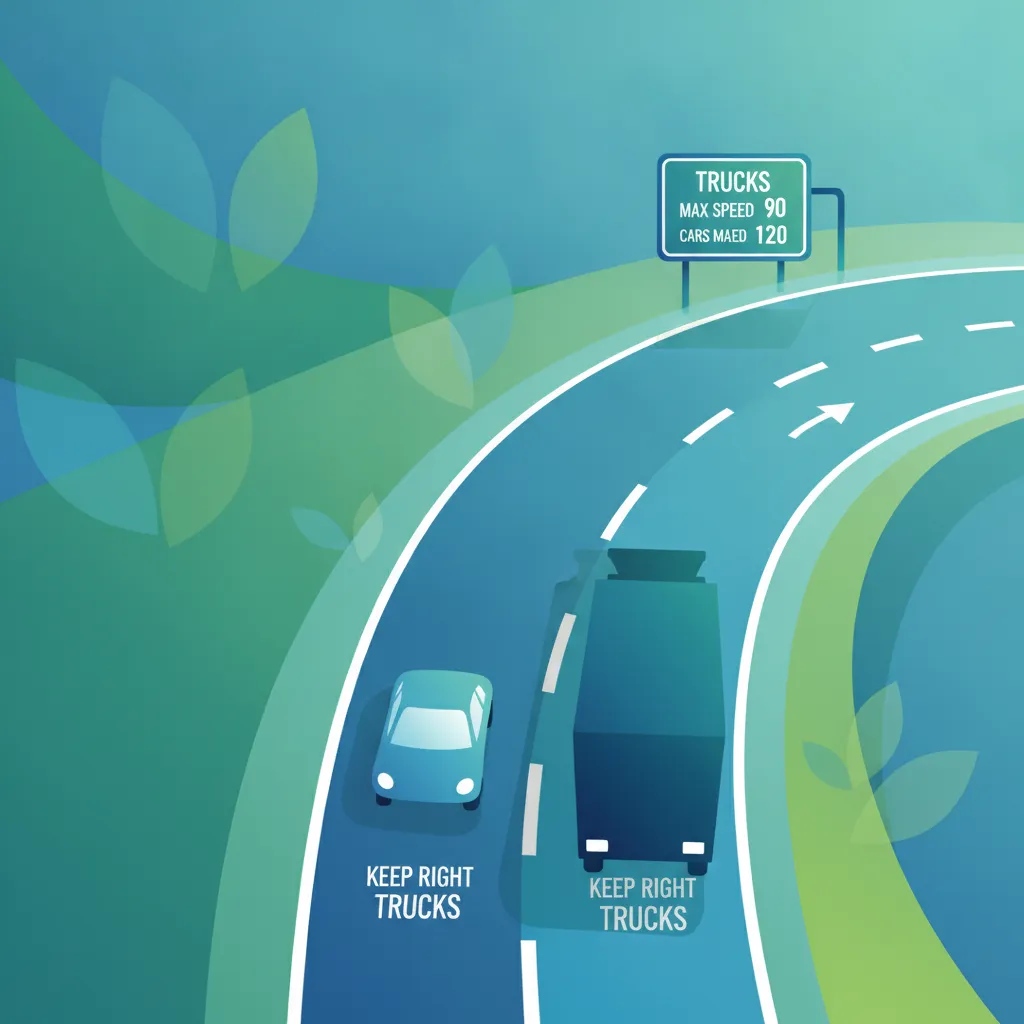
This lesson addresses the specific considerations for goods vehicle operation on highways and expressways, covering speed limits, lane discipline, safe merging, and overtaking. Learners will learn how to adapt to traffic flow, manage heavy vehicle dynamics at higher speeds, and ensure safe operation. The lesson emphasizes the importance of vigilance and proper lane usage to prevent accidents.

This lesson covers the techniques and safety considerations for docking a goods vehicle in loading areas and performing precision parking maneuvers. Learners will learn how to align the vehicle correctly, use reverse gears effectively, and communicate with spotters when necessary. Emphasis is placed on maintaining situational awareness, checking for obstacles, and ensuring secure dock operations.
Understand how the physical dimensions and weight of large vehicles impact turning, reversing, and navigating confined spaces. This lesson explains the mechanics of trailer tracking, blind spot management, and the influence of load distribution on vehicle control during complex maneuvers in urban and industrial traffic environments.

This lesson focuses on the challenges and techniques required when maneuvering goods vehicles in confined spaces such as loading docks, narrow streets, and urban environments. It addresses the importance of spatial awareness, precision driving, and understanding vehicle dimensions to avoid collisions. Learners will explore strategies for effective parking, reversing, and handling blind spots safely.
Find clear answers to common questions learners have about Center of Gravity and Vehicle Stability. Learn how the lesson is structured, which driving theory objectives it supports, and how it fits into the overall learning path of units and curriculum progression in Turkey. These explanations help you understand key concepts, lesson flow, and exam focused study goals.
A high center of gravity increases the risk of the vehicle tipping over, especially during tight cornering or sudden evasive maneuvers, because the vehicle's weight is less stable relative to the ground.
Poorly distributed loads can cause uneven weight on axles, leading to reduced braking efficiency, longer stopping distances, and a higher risk of the vehicle skidding or losing control.
Yes, professional license exams frequently test your understanding of vehicle dynamics and safety, particularly how load placement influences the stability of C, C1, and CE vehicles.
Yes, a full load, especially if stacked high, raises the center of gravity significantly. You must adjust your driving speed and cornering technique accordingly to maintain control.
Use our comprehensive practice search to find exactly the Turkish driving theory questions you need to master. Whether reviewing specific road signs, traffic rules, or first aid scenarios, select your perfect practice set and boost your confidence for the official ehliyet sınavı.