
This lesson focuses on the critical soft skills required for Class D passenger vehicle drivers in Türkiye, specifically managing passenger conduct and maintaining clear communication. You will learn how to handle in-vehicle disruptions professionally and use effective signals to ensure a safe, orderly environment. This topic is essential for your theoretical exam and builds upon your understanding of passenger safety priorities within the Class D curriculum.

Lesson content overview
Operating a commercial passenger vehicle, such as a bus or coach, requires far more than technical driving skills. Under the Turkish Class D passenger vehicle driving licence framework (D Sınıfı Sürücü Belgesi), a professional driver acts as the designated commander of the vehicle. This responsibility entails managing the collective environment within the cabin to ensure safety, maintain order, and deliver a comfortable journey.
In-vehicle passenger behaviour directly impacts driver focus, overall safety, and the efficiency of the transport service. A driver who is distracted by cabin disruptions, passenger conflicts, or poor communication is significantly more likely to make errors or fail to perceive critical road hazards. This lesson provides the strategies, communication techniques, and legal knowledge necessary to foster a safe, cooperative cabin environment.
A commercial passenger vehicle is a shared, dynamic public space. Unlike private passenger cars, buses transport large numbers of individuals with varying needs, backgrounds, and expectations. Managing this environment is a core professional competency for Class D licence holders and those seeking SRC-1 or SRC-2 vocational competence certificates (Mesleki Yeterlilik Belgesi).
The proactive and reactive strategies used by a transport operator to monitor, guide, and regulate passenger actions to ensure the safety, security, and comfort of everyone on board.
Effective passenger management relies on two key approaches:
By actively managing the cabin, drivers prevent minor issues from escalating into major safety hazards. When passengers understand the rules of conduct and feel that the driver is in control, their stress is reduced, compliance increases, and the overall risk of driver distraction drops.
To safely manage a large passenger vehicle, drivers must adhere to four core operational principles.
| Principle | Definition | Purpose / Rationale | Practical Implication |
|---|---|---|---|
| Proactive Authority | Establishing professional control and a welcoming, orderly environment from the moment of boarding. | Prevents passenger anxiety and deters disruptive conduct early. | Maintain a clean vehicle, greet passengers, and enforce boarding protocols consistently. |
| Clear Communication | Using structured, concise verbal and non-verbal methods to convey instructions. | Minimizes misunderstandings and ensures rapid compliance with safety rules. | Keep announcements short, highly audible, and direct. |
| Conflict De-escalation | Employing specific verbal and physical techniques to reduce tension during disputes. | Avoids physical altercations and preserves driver focus during transit. | Speak in a calm, flat tone; never engage in emotional arguments or retaliate. |
| Regulatory Compliance | Enforcing national transport rules regarding safety equipment, capacity, and conduct. | Aligns the journey with legal mandates and shields the operator from liability. | Enforce seatbelt compliance, keep aisles clear, and prevent passenger access to controls. |
Verbal announcements are the primary tool for direct communication. Whether driving an urban transit bus (belediye otobüsü) or a long-distance coach (şehirlerarası otobüs), clear announcements set the standard for the trip.
Before the wheels turn, the driver must deliver essential safety and route information. This is critical for establishing authority and informing passengers of their safety obligations. A typical pre-journey announcement should cover:
During the journey, keep passengers informed to reduce anxiety and prevent unnecessary questions that could distract you while driving. Inform them of:
When making announcements, drivers must be direct and avoid cognitive overload. Speak at a moderate pace with a clear, calm tone. Avoid using overly technical or jargon-heavy language, and keep messages focused purely on essential travel or safety facts.
Avoid Distracted Announcements: Never make hand-held microphone announcements while the vehicle is in motion. Use a hands-free public address (PA) system or wait until the vehicle is safely stopped at a red light, bus stop, or rest station to address passengers.
Passive announcements and non-verbal cues allow drivers to convey instructions continuously without speaking, preserving mental energy and minimizing verbal noise in the cabin.
Modern passenger vehicles utilize standardized pictograms and electronic signs to direct behaviour. This is especially helpful for passengers who may have hearing impairments or do not speak the local language.
When face-to-face interaction is required, a driver's non-verbal cues are highly influential.
Confrontations can occur due to boarding delays, ticketing issues, seating disputes, or disruptive passenger behavior. In these situations, your primary objective is to maintain safety and prevent the conflict from distracting you from driving.
Assess and Prioritize Safety: If a conflict begins while the vehicle is in motion, assess if you can safely address it while maintaining control of the bus. If the situation requires significant attention, pull over safely at the nearest bus stop, shoulder, or layby, and secure the vehicle.
Control Your Physiology and Tone: Take a deep breath. Speak in a lower, calmer, and slower register than the agitated passenger. Do not match their volume, use aggressive body language, or touch the passenger.
Use Active Listening: Let the passenger air their complaint without interruption for a few seconds. Acknowledge their frustration with phrases like, "I understand you are upset, but..." to validate their state without necessarily agreeing with their point.
Establish Clear Safety Boundaries: Clearly state the safety or legal rationale behind your request. Frame it around passenger safety and national transport rules, rather than personal preference.
Offer a Constructive Alternative: If possible, present a simple, compliant choice (e.g., "You can either lower the volume of your device or use headphones, so that I can focus on driving safely").
Involve Law Enforcement if Necessary: If the passenger refuses to comply, threatens violence, or damages property, do not try to physically eject them. Stay in your seat, keep the cabin secure, and contact emergency services (112) or transit security immediately.
A skilled professional driver adapts their communication and cabin management style to accommodate the diverse needs of different passenger groups.
On school bus runs (Okul Taşıtı) or family holiday routes, children require extra supervision and clear rules.
Seniors may have reduced mobility, slower reaction times, or hearing difficulties.
Providing safe, accessible transport is a core professional duty.
Distractions within the cabin can be as dangerous as external hazards. To maintain focus, drivers must establish firm boundaries between the driving cab and the passenger area.
Passenger Interventions -> Cabin Distractions -> Delayed Driver Reaction Time -> Increased Stopping Distance
Under no circumstances should passengers touch or stand near the driver's controls.
Loud conversations, shouting, or unmuted video playback can mask warning sirens, squealing brakes, or mechanical noises from your own vehicle.
Turkish Highway Traffic Law (Karayolları Trafik Kanunu) and the Road Transport Regulation (Karayolu Taşıma Yönetmeliği) establish clear duties for operators of Class D vehicles:
To ensure compliance with safety regulations and avoid fines, review these common violations and their correct operational procedures:
A driver’s approach to passenger management must adapt to external environmental and driving conditions:
This lesson covers the essential soft skills and legal duties for Class D passenger vehicle drivers in Turkey, focusing on cabin management, in-vehicle communication, and conflict de-escalation. Drivers learn to establish proactive authority through clear verbal announcements and passive signage systems, while applying a structured six-step de-escalation protocol that prioritizes safety by pulling over before engaging with serious conflicts. The content emphasizes adapting communication for vulnerable passenger groups and strictly enforcing safety boundaries such as the yellow line and emergency equipment zones. Legal obligations under the Karayolları Trafik Kanunu are reinforced, including capacity limits, seatbelt enforcement, and authorized boarding points.
A short set of high-value points that capture the most important learning from this lesson.
Cabin management is a core professional competency for Class D drivers, directly affecting road safety by preventing driver distraction.
Effective passenger management uses both preventive approaches like pre-journey announcements and reactive strategies like calm, structured de-escalation.
The Yellow Line Boundary is a critical safety demarcation that passengers must stay behind to preserve the driver's field of vision.
Drivers must adapt communication and cabin management styles to accommodate children, elderly passengers, and those with disabilities.
Verbal announcements should be short, audible, and factual; never make PA announcements while the vehicle is in motion.
Explore all units and lessons included in this driving theory course.
Passenger capacity limits are legally binding; overcrowding compromises vehicle handling and passenger safety.
Non-verbal tools (illuminated signs, pictograms, electronic destination boards) support verbal communication without increasing driver cognitive load.
During conflicts, always pull over safely before engaging; never attempt to physically eject a non-compliant passenger.
Drivers are legally responsible for ensuring wheelchair restraint systems are properly secured before departure.
Stopping at undesignated locations to resolve disputes or drop off passengers violates Turkish Road Transport Regulation.
Engaging emotionally or raising voice to match an agitated passenger, which escalates tension and increases accident risk.
Relying solely on passive passenger self-regulation instead of issuing pre-emptive safety reminders.
Allowing passengers to access driver controls, stand near the yellow line boundary, or tamper with emergency equipment.
Failing to wait until elderly or mobility-impaired passengers are fully seated before accelerating from stops.
Using jargon-heavy or technically complex language in announcements that passengers may not understand.
Lesson content overview
A short set of high-value points that capture the most important learning from this lesson.
Cabin management is a core professional competency for Class D drivers, directly affecting road safety by preventing driver distraction.
Effective passenger management uses both preventive approaches like pre-journey announcements and reactive strategies like calm, structured de-escalation.
The Yellow Line Boundary is a critical safety demarcation that passengers must stay behind to preserve the driver's field of vision.
Drivers must adapt communication and cabin management styles to accommodate children, elderly passengers, and those with disabilities.
Verbal announcements should be short, audible, and factual; never make PA announcements while the vehicle is in motion.
Explore all units and lessons included in this driving theory course.
Passenger capacity limits are legally binding; overcrowding compromises vehicle handling and passenger safety.
Non-verbal tools (illuminated signs, pictograms, electronic destination boards) support verbal communication without increasing driver cognitive load.
During conflicts, always pull over safely before engaging; never attempt to physically eject a non-compliant passenger.
Drivers are legally responsible for ensuring wheelchair restraint systems are properly secured before departure.
Stopping at undesignated locations to resolve disputes or drop off passengers violates Turkish Road Transport Regulation.
Engaging emotionally or raising voice to match an agitated passenger, which escalates tension and increases accident risk.
Relying solely on passive passenger self-regulation instead of issuing pre-emptive safety reminders.
Allowing passengers to access driver controls, stand near the yellow line boundary, or tamper with emergency equipment.
Failing to wait until elderly or mobility-impaired passengers are fully seated before accelerating from stops.
Using jargon-heavy or technically complex language in announcements that passengers may not understand.
Explore search topics learners often look for when studying Managing Passenger Behaviour and In-vehicle Communication. These topics reflect common questions about road rules, driving situations, safety guidance, and lesson level theory preparation for learners in Turkey.
Browse additional driving theory lessons that cover connected traffic rules, road signs, and common driving situations related to this topic. Improve your understanding of how different rules interact across everyday traffic scenarios.
Understand the official Turkish transport regulations regarding passenger safety, vehicle capacity limits, and driver responsibilities. This lesson explores the legal requirements for maintaining order and managing passenger conduct to ensure compliance with the Highway Traffic Law and professional driving standards.

Learners will explore the core safety priorities for passenger transport, including the correct use of seat belts, securing luggage, and maintaining passenger stability during vehicle motion. The lesson highlights the importance of clear safety briefings, the location and operation of emergency exits, and conducting risk assessments before departure. By mastering these practices, drivers can significantly reduce the likelihood of accidents and injuries.

Learners will explore best practices for ensuring passenger safety during the boarding and alighting process, focusing on proper vehicle positioning, door operation, and passenger assistance. The lesson covers the use of handrails, steps, and ramps, as well as strategies for managing standing passengers and luggage. Emphasis is placed on clear communication and maintaining situational awareness to prevent accidents.
In this lesson, participants will learn about the specific offences and penalties that apply to passenger vehicle drivers, focusing on violations that directly jeopardize passenger safety and public security. The content outlines the legal repercussions of non-compliance, including fines, licence suspensions, and other enforcement actions. Understanding these penalties reinforces the critical nature of adhering to traffic laws and safety protocols in professional passenger transport.
This lesson outlines the legal framework governing passenger vehicle operation, highlighting the penalties for various offences, such as speeding, failure to adhere to stop procedures, or neglecting passenger safety protocols. Learners will understand the importance of compliance to avoid fines, licence suspension, or other legal actions, and the role of regulatory bodies in enforcement.

This lesson focuses on the specific considerations required when transporting children, elderly individuals, and passengers with reduced mobility. Topics include the proper installation of child safety seats, techniques for assisting elderly passengers, and procedures for safely boarding and securing wheelchair users. Drivers will learn how to use accessibility features and special equipment to ensure a safe and dignified travel experience for these vulnerable groups.

This lesson addresses the particular challenges posed by standing passengers and the handling of luggage within passenger vehicles. Learners will explore best practices for securing items, guiding passenger movement, and maintaining vehicle stability. Understanding these aspects helps prevent accidents caused by shifting loads or passenger instability, especially during sudden stops or turns.

Learners will examine the broader concept of fostering a safety-oriented and professional culture within passenger transport services. The lesson discusses the impact of driver attitudes on passenger trust, the importance of ongoing safety training, and the role of ethical conduct in enhancing service quality. Strategies for promoting a proactive safety mindset among drivers and staff are presented.

This lesson details the procedures for safely evacuating passengers from a bus in the event of a fire or other critical emergency. Topics include the location and use of emergency exits, fire extinguishers, and lighting, as well as the importance of clear communication and orderly movement of passengers. Practical steps for assisting vulnerable passengers during evacuation are emphasized.

This lesson focuses on creating a comfortable and accessible environment for all passengers, addressing climate control, lighting, and ergonomic seating arrangements. It also discusses provisions for wheelchair users, the use of boarding ramps, and the importance of priority seating for those with special needs. Drivers will learn how to assist passengers effectively while maintaining comfort standards throughout the journey.
This lesson details the statutory duties imposed on motor vehicle drivers by Turkish traffic legislation to maintain order on public roads. It emphasizes mandatory seat belt usage, mobile phone bans, vehicle inspection rules, and general compliance with police directions. Understanding these duties ensures drivers avoid heavy penalties and maintain road safety.
Explore strategies for navigating dense urban traffic while ensuring safe boarding and alighting for passengers. Learn how to manage bus stops, handle passenger interactions in busy city environments, and maintain control of the vehicle during transit according to Turkish driving theory requirements.
Learners will explore best practices for ensuring passenger safety during the boarding and alighting process, focusing on proper vehicle positioning, door operation, and passenger assistance. The lesson covers the use of handrails, steps, and ramps, as well as strategies for managing standing passengers and luggage. Emphasis is placed on clear communication and maintaining situational awareness to prevent accidents.

This lesson covers the proper handling of bus stops and designated passenger boarding zones, emphasizing safety, efficiency, and compliance with regulations. Topics include the correct positioning of the vehicle, safe boarding and alighting procedures, and managing passenger flow during stops. Effective management of these zones reduces the risk of accidents and ensures a smooth passenger experience.
This lesson focuses on the proper approach to bus stops and terminals within city traffic, emphasizing safe positioning, adherence to traffic signals, and maintaining smooth traffic flow. Learners will understand the importance of signaling intentions, checking blind spots, and ensuring the safety of boarding and alighting passengers. Effective stop management reduces the risk of accidents and traffic disruption.

Learners will examine effective strategies for safely coordinating with pedestrians and other road users when approaching and departing bus stops. The lesson highlights right-of-way rules, the importance of yielding at crosswalks, and clear communication with both passengers and other drivers. These practices are vital for preventing accidents and ensuring a harmonious flow of traffic in busy urban areas.
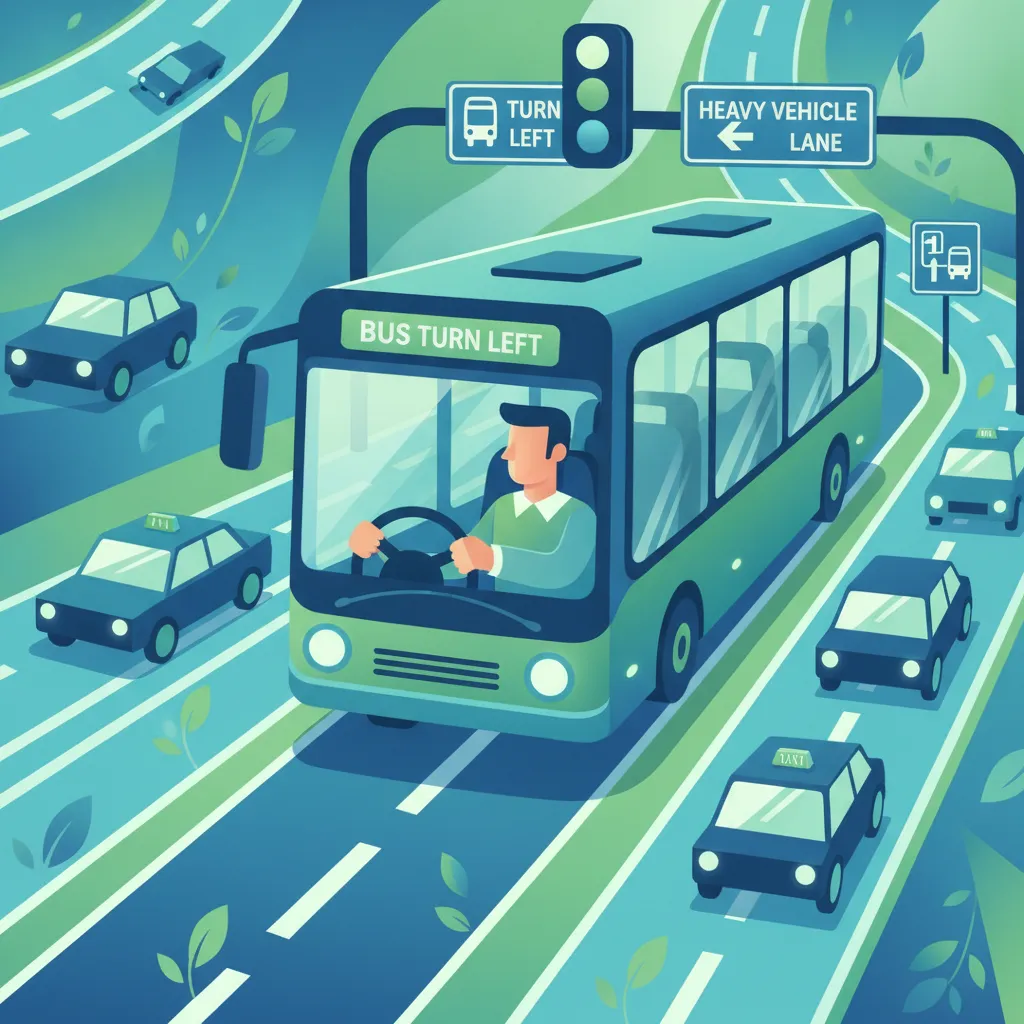
Learners will explore strategies for navigating congested urban traffic environments while operating large passenger vehicles. The lesson covers lane selection, adherence to traffic signals, and the use of bus lanes where applicable. Understanding how to maintain smooth traffic flow while ensuring passenger safety is crucial for efficient urban transportation.

This lesson details the processes involved in terminal operations and the planning of rest stops for passenger vehicles. Learners will learn about safe and efficient procedures for passenger boarding and alighting at terminals, coordinating schedules, and performing safety checks. The importance of selecting appropriate rest areas and managing breaks for both drivers and passengers is emphasized.

Learners will explore the specific regulations governing bus lanes, priority routes, and other legal restrictions applicable to passenger vehicles. The lesson covers the conditions under which buses may use dedicated lanes, how to navigate priority roadways, and the penalties associated with misuse. Understanding these rules is essential for efficient operation and avoiding violations in high-traffic areas.
This lesson addresses the particular challenges posed by standing passengers and the handling of luggage within passenger vehicles. Learners will explore best practices for securing items, guiding passenger movement, and maintaining vehicle stability. Understanding these aspects helps prevent accidents caused by shifting loads or passenger instability, especially during sudden stops or turns.
This lesson details the procedures for safely evacuating passengers from a bus in the event of a fire or other critical emergency. Topics include the location and use of emergency exits, fire extinguishers, and lighting, as well as the importance of clear communication and orderly movement of passengers. Practical steps for assisting vulnerable passengers during evacuation are emphasized.

This lesson delves into specific manoeuvring strategies required when navigating both tight urban environments and open rural roads with large passenger vehicles. Learners will explore techniques for handling narrow streets, tight turns, and intersections, while maintaining safety and efficiency. The content emphasizes planning and execution of manoeuvres based on road conditions and vehicle dimensions.
Find clear answers to common questions learners have about Managing Passenger Behaviour and In-vehicle Communication. Learn how the lesson is structured, which driving theory objectives it supports, and how it fits into the overall learning path of units and curriculum progression in Turkey. These explanations help you understand key concepts, lesson flow, and exam focused study goals.
Disruptive behaviour can cause significant driver distraction, increasing the risk of accidents. Maintaining order through clear communication is a fundamental safety responsibility for every professional Class D driver.
Always prioritize vehicle safety first. Use calm, clear verbal requests to address the behaviour while the vehicle is stationary if possible, or use non-verbal cues to maintain a professional atmosphere without escalating the situation.
Yes, the Turkish theory exam often includes situational questions regarding the professional responsibilities of passenger transport drivers, including how to handle various passenger-related incidents.
Professional conduct involves maintaining a calm demeanor, providing clear instructions for boarding and alighting, and ensuring that passenger interactions are respectful, safe, and compliant with transport regulations.
Use our comprehensive practice search to find exactly the Turkish driving theory questions you need to master. Whether reviewing specific road signs, traffic rules, or first aid scenarios, select your perfect practice set and boost your confidence for the official ehliyet sınavı.