This lesson teaches you how to identify and navigate the dangerous blind spots of larger vehicles on French roads. By mastering these spatial awareness techniques, you will significantly reduce your risk of collision and prepare effectively for motorcycle-specific hazard perception questions in the theory exam.
Lesson content overview
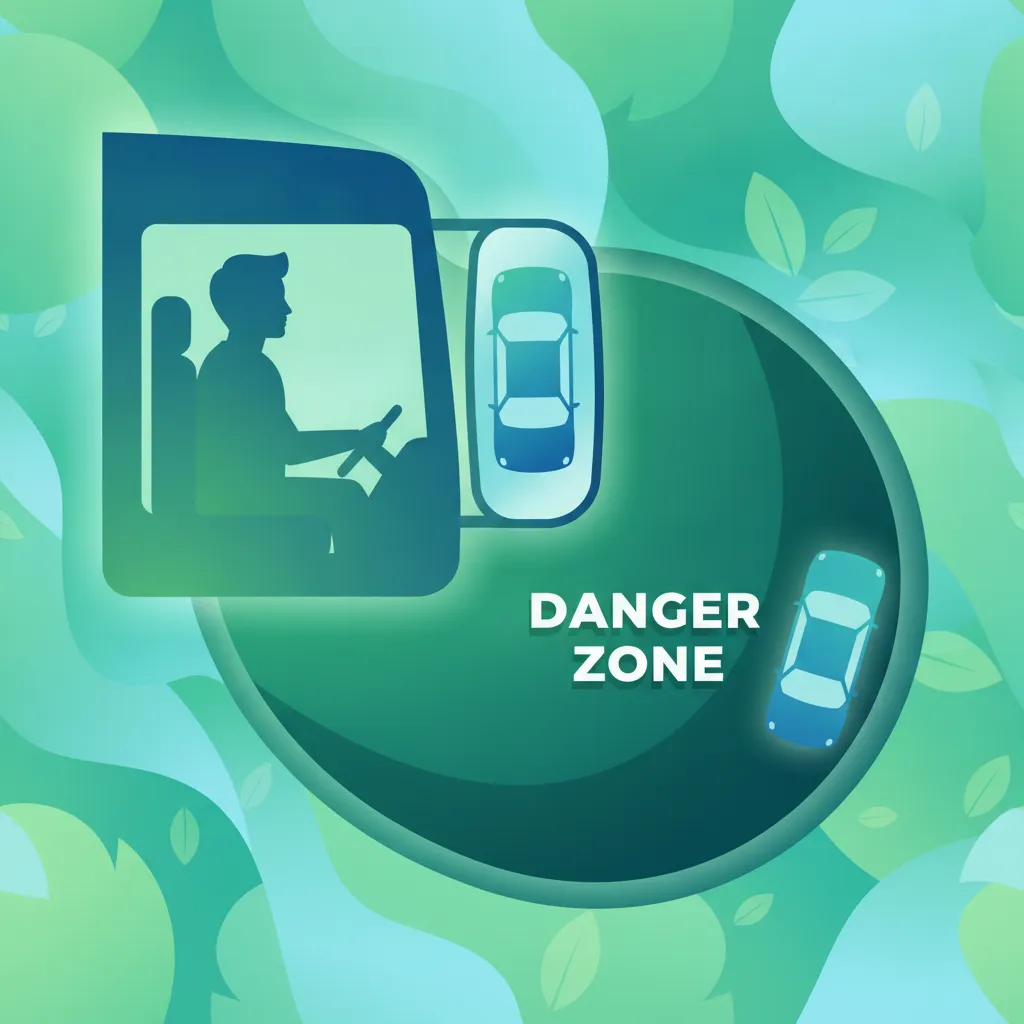
In the French Motorcycle Theory Course (Épreuve Théorique Moto - ETM), understanding how to share the road safely with heavy goods vehicles (poids lourds), buses, and coaches is a critical competency for Categories A, A1, and A2. Because of a motorcycle's slim profile, riders are naturally less visible than cars. When combined with the massive visual obstructions inherent in larger vehicles—commonly referred to in France as angles morts (blind spots) or the "No-Zone"—the risk of a catastrophic collision increases exponentially.
This lesson provides an in-depth analysis of where these blind spots are located, the physics behind them, the relevant French road safety regulations, and actionable defensive riding strategies to ensure you never remain invisible to other drivers.
A blind spot is any area around a vehicle that the driver cannot directly see through their windows or indirectly observe via their rear-view and side-view mirrors. While passenger cars have relatively small blind spots, large commercial vehicles have massive blind zones that can easily swallow multiple motorcycles, cars, or even entire groups of cyclists.
Understanding the physical boundaries of these zones is the first step toward avoiding them:
The Golden Rule of Mirror Visibility: If you cannot see the face or eyes of the truck driver in their side-view mirror, they cannot see you. You are completely invisible to them.
To address the high frequency of accidents involving vulnerable road users and large vehicles, French traffic law (Code de la route) mandates visual warning signs on heavy vehicles.
Since January 1, 2021, all vehicles with a Gross Vehicle Weight Rating (GVWR / Poids Total Autorisé en Charge - PTAC) exceeding 3.5 tonnes must display official "Attention: Angles Morts" stickers or signs. This includes heavy goods vehicles, trailers, semi-trailers, buses, and coaches operating on French public roads.
As a Category A, A1, or A2 rider, you should treat these stickers as active visual warnings. When you spot an "Angles Morts" sign, it marks the exact physical boundary of the danger zone.
Riding a motorcycle safely around large vehicles requires strategic lane positioning to maximize your visibility and maintain a safe buffer zone (protective space).
When passing or riding parallel to a heavy goods vehicle, you must respect the lateral safety margins defined by Article R414-4 of the French Code de la route:
On a motorcycle, you have the flexibility to adjust your lateral position within your lane. When passing a large vehicle, position yourself on the outer third of your lane (away from the truck) to maximize this lateral distance. This buffer provides crucial reaction time if the truck experiences a tire blowout, suffers from wind buffeting, or begins to drift due to crosswinds.
The dynamic buffer zone surrounding a motorcycle—including front, rear, and lateral clearances—that accounts for the reaction times, braking capabilities, and blind spots of surrounding road users.
Overtaking a long vehicle (such as an articulated lorry or a double-decker bus) requires careful planning, decisive acceleration, and strict compliance with the Code de la route.
Establish Visibility: Fall back to increase your follow distance. This opens up your line of sight around the truck and ensures the truck driver can see you in their side-view mirrors.
Assess the Road Ahead: Check that there are no oncoming hazards, upcoming intersections, or narrowing lanes. Ensure the lane you are merging into is completely clear.
Signal Early: Activate your left indicator well in advance to announce your intention to the truck driver and vehicles behind you.
Perform Visual Checks: Conduct a systematic check: mirrors first, followed by a quick direct head check (un contrôle direct/angle mort) over your left shoulder.
Pass Swiftly: Execute the maneuver quickly and smoothly without exceeding the speed limit. Do not linger alongside the truck’s cab or trailer.
Do Not Cut Back Too Early: Only merge back into the right lane once you can see the entire front of the truck in your rearview mirrors. This ensures you remain well clear of the truck's front blind spot.
When passing a large vehicle in wet weather, be prepared for severe road spray (projections d'eau), which can instantly obscure your visor. Increase your lateral distance, ensure your visor is clean, and use a steady, firm grip on the handlebars to counter aerodynamic turbulence.
In France, the practice of riding between lanes of slow-moving or stationary traffic—known as circulation inter-files (CIF)—is subject to strict regional regulations and ongoing experimental frameworks. For motorcyclists, filtering next to or between large vehicles represents an extreme safety hazard.
Understanding where riders frequently make mistakes can save your life. Below are common high-risk scenarios and how to handle them:
As a motorcyclist, you must adopt a proactive attitude: assume you are invisible. Do not rely on the truck driver's mirrors, electronic blind-spot sensors, or driving aids to keep you safe.
Now that you understand how to navigate around large vehicles, you can build on these visibility and space management concepts in subsequent lessons.
Explore all units and lessons included in this driving theory course.
Lesson content overview
Explore all units and lessons included in this driving theory course.
Explore search topics learners often look for when studying Understanding and Avoiding Blind Spots of Larger Vehicles. These topics reflect common questions about road rules, driving situations, safety guidance, and lesson level theory preparation for learners in France.
Browse additional driving theory lessons that cover connected traffic rules, road signs, and common driving situations related to this topic. Improve your understanding of how different rules interact across everyday traffic scenarios.
Learn the mandatory legal safety distances for motorcyclists when navigating urban and rural roads in France. This guide explains how to use lane positioning to increase your visibility and maintain a safe protective space relative to other vehicles, ensuring compliance with Article R414-4 of the French Code de la route.
This lesson explores how dividing your travel lane into three distinct vertical zones allows you to adjust your positioning for optimal safety. You will learn to shift your line to avoid oil slicks in the lane center, road debris at the edges, and wind blasts from passing trucks. Crucially, the lesson covers how to adapt your lane position on blind bends to widen your field of vision and stay clear of oncoming traffic.

This lesson teaches you how to establish and preserve a dynamic cushion of safety on all sides of your motorcycle. You will study how to apply the 'two-second rule' to keep a safe following distance, extending it to three or more seconds in adverse weather. Additionally, you will discover how to manage tailgating motorists safely without resorting to dangerous speed increases, ensuring you always maintain a clear escape route.
This lesson details how to safely enter, cruise on, and exit French motorways, known as autoroutes, which feature high-speed traffic flows. You will master the process of matching highway speeds in the acceleration lane and performing blind spot checks before merging. The lesson also explains correct lane positioning to avoid aerodynamic turbulences from large semi-trucks, and how to safely prepare for decelerating at exit ramps.

This lesson covers the strict legal conditions under which you may overtake other vehicles on French roads, including necessary visibility criteria. You will master the step-by-step process of checking rearview mirrors, performing head checks, signaling, and maintaining a safe speed differential during the pass. It also details when overtaking is strictly forbidden, such as before intersections, near pedestrian crossings, or across solid lines.

This lesson outlines the rules and practical safety limits of lane filtering, known as 'inter-files' riding, under French road guidelines. You will study the specific speed limits allowed during filtering, the conditions of high congestion where it is permitted, and where it remains completely banned. The lesson also highlights the critical need to anticipate sudden lane changes from frustrated car drivers stuck in stationary traffic queues.

This lesson addresses the challenges of positioning near larger vehicles such as cars, vans, buses, and lorries on French roads. Learners will learn to identify blind spots (angles morts), maintain a safe distance, and position themselves to maximize visibility and predictability. Understanding these dynamics is crucial for AM riders to avoid dangerous situations and ensure safe overtaking and lane sharing.

This lesson details the legal and physical implications of horizontal markings, including solid white lines, broken warning lines, and cycle lane dividers. You will learn about the strict prohibition against crossing solid lines and how directional arrows dictate correct lane choices at complex junctions. Importantly, the lesson teaches you to recognize the physical hazard of wet road paint, which drastically reduces tire grip during braking.

This lesson explains the correct procedures for entering, circulating, and exiting roundabouts, which are highly prevalent throughout France. You will learn the exact lane choice strategies based on your intended exit, and how to use your turn indicators at each stage of the maneuver. The content also addresses the critical task of performing over-the-shoulder blind spot checks to avoid conflicts with overtaking vehicles when exiting.

This lesson covers the physical mechanics of cornering, highlighting the technique of countersteering to initiate and control lean angles. You will learn to divide bends into distinct entry, apex, and exit phases, choosing the safest path that maximizes your visibility and grip reserves. Finally, the lesson explains the concept of the traction circle, helping you manage the division of tire grip between lateral cornering forces and acceleration.

This lesson covers the operational logic of traffic light signals in France, emphasizing the legal implications of the red, amber, and green cycles. You will study how to safely manage the amber phase to avoid rear-end collisions from vehicles behind while maintaining control. Additionally, you will discover the unique challenge of electromagnetic induction loops, which sometimes fail to detect lightweight motorcycles at quiet intersections.
Explore the principles of proactive risk management for motorcycle riders in France. This theory lesson covers strategies to anticipate driver errors, manage complex urban traffic environments, and identify high-risk scenarios such as intersections and turning vehicles to help you remain safe while riding on public roads.

This final lesson integrates all course concepts into a single, cohesive approach to defensive riding and continuous risk assessment. You will study how to maintain a high-mileage visual lead, continuously scanning the road ahead for warning signs of conflict. By learning to assume that other motorists may not see you, you will build the proactive slowing habits and situational awareness needed to remain safe throughout your riding life.

This lesson emphasizes that driving a motorcycle in France involves unique moral and social responsibilities towards vulnerable road users like cyclists and pedestrians. You will examine the importance of defensive riding habits, civil road etiquette, and the prioritizing of shared road safety. Understanding these principles helps to prevent dangerous situations, respect local communities, and lower overall accident statistics.

Learners will develop the ability to anticipate potential hazards on the road, enhancing reaction times and defensive riding strategies. The lesson emphasizes constant scanning, early identification of threats such as sudden stops, pedestrian crossings, or unexpected lane changes, and appropriate response measures. By cultivating proactive risk assessment, AM riders can significantly reduce accident likelihood.
This lesson teaches you how to establish and preserve a dynamic cushion of safety on all sides of your motorcycle. You will study how to apply the 'two-second rule' to keep a safe following distance, extending it to three or more seconds in adverse weather. Additionally, you will discover how to manage tailgating motorists safely without resorting to dangerous speed increases, ensuring you always maintain a clear escape route.

This lesson provides guidance on safe riding practices during nighttime, emphasizing proper headlamp usage, reflective clothing, and strategies to manage glare from oncoming traffic. Learners will learn to compensate for reduced peripheral vision and increased fatigue, as well as to identify common night road hazards in France. By applying these techniques, riders can enhance their visibility and safety after dark.

This lesson addresses the critical psychological elements that often lead to hazardous riding decisions, especially among newer motorcyclists. You will examine the dangers of overestimating your personal control limits and downplaying common road risks during group rides. The lesson provides practical strategies to resist peer pressure, maintain your own safe pace, and prioritize professional defensive habits over showing off.

This lesson focuses on adapting your riding behavior to sudden environmental shifts, such as heavy fog or strong crosswinds on exposed bridges. You will learn specific technical adjustments, including leaning slightly into crosswinds and widening your safety margins during low-visibility fog. The lesson also highlights how seasonal temperature drops affect your tires' ability to warm up and achieve reliable, safe levels of road adhesion.

This lesson addresses the unique physiological demands of operating a heavy motorcycle, requiring high muscular coordination, core stability, and rapid reaction times. You will learn to perform self-assessments of your current health status and identify how minor physical ailments can impair balance. The lesson also covers cognitive load management, ensuring that mental stress does not compromise your reaction patterns on the road.

This lesson teaches critical emergency response maneuvers to help you avoid sudden, unexpected obstacles on the roadway. You will learn the exact step-by-step process of executing a rapid, controlled swerve, keeping braking forces separate from steering inputs to prevent a slide. Additionally, the lesson addresses the psychological challenge of 'target fixation' and provides techniques to keep your eyes focused on your clear escape route.
This lesson focuses on the legal requirement to yield to pedestrians on or about to step onto zebra crossings, a major focus of French road safety. You will learn how to approach school zones and pedestrian islands with heightened vigilance and reduced speed. Additionally, the lesson explores shared urban spaces, explaining how to maintain safe lateral distances when overtaking cyclists or personal electric scooters.
Find clear answers to common questions learners have about Understanding and Avoiding Blind Spots of Larger Vehicles. Learn how the lesson is structured, which driving theory objectives it supports, and how it fits into the overall learning path of units and curriculum progression in France. These explanations help you understand key concepts, lesson flow, and exam focused study goals.
The angles morts are the blind spots where a truck driver cannot see you, particularly directly behind the trailer and alongside the passenger door. In the theory exam, always assume that if you cannot see the driver's face in their mirror, they cannot see you.
While not strictly forbidden to pass, lingering in a blind spot is dangerous and highly discouraged. You should plan your overtaking maneuver to move through the blind spot as quickly and safely as possible without exceeding speed limits.
Questions often present a dashboard or mirror view from a heavy vehicle, asking if you are currently in a dangerous position. You must identify the hazard and choose the safest response, which usually involves moving to a position where you are visible to the driver.
Yes, these rules are universal for all two-wheeled motor vehicles in France. Whether you are riding a smaller A1 machine or a high-powered category A motorcycle, the principles of visibility and space management remain critical for your safety.
Ready to focus your study? Use the practice search to find exactly the French driving theory questions you need for the Code de la route and permis de conduire ETG. Refine your knowledge on specific topics or challenging rules to boost your confidence and exam readiness.