
This lesson teaches you how to maintain control of your motorcycle when encountering unpredictable road surfaces like gravel, sand, or uneven asphalt. It is a critical part of our safety unit, building on your knowledge of motorcycle dynamics to help you handle real-world challenges in France.
Lesson content overview
Negotiating unpredictable and loose surfaces is one of the most challenging aspects of riding a motorcycle. Unlike a car, which has four wide contact patches and a self-supporting chassis, a motorcycle relies on two narrow patches of rubber to maintain balance, steering, and traction. When you encounter gravel, sand, or uneven urban pavement, the coefficient of friction drops significantly, exposing you to immediate risks of tyre slip and instability.
For riders preparing for the French motorcycle theory examination (Épreuve Théorique Moto - ETM) for the Category A, A1, and A2 licenses, understanding the physics of traction on loose surfaces is not only a requirement for passing the exam but also a foundational safety skill for navigating French roads. This lesson covers how to spot these hazards, adjust your physical posture, control your controls smoothly, and adapt your braking to prevent accidents.
On French roads, loose surfaces can appear in various environments, from rural lanes (routes départementales) to urban construction zones. Identifying these surfaces early is key to maintaining control.
Gravel is commonly found on rural roads, mountain passes, and highway exits undergoing maintenance. It acts like tiny ball bearings beneath your tyres, preventing the rubber from directly contacting the solid asphalt. The risk is twofold:
Sand is highly mobile and shifts easily under the weight of a motorcycle. Often accumulated near coastal areas, construction sites, or washed onto rural roads after heavy rain, sand can completely fill the tread grooves of your tyres, neutralizing their ability to grip the pavement.
Deteriorated urban asphalt, cracks, frost heaves, and potholes pose a physical obstruction. Striking an uneven surface at speed can compress the motorcycle's suspension completely (bottoming out), which transfers the impact directly to the chassis, potentially throwing the bike off its line or causing the rider to lose hold of the handlebars.
To safely navigate these surfaces, you must understand the mechanical forces at play between your tyres and the road.
The ratio of the force of friction between two bodies (tyre rubber and the road) to the force pressing them together. On dry, clean asphalt, this coefficient is high (approx. 0.8 to 0.9). On gravel, sand, or wet mud, it can drop to 0.3 or lower, drastically reducing the forces available for braking, accelerating, and steering.
When riding on high-grip tarmac, the tyre rubber conforms to the microscopic irregularities of the road surface. On loose surfaces, the material itself moves. When force is applied (such as braking or cornering), the gravel or sand shifts, causing the tyre to slide.
A front wheel washout occurs when the front tyre loses lateral traction and slides out sideways from under the motorcycle. This is one of the most common causes of single-vehicle motorcycle crashes. Because the front wheel is responsible for steering and provides up to 70-80% of the stopping power, any sudden loss of grip at the front leaves the rider with virtually zero recovery time, resulting in an immediate fall. This is almost always triggered by sudden front braking or excessive lean angles on a loose surface.
Rear wheel slip occurs when the engine's torque exceeds the available traction of the rear tyre, causing it to spin faster than the motorcycle's road speed. While a rear wheel slide is generally more manageable than a front-wheel washout, it can quickly lead to a "high-side" crash if the spinning tyre suddenly regains grip while the bike is out of alignment with its direction of travel.
Your physical relationship with the motorcycle determines how well the chassis can absorb the movements of loose terrain without transferring those destabilizing forces to your body.
Center Your Weight: Keep your torso centered over the motorcycle's centerline. Do not lean aggressively into turns; instead, keep the motorcycle as upright as possible by utilizing a mild "counter-weighting" technique (leaning your body slightly opposite to the turn to keep the bike upright).
Relax Your Grip (Grip Relaxation): Loosen your hold on the handlebars. Let your elbows remain bent and fluid. If you grip the bars too tightly, every minor wiggle of the front wheel over loose pebbles will be amplified by your stiff arms, turning a minor wheel movement into a major steering instability.
Squeeze the Fuel Tank: Use your knees and thighs to hug the fuel tank. This anchors your lower body to the machine, allowing your upper body and arms to remain relaxed and responsive.
Slight Rearward Bias: On deep sand or thick gravel, shifting your hips slightly backward on the seat transfers weight to the rear wheel, helping the front wheel "float" over the loose material rather than plowing into it.
On low-traction surfaces, any sudden change in speed or direction can overwhelm the limited grip available.
Avoid Throttle "Chopping": If you feel the rear wheel break traction or slip slightly on gravel, do not instantly slam (chop) the throttle closed. Sudden engine braking can cause the rear tyre to lock or slide worse. Instead, smoothly ease off the throttle to let the tyre regain traction progressively.
When accelerating on gravel or sand, you must use a smooth, progressive throttle hand. Sudden throttle inputs generate high torque spikes that easily break the weak traction barrier of loose surfaces.
Additionally, you should select a slightly higher gear than you normally would for your current road speed. Riding in a higher gear reduces the mechanical advantage of the engine, softening the power delivery and making sudden wheel spin much less likely.
The golden rule of the French Code de la route regarding speed is that your speed must be adjusted before you enter the hazard, not while you are inside it.
[Normal Asphalt Speed] ---> [Slow Down / Align Bike] ---> [Enter Gravel Zone]
                               (Braking Phase)             (Maintenance Throttle)
By reducing your speed on clean tarmac prior to entering the gravel or sand patch, you minimize the need to brake or steer aggressively while on the unstable surface.
Braking requires a complete shift in technique when riding on surfaces with low coefficients of friction.
Under normal dry road conditions, the front brake provides the majority of your stopping power. However, on loose surfaces, this rule is inverted.
While modern French and European motorcycles (Category A2 and A licenses) are equipped with standard ABS, you cannot rely blindly on this system on loose surfaces.
On deep gravel or sand, standard ABS can become confused. Because the loose material rolls under the tyres, the ABS sensors detect constant micro-locking and repeatedly release brake pressure. This can dramatically increase your stopping distance, sometimes to a dangerous degree. You must still practice progressive manual braking, treating ABS as an emergency backup rather than a primary stopping strategy.
Operating a motorcycle safely on loose surfaces is not just a physical skill; it is also regulated by traffic laws in France.
Under Article R413-17 of the French Code de la route, drivers and riders are legally required to regulate their speed based on road conditions, weather, visibility, and obstacles.
Failing to reduce speed when approaching a known hazard—such as a section of road marked by a Sign A3 (Projection de gravillons) or a construction zone—constitutes a traffic violation. In the event of a crash, failing to adapt your speed to the road conditions can result in a determination of sole liability by insurance companies and law enforcement, regardless of whether a speed limit sign was posted.
Because your stopping distances can double or triple on gravel, sand, or uneven pavement, you must increase your following distance behind the vehicle in front of you.
On loose surfaces, increase your following distance to at least 3 to 4 seconds (compared to the standard 2 seconds on dry asphalt). This prevents you from being struck by flying debris thrown up by the vehicle ahead and gives you ample time to read the surface contours and adjust your line.
| Incorrect Riding Action | Physical Consequence | Correct Safe Practice |
|---|---|---|
| Abrupt Front Braking on Gravel | Immediate front wheel lockup, leading to a front wheel washout and crash. | Reduce speed before the gravel; use the rear brake progressively. |
| Stiffening Arms / Gripping Too Tightly | Transmits every surface disturbance to the steering, causing headshake or wobble. | Relax your elbows and maintain a light, flexible grip on the handlebars. |
| Accelerating Sharply Out of a Corner | Rear wheel slip, leading to fishtailing or a high-side crash. | Apply the throttle smoothly and keep the motorcycle as upright as possible. |
| Leaning Heavily Into Loose Corners | Exceeds the lateral traction limits of the tyres, causing low-side sliding. | Keep the bike more vertical; use slight body weight shifts instead of extreme lean angles. |
| Following Too Closely Behind a Car | Exposure to projected stones; insufficient reaction time if the car brakes suddenly. | Increase following distance to a minimum of 3 to 4 seconds. |
While riding on a winding départementale road in France, you round a bend and discover a patch of loose gravel (gravillons) washed across your lane from a farm entrance.
You are riding through a city center where the top layer of asphalt has been scraped away for resurfacing, leaving a grooved, uneven concrete surface with patches of sand and raised manhole covers.
Remember, handling loose surfaces is all about anticipation and smoothness. By keeping your eyes up, relaxing your physical grip, slowing down before the hazard, and letting your motorcycle do its job, you will safely handle whatever the French road network throws your way.
Explore all units and lessons included in this driving theory course.
Lesson content overview
Explore all units and lessons included in this driving theory course.
Explore search topics learners often look for when studying Riding on Gravel, Sand, and Uneven Surfaces. These topics reflect common questions about road rules, driving situations, safety guidance, and lesson level theory preparation for learners in France.
Browse additional driving theory lessons that cover connected traffic rules, road signs, and common driving situations related to this topic. Improve your understanding of how different rules interact across everyday traffic scenarios.
Learn the mechanics of motorcycle braking and how weight transfer influences stopping performance on various road surfaces. This guide explains how to manage brake coordination and maintain chassis stability to meet the safety requirements of the French ETM motorcycle theory exam.
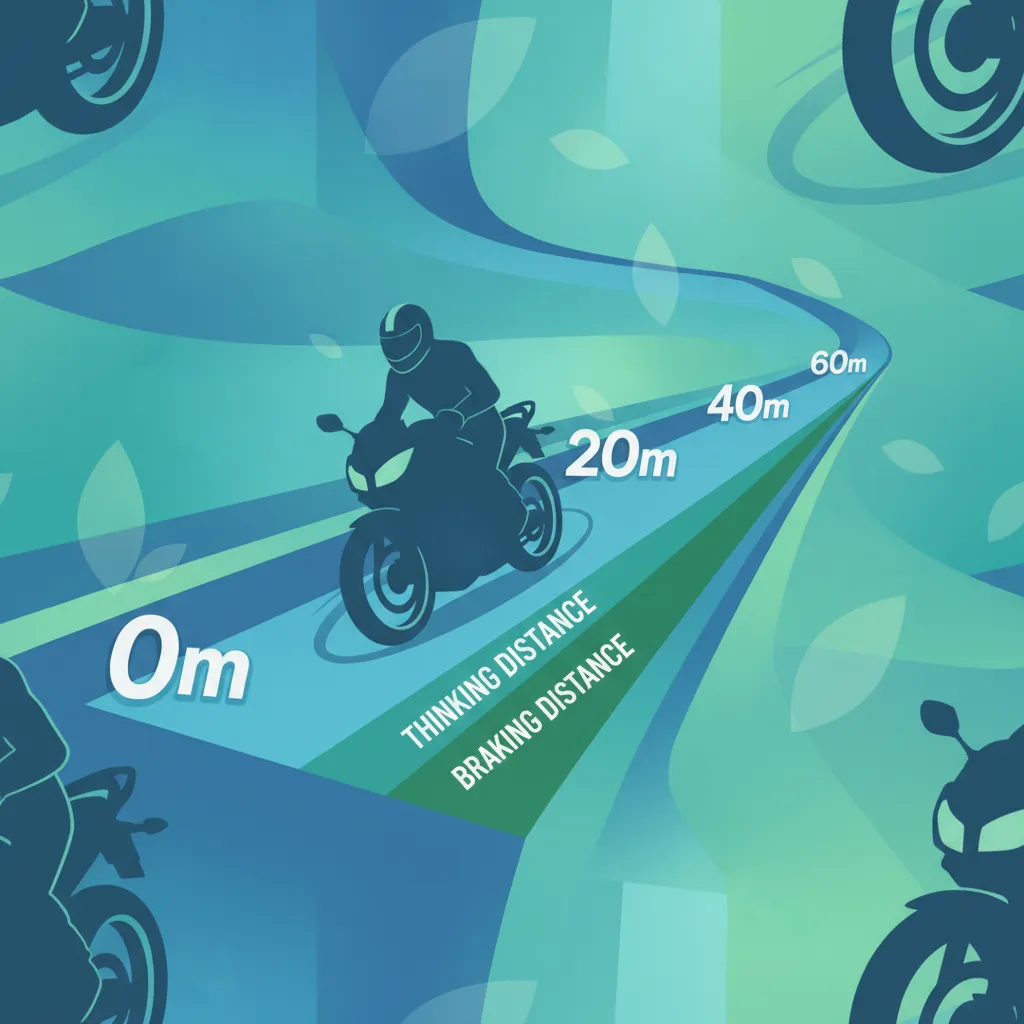
This lesson breaks down the physics of stopping a motorcycle, exploring how kinetic energy varies with the square of your speed. You will learn the mathematical components of total stopping distance, which includes both perception-reaction distance and physical braking distance. The lesson also explains how forward weight transfer during heavy braking increases traction on the front tire while reducing rear-wheel load.

This lesson explains how to coordinate your front and rear brake controls to achieve maximum stopping power without compromising your lateral stability. You will study how to progressively squeeze the front brake lever to prevent sudden wheel lockup, while using the rear brake for stabilization. The lesson also highlights the function of Anti-Lock Braking Systems (ABS) and how they help you maintain steering control during emergency stops.
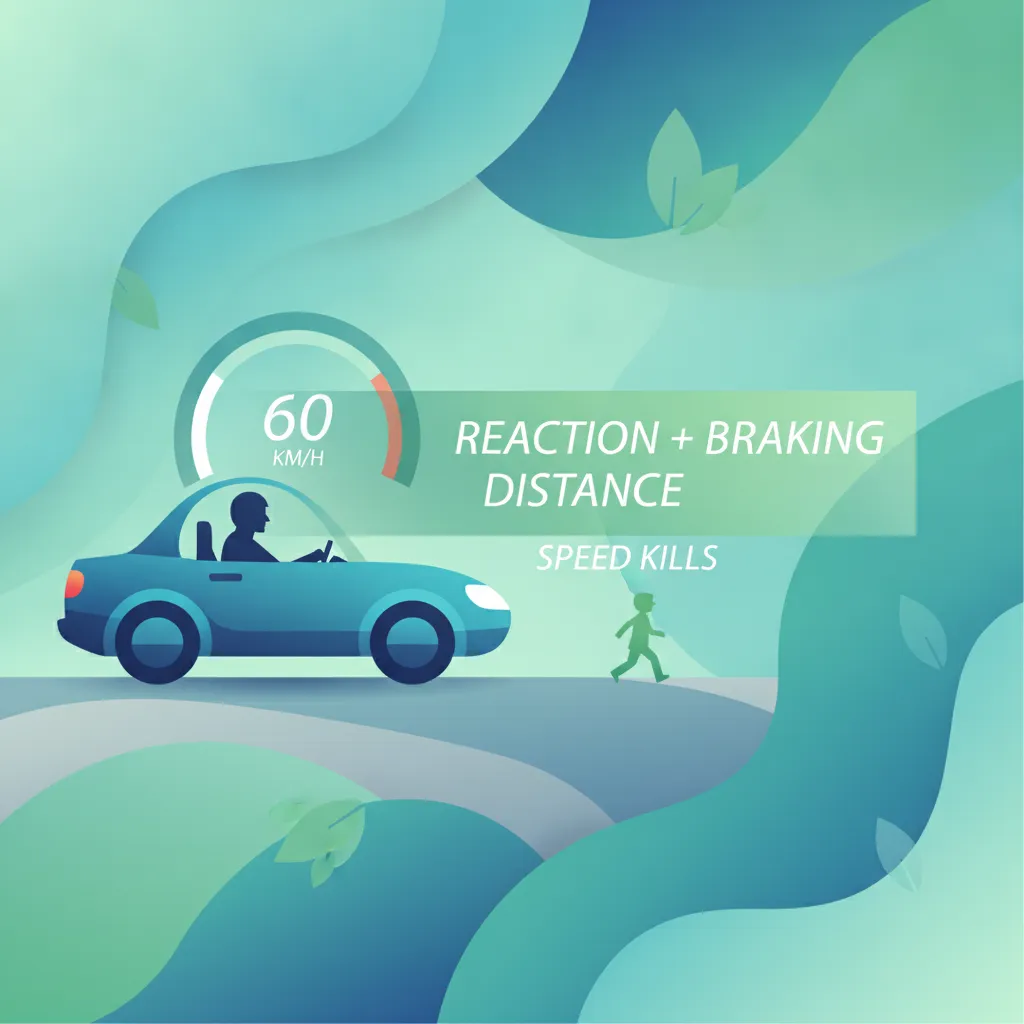
Total stopping distance is calculated as the sum of your reaction distance and the physical braking distance of the car. This lesson explains how reaction time is affected by driver focus and how speed exponentially increases the braking distance. You will learn how tire condition and slippery road surfaces degrade braking adhesion, requiring drivers to recognize and counteract these physical limits.

Learners will be introduced to effective braking techniques tailored for AM vehicles, emphasizing progressive pressure application and the importance of maintaining grip. The lesson covers how to estimate stopping distances, execute emergency stops safely, and understand the limitations of light vehicle braking systems in France. Mastery of these techniques ensures riders can stop promptly and maintain control in various traffic scenarios.
Understand how to proactively manage risks on French roads by anticipating surface hazards and environmental conditions. This lesson covers the theory behind continuous risk evaluation and how to adapt your riding style to maintain safety margins as required by the French Code de la route.

This final lesson integrates all course concepts into a single, cohesive approach to defensive riding and continuous risk assessment. You will study how to maintain a high-mileage visual lead, continuously scanning the road ahead for warning signs of conflict. By learning to assume that other motorists may not see you, you will build the proactive slowing habits and situational awareness needed to remain safe throughout your riding life.

This lesson teaches you how to establish and preserve a dynamic cushion of safety on all sides of your motorcycle. You will study how to apply the 'two-second rule' to keep a safe following distance, extending it to three or more seconds in adverse weather. Additionally, you will discover how to manage tailgating motorists safely without resorting to dangerous speed increases, ensuring you always maintain a clear escape route.

This lesson addresses the critical psychological elements that often lead to hazardous riding decisions, especially among newer motorcyclists. You will examine the dangers of overestimating your personal control limits and downplaying common road risks during group rides. The lesson provides practical strategies to resist peer pressure, maintain your own safe pace, and prioritize professional defensive habits over showing off.

Learners will develop the ability to anticipate potential hazards on the road, enhancing reaction times and defensive riding strategies. The lesson emphasizes constant scanning, early identification of threats such as sudden stops, pedestrian crossings, or unexpected lane changes, and appropriate response measures. By cultivating proactive risk assessment, AM riders can significantly reduce accident likelihood.

This lesson teaches critical emergency response maneuvers to help you avoid sudden, unexpected obstacles on the roadway. You will learn the exact step-by-step process of executing a rapid, controlled swerve, keeping braking forces separate from steering inputs to prevent a slide. Additionally, the lesson addresses the psychological challenge of 'target fixation' and provides techniques to keep your eyes focused on your clear escape route.

This lesson teaches riders how to approach and cross both controlled and uncontrolled intersections in urban settings. You will practice the 'scanning cycle' technique to identify cross-traffic hazards and manage your defensive line of sight around physical obstructions. The lesson also highlights the critical importance of early signaling and positioning to ensure that turning passenger cars do not violate your safety zone.

This lesson addresses the unique physiological demands of operating a heavy motorcycle, requiring high muscular coordination, core stability, and rapid reaction times. You will learn to perform self-assessments of your current health status and identify how minor physical ailments can impair balance. The lesson also covers cognitive load management, ensuring that mental stress does not compromise your reaction patterns on the road.
This lesson breaks down triangular warning signs, which warn of upcoming safety hazards like reverse curves, narrowing lanes, or loose gravel. You will learn to translate these visual markers into proactive riding techniques, such as adjusting your entry speed or choosing an alternative lean angle. Special attention is given to signs indicating temporary roadworks or variable grip conditions, which pose elevated dangers to motorcycles.

This lesson emphasizes that driving a motorcycle in France involves unique moral and social responsibilities towards vulnerable road users like cyclists and pedestrians. You will examine the importance of defensive riding habits, civil road etiquette, and the prioritizing of shared road safety. Understanding these principles helps to prevent dangerous situations, respect local communities, and lower overall accident statistics.

This lesson focuses on adapting your riding behavior to sudden environmental shifts, such as heavy fog or strong crosswinds on exposed bridges. You will learn specific technical adjustments, including leaning slightly into crosswinds and widening your safety margins during low-visibility fog. The lesson also highlights how seasonal temperature drops affect your tires' ability to warm up and achieve reliable, safe levels of road adhesion.
Find clear answers to common questions learners have about Riding on Gravel, Sand, and Uneven Surfaces. Learn how the lesson is structured, which driving theory objectives it supports, and how it fits into the overall learning path of units and curriculum progression in France. These explanations help you understand key concepts, lesson flow, and exam focused study goals.
On loose surfaces, the front tire has significantly less grip. Abrupt braking causes the wheel to lock instantly, leading to a loss of steering control and a high probability of the motorcycle washing out.
Keep a light and relaxed grip. A rigid grip on the handlebars transfers road vibrations directly to your upper body, which can destabilize the bike and cause you to inadvertently pull on the steering.
You should reduce your speed well before reaching the gravel section. Sudden changes in speed or direction while on loose material are the primary causes of accidents.
Yes. Keeping your weight centered and your body relaxed helps the motorcycle track better through the loose surface. Avoid leaning the bike aggressively; keep it as upright as possible.
Ready to focus your study? Use the practice search to find exactly the French driving theory questions you need for the Code de la route and permis de conduire ETG. Refine your knowledge on specific topics or challenging rules to boost your confidence and exam readiness.