
This lesson explores the critical relationship between substance use and motorcycle safety in France. You will learn the legal Blood Alcohol Concentration limits, the impairment effects of drugs, and the serious penalties associated with riding under the influence for A1, A2, and Category A candidates.
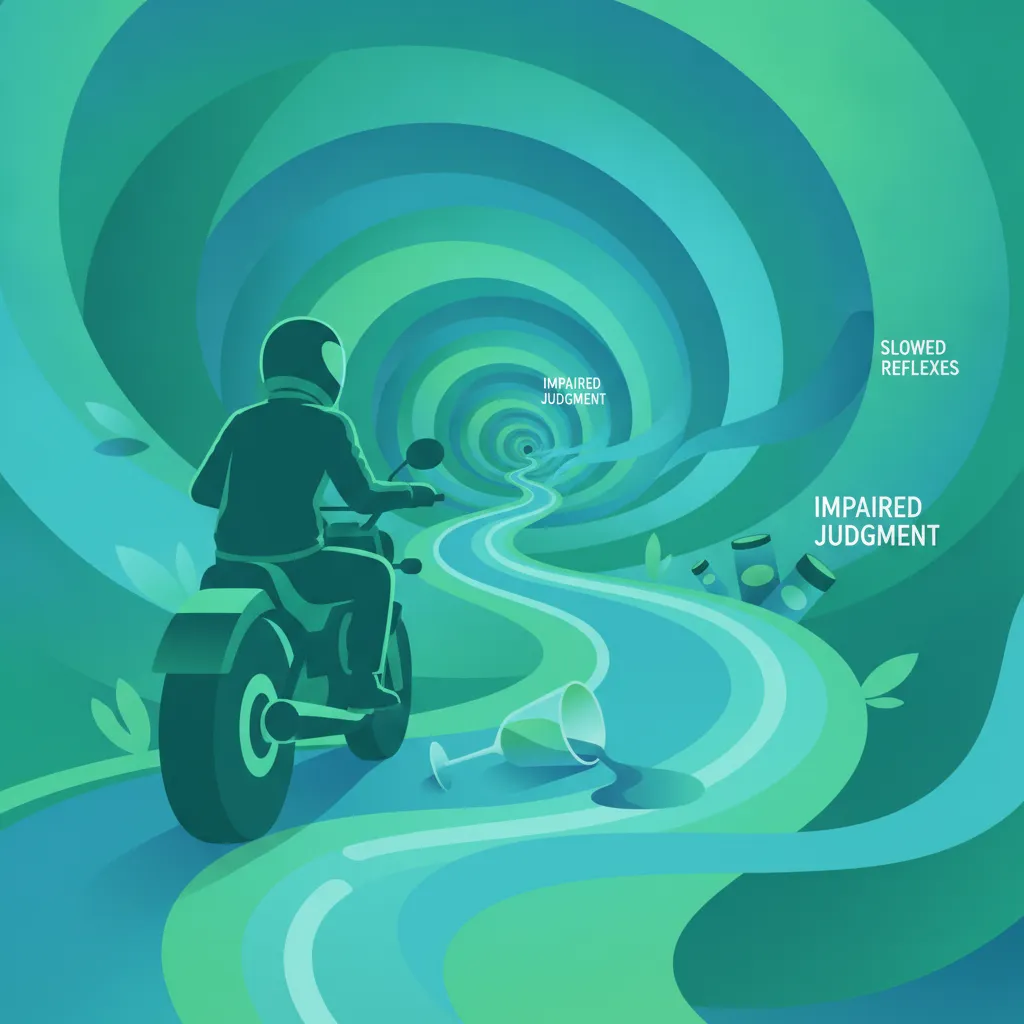
Lesson content overview
Operating a motorcycle under the French Code de la route requires peak physical and psychological conditioning. Unlike car drivers, motorcyclists must constantly maintain active physical balance, coordinate independent front and rear braking systems, and perform continuous visual scans to spot hazards.
Introducing alcohol, illicit drugs, or certain prescription medications into your system directly degrades the central nervous system (CNS), making safe operation impossible. This lesson analyzes the physiological impact of these substances, the strict legal limits enforced in France, and the severe administrative and criminal penalties for riding under the influence.
Driving a motorcycle under Category A1, A2, or A licenses demands split-second decision-making. Psychoactive substances—substances that alter brain function—interfere with how your brain perceives, processes, and responds to the environment.
A rider's eyes are their primary safety tool. At speeds of 80 km/h or higher, your visual field naturally narrows. Alcohol and drugs accelerate and worsen this effect, creating severe "tunnel vision" (vision en tunnel).
Accurate depth perception relies on both eyes sending clear, synchronized signals to the brain. Alcohol alters this binocular coordination. An impaired rider cannot accurately judge the distance between their motorcycle and the vehicle ahead, nor can they safely calculate the gap required to complete an overtaking maneuver. This often results in tailgating or misjudging the entry speed for tight corners.
At a BAC of 0.5 g/L, a rider's physical reaction time is delayed by up to 30%. In a critical situation, this delay translates directly into increased stopping distance.
The distance your motorcycle travels from the moment your eyes detect a hazard (e.g., brake lights ahead) to the moment you physically apply the brakes. At 90 km/h, a sober rider's reaction time of 1 second covers 25 meters; an impaired rider's reaction time can easily double, adding another 25 meters before braking even begins.
Motorcycles require highly refined physical inputs: smooth throttle roll-on, precise clutch friction-zone management, and progressive brake lever pressure. Impairment degrades fine motor skills, leading to jerky inputs, sudden braking, wheel lockups, and loss of control.
In France, the Code de la route establishes clear, objective thresholds for Blood Alcohol Concentration (BAC), measured either in grams per litre of blood (g/L) or milligrams per litre of exhaled air (mg/L).
The legal conversion factor used by French law enforcement is: 0.5 g/L in blood is equivalent to 0.25 mg/L in exhaled air (breathalyzer test).
For experienced riders (those holding their licence for more than two years, or outside of the probationary period), the maximum legal limit is:
New riders face a much higher risk of accidents due to their lack of experience. To mitigate this risk, France enforces a strict near-zero limit for all novice riders (jeunes conducteurs) during their probationary period (typically 3 years for standard licensing, or 2 years if completing supervised progressive training):
Many riders believe they can accelerate the elimination of alcohol by drinking coffee, exercising, taking a cold shower, or drinking large quantities of water.
Unlike alcohol, which has a legal threshold below which riding is permitted, France applies a zero-tolerance policy (tolérance zéro) for illicit narcotics and psychoactive substances while operating any vehicle.
Any detectable trace of a classified narcotic in your system while riding is a serious criminal offense.
French law enforcement officers are authorized to conduct rapid roadside saliva tests (dépistage salivaire) during traffic stops, routine checkpoints, or automatically following any traffic accident.
Initial Saliva Test: The officer uses a chemical swab test on your tongue to detect the presence of cannabis (THC), cocaine, opiates, and amphetamines/MDMA.
Secondary Verification: If the saliva test is positive, the officer will transport you to a medical facility for a blood test or a secondary laboratory saliva analysis to confirm the presence of the substance and measure its concentration.
Immediate License Retention: Upon a positive initial test, police can immediately retain your physical license for up to 120 hours while awaiting formal lab verification.
Each drug class has unique, highly dangerous effects on motorcycle control:
Not all impairing substances are illegal. Many everyday prescription (médicaments sur ordonnance) and over-the-counter drugs have powerful psychoactive effects that make riding highly dangerous.
In France, all medications that may affect your driving ability are legally required to display a standardized, color-coded warning triangle on their packaging, developed by the French National Agency for Medicines and Health Products Safety (ANSM).
Common impairing medications include antihistamines (for allergies), anti-anxiety medications (benzodiazepines), sleep aids, antidepressants, and strong painkillers containing codeine or tramadol.
The French Code de la route categorizes driving under the influence into two distinct legal classifications based on severity: Contraventions (minor to moderate offenses) and Délits (serious criminal offenses).
If your BAC is between 0.5 g/L and 0.79 g/L in your blood, you have committed a 4th-class contravention.
For a novice rider on a probationary license (which starts with a capital of only 6 points in their first year), a 6-point deduction results in the immediate and complete loss of all points, leading to the automatic invalidation of their driving license (invalidation du permis). They must wait 6 months to retake all examinations.
If your BAC is 0.8 g/L or higher, the infraction escalates into a délit (criminal offense), which is prosecuted in a criminal court (Tribunal correctionnel).
Riding with any detectable trace of illegal drugs is a criminal offense (délit), regardless of whether you feel impaired.
A motorcyclist's safety margin is highly sensitive to external conditions. When impairment is combined with adverse environments, the probability of a fatal crash increases exponentially.
[Alcohol/Drug Impairment]
       +
[Adverse Condition (Night/Rain/Heavy Cargo)]
       =
[Exponential Collision Risk]
At night, your vision is already compromised. Alcohol directly degrades your ability to recover from glare caused by the headlights of oncoming vehicles. Furthermore, the combination of darkness and chemical depressants accelerates fatigue, causing you to miss critical road signs, curves, or debris on the road surface.
Riding in rain or on wet asphalt requires highly sensitive traction management. Because substances like alcohol and cannabis cause jerky physical movements and slow down cognitive calculations, an impaired rider cannot smoothly modulate the throttle or front brake lever. This leads directly to low-side crashes or front-wheel lockups on low-grip surfaces.
Carrying a passenger (passager) or heavy luggage shifts your motorcycle's center of gravity backward and increases your stopping distance. If your coordination is already slowed by substances, you will not be able to compensate for this extra weight during low-speed maneuvers or emergency braking.
As a responsible motorcyclist, you must implement strict personal rules to ensure you never ride while impaired:
Explore all units and lessons included in this driving theory course.
Lesson content overview
Explore all units and lessons included in this driving theory course.
Explore search topics learners often look for when studying Alcohol, Drugs, and Their Effects on Riding Ability. These topics reflect common questions about road rules, driving situations, safety guidance, and lesson level theory preparation for learners in France.
Browse additional driving theory lessons that cover connected traffic rules, road signs, and common driving situations related to this topic. Improve your understanding of how different rules interact across everyday traffic scenarios.
Learn how to apply continuous risk assessment and defensive riding maneuvers to avoid common traffic hazards. This lesson explains how to maintain situational awareness and adapt your riding style to changing environmental conditions, helping you anticipate potential dangers before they occur on the road.

This final lesson integrates all course concepts into a single, cohesive approach to defensive riding and continuous risk assessment. You will study how to maintain a high-mileage visual lead, continuously scanning the road ahead for warning signs of conflict. By learning to assume that other motorists may not see you, you will build the proactive slowing habits and situational awareness needed to remain safe throughout your riding life.

This lesson teaches you how to establish and preserve a dynamic cushion of safety on all sides of your motorcycle. You will study how to apply the 'two-second rule' to keep a safe following distance, extending it to three or more seconds in adverse weather. Additionally, you will discover how to manage tailgating motorists safely without resorting to dangerous speed increases, ensuring you always maintain a clear escape route.

This lesson addresses the critical psychological elements that often lead to hazardous riding decisions, especially among newer motorcyclists. You will examine the dangers of overestimating your personal control limits and downplaying common road risks during group rides. The lesson provides practical strategies to resist peer pressure, maintain your own safe pace, and prioritize professional defensive habits over showing off.

Learners will develop the ability to anticipate potential hazards on the road, enhancing reaction times and defensive riding strategies. The lesson emphasizes constant scanning, early identification of threats such as sudden stops, pedestrian crossings, or unexpected lane changes, and appropriate response measures. By cultivating proactive risk assessment, AM riders can significantly reduce accident likelihood.

This lesson teaches critical emergency response maneuvers to help you avoid sudden, unexpected obstacles on the roadway. You will learn the exact step-by-step process of executing a rapid, controlled swerve, keeping braking forces separate from steering inputs to prevent a slide. Additionally, the lesson addresses the psychological challenge of 'target fixation' and provides techniques to keep your eyes focused on your clear escape route.

This lesson teaches riders how to approach and cross both controlled and uncontrolled intersections in urban settings. You will practice the 'scanning cycle' technique to identify cross-traffic hazards and manage your defensive line of sight around physical obstructions. The lesson also highlights the critical importance of early signaling and positioning to ensure that turning passenger cars do not violate your safety zone.
This lesson breaks down triangular warning signs, which warn of upcoming safety hazards like reverse curves, narrowing lanes, or loose gravel. You will learn to translate these visual markers into proactive riding techniques, such as adjusting your entry speed or choosing an alternative lean angle. Special attention is given to signs indicating temporary roadworks or variable grip conditions, which pose elevated dangers to motorcycles.

This lesson addresses the unique physiological demands of operating a heavy motorcycle, requiring high muscular coordination, core stability, and rapid reaction times. You will learn to perform self-assessments of your current health status and identify how minor physical ailments can impair balance. The lesson also covers cognitive load management, ensuring that mental stress does not compromise your reaction patterns on the road.

This lesson focuses on adapting your riding behavior to sudden environmental shifts, such as heavy fog or strong crosswinds on exposed bridges. You will learn specific technical adjustments, including leaning slightly into crosswinds and widening your safety margins during low-visibility fog. The lesson also highlights how seasonal temperature drops affect your tires' ability to warm up and achieve reliable, safe levels of road adhesion.

This lesson addresses the unique hazards of riding a motorcycle in wet conditions, emphasizing the danger of aquaplaning. You will learn how water pooling on the asphalt can cause tires to lose direct contact with the road, leading to a complete loss of steering control. The lesson offers practical advice on reducing your speed, using smooth throttle and brake inputs, and ensuring your tires have adequate tread depth to clear water.
Understand the critical importance of rider condition, including the effects of fatigue, stress, and distractions on motorcycle control. This lesson covers how maintaining peak mental and physical alertness is essential for split-second decision-making and safe operation of your vehicle under the French Code de la route.
This lesson addresses the unique physiological demands of operating a heavy motorcycle, requiring high muscular coordination, core stability, and rapid reaction times. You will learn to perform self-assessments of your current health status and identify how minor physical ailments can impair balance. The lesson also covers cognitive load management, ensuring that mental stress does not compromise your reaction patterns on the road.

This lesson equips riders with the skills to identify the early warning signs of physical and mental exhaustion, such as drifting attention or slow reflexes. You will study effective scheduling strategies for long-distance journeys, emphasizing the rule of taking active rests at least every two hours. Finally, the lesson explains the extreme dangers of cognitive and auditory distractions, focusing on French laws regarding Bluetooth intercoms.
Find clear answers to common questions learners have about Alcohol, Drugs, and Their Effects on Riding Ability. Learn how the lesson is structured, which driving theory objectives it supports, and how it fits into the overall learning path of units and curriculum progression in France. These explanations help you understand key concepts, lesson flow, and exam focused study goals.
Yes, during your probationary license period, the blood alcohol concentration limit is strictly 0.2 g/l, which is significantly lower than the standard 0.5 g/l limit for full license holders.
Alcohol impairs balance, coordination, and depth perception, all of which are crucial for staying upright and navigating curves on a motorcycle. Even small amounts can delay reaction times during emergency braking.
Penalties are severe and include heavy fines, immediate license suspension, loss of license points, and potential prison time. A conviction can lead to the permanent revocation of your motorcycle license.
Yes, certain medications can impair alertness and motor skills. You are legally responsible for checking if your medication includes a warning symbol indicating that it is unsafe to operate a vehicle.
Ready to focus your study? Use the practice search to find exactly the French driving theory questions you need for the Code de la route and permis de conduire ETG. Refine your knowledge on specific topics or challenging rules to boost your confidence and exam readiness.