
This lesson explains the critical legal framework governing your French motorcycle license, specifically the points-based system and penalty structure. You will learn how traffic violations impact your license standing and the steps required to keep your driving record clean during your motorcycle journey.
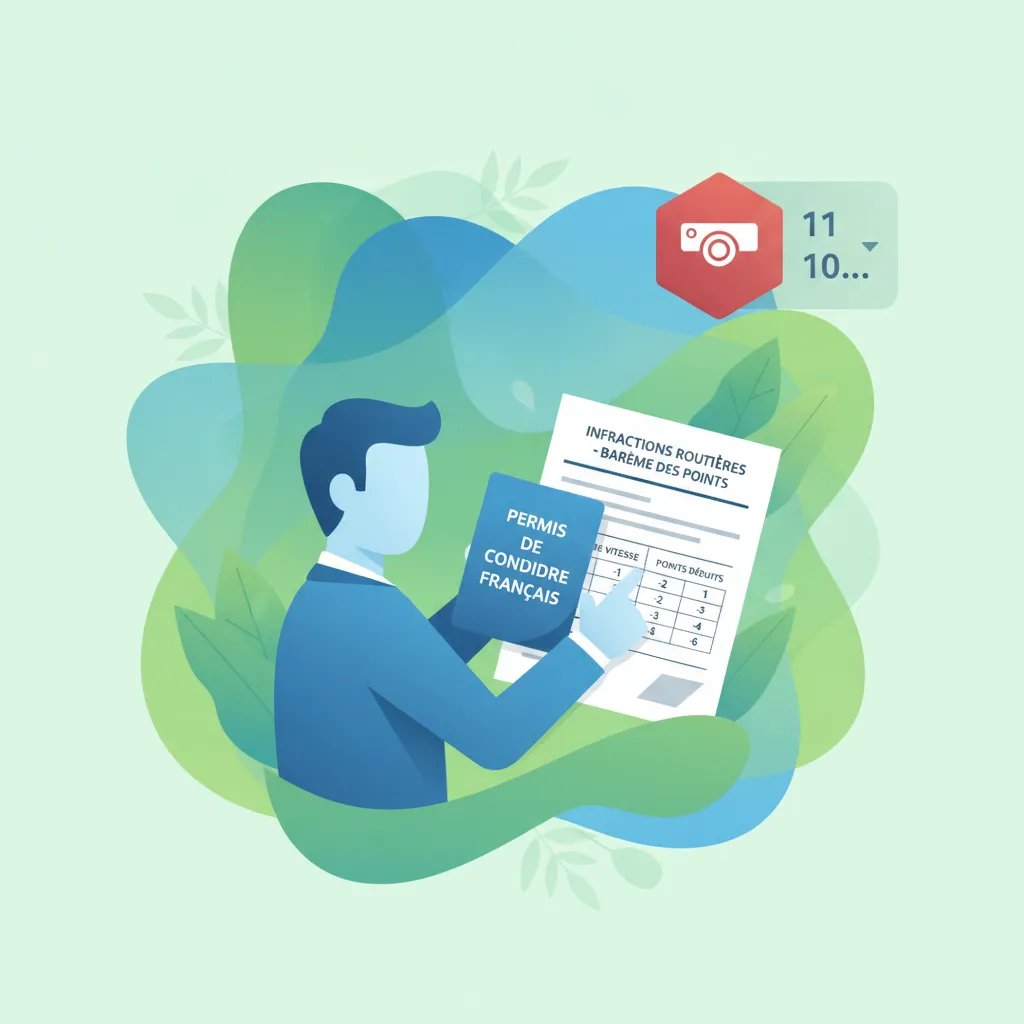
Lesson content overview
The French traffic law system operates under a rigorous regulatory framework designed to maximize road safety and minimize accidents. For motorcycle riders operating under Category A, A1, or A2 licenses, understanding this legal framework is not merely a requirement for passing the theoretical examination (Épreuve Théorique Moto - ETM); it is a vital shield that protects your driving privileges, your financial well-being, and your physical safety on public roads.
Because motorcycle riders are inherently more vulnerable than car drivers, the Code de la route applies strict enforcement mechanisms. This lesson covers the mechanics of the French points-based licensing system, the tiered structure of monetary fines, the processes for recovering lost points, and the severe legal consequences of major traffic violations, such as vehicle impoundment and license suspension.
The cornerstone of driver accountability in France is the demerit point system. Introduced to incentivize consistent safe driving, this system pairs administrative action directly with safety education and punitive measures.
Every fully licensed driver in France has a maximum capital of 12 points on their driving license. When a traffic violation is committed, points are subtracted from this total. The deduction is not immediate upon the police officer writing a ticket; instead, it is legally registered once:
If your point balance reaches zero, your license is declared invalid (permis invalidé). You will receive an official notification from the Ministry of the Interior via registered mail (known as Letter 48SI). This notification orders you to surrender your license to the local prefecture within 10 days and bans you from operating any motorized vehicle requiring a license for a minimum of six months.
For newly qualified riders, the rules are significantly stricter. Anyone passing their first motorcycle exam (Category A1 at age 16 or Category A2 at age 18) is issued a probationary license (permis probatoire).
A probationary period during which a novice driver or rider starts with a reduced capital of 6 points and must demonstrate clean driving behavior over several years to progressively reach the full 12-point threshold.
The standard probationary period lasts 3 years. If you do not commit any traffic violations that result in point loss during this period, your point capital increases gradually at the end of each year:
If you obtained your license via an accompanied driving scheme (apprentissage anticipé de la conduite - AAC, though this is primarily for cars), the probationary period is shortened to 2 years, with points increasing by 3 each year. However, for most direct motorcycle pathways (A1 and A2), the 3-year timeline is the standard.
If a novice rider commits an infraction resulting in a loss of 3 or more points during their probationary period, they are issued Letter 48N. This letter makes it mandatory to attend a paid Road Safety Awareness Course (stage de sensibilisation à la sécurité routière) within 4 months of receiving the notice.
French traffic law divides minor to serious violations into five distinct categories called contraventions. The seriousness of the offense dictates the "class" of the fine and the associated point penalty.
The vast majority of typical riding violations fall within Classes 1 through 4. Class 5 violations are reserved for highly serious offenses that are usually referred directly to a police court (tribunal de police).
| Fine Class | Violation Severity | Common Examples for Motorcycles | Maximum Fine Amount | Typical Point Deduction |
|---|---|---|---|---|
| Class 1 | Minor | Non-compliant or illegible registration plate; parking violations. | Up to €135 | 0 points |
| Class 2 | Moderate | Failure to use turn signals (clignotants); riding without CE-certified gloves; failure to pay toll. | Up to €375 | 1 to 3 points |
| Class 3 | Serious | Speeding (less than 20 km/h over the limit on roads where the limit is > 50 km/h); operating a motorcycle with defective brakes or lights. | Up to €750 | 1 to 3 points |
| Class 4 | Very Serious | Running a red light or Stop sign; phone use while riding; driving against traffic; speeding between 20 km/h and 50 km/h. | Up to €1,500 | 1 to 6 points |
To streamline the legal system, most Class 1 to 4 moving violations are processed through the fixed fine (amende forfaitaire) system. Under this mechanism, the fine amount is adjusted depending on how quickly you pay:
Minor Fine (Amende Minorée): If you pay the fine immediately on-site to the officer, or online within 15 days (30 days if paid electronically), the amount is significantly reduced. For example, a Class 4 standard fine of €135 is reduced to €90.
Standard Fine (Amende Forfaitaire): The baseline rate applied if paid within 45 days of receiving the violation notice. For Class 4, this baseline is €135.
Increased Fine (Amende Majorée): If payment is not completed within 45 days (or 60 days if paying online), the fine is heavily increased. For a Class 4 violation, this fine rises to €375.
When violations exceed standard infractions and present an immediate risk to the public, French law enforcement is empowered to remove the rider from the road immediately.
There are two primary legal paths for license suspension:
Vehicle impoundment is a highly disruptive and costly penalty. If you commit a severe infraction, the police can order your motorcycle to be towed to a secure municipal lot (fourrière) on the spot.
This measure is automatically triggered or highly likely for:
The owner of the vehicle is solely responsible for all towing costs and daily storage fees (frais de garde). The vehicle will not be released until all fees are settled, a valid insurance certificate is presented, and an individual with a valid matching motorcycle license is present to ride it out of the facility.
Losing points does not mean they are gone forever. The French legal system provides two distinct paths for riders to regain points: passive time-based recovery and active safety education.
If you commit an infraction but maintain clean driving habits afterward, your points will be restored automatically over time. The time required depends on the severity of the initial infraction:
If your point capital is low and you want to proactively protect your license from invalidation, you can enroll in a voluntary Stage de Sensibilisation à la Sécurité Routière.
Motorcycle riders face unique physical and legal risks. Below is a comprehensive breakdown of common traffic violations, their legal classifications, and their physical consequences.
Speeding is one of the leading causes of fatal motorcycle accidents in France. The penalties scale sharply with the severity of the offense:
Specific protective equipment is legally mandated for two-wheeler operators in France:
The legal consequences of traffic infractions can shift based on environmental conditions, vehicle status, and your interaction with other road users.
In wet weather, speed limits across France are automatically lowered (e.g., from 130 km/h to 110 km/h on motorways, and from 110 km/h to 100 km/h on dual carriageways).
Lane filtering—riding between lanes of slow-moving or stationary traffic—is strictly regulated in France.
Failure to yield the right-of-way to a pedestrian who is crossing, or clearly indicating their intention to cross, is a severe Class 4 infraction. For a motorcycle rider, this violation carries a heavy penalty of 6 points deducted from your license, a €135 fine, and a potential suspension of your driving license.
To see how these rules apply in real life, review the following scenarios:
Managing your license points and understanding the penalty structure is a key part of riding safely and responsibly:
By riding defensively, maintaining your equipment, and respecting speed limits, you can avoid costly fines, preserve your license, and keep yourself safe on the road.
The French points-based license system caps full licenses at 12 points and probationary licenses at 6 points, with violations classified into five contravention classes determining both fine amounts and point deductions. Point deductions register only after fine payment, expired payment windows, or judicial conviction, and learners face strict probationary rules including mandatory safety courses after losing 3 or more points. Recovery occurs passively through clean driving (6 months to 3 years depending on infraction class) or actively via a 2-day Road Safety Awareness Course that restores up to 4 points annually. Severe violations like exceeding limits by 50 km/h or more result in immediate license retention, vehicle impoundment, and potential court summons, making defensive riding and equipment compliance essential for license preservation.
A short set of high-value points that capture the most important learning from this lesson.
Full license holders have 12 points; new probationary riders start with 6 points that increase annually to 12 over 3 years
Points are deducted only after fine payment, expired payment window, or judicial conviction—not immediately upon receiving a ticket
Reaching zero points triggers license invalidation through Letter 48SI, requiring surrender within 10 days and a 6-month driving ban
Traffic violations are classified into Classes 1-5 contraventions, with point deductions ranging from 0 to 6 points depending on severity
Probationary riders who lose 3 or more points receive Letter 48N, mandating a paid safety course within 4 months
Explore all units and lessons included in this driving theory course.
Probationary point progression: 6 points at issue → 8 after Year 1 → 10 after Year 2 → 12 after Year 3
Fine payment timing: minor (within 15-30 days), standard (within 45 days), or major (after 60 days) with amounts scaling significantly
Point recovery rules: 6 months for single-point violations, 2 years for Class 1-3 infractions, 3 years for Class 4-5 infractions
Stage de Sensibilisation safety course restores up to 4 points but can only be taken once per 365-day period
Exceeding speed limits by 50 km/h or more triggers automatic vehicle impoundment as a Class 5 offense
Assuming points are deducted immediately when a police officer issues a ticket rather than understanding the registration timing rules
Confusing Class 4 fine amounts: the minor rate is €90, standard is €135, and major is €375, with learners often mixing these thresholds
Believing equipment violations like missing gloves carry no point penalties when they actually deduct 1 point under Class 2 rules
Not realizing that multiple simultaneous infractions can deduct up to 8 points in a single traffic stop, potentially invalidating a probationary license
Overlooking wet weather speed limit reductions, which can turn otherwise acceptable speeds into Class 3 or 4 violations
Lesson content overview
A short set of high-value points that capture the most important learning from this lesson.
Full license holders have 12 points; new probationary riders start with 6 points that increase annually to 12 over 3 years
Points are deducted only after fine payment, expired payment window, or judicial conviction—not immediately upon receiving a ticket
Reaching zero points triggers license invalidation through Letter 48SI, requiring surrender within 10 days and a 6-month driving ban
Traffic violations are classified into Classes 1-5 contraventions, with point deductions ranging from 0 to 6 points depending on severity
Probationary riders who lose 3 or more points receive Letter 48N, mandating a paid safety course within 4 months
Explore all units and lessons included in this driving theory course.
Probationary point progression: 6 points at issue → 8 after Year 1 → 10 after Year 2 → 12 after Year 3
Fine payment timing: minor (within 15-30 days), standard (within 45 days), or major (after 60 days) with amounts scaling significantly
Point recovery rules: 6 months for single-point violations, 2 years for Class 1-3 infractions, 3 years for Class 4-5 infractions
Stage de Sensibilisation safety course restores up to 4 points but can only be taken once per 365-day period
Exceeding speed limits by 50 km/h or more triggers automatic vehicle impoundment as a Class 5 offense
Assuming points are deducted immediately when a police officer issues a ticket rather than understanding the registration timing rules
Confusing Class 4 fine amounts: the minor rate is €90, standard is €135, and major is €375, with learners often mixing these thresholds
Believing equipment violations like missing gloves carry no point penalties when they actually deduct 1 point under Class 2 rules
Not realizing that multiple simultaneous infractions can deduct up to 8 points in a single traffic stop, potentially invalidating a probationary license
Overlooking wet weather speed limit reductions, which can turn otherwise acceptable speeds into Class 3 or 4 violations
Explore search topics learners often look for when studying Legal Penalties, Fines, and License Points System. These topics reflect common questions about road rules, driving situations, safety guidance, and lesson level theory preparation for learners in France.
Browse additional driving theory lessons that cover connected traffic rules, road signs, and common driving situations related to this topic. Improve your understanding of how different rules interact across everyday traffic scenarios.
Understand the legal obligations for drivers involved in road traffic accidents. This lesson covers essential steps for first aid, emergency contact protocols, and the official accident reporting requirements according to the French Code de la route.

This lesson provides a clear, step-by-step procedure to follow if you witness or are involved in a traffic accident in France. You will learn how to secure the scene using your mandatory hazard triangle and yellow vest to prevent secondary collisions. Crucially, it explains how to contact emergency services via 112 and covers basic first-aid rules, including the absolute ban on removing an injured rider's helmet unless necessary.

Learners will learn the immediate steps to take following an accident or vehicle breakdown, including contacting emergency services (112), providing first aid, and securing the accident scene. The lesson also covers the necessary administrative actions such as completing the official French 'constat amiable' and reporting the incident to insurance providers. Knowing these procedures ensures that riders respond effectively in emergencies.
When encountering or participating in a road accident, following a strict safety protocol protects lives and prevents secondary crashes. This lesson covers the essential 'Protect, Alert, Rescue' (PAS) protocol, which involves wearing a yellow high-visibility vest, placing a warning triangle, and calling 112. You will also learn basic first-aid practices, how to secure victims, and the correct way to fill out an accident report.

In this lesson, drivers will learn the essential steps to take following an accident involving a goods vehicle. The content covers contacting emergency services via 112, providing first aid, and safely positioning the vehicle to protect other road users. Learners will be instructed on documenting the incident, notifying insurance providers, and fulfilling legal obligations for accident reporting, including gathering witness statements.
This lesson covers immediate response steps for critical on-board events, including passenger medical emergencies and engine compartment fires. Learners will study the location and proper application of fire extinguishers, safety hammers, and first aid kits. It also explains how to coordinate effectively with French emergency services (SAMU, Fire Brigade) and reassure passengers to maintain calm during an incident.

In this lesson, learners will be equipped with the essential steps to take in the event of an emergency involving their goods vehicle, such as accidents, spills, or fires. The content covers the correct usage of the European emergency number 112, immediate safety measures to protect the scene, and the required use of driver emergency equipment like fire extinguishers and spill kits. Additionally, the lesson details the obligatory reporting processes, documentation of incidents, and cooperation with emergency services and law enforcement.

This lesson details the emergency protocols for handling mechanical breakdowns or tire blowouts on public highways and motorways. Drivers will learn how to park the vehicle in the safest possible location, activate hazard warning lights, and deploy the reflective warning triangle. It teaches precise commands and steps for evacuating passengers quickly through safety exits, positioning them behind protective guardrails.
Explore proactive defensive riding techniques designed to minimize accident risks. This theory lesson focuses on continuous risk assessment, understanding common dangerous behaviors on the road, and strategies for maintaining safety when sharing traffic with other road users.

This final lesson integrates all course concepts into a single, cohesive approach to defensive riding and continuous risk assessment. You will study how to maintain a high-mileage visual lead, continuously scanning the road ahead for warning signs of conflict. By learning to assume that other motorists may not see you, you will build the proactive slowing habits and situational awareness needed to remain safe throughout your riding life.

Learners will develop the ability to anticipate potential hazards on the road, enhancing reaction times and defensive riding strategies. The lesson emphasizes constant scanning, early identification of threats such as sudden stops, pedestrian crossings, or unexpected lane changes, and appropriate response measures. By cultivating proactive risk assessment, AM riders can significantly reduce accident likelihood.

This lesson teaches you how to establish and preserve a dynamic cushion of safety on all sides of your motorcycle. You will study how to apply the 'two-second rule' to keep a safe following distance, extending it to three or more seconds in adverse weather. Additionally, you will discover how to manage tailgating motorists safely without resorting to dangerous speed increases, ensuring you always maintain a clear escape route.

This lesson teaches critical emergency response maneuvers to help you avoid sudden, unexpected obstacles on the roadway. You will learn the exact step-by-step process of executing a rapid, controlled swerve, keeping braking forces separate from steering inputs to prevent a slide. Additionally, the lesson addresses the psychological challenge of 'target fixation' and provides techniques to keep your eyes focused on your clear escape route.

This lesson emphasizes that driving a motorcycle in France involves unique moral and social responsibilities towards vulnerable road users like cyclists and pedestrians. You will examine the importance of defensive riding habits, civil road etiquette, and the prioritizing of shared road safety. Understanding these principles helps to prevent dangerous situations, respect local communities, and lower overall accident statistics.

This lesson provides guidance on safe riding practices during nighttime, emphasizing proper headlamp usage, reflective clothing, and strategies to manage glare from oncoming traffic. Learners will learn to compensate for reduced peripheral vision and increased fatigue, as well as to identify common night road hazards in France. By applying these techniques, riders can enhance their visibility and safety after dark.

This lesson focuses on the inherent vulnerability of AM vehicles due to their limited mass, exposure, and visibility within mixed traffic flows on French roads. Learners will examine how blind spots, sudden lane changes by larger vehicles, and higher impact severity affect small vehicle safety. The content underscores the necessity for riders to adopt proactive safety measures, maintain safe distances, and be constantly aware of surrounding traffic dynamics.

This lesson focuses on the legal requirement to yield to pedestrians on or about to step onto zebra crossings, a major focus of French road safety. You will learn how to approach school zones and pedestrian islands with heightened vigilance and reduced speed. Additionally, the lesson explores shared urban spaces, explaining how to maintain safe lateral distances when overtaking cyclists or personal electric scooters.

This lesson focuses on French warning signs that alert drivers to potential hazards ahead, such as curves, animal crossings, or slippery surfaces, with particular attention to signs relevant to AM riders. Learners will examine how to interpret these signs, understand the associated risks, and adapt riding behavior accordingly. By mastering warning sign recognition, riders can proactively manage safety risks in diverse road conditions.

This lesson addresses the critical psychological elements that often lead to hazardous riding decisions, especially among newer motorcyclists. You will examine the dangers of overestimating your personal control limits and downplaying common road risks during group rides. The lesson provides practical strategies to resist peer pressure, maintain your own safe pace, and prioritize professional defensive habits over showing off.
Find clear answers to common questions learners have about Legal Penalties, Fines, and License Points System. Learn how the lesson is structured, which driving theory objectives it supports, and how it fits into the overall learning path of units and curriculum progression in France. These explanations help you understand key concepts, lesson flow, and exam focused study goals.
As a novice driver on a probationary license, you start with 6 points. You gain points annually, provided you commit no traffic violations, eventually reaching the full 12-point total.
Yes, you can recover points automatically after a set period of time without further offenses, or voluntarily by attending an approved road safety awareness course.
Losing all points results in the invalidation of your driving license. You are prohibited from driving or riding and must complete administrative procedures to regain the right to drive.
The point deduction system for traffic violations is governed by the general Code de la route and applies consistently across all motorcycle license categories.
Ready to focus your study? Use the practice search to find exactly the French driving theory questions you need for the Code de la route and permis de conduire ETG. Refine your knowledge on specific topics or challenging rules to boost your confidence and exam readiness.