
This lesson details the specific legal obligations for securing cargo on heavy goods vehicles under the Italian Codice della Strada. You will explore the regulatory standards for load-securing equipment and understand how these rules are strictly enforced to prevent accidents and legal penalties. Mastering these concepts is essential for both your professional C/CE theory exam and safe, compliant transport operations.

Lesson content overview
Securing a load correctly is not merely a matter of good practice; it is a fundamental legal obligation for all professional drivers in Italy, particularly those operating heavy goods vehicles (C, C1, C1E, CE categories). This lesson, part of your Italian Goods Vehicle License Theory Course, provides a detailed overview of the legal framework established by the Codice della Strada (Italian Traffic Code) and related technical standards. Understanding and adhering to these regulations is crucial for ensuring road safety, preventing accidents, and avoiding severe penalties.
The primary objective of load securing laws is to prevent load shift, which can severely compromise vehicle stability, extend braking distances, and increase the risk of rollovers or other hazardous incidents. These laws clearly delineate the driver's responsibility to verify that loads are properly secured before departure and throughout the journey, and they prescribe specific technical standards for all securing equipment. Non-compliance can lead to substantial fines, points on the driver's license, and even criminal liability in the event of an accident.
The Italian legal system places significant emphasis on the safe transport of goods, recognizing the potential dangers posed by improperly secured cargo. The Codice della Strada serves as the foundational text, outlining the duties and responsibilities of drivers and transport operators. Compliance with these regulations is not just about avoiding penalties; it's about protecting lives, maintaining vehicle integrity, and preserving public infrastructure.
Heavy goods vehicles, due to their size and weight, carry inherent risks that are amplified by unstable loads. An unsecured load can become a dangerous projectile during sudden braking or a severe curve, impacting other road users or damaging the vehicle itself. The dynamic forces exerted on cargo during transport are considerable, requiring robust securing methods.
Proper load securing ensures that:
A core principle of Italian transport law is that the driver bears the ultimate responsibility for the security of the load. This responsibility is continuous, starting from the moment the load is placed on the vehicle until it reaches its destination. It requires active engagement, not passive oversight. The driver cannot delegate this crucial duty entirely to loading personnel or third parties; they must personally inspect and confirm the load's security. This legal obligation underscores the critical role of the driver in maintaining overall road safety.
Italian law, informed by broader European regulations, establishes several key principles that govern load securing for heavy goods vehicles. These principles are designed to create a comprehensive safety net, addressing both human responsibility and technical standards.
The driver's responsibility is central to the legal framework for load securing. Before commencing any journey, and at appropriate intervals during the journey, the driver must ensure that the load is securely fixed, the securing devices are in good condition, and the load distribution complies with legal limits. This duty is specifically outlined in the Codice della Strada.
The mandatory duty of the driver to inspect and verify that the cargo is correctly secured before starting the journey and to monitor its security during transit.
This personal verification is essential. It means checking the tension of straps, the integrity of chains, the condition of lashing points, and the overall stability of the cargo. Failure to perform these checks can lead to severe penalties and may result in criminal liability if an accident occurs due to an unsecured load.
All equipment used for securing loads, such as tie-down straps, chains, tensioning devices, and load restraints, must meet specific technical specifications. In Italy, these are typically defined by UNI standards, which are often aligned with broader European Norms (EN). These standards ensure that securing devices are capable of withstanding the forces they may be subjected to during transport without failing.
For example, polyester tie-down straps are typically required to conform to UNI EN 12195-2, which specifies their lashing capacity (LC) and breaking strength. Chains might be subject to UNI EN 12640. Using substandard, worn, or improvised equipment is illegal and will invalidate the driver's compliance with load securing obligations, even if the load appears visually secure. Certification and proper markings on equipment are therefore crucial.
Beyond simply securing the load, its placement within the vehicle is equally critical. The cargo's distribution must respect the legal limits for axle loads and maintain a safe center of gravity (COG) for the entire vehicle.
The maximum permissible weight that can be borne by a single axle or group of axles, as defined by law, crucial for protecting road infrastructure and ensuring vehicle stability.
The hypothetical point where the entire weight of the load, or the vehicle and its load, can be considered to act. Its position significantly influences vehicle stability.
Improper load distribution can lead to:
Drivers must therefore be aware of their vehicle's maximum permissible axle loads and distribute cargo evenly to keep the COG as low and central as possible. This requires an understanding of basic physics concepts and careful planning during the loading process.
The Codice della Strada is the authoritative legal document governing road traffic in Italy. Several articles specifically address load securing and related responsibilities for heavy goods vehicle drivers.
Article 97 of the Codice della Strada explicitly outlines the driver's duty regarding pre-departure checks. It mandates that the driver must ensure that the load is securely fixed and that its distribution is safe before starting any journey. This is not a suggestion but a mandatory requirement.
Consider creating a pre-departure checklist for load securing to ensure no critical step is missed. This could include checking strap tension, shackle integrity, anti-slip mat placement, and overall load stability.
This article emphasizes that the driver's personal verification is paramount. It means actively checking securing devices for tightness, signs of wear, or damage. Simply assuming the load is secure because it was loaded by others is a common misunderstanding that can lead to severe consequences.
Article 98 delves into the technical aspects of load securing, mandating that all securing devices must meet specific technical norms and be in proper working condition. This article directly links to the UNI standards and European Norms discussed earlier.
Official approval and markings indicating that a load securing device complies with specified technical standards and performance criteria, such as UNI EN 12195.
This means using certified equipment appropriate for the load's weight and characteristics. Using improvised materials, such as household ropes or non-certified chains, is a direct violation of this article, regardless of how "secure" they might appear visually. Regular maintenance and replacement of worn equipment are therefore essential for compliance.
While not exclusively about securing, Article 102 (and other related articles, e.g., Art. 61-62 on vehicle dimensions and mass) is critically important as it defines the maximum permissible axle loads for vehicles. Correct load distribution is essential to prevent exceeding these limits. Overloading an axle can lead to fines, damage to the vehicle and road infrastructure, and significantly compromise vehicle stability and braking performance.
Drivers must be aware of their vehicle's specific axle load capacities and how different loading configurations impact these limits.
Several other articles within the Codice della Strada and subsequent implementing decrees deal with aspects of load securing and the consequences of non-compliance. These cover the administrative and potentially criminal penalties.
For example, Article 101 specifies penalties for loads that are poorly secured or protruding dangerously. The consequences for violations are stringent, reflecting the high-risk nature of unsecured loads. These can range from significant administrative fines to penalty points on the driver's license. In severe cases, especially if an accident occurs due to an unsecured load, the driver may face criminal prosecution under Article 108 and other relevant penal code provisions.
Compliance with load securing regulations extends beyond initial application; it requires ongoing vigilance. Drivers are responsible for verifying the condition of their securing devices and ensuring they remain effective throughout the journey.
A routine inspection process is critical. Before departing, the driver should perform a thorough check of all securing components.
Visually inspect all straps, chains, and ropes for fraying, cuts, knots, rust, or other damage.
Check tensioning devices (ratchets, winches) for proper function, signs of wear, and secure locking mechanisms.
Verify that all lashing points on the vehicle are intact and free from damage or corrosion.
Ensure anti-slip mats, if used, are correctly positioned and effective.
Confirm the load itself is stable, not shifting, and distributed according to axle load limits.
For specific cargo types (e.g., liquids, aggregates), check for any special containment measures.
During transit, particularly after the first few kilometers, and then at regular intervals (e.g., during mandated breaks), the driver should re-check the load's security. Cargo can settle, straps can loosen, or environmental factors can affect tension. Tactile verification—feeling the tightness of straps—is often more reliable than a visual check alone.
Securing devices are subject to considerable stress and environmental exposure. Regular inspection for wear and tear is vital.
Using damaged or worn equipment is not only illegal but extremely dangerous. It creates a false sense of security and significantly increases the risk of load failure during transport.
Never attempt to repair damaged load securing equipment. Frayed straps, bent chains, or faulty tensioners must be replaced with new, certified items to ensure safety and compliance.
The Codice della Strada imposes clear and significant penalties for violations related to load securing. These are designed to deter negligence and reinforce the critical importance of compliance.
Drivers found operating a vehicle with an unsecured or improperly secured load can face substantial administrative fines. The exact amount varies depending on the severity of the violation and specific articles invoked (e.g., Art. 97, Art. 98, Art. 101). In addition to fines, penalty points are typically added to the driver's license. A serious offense, such as a load posing an immediate danger, can result in a significant number of points (e.g., 10 points for certain serious violations). Accumulating too many points can lead to license suspension or revocation.
Beyond administrative penalties, the driver can face criminal charges if an unsecured load leads to an accident causing injury, death, or significant property damage. Article 108 of the Codice della Strada specifically addresses liability in such cases. The driver may be held responsible for causing the accident, potentially leading to imprisonment, heavy financial compensation, and a permanent criminal record. This aspect highlights the very serious implications of failing to meet load securing obligations.
Drivers often make common mistakes that lead to violations:
Load securing is not a one-size-fits-all process. Various contextual factors require adjustments to methods and vigilance levels.
In urban areas, vehicles operate in close proximity to pedestrians, cyclists, and other vehicles. Load shift in such environments can have particularly dangerous consequences:
Extra caution, frequent checks, and conservative driving are essential when transporting loads in urban environments.
Mastering the legal requirements for load securing in Italy is an indispensable part of becoming a competent and responsible heavy goods vehicle driver. The Codice della Strada, with articles such as 97, 98, and 102, clearly defines the driver's pivotal role and the technical standards that must be met. From rigorous pre-departure checks and the correct use of certified equipment to meticulous load distribution and ongoing verification, every aspect is critical.
Understanding these regulations is not just about avoiding severe penalties—fines, license points, and potential criminal liability—but fundamentally about ensuring the safety of all road users, protecting your vehicle and cargo, and upholding professional standards. By diligently applying these principles and adapting securing methods to various conditions, drivers contribute significantly to overall road safety in Italy.
This lesson covers the legal framework for load securing on Italian heavy goods vehicles under the Codice della Strada. Drivers are legally obligated to personally verify load security before and during journeys, using only equipment certified to UNI and European Norm standards such as UNI EN 12195-2 for straps. Proper load distribution respecting axle load limits and maintaining a low center of gravity is essential for vehicle stability and legal compliance. Violations can result in substantial administrative fines, penalty points on the driver's license, and criminal liability if an accident occurs due to an unsecured load. The content also addresses practical adaptations for different conditions including weather variations, road types, and urban environments where vulnerable road users are present.
A short set of high-value points that capture the most important learning from this lesson.
The driver bears ultimate personal legal responsibility for load security, regardless of who performed the loading
Specific Codice della Strada articles (97, 98, 102) define mandatory obligations for pre-departure checks, equipment standards, and axle load limits
All load-securing equipment must meet certified UNI/European Norm technical standards and display proper markings such as Lashing Capacity (LC)
Load distribution must respect axle load limits while keeping the center of gravity as low and central as possible
Unsecured loads create multiple legal exposure risks including administrative fines, penalty points, and potential criminal liability under Article 108
Explore all units and lessons included in this driving theory course.
Article 97 mandates personal pre-departure verification; Article 98 requires certified equipment; Article 102 governs axle load limits
Straps must conform to standards like UNI EN 12195-2; chains to UNI EN 12640; look for certification marks and LC values
Axle load limits protect road infrastructure and vehicle stability—overloading even one axle is a violation
Tactile verification of tension and condition is more reliable than visual inspection alone
Driver responsibility is continuous: check before departure, after first kilometers, and during mandated breaks
Assuming load security responsibility can be fully delegated to loading personnel—the driver remains legally accountable
Relying solely on visual inspection without physically checking strap tension and equipment condition
Using worn, damaged, or improvised securing equipment that lacks proper certification marks
Failing to account for reduced friction in wet or icy conditions, which can cause apparently secure loads to shift
Neglecting to re-check and re-tension securing devices after cargo settles during the first kilometers of travel
Lesson content overview
A short set of high-value points that capture the most important learning from this lesson.
The driver bears ultimate personal legal responsibility for load security, regardless of who performed the loading
Specific Codice della Strada articles (97, 98, 102) define mandatory obligations for pre-departure checks, equipment standards, and axle load limits
All load-securing equipment must meet certified UNI/European Norm technical standards and display proper markings such as Lashing Capacity (LC)
Load distribution must respect axle load limits while keeping the center of gravity as low and central as possible
Unsecured loads create multiple legal exposure risks including administrative fines, penalty points, and potential criminal liability under Article 108
Explore all units and lessons included in this driving theory course.
Article 97 mandates personal pre-departure verification; Article 98 requires certified equipment; Article 102 governs axle load limits
Straps must conform to standards like UNI EN 12195-2; chains to UNI EN 12640; look for certification marks and LC values
Axle load limits protect road infrastructure and vehicle stability—overloading even one axle is a violation
Tactile verification of tension and condition is more reliable than visual inspection alone
Driver responsibility is continuous: check before departure, after first kilometers, and during mandated breaks
Assuming load security responsibility can be fully delegated to loading personnel—the driver remains legally accountable
Relying solely on visual inspection without physically checking strap tension and equipment condition
Using worn, damaged, or improvised securing equipment that lacks proper certification marks
Failing to account for reduced friction in wet or icy conditions, which can cause apparently secure loads to shift
Neglecting to re-check and re-tension securing devices after cargo settles during the first kilometers of travel
Explore search topics learners often look for when studying Legal Requirements for Load Securing in Italy. These topics reflect common questions about road rules, driving situations, safety guidance, and lesson level theory preparation for learners in Italy.
Browse additional driving theory lessons that cover connected traffic rules, road signs, and common driving situations related to this topic. Improve your understanding of how different rules interact across everyday traffic scenarios.
Understand the significant administrative fines, license point deductions, and potential criminal liabilities associated with non-compliant load securing in Italy. Learn about driver's responsibility under the Codice della Strada to prevent accidents.
This lesson provides a clear overview of the legal consequences for failing to comply with road transport regulations in Italy. It covers the system of fines for common offenses like speeding, overloading, and violations of driving hours. The lesson also explains the penalty point system that can lead to license suspension and touches upon the responsibilities and potential liability of the transport company.

This lesson delves into the specific articles of the Italian Codice della Strada that apply to heavy goods vehicles. It outlines the core legal and professional obligations of a driver, including the heightened duty of care owed to other road users and the responsibility for the vehicle's roadworthiness and load. Learners will understand the legal consequences of non-compliance, such as fines and sanctions, reinforcing the importance of adhering to all traffic regulations.

This lesson prepares drivers for incidents beyond a simple breakdown, such as losing part of the load onto the roadway or dealing with a spillage. It outlines the immediate priorities: ensuring personal safety, warning other traffic of the hazard, and notifying the authorities. The lesson also covers the fundamental principles of managing an accident scene, including protecting the area, assessing for casualties, and providing essential information to emergency services.

This lesson introduces the core physical principles behind effective cargo restraint. It explains how different methods—such as blocking to prevent sliding, and lashing to increase pressure and friction—work to counteract the forces of acceleration, braking, and cornering. Learners will become familiar with the various types of equipment, like straps and chains, and understand the basic concepts that underpin all secure loading practices.

This lesson outlines the correct protocols for stopping to make a delivery in a public area. It covers the legal use of designated loading bays, the importance of making the vehicle highly visible with hazard lights, and ensuring that the parking brake is securely applied. The lesson stresses the need to conduct loading and unloading activities efficiently and safely, without causing undue obstruction or danger to other road users and pedestrians.

This lesson explains the principles of safe load management to maintain vehicle stability and comply with legal requirements. It covers how to properly distribute and secure cargo inside the vehicle, the rules for using roof racks, and the specific signaling required for loads that project beyond the vehicle's rear. The content also provides a basic introduction to the rules and safety considerations when towing a small trailer.

This lesson details the legal restrictions on the weight that can be supported by a single axle or a group of axles. It explains the importance of distributing the load correctly across the vehicle's length to prevent exceeding these limits, which can cause significant road damage and compromise vehicle safety. Learners will understand the relationship between load placement, axle pressure, and overall stability, particularly during braking and cornering.
Explore the technical standards, including UNI and European norms, that securing equipment must meet for heavy goods vehicles in Italy. Understand the driver's role in verifying equipment integrity and compliance with legal requirements.
This lesson introduces the core physical principles behind effective cargo restraint. It explains how different methods—such as blocking to prevent sliding, and lashing to increase pressure and friction—work to counteract the forces of acceleration, braking, and cornering. Learners will become familiar with the various types of equipment, like straps and chains, and understand the basic concepts that underpin all secure loading practices.

This lesson addresses how adverse weather can compromise load securing arrangements. It explains how rain and ice can reduce the friction between the load and the vehicle bed, and how some lashing materials like webbing straps can stretch when wet, losing tension. Learners will understand the need to check and re-tighten securing equipment during journeys in bad weather and to take extra precautions to account for reduced friction.
This lesson outlines the correct protocols for stopping to make a delivery in a public area. It covers the legal use of designated loading bays, the importance of making the vehicle highly visible with hazard lights, and ensuring that the parking brake is securely applied. The lesson stresses the need to conduct loading and unloading activities efficiently and safely, without causing undue obstruction or danger to other road users and pedestrians.

This lesson covers the complete set of lighting, reflective equipment, and protective guards mandated for heavy vehicles. It explains the function of each light, from headlights to side markers, and the importance of keeping them clean and operational to ensure the vehicle is visible to others. The lesson also details the legal requirements and safety purpose of side guards and rear underrun protection, which are designed to protect vulnerable road users in a collision.
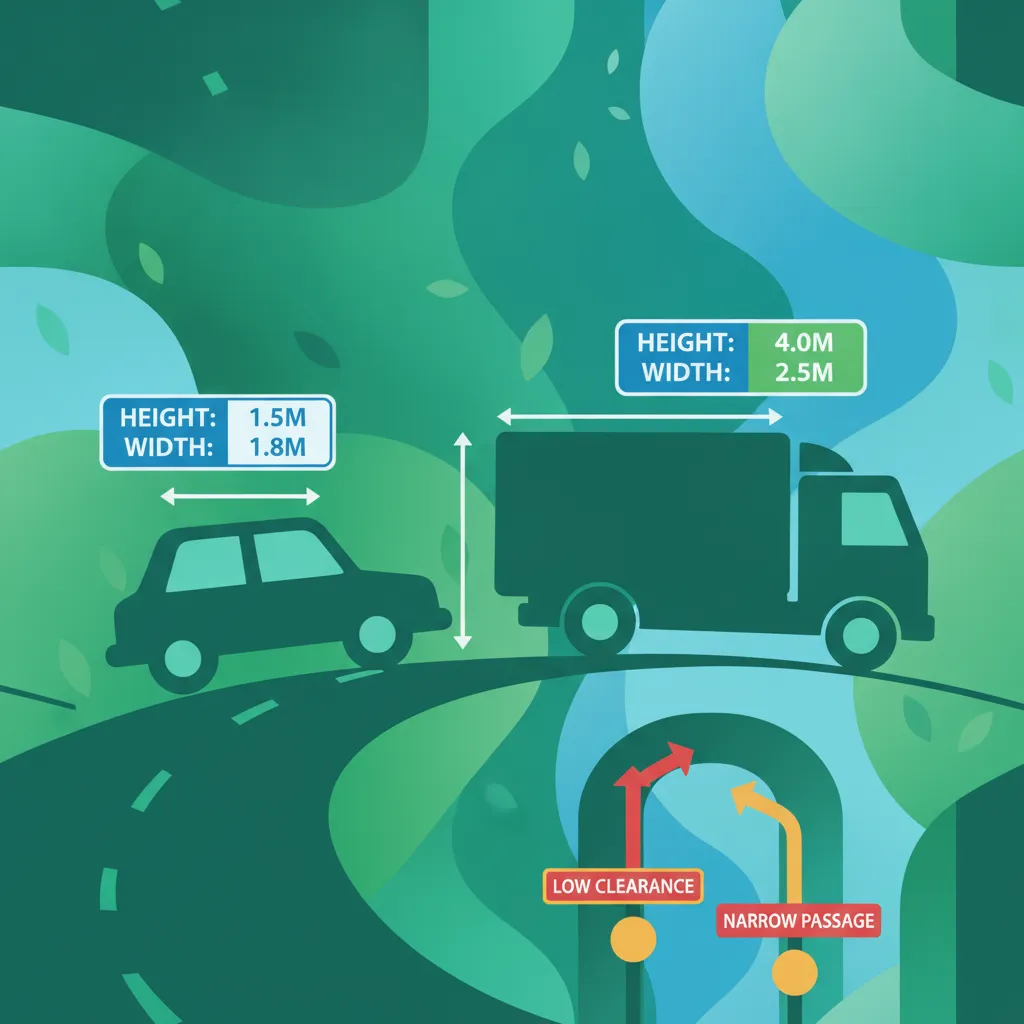
This lesson focuses on the specific dimensional limits that heavy goods vehicles must adhere to on Italian roads, as stipulated by the Codice della Strada. It covers the maximum permissible length, width, and height, explaining how these restrictions impact navigation through tunnels, under bridges, and within urban environments. Learners will also understand the conditions under which special permits for exceptional or oversized transport are required.

This lesson provides a detailed, safety-focused procedure for detaching a tractor from a semitrailer. It covers selecting a suitable, firm, and level location, correctly deploying the trailer's landing gear to support its weight, and disconnecting the air and electrical lines in the proper order. Following these systematic steps is essential to prevent the trailer from tipping over or rolling away, ensuring the safety of the driver and anyone nearby.

This lesson provides a comprehensive overview of the essential documentation required for both the driver and the vehicle. It covers the driver's license (patente), CQC card, vehicle registration (carta di circolazione), insurance certificate, and transport-specific documents like the cargo manifest. Learners will understand the importance of ensuring all documents are valid and readily available for inspection by authorities to avoid legal penalties and operational delays.
This lesson details the legal restrictions on the weight that can be supported by a single axle or a group of axles. It explains the importance of distributing the load correctly across the vehicle's length to prevent exceeding these limits, which can cause significant road damage and compromise vehicle safety. Learners will understand the relationship between load placement, axle pressure, and overall stability, particularly during braking and cornering.
This lesson explains the principles of safe load management to maintain vehicle stability and comply with legal requirements. It covers how to properly distribute and secure cargo inside the vehicle, the rules for using roof racks, and the specific signaling required for loads that project beyond the vehicle's rear. The content also provides a basic introduction to the rules and safety considerations when towing a small trailer.
This lesson delves into the specific articles of the Italian Codice della Strada that apply to heavy goods vehicles. It outlines the core legal and professional obligations of a driver, including the heightened duty of care owed to other road users and the responsibility for the vehicle's roadworthiness and load. Learners will understand the legal consequences of non-compliance, such as fines and sanctions, reinforcing the importance of adhering to all traffic regulations.
Find clear answers to common questions learners have about Legal Requirements for Load Securing in Italy. Learn how the lesson is structured, which driving theory objectives it supports, and how it fits into the overall learning path of units and curriculum progression in Italy. These explanations help you understand key concepts, lesson flow, and exam focused study goals.
Under Italian law, the driver has the primary responsibility to ensure that the load is positioned and secured in a way that prevents it from falling or shifting, which could jeopardize safety or damage the road.
Violations of load-securing regulations can result in heavy administrative fines, points deducted from your license, and in severe cases, the prohibition to continue your journey until the load is properly secured.
Yes, equipment like lashing straps or chains must meet specific technical standards (often EU-harmonized) and be in good condition. The inspector may check for clear labeling regarding load capacity.
Correct load securing is not just about keeping the cargo in place; it involves distributing the weight so that no individual axle exceeds its legal limit as defined in the Italian registration documents.
Start searching now to pinpoint exactly which Italian driving theory topics, road signs, or traffic rules you need to master. Use our advanced filters to build a custom practice session and ensure you're fully prepared for every aspect of your official driving licence exam.