
This lesson provides a critical, step-by-step guide to the safe coupling and uncoupling of trailers for Category D and DE licence holders. Mastering these procedures is essential for operational safety, protecting both the vehicle and the driver, while ensuring you are fully prepared for practical exam scenarios regarding vehicle connection.
Lesson content overview
Operating a bus or coach with a trailer, known as a combination vehicle, introduces significant complexities that demand meticulous attention to safety. Incorrectly coupling or uncoupling a trailer can have catastrophic consequences, ranging from mechanical failure and loss of control to severe accidents, endangering passengers and other road users. This lesson provides a comprehensive, step-by-step guide to the safe procedures for attaching (coupling) and detaching (uncoupling) a trailer, emphasizing the critical safety checks required before movement.
Drivers of Category D vehicles (buses and coaches) are entrusted with the highest duty of care for their passengers. Understanding and flawlessly executing coupling and uncoupling procedures is not just a matter of operational efficiency, but a fundamental responsibility rooted in safety, physics, and strict legal obligations within the Austrian driving context. This knowledge builds upon your understanding of basic vehicle checks, managing blind spots, and safe reversing techniques, forming the bedrock for professional combination vehicle operation.
The connection between a bus or coach and its trailer relies on specialized mechanical devices designed to ensure a secure and stable link. These devices are known as coupling mechanisms, and their type dictates the specific steps for engagement and release. It is crucial to understand the characteristics and proper operation of the mechanism on your vehicle.
There are several primary types of coupling mechanisms used with heavy vehicles:
Regardless of the type, all coupling mechanisms must be regularly inspected for wear, damage, and proper locking function. A common misunderstanding is assuming the coupler is locked merely because the trailer has settled onto it, without physically checking the lock indicator or performing a tug test. This assumption can lead to critical failures.
Coupling a trailer to a bus or coach requires a systematic approach to ensure every component is correctly aligned, connected, and secured. Deviating from these steps significantly increases the risk of accidents.
Preparation and Initial Vehicle Positioning: Before approaching the trailer, ensure the bus is positioned on a level surface if possible, with its parking brake engaged. Visually inspect the trailer to ensure its landing gear is stable and supporting its weight, and that the area around the coupling point is clear of obstructions.
Precise Vehicle Alignment: Carefully reverse the bus towards the trailer, aiming to align the coupling mechanism (fifth wheel or drawbar hitch) with the trailer's kingpin or towing eye. Use your mirrors extensively, and a rear-view camera if equipped, to ensure perfect horizontal and vertical alignment. The bus should approach the trailer as straight as possible, ideally at an angle of 0-5 degrees off straight. Proper alignment prevents the kingpin from striking the fifth wheel's guard or frame, which could cause damage or an incomplete connection.
Engaging the Coupling Mechanism: Slowly continue reversing until the kingpin (or towing eye) fully engages with the coupler. You should feel a slight bump as it makes contact and, for automatic or semi-automatic systems, you might hear an audible 'click' as the locking mechanism engages. Once engaged, pull forward slightly against the trailer to confirm the connection, but do not move off yet.
Visual and Physical Verification of Lock: Exit the vehicle and perform a thorough visual inspection. For a fifth-wheel, ensure the locking jaws have fully closed around the kingpin and that any safety latches or locking pins are fully engaged. For a drawbar, confirm the locking mechanism is securely fastened. There is often a visual indicator (e.g., a handle that retracts fully, a colored indicator) showing the lock is complete.
Connecting the Brake System: This is a critical safety step. Connect the trailer's air or hydraulic brake system to the bus's braking circuit. For air brakes, this involves connecting the red (emergency/supply) and yellow (service/control) air lines using gladhand connectors. Ensure the gladhands are clean, properly seated, and free from leaks. Once connected, the trailer's air tanks will begin to pressurize.
Connecting the Electrical System: Connect the multi-pin electrical connector from the bus to the trailer. This supplies power for all trailer lighting circuits, including brake lights, turn signals, hazard lights, and reverse lights. Ensure the connector is firmly seated and the safety clip or collar is engaged to prevent accidental disconnection.
Checking for Proper Load Distribution and Weight Limits: Before any movement, confirm that the trailer's load is within legal limits. This includes checking the Gross Combination Weight (GCW), which is the maximum combined weight allowed for the bus and trailer, and the Maximum Trailer Weight (MTW), the legal limit for the trailer itself. Proper load distribution ensures the trailer’s Center of Gravity (CG) is balanced, preventing sway, excessive braking disparity, or mechanical strain. Overloading or improper load distribution is illegal and extremely dangerous.
Raising Landing Gear and Stowing Equipment: Once the coupling is secure and all connections are made, raise the trailer's landing gear fully and secure it. Ensure any chocks, tools, or other equipment used during the coupling process are safely stowed away.
Even after carefully following the coupling steps, a series of mandatory safety checks must be performed to confirm everything is correctly functional before moving off. These checks are non-negotiable for Category D combination vehicles.
The tug test is the primary physical verification of a secure mechanical coupling. After engaging the coupler, releasing the bus's parking brake, and ensuring the trailer's brakes are still applied (or are automatically applied through air pressure loss from the red line), gently attempt to pull the bus forward a few centimeters. The trailer should remain stationary, indicating that the coupling is fully engaged and locked. If the trailer moves or separates, do not proceed. Re-evaluate the coupling and repeat the procedure.
A functional brake system for the trailer is paramount for safety. After connecting the air or hydraulic lines and allowing sufficient time for the trailer's air tanks to pressurize (to at least 5 bar):
The trailer's lights are vital for communicating your intentions to other road users. After connecting the electrical connector:
Detaching a trailer also requires a precise sequence of actions to ensure stability, prevent rollaways, and protect the vehicle's components.
Select a Safe and Level Uncoupling Area: Park the combination vehicle on a firm, level surface, away from traffic, if possible. Avoid inclines as much as possible, as this significantly increases the risk of a trailer rollaway during uncoupling.
Secure the Trailer: Before disconnecting anything, ensure the trailer is securely held. Apply the trailer's parking brake (handbrake) fully. For additional security, especially if on a slight incline, place wheel chocks under the trailer wheels.
Lower the Trailer Landing Gear: Crank down the trailer's landing gear until it makes firm contact with the ground and begins to take some of the trailer's weight. Do not lift the trailer off the kingpin yet; simply ensure it is well-supported.
Disconnect Electrical System: Carefully disconnect the multi-pin electrical connector. Secure the bus's electrical plug in its dummy socket and cover the trailer's electrical receptacle to protect it from dirt and moisture.
Disconnect Brake System: Release the air pressure or disconnect the hydraulic lines. For air brakes, disconnect the yellow (service) and then the red (emergency) air lines, securing the gladhands onto their dummy couplers on the bus. This action will typically cause the trailer's spring brakes to fully engage, providing additional security.
Unlock the Coupling Mechanism: Locate and actuate the release mechanism for your specific coupler type. For a fifth-wheel, this usually involves pulling a release handle or lever. For a drawbar, it might be a specific lock pin. Ensure the mechanism is fully disengaged. Perform a visual confirmation that the coupler is completely released and the locking jaws are open.
Drive the Bus Away Slowly: Once the coupling is fully released, slowly drive the bus forward, ensuring the trailer's kingpin (or towing eye) clears the coupling mechanism without snagging. Once clear, park the bus safely.
In rare circumstances, such as during a severe malfunction or a critical hazard during movement, an emergency decoupling might be necessary. Most coupling mechanisms are equipped with an emergency release lever, often accessible from the driver's cab or quickly reachable from outside. This is designed for rapid release but should only be used in situations of immediate danger where standard uncoupling is not feasible or safe. Familiarize yourself with the location and operation of this lever for your specific vehicle.
Adherence to national and European regulations is not only a legal obligation but a cornerstone of safe operation for Category D combination vehicles in Austria.
Before commencing any journey, drivers of combination vehicles must meticulously verify that the coupling device is correctly engaged and locked. Furthermore, the brake system must be fully functional, and all lighting connections must be operational. This mandatory safety check is enshrined in Austrian traffic law (e.g., Straßenverkehrsordnung – StVO) to prevent accidents stemming from unexpected trailer separation or system failures, thereby protecting all road users and passengers. A correct example involves performing a tug test, a brake pressure test, and a light test. An incorrect example would be a driver proceeding without confirming brake pressure, leading to a trailer brake failure on the road.
For all air-braked combination vehicles, the air pressure in the trailer brake system must reach a minimum of 5 bar (or 0.5 MPa) before departure. This ensures sufficient pneumatic force is available to activate the trailer's brakes effectively. Failing to meet this minimum pressure can result in significantly reduced braking performance or complete trailer brake failure, drastically increasing stopping distances and collision risk. Drivers must check the air gauge in the cab, confirming the pressure before moving off.
All lighting functions on the trailer, including brake lights, turn signals, reverse lights, and hazard warning lights, must be thoroughly checked and verified as operational before the vehicle commences travel. This regulation ensures the trailer is highly visible to other road users, allowing them to anticipate the combination vehicle's movements and react accordingly, thereby reducing the risk of rear-end collisions or other incidents caused by miscommunication.
The combined weight of the bus, trailer, cargo, and passengers must never exceed the manufacturer's specified Gross Combination Weight (GCW) or the national weight limits set by Austrian law. Similarly, the Maximum Trailer Weight (MTW) must not be surpassed. Overloading a trailer not only constitutes a legal violation but also profoundly compromises vehicle stability, braking performance, and steering control. It can lead to mechanical failure, excessive tire wear, and increased risk of trailer sway, particularly at higher speeds or during emergency maneuvers.
Many accidents involving combination vehicles stem from common errors during coupling and uncoupling. Being aware of these pitfalls is the first step in avoiding them.
The environment and conditions under which coupling and uncoupling take place can significantly impact the procedure. Professional drivers must adapt their approach.
Understanding the "why" behind each procedure helps ingrain safe practices.
Mastering safe coupling and uncoupling procedures is paramount for every Category D combination vehicle driver. It encompasses a series of precise mechanical actions, thorough system checks, and an unwavering commitment to safety.
By diligently applying these principles and procedures, aspiring bus and coach drivers will ensure the safe, reliable, and legally compliant operation of combination vehicles, upholding their critical duty of care for passengers and other road users.
Safe coupling and uncoupling for Category D combination vehicles demands a systematic, step-by-step approach that prioritises mechanical verification over assumption. Before coupling, ensure precise vehicle alignment and verify the kingpin is fully seated in the coupler with a physical tug test. Connect and verify both air brake lines (confirming 5 bar minimum pressure) and electrical connections, then test all trailer lights before departure. During uncoupling, always apply the trailer handbrake and use wheel chocks before lowering landing gear or disconnecting any systems, following the correct disconnection sequence for your specific coupler type. Austrian law mandates these safety checks and enforces strict weight limits (GCW and MTW) for combination vehicles.
A short set of high-value points that capture the most important learning from this lesson.
Correct coupling requires meticulous vehicle alignment (ideally 0-5 degrees off straight) to ensure the kingpin fully engages the fifth wheel without striking the guard or frame.
The tug test is the primary physical verification that the coupling is fully locked—never rely solely on an audible click or visual indicator alone.
Air brake pressure must reach at least 5 bar (0.5 MPa) before departure to ensure the trailer brakes function effectively.
Electrical and air brake connections must both be verified; the trailer must illuminate brake lights, turn signals, and hazard lights, and the brake system must respond to cab controls.
Uncoupling on any incline requires applying the trailer handbrake first, then using wheel chocks, before lowering landing gear or disconnecting any lines.
Explore all units and lessons included in this driving theory course.
Different coupler types (fifth-wheel, semi-automatic, full-automatic, drawbar hitch) all require visual and physical verification regardless of automatic locking features.
Disconnect brake lines before unlocking the coupling mechanism during uncoupling; this sequence ensures spring brakes engage automatically.
The Gross Combination Weight (GCW) and Maximum Trailer Weight (MTW) limits must never be exceeded, as overloading compromises stability, braking, and causes mechanical stress.
Landing gear supports the trailer during uncoupling but never secures it—always use the handbrake and wheel chocks as primary stability measures.
Emergency decoupling levers exist for immediate danger situations only; standard uncoupling follows a precise, deliberate sequence.
Skipping the tug test assuming the coupling is locked because the trailer settled, leading to potential trailer detachment during travel.
Driving away with insufficient air brake pressure (below 5 bar), resulting in ineffective trailer brakes and drastically extended stopping distances.
Failing to check all trailer lights individually, leaving other road users unaware of braking, turning, or reversing intentions.
Uncoupling on an incline without applying the handbrake first, risking the trailer rolling away while the driver is still connected.
Relying on coupler lock indicators without performing physical verification, which can give false confidence if the mechanism is only partially engaged.
Lesson content overview
A short set of high-value points that capture the most important learning from this lesson.
Correct coupling requires meticulous vehicle alignment (ideally 0-5 degrees off straight) to ensure the kingpin fully engages the fifth wheel without striking the guard or frame.
The tug test is the primary physical verification that the coupling is fully locked—never rely solely on an audible click or visual indicator alone.
Air brake pressure must reach at least 5 bar (0.5 MPa) before departure to ensure the trailer brakes function effectively.
Electrical and air brake connections must both be verified; the trailer must illuminate brake lights, turn signals, and hazard lights, and the brake system must respond to cab controls.
Uncoupling on any incline requires applying the trailer handbrake first, then using wheel chocks, before lowering landing gear or disconnecting any lines.
Explore all units and lessons included in this driving theory course.
Different coupler types (fifth-wheel, semi-automatic, full-automatic, drawbar hitch) all require visual and physical verification regardless of automatic locking features.
Disconnect brake lines before unlocking the coupling mechanism during uncoupling; this sequence ensures spring brakes engage automatically.
The Gross Combination Weight (GCW) and Maximum Trailer Weight (MTW) limits must never be exceeded, as overloading compromises stability, braking, and causes mechanical stress.
Landing gear supports the trailer during uncoupling but never secures it—always use the handbrake and wheel chocks as primary stability measures.
Emergency decoupling levers exist for immediate danger situations only; standard uncoupling follows a precise, deliberate sequence.
Skipping the tug test assuming the coupling is locked because the trailer settled, leading to potential trailer detachment during travel.
Driving away with insufficient air brake pressure (below 5 bar), resulting in ineffective trailer brakes and drastically extended stopping distances.
Failing to check all trailer lights individually, leaving other road users unaware of braking, turning, or reversing intentions.
Uncoupling on an incline without applying the handbrake first, risking the trailer rolling away while the driver is still connected.
Relying on coupler lock indicators without performing physical verification, which can give false confidence if the mechanism is only partially engaged.
Explore search topics learners often look for when studying Safe Coupling and Uncoupling Procedures. These topics reflect common questions about road rules, driving situations, safety guidance, and lesson level theory preparation for learners in Austria.
Browse additional driving theory lessons that cover connected traffic rules, road signs, and common driving situations related to this topic. Improve your understanding of how different rules interact across everyday traffic scenarios.
Learn essential pre-departure checks for bus and coach combination vehicles in Austria, including coupling, brake system, and lighting verification. Understand critical steps to ensure safe operation and compliance with legal requirements for DE category drivers.

This lesson teaches the systematic procedure for conducting a thorough pre-trip walk-around inspection. It provides a checklist of critical components to examine, including tyres, lights, braking systems, and load security. Performing this daily check is a legal requirement and a fundamental practice for preventing mechanical failures and ensuring safety.
This lesson introduces the fundamentals of regular vehicle inspection and preventive maintenance. Learners will understand how to perform essential pre-drive checks, including verifying fluid levels (oil, coolant, washer fluid), testing brakes, and checking the responsiveness of the steering. Adhering to a basic maintenance schedule is presented as a critical habit for ensuring long-term vehicle safety and roadworthiness, helping to prevent mechanical failures.
This lesson outlines the essential daily checks that form the foundation of safe passenger transport. It provides a step-by-step guide to inspecting key components such as tyres, brakes, lights, steering, and emergency equipment. You will learn how to identify potential defects and understand the procedures for reporting issues to ensure the vehicle is roadworthy.

This lesson emphasizes the importance of conducting a thorough pre-ride inspection to ensure vehicle safety. It provides a simple checklist covering critical components such as tires, brakes, lights, and controls. Performing these checks regularly helps identify potential issues before they become dangerous on the road.

Adding a trailer (Category DE/D1E) changes a vehicle's handling characteristics significantly. This lesson introduces key concepts, such as the increased turning circle, the effect of trailer swing, and the complexities of braking with the extra weight and length. It provides a theoretical foundation for understanding how to safely manage a combination vehicle, particularly during low-speed manoeuvres.

The most critical moment at a stop is the final check before pulling away. This lesson teaches a non-negotiable safety routine: ensure all passengers are clear, close the doors, check all relevant mirrors and blind spots one last time, signal, and only then move off when safe. This systematic process is designed to prevent incidents with late-running passengers, pedestrians, or cyclists.

This lesson emphasizes the need to inspect all load-securing equipment as part of the daily pre-trip check. It teaches drivers how to look for signs of wear, damage, or malfunction in straps, chains, ratchets, and other devices. Verifying the integrity of this equipment is essential before every journey to ensure the load remains secure.
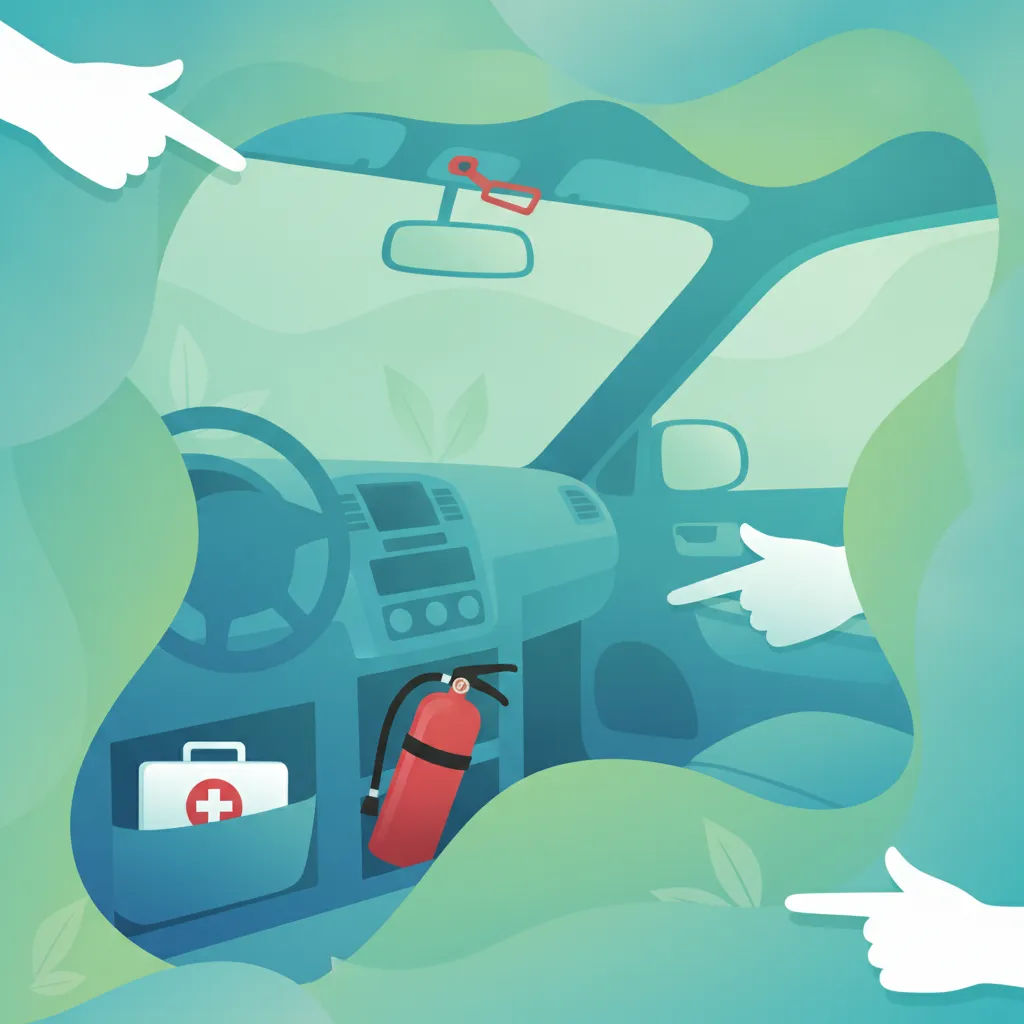
In an emergency, knowing the location and status of safety equipment is critical. This lesson details how to locate and inspect fire extinguishers, first aid kits, emergency hammers, and all designated emergency exits, including doors and roof hatches. It emphasizes the importance of ensuring these items are unobstructed and included in the daily pre-trip inspection.
Explore typical mistakes and potential hazards associated with coupling and uncoupling trailers for Austrian Category D/DE driving theory. Understand how to identify and avoid common violations to ensure passenger and road safety.

This lesson provides a step-by-step guide to the process of safely coupling a trailer to a tractor unit (Kuppeln). It covers aligning the vehicles, securing the mechanical lock (e.g., fifth wheel), and correctly connecting the air and electrical lines. A thorough safety check after coupling is mandatory to prevent trailer separation.
This lesson provides a foundational overview of towing a trailer with a Category B vehicle. It explains the basics of the coupling process, the importance of safety checks, and the principles of correct load distribution for stability. The content clarifies the legal framework, outlining the weight limits that apply to a standard B license and explaining when the B96 or BE permit extensions are required for heavier combinations.

This lesson introduces the different classifications of trailers used in Austria, including drawbar trailers (Anhänger) and semi-trailers (Sattelanhänger/Auflieger). It explains their key structural differences, typical uses, and the types of coupling systems they employ. Understanding these types is the first step in learning to operate combination vehicles.

This lesson focuses on the phenomenon of off-tracking, where the rear wheels of a trailer follow a path inside that of the tractor's wheels during a turn. It explains how to anticipate this effect and allow extra space when cornering to avoid running over curbs, signs, or other roadside objects. Managing off-tracking is a key skill for navigating intersections and roundabouts.
Adding a trailer (Category DE/D1E) changes a vehicle's handling characteristics significantly. This lesson introduces key concepts, such as the increased turning circle, the effect of trailer swing, and the complexities of braking with the extra weight and length. It provides a theoretical foundation for understanding how to safely manage a combination vehicle, particularly during low-speed manoeuvres.

This lesson explains the critical importance of properly securing any load, whether inside the vehicle, on a roof rack, or in a trailer. It covers the principles of correct weight distribution to maintain the vehicle's center of gravity and stability. Learners will understand the legal requirements and best practices for using tie-downs and other securing methods to prevent items from shifting or falling, which could create a serious hazard on the road.

This lesson explains the physics of an articulated vehicle and the factors that can lead to a jackknife, where the trailer swings out and folds against the tractor. It discusses common causes, such as improper braking on slippery surfaces or excessive speed in a turn. Learners will understand the crucial preventative measures to avoid this dangerous loss of control.

This lesson provides guidance on how to strategically distribute a load across both the main vehicle and its trailer. It covers planning the placement of cargo to maintain a stable centre of gravity for the entire combination. This holistic approach to loading is crucial for safe handling and adhering to individual vehicle and axle weight limits.

This lesson outlines the standardized procedure for handling a vehicle breakdown safely. It covers pulling over to a safe location, activating hazard lights, deploying the warning triangle, and wearing a high-visibility vest. It also explains when and how to contact roadside assistance or emergency services.

This lesson addresses the complex task of reversing a combination vehicle. It explains the principles of reverse articulation and how steering inputs have an opposite effect on the trailer's direction. The lesson provides strategies for using mirrors and, if available, a spotter to safely and accurately back the trailer into a desired position.
Find clear answers to common questions learners have about Safe Coupling and Uncoupling Procedures. Learn how the lesson is structured, which driving theory objectives it supports, and how it fits into the overall learning path of units and curriculum progression in Austria. These explanations help you understand key concepts, lesson flow, and exam focused study goals.
The tug test is a physical verification that the coupling mechanism is fully engaged and locked. It prevents the danger of the trailer detaching at low speed, which is a frequent cause of preventable incidents in commercial driving.
Always ensure the mechanical coupling is secure and locked before connecting brake lines. Connect the air lines in the standard order for your specific vehicle configuration, typically starting with the service line and then the emergency line, and always test the brake system functionality before moving.
Never. The trailer must always be secured with its own parking brake and, if on an incline, properly chocked before the towing vehicle is disconnected. Failure to do this is a major safety violation and a common trap in theory exam questions.
Complacency is the biggest risk. Even with automatic systems, you must visually inspect the locking indicator and perform a physical check to ensure the connection is truly secure, as electronic sensors can sometimes be obscured by dirt or malfunction.
Refine your study plan by searching for specific Austrian driving theory practice sets. Pinpoint questions related to particular road rules, signs, or challenge levels, and begin practicing immediately to reinforce your knowledge and excel in your official exam with confidence. Get started with focused revision today.