
This lesson teaches you how to strategically use your position within a lane to maximize your visibility and safety while riding in Austria. You will learn the art of anticipative riding, which involves actively identifying potential hazards and planning your escape routes well in advance. This is a core competency for all A1, A2, and A licence holders, ensuring you can navigate complex traffic environments with confidence.

Lesson content overview
Navigating Austrian roads on a motorcycle demands more than just basic vehicle control; it requires a dynamic and strategic approach to your position within the lane. This lesson, part of the Austrian Motorcycle Theory Comprehensive Guide for A, A1, & A2 Licences, will delve into the critical concepts of lane position and anticipative riding. By understanding and applying these principles, you will significantly enhance your visibility, create crucial safety buffers, and proactively plan escape routes, making your riding experience safer and more predictable for yourself and other road users.
Dynamic lane positioning is a fundamental skill for every motorcyclist. It involves the continuous adjustment of your motorcycle's lateral (side-to-side) position within a lane, not just staying in the centre. This proactive strategy is based on an ongoing assessment of traffic density, road geometry, upcoming manoeuvres, and potential hazards. Unlike a static approach, dynamic positioning means you are always moving within the lane to optimise your situation.
Proper lane positioning serves multiple vital functions for motorcycle riders. Primarily, it aims to maximise your visibility to other road users, ensuring that you are seen and reducing the likelihood of collisions, especially in congested urban areas or on winding alpine roads. Secondly, it allows you to create safety buffers around your motorcycle, providing precious time and space for corrective actions in emergencies. Thirdly, it enables escape route planning, giving you predefined paths to avoid obstacles or sudden threats. For Austrian riders, where road conditions can vary from autobahns to narrow mountain passes, mastering this skill is paramount for accident avoidance and safe navigation.
Effective lane positioning is built upon several interconnected principles that guide a rider's decisions in real-time.
The continuous adjustment of a motorcycle's lateral position within a lane based on traffic, road shape, and intended manoeuvre to maximise safety and visibility.
Dynamic Lane Positioning is the overarching strategy. Instead of rigidly adhering to one spot, you constantly adapt. For example, you might shift left to improve your view around a parked vehicle, or move right when approaching a left-hand bend to increase your sightline through the turn.
The geometric area formed by the rider’s line of sight, mirrors, and peripheral vision that ensures detection of surrounding road users and hazards.
The Visibility Triangle defines the critical area you must maintain to see hazards early. This involves not only your forward view but also actively monitoring your sides and rear using mirrors and peripheral vision. Your lane position directly impacts how wide and clear this triangle remains.
The minimum protective distance between the rider’s motorcycle and surrounding vehicles or obstacles, providing sufficient reaction time.
A Safety Buffer is the physical space you create around yourself. This includes both longitudinal (front and back) and lateral (side-to-side) distances. Adequate buffers are crucial for responding to sudden braking, swerving, or unexpected actions from other drivers, especially given Austria's varied road network.
The pre-emptive identification and preservation of a clear path (laterally or longitudinally) to avoid obstacles if a collision risk emerges.
Escape Route Planning involves constantly scouting for potential paths to safety. Whether it’s an open space to your side, a clear lane ahead, or a safe area on the shoulder, having an escape route in mind significantly reduces collision risk. Your lane position is key to maintaining these routes.
The proactive scanning of traffic, road conditions, and driver behaviours to predict hazards before they materialise, allowing for early action.
Finally, Anticipative Riding integrates all these elements. It's a mindset of continuous observation and prediction, enabling you to shift from reactive responses to proactive management of your environment. This skill is fundamental for all types of motorcycle licences in Austria (A, A1, A2).
The concept of the visibility triangle is central to anticipative riding. It represents the crucial zone within which you must detect and monitor potential hazards. By consciously managing this triangle, you ensure you have the maximum possible time to react.
Your forward vision is your primary tool for scanning the road ahead. Riders should practice a 10-12 second scanning horizon, meaning you should be actively observing what’s happening 10 to 12 seconds in front of you. This allows you to identify potential issues such as changes in road surface, traffic congestion, or upcoming turns well in advance. However, forward vision alone is insufficient.
Your peripheral vision plays an equally critical role. Without turning your head, you can monitor the lateral zones to your left and right, detecting movement or changes that might indicate a hazard. For instance, a vehicle approaching from a side street, a pedestrian stepping onto the curb, or a cyclist overtaking you can often be first detected in your peripheral vision. Strategic lane positioning helps keep these lateral zones clear and observable. Riding slightly offset to one side of the lane, for example, can open up your view into intersections or around parked cars.
While a rider strives to see everything within their visibility triangle, every vehicle has inherent blind spots – areas not directly visible through mirrors or peripheral vision without a head check. For motorcyclists, reducing your exposure to others' blind spots is crucial.
Your lane position can significantly influence whether you are visible to other drivers. Avoid riding in positions where you disappear from their mirrors. When alongside larger vehicles like trucks or vans, assume they cannot see you unless you make eye contact with the driver.
Mirror Check: Regularly scan your rearview mirrors to be aware of traffic behind and to your sides.
Head Check (Over-the-Shoulder Glance): Before any lateral movement (e.g., changing lane position, preparing to overtake), quickly turn your head to glance over your shoulder into the blind spot area. This is a mandatory safety step.
Adjust Lane Position: If you find yourself lingering in another vehicle's blind spot, adjust your speed or lane position to either move ahead or drop back into a visible zone.
Safety buffers are your first line of defence against collisions. They represent the critical distance you maintain between your motorcycle and surrounding traffic or obstacles. These buffers buy you valuable time to react and space to manoeuvre, which is especially important on a motorcycle where sudden stops or evasive actions require precise control.
The longitudinal buffer is the distance you keep between your motorcycle and the vehicle directly in front of you, as well as the space behind you. In Austria, the general rule of thumb for a safe following distance is the "2-second rule" under normal conditions.
A method for calculating a safe following distance by ensuring at least two seconds pass between the moment the vehicle in front passes a fixed point and your vehicle reaches that same point.
To apply the 2-second rule: Pick a fixed point on the road (e.g., a sign, tree, or bridge). When the vehicle in front of you passes that point, start counting "one thousand one, one thousand two." If you reach the fixed point before you finish counting, you are following too closely.
This 2-second gap provides sufficient time to react and brake safely if the vehicle ahead suddenly stops. Under adverse conditions such as rain, fog, or icy roads, this gap should be increased to 3 seconds or more to account for reduced visibility and longer braking distances. Similarly, when riding in traffic, try to maintain an adequate space behind you by checking your mirrors and gently adjusting your speed to allow following vehicles to have their own safety buffer.
The lateral buffer refers to the side clearance you maintain from lane edges, parked cars, other vehicles in adjacent lanes, and roadside obstacles. This buffer provides crucial space for evasive manoeuvres and reduces the risk of side-swipe collisions or "dooring" incidents (where a parked car door suddenly opens).
On narrow roads, aim to maintain an equal buffer on both sides of your motorcycle. When passing parked cars, aim for at least 0.5 metres of clearance, and be prepared to move further left if a door appears to be opening or a pedestrian emerges. This applies particularly to urban streets in Austria where parking can be tight and pedestrians frequent.
Riding too close to the side of the road, especially near curbs or shoulders, can reduce your escape options, hide road surface hazards (like potholes or debris), and increase vulnerability to hazards from the side.
An escape route is a pre-identified, clear path to safety that you can use to avoid a collision if an unexpected hazard arises. Effective escape route planning is a hallmark of anticipative riding and requires constant awareness of your surroundings.
As you ride, continuously scan for available space that could serve as an escape route. These can be:
For example, when approaching an intersection, rather than riding directly behind the car in front, position your motorcycle slightly to one side of the lane. This gives you a clear view ahead and an immediate lateral escape path if the car in front suddenly reverses or stalls.
Identifying an escape route is only half the battle; you must also be ready to use it. This means:
For instance, when riding next to a row of parked cars, you might consider the opposing lane (if clear) or an open driveway as a potential lateral escape route if a car door suddenly opens. Your current lane position should facilitate quick access to these paths.
Anticipative riding is the skill of constantly observing your environment, interpreting potential dangers, and predicting the actions of other road users before they become immediate threats. It transforms riding from a reactive process into a proactive, strategic one, giving you more time to respond safely.
Effective anticipative riding relies on systematic scanning, which goes beyond simply looking straight ahead.
Forward Scan (10-12 seconds): Look far down the road to identify upcoming changes, traffic lights, intersections, or road hazards.
Mid-Range Scan (4-6 seconds): Focus on the immediate path ahead, monitoring the actions of vehicles directly in front and adjacent to you.
Mirror Scan (Every 5-8 seconds): Regularly check your rearview and side mirrors to be aware of traffic approaching from behind or to your sides. This should be done more frequently in busy traffic.
Peripheral Scan: Actively use your peripheral vision to detect movement at the edges of your view, such as pedestrians, cyclists, or vehicles entering from side streets.
Head Checks: Perform quick over-the-shoulder glances before any lateral movement to clear your blind spots.
This continuous, cyclical scanning pattern ensures you have a comprehensive understanding of your immediate surroundings and what's developing further down the road.
Scanning provides data; prediction turns that data into actionable insights. To predict effectively, consider:
Always assume the worst-case scenario. For example, assume a driver turning left across your path hasn't seen you, or that a parked car's door will open suddenly. This defensive mindset is crucial for survival on two wheels.
By combining systematic scanning with intelligent prediction, you can anticipate potential conflicts and adjust your speed, lane position, or even prepare to brake or swerve, well before a situation becomes critical. This proactive approach significantly reduces stress and enhances safety.
Adhering to local traffic laws is fundamental to safe and anticipative riding in Austria. These regulations provide a framework for predictable traffic flow and minimise risk for all road users.
In Austria, as in most European countries, specific rules govern how vehicles must use lanes:
Clear and early communication of your intentions is a legal requirement and a critical aspect of anticipative riding.
Understanding common errors is as important as learning correct procedures. Many accidents involving motorcyclists can be attributed to predictable mistakes in lane positioning or a lack of anticipation.
The principles of dynamic lane positioning and anticipative riding are not static; they must be adapted to changing environmental and traffic conditions.
Mastering lane position and anticipative riding is not about memorising isolated rules, but about developing a holistic and dynamic approach to riding. These concepts are interconnected and mutually reinforcing.
By consistently applying these interrelated concepts—understanding and utilising dynamic lane positioning, maintaining a clear visibility triangle, preserving adequate safety buffers, always planning an escape route, and performing anticipative riding—riders will significantly enhance their safety and control on Austrian roads. This comprehensive approach is foundational for demonstrating competence and confidence required for all Austrian A-category motorcycle licences (A, A1, A2).
This lesson teaches motorcyclists to continuously adjust their lane position based on traffic, road geometry, and hazards, rather than riding statically in one spot. Key concepts include the visibility triangle for early hazard detection, maintaining adequate longitudinal and lateral safety buffers, always planning escape routes, and applying systematic scanning techniques that combine forward scan, mirror checks, and peripheral awareness. Austrian-specific requirements covered include the 2-second following distance rule, 200-metre signalling distance outside built-up areas, and the prohibition on using hard shoulders for regular travel. Anticipative riding transforms defensive riding from reactive responses to proactive hazard prediction, enabling smoother, safer navigation through Austrian traffic from urban intersections to alpine roads.
A short set of high-value points that capture the most important learning from this lesson.
Dynamic lane positioning means continuously adjusting your lateral position within the lane based on traffic, road shape, and hazards—not staying in one spot
The visibility triangle combines forward vision, mirrors, and peripheral vision to detect hazards early and stay visible to others
Maintain safety buffers both longitudinally (following distance) and laterally (side clearance) to ensure reaction time and space
Always identify and preserve escape routes before you need them—this transforms you from reactive to proactive
Anticipative riding integrates scanning, prediction, and positioning to manage safety dynamically rather than waiting for emergencies
Explore all units and lessons included in this driving theory course.
Apply the 2-second rule for following distance; increase to 3+ seconds in rain, fog, or icy conditions
In Austria, signal at least 200 metres before a turn outside built-up areas and adequately early within urban zones
Keep at least 0.5–1 metre lateral clearance from parked cars to avoid dooring incidents and maintain escape options
Perform mirror checks every 5–8 seconds and always do an over-the-shoulder head-check before any lateral movement
On curves, shift to the opposite side of your lane to improve sightline through the bend
Riding too close to parked cars on narrow streets, which creates dooring risk and blocks view of pedestrians or cyclists
Tail-gating other vehicles, which drastically shortens reaction time and is a primary cause of rear-end collisions
Ignoring mirrors before lane changes or lateral movements, leading to blind spot collisions with approaching traffic
Failing to signal early enough before turns, depriving other road users of time to react to your intentions
Using only forward vision and neglecting peripheral zones and mirror checks, missing hazards from side streets or adjacent lanes
Lesson content overview
A short set of high-value points that capture the most important learning from this lesson.
Dynamic lane positioning means continuously adjusting your lateral position within the lane based on traffic, road shape, and hazards—not staying in one spot
The visibility triangle combines forward vision, mirrors, and peripheral vision to detect hazards early and stay visible to others
Maintain safety buffers both longitudinally (following distance) and laterally (side clearance) to ensure reaction time and space
Always identify and preserve escape routes before you need them—this transforms you from reactive to proactive
Anticipative riding integrates scanning, prediction, and positioning to manage safety dynamically rather than waiting for emergencies
Explore all units and lessons included in this driving theory course.
Apply the 2-second rule for following distance; increase to 3+ seconds in rain, fog, or icy conditions
In Austria, signal at least 200 metres before a turn outside built-up areas and adequately early within urban zones
Keep at least 0.5–1 metre lateral clearance from parked cars to avoid dooring incidents and maintain escape options
Perform mirror checks every 5–8 seconds and always do an over-the-shoulder head-check before any lateral movement
On curves, shift to the opposite side of your lane to improve sightline through the bend
Riding too close to parked cars on narrow streets, which creates dooring risk and blocks view of pedestrians or cyclists
Tail-gating other vehicles, which drastically shortens reaction time and is a primary cause of rear-end collisions
Ignoring mirrors before lane changes or lateral movements, leading to blind spot collisions with approaching traffic
Failing to signal early enough before turns, depriving other road users of time to react to your intentions
Using only forward vision and neglecting peripheral zones and mirror checks, missing hazards from side streets or adjacent lanes
Explore search topics learners often look for when studying Lane Position and Anticipative Riding. These topics reflect common questions about road rules, driving situations, safety guidance, and lesson level theory preparation for learners in Austria.
Browse additional driving theory lessons that cover connected traffic rules, road signs, and common driving situations related to this topic. Improve your understanding of how different rules interact across everyday traffic scenarios.
Explore practical, real-world scenarios demonstrating effective lane positioning and anticipative riding techniques for Austrian motorcyclists. Learn how to apply these defensive riding strategies in diverse traffic situations to enhance safety and visibility.

This lesson provides guidance on selecting the appropriate road position to maximize visibility and safety. It covers strategies for riding in different parts of a lane based on traffic, road conditions, and potential hazards like parked cars. The goal is to establish a defensive position that allows for adequate reaction time and makes the rider predictable to others.

This lesson provides essential knowledge for using Austria's high-speed road network. It covers the correct procedure for entering via acceleration lanes, maintaining strict lane discipline (keeping right, passing left), and understanding the digital or physical Vignette (toll sticker) requirement. The formation of the 'Rettungsgasse' (emergency corridor) during traffic jams is also a key topic.
This lesson provides advice for navigating popular scenic routes, which often feature heavy traffic, cyclists, and distracted drivers. It emphasizes maintaining focus on the road despite beautiful scenery and anticipating unpredictable actions from other tourists who may stop suddenly. Adopting a patient and defensive mindset is key to safely enjoying these remarkable roads.

This lesson teaches a safe, methodical process for navigating intersections. It stresses the importance of proper lane positioning on approach, comprehensive visual scans for cross-traffic, pedestrians, and cyclists, and clear communication of intent. Special attention is given to the increased risks associated with left turns across oncoming traffic.
This lesson prepares riders for safely transiting through construction zones ('Baustellen'). It covers the interpretation of temporary signage, adherence to reduced speed limits, and awareness of hazards suchas altered lane markings, abrupt surface changes, and loose gravel. Respecting the safety of road workers and anticipating unpredictable traffic patterns are key themes.

This lesson covers the principles of proper lane discipline, including maintaining a correct and steady position within a lane and adhering to the 'keep right' rule on multi-lane roads. It details the safe and systematic protocol for changing lanes, which involves checking mirrors, signaling intention, performing a blind spot check, and then smoothly executing the manoeuvre. Correct lane usage is essential for maintaining predictable and safe traffic flow.
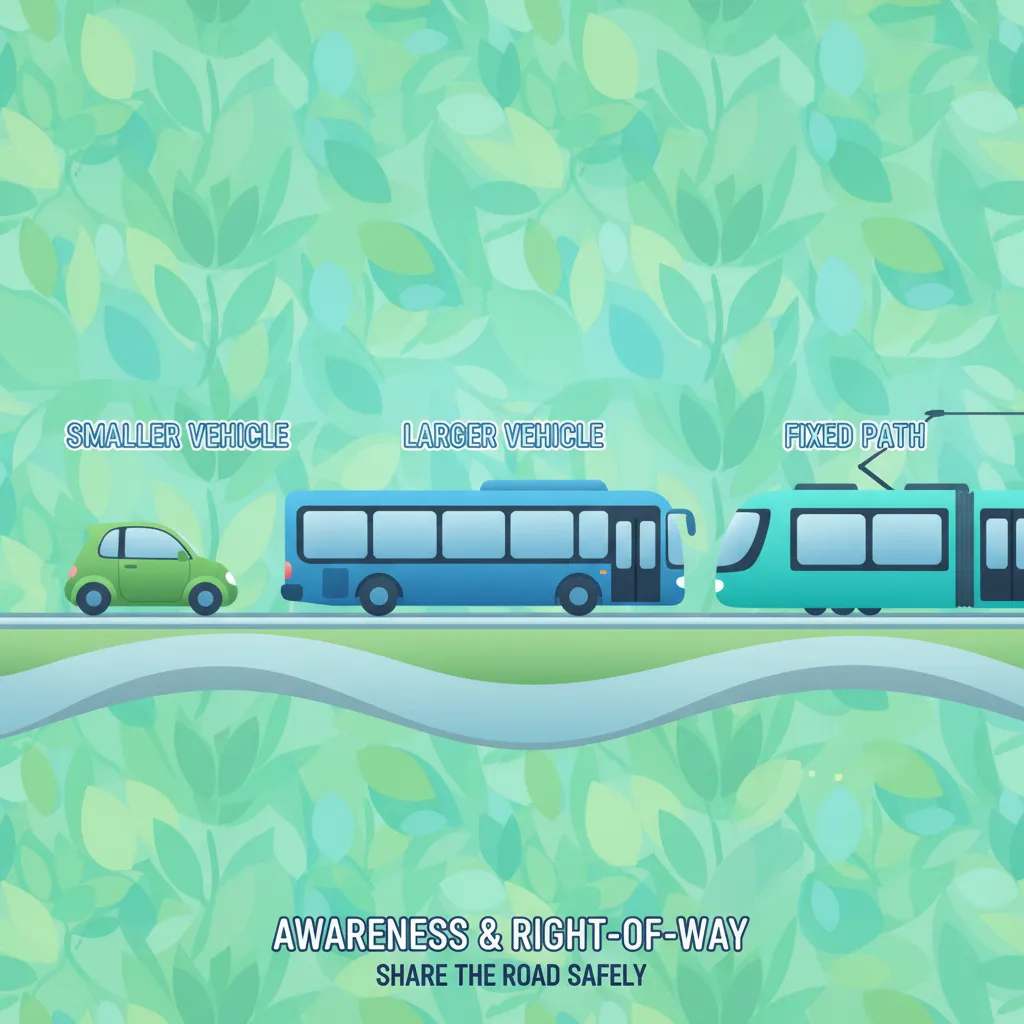
This lesson provides specific guidance for sharing the road with different types of vehicles in Austria. It covers the dangers of large vehicle blind spots, the rules for navigating near buses and dedicated tram tracks, and common conflict points at intersections. Understanding the behavior and limitations of other vehicles is key to safely navigating complex urban environments.
This lesson provides clear instructions for maneuvering through single and multi-lane roundabouts. It covers the critical rule of giving way to traffic already in the circle, proper lane selection based on the intended exit, and the correct use of indicators when entering and exiting. Mastering roundabouts is key to efficient and safe travel in modern Austrian traffic systems.

This lesson provides a comprehensive explanation of Austria's right-of-way laws, which are fundamental to intersection safety. It covers the meaning of different priority signs and clarifies the 'Rechts vor Links' (priority to the right) rule that applies at unmarked junctions. A clear understanding of these rules is essential to prevent conflicts and collisions in urban and rural settings.

This lesson breaks down the overtaking maneuver into a safe, repeatable process: assess, signal, check, move, and return. It emphasizes the importance of ensuring a sufficient gap in oncoming traffic, checking mirrors and blind spots thoroughly, and maintaining a proper speed differential. Adherence to Austrian laws regarding where overtaking is prohibited is also covered in detail.
Understand how to maximize your visibility and effectively communicate your intentions as a motorcycle rider in Austria. Learn strategies for managing blind spots and using positioning and signals to interact safely with other road users.

This lesson covers the foundational principles of making a motorcyclist conspicuous to other road users. It examines the role of brightly colored and reflective clothing, effective helmet colors, and the mandatory use of headlights during the day. Understanding how to create a strong visual presence in traffic is a key component of proactive accident prevention for any rider.

This lesson teaches the correct technique for setting and using motorcycle mirrors to maintain awareness of traffic behind and to the sides. It emphasizes that mirrors alone are not enough, detailing the necessity of the 'lifesaver' shoulder check to cover critical blind spots. A disciplined observation routine is crucial for safe lane changes, merging, and navigating dense traffic.

This lesson explains the correct techniques for using mirrors to maintain awareness of surrounding traffic and for checking blind spots. It details the proper timing and use of indicators to signal turns and lane changes effectively. The content reinforces that clear, early communication is key to preventing misunderstandings with other drivers.

This lesson focuses on the rider's primary responsibility: ensuring they are visible and their actions are predictable to other road users. It explains effective strategies such as using proper lighting, wearing reflective clothing, and adopting a safe road position. The content also emphasizes how clear signaling and anticipating the actions of others can significantly reduce the risk of collisions.
This lesson provides specific guidance for sharing the road with different types of vehicles in Austria. It covers the dangers of large vehicle blind spots, the rules for navigating near buses and dedicated tram tracks, and common conflict points at intersections. Understanding the behavior and limitations of other vehicles is key to safely navigating complex urban environments.

This lesson focuses on clear communication with other road users through the correct use of signals. It covers the proper operation of turn indicators, including the importance of cancelling them after a maneuver, and the use of brake lights. Additionally, it reviews standard hand signals for turning and stopping, which serve as a vital backup or supplementary communication tool.
This lesson provides advice for navigating popular scenic routes, which often feature heavy traffic, cyclists, and distracted drivers. It emphasizes maintaining focus on the road despite beautiful scenery and anticipating unpredictable actions from other tourists who may stop suddenly. Adopting a patient and defensive mindset is key to safely enjoying these remarkable roads.

This lesson addresses the heightened vulnerability of motorcyclists and outlines essential strategies for personal safety and risk mitigation. It covers the importance of wearing certified protective gear, maintaining situational awareness, and adopting a defensive riding posture. By understanding and anticipating potential hazards in the Austrian traffic environment, riders can actively reduce their risk of accidents.

This lesson examines how adverse weather directly affects motorcycle safety. It explains how water on the road reduces tyre grip, increasing braking distances and the risk of aquaplaning. Strategies for riding in fog, dealing with reduced visibility from road spray, and identifying potential ice patches are covered to help riders manage weather-related risks.

This lesson focuses on strategies for riding safely in conditions of poor visibility, such as rain, fog, and low sun glare. It explains how to use lights effectively, increase following distances, and moderate speed to maintain control. The content also addresses braking techniques on wet surfaces to prevent skidding and hydroplaning.
Find clear answers to common questions learners have about Lane Position and Anticipative Riding. Learn how the lesson is structured, which driving theory objectives it supports, and how it fits into the overall learning path of units and curriculum progression in Austria. These explanations help you understand key concepts, lesson flow, and exam focused study goals.
The exam tests your ability to identify the safest path through traffic. Choosing the correct lane position improves your visibility to other drivers and increases your escape options if a hazard suddenly arises.
Anticipative riding is the practice of scanning the road ahead and predicting potential conflicts before they happen. It allows you to adjust your speed or position early to avoid being caught in a dangerous situation.
Yes, road conditions like rain or gravel in corners require you to shift your lane position to avoid slippery surfaces like lane markings or oil patches, while keeping your visibility high.
In Austria, you must always be mindful of legal constraints. Keep a safe distance from stationary or slow-moving traffic by positioning yourself where you are clearly visible in the side mirrors of other vehicles.
Refine your study plan by searching for specific Austrian driving theory practice sets. Pinpoint questions related to particular road rules, signs, or challenge levels, and begin practicing immediately to reinforce your knowledge and excel in your official exam with confidence. Get started with focused revision today.