
This lesson guides professional drivers through the complexities of interacting with municipal traffic controls in Austria. You will learn how to anticipate traffic light cycles and adhere strictly to directions given by traffic personnel or temporary signage, which is crucial for passing your HGV theory exam and maintaining safe operations.

Lesson content overview
Operating heavy goods vehicles (HGVs) within urban environments, as required for the Austrian Driving License Theory Course for Heavy Goods Vehicles (C, C1, C1E, CE categories), demands precise coordination with municipal traffic control measures. This comprehensive lesson explores the critical interaction between HGV drivers and various urban traffic control systems, including permanent and temporary traffic signals, as well as directions from police and construction personnel. Effective compliance with these controls is paramount for ensuring smooth traffic flow, enhancing safety, reducing congestion, and preventing accidents, particularly given the unique characteristics of heavy vehicles.
Permanent traffic signals are fixed installations typically found at intersections, designed to regulate the flow of traffic and prevent collisions. For drivers of heavy goods vehicles, a thorough understanding of these signals and their implications is crucial.
Standard three-color signals (red, amber, green) dictate the right-of-way at controlled intersections.
The legal concession allowing a vehicle already too close to an intersection to safely stop when the amber light appears to proceed through the intersection, rather than making an abrupt and dangerous stop. Drivers must not enter the intersection on amber if they could have stopped safely.
Many urban intersections also feature dedicated signals for pedestrians and public transport. Pedestrian signals, typically showing a red or green figure, regulate when pedestrians may cross. Heavy vehicle drivers must always be aware of these signals and yield to pedestrians who have a green light, even if their own vehicle signal is green. Some signals might also prioritize public transport, which can affect the timing and flow for other vehicles. It is essential for HGV drivers to be vigilant for these specialized signals and to understand their impact on overall traffic coordination, especially when turning across pedestrian or tram routes.
Temporary traffic control measures are frequently encountered in urban areas, particularly at construction sites, during special events, or in emergency situations. These measures are critical for managing traffic safely under altered conditions and often supersede permanent signals.
Temporary traffic lights are portable signal devices used to control traffic flow where permanent signals are absent, damaged, or where roadworks require altered lane configurations. These can be single lights or a pair of lights controlling opposing directions through a narrow passage. Drivers must treat these temporary lights with the same seriousness as permanent signals. Similarly, temporary roadwork signs, such as those indicating lane closures, reduced speed limits, or diversions, provide essential guidance. It is imperative to obey these signs, even if they appear to contradict permanent signage or signals, as they reflect the immediate, changing conditions of the road.
Always be alert for temporary traffic control devices. They take precedence over permanent signals and road markings because they reflect real-time hazards or changes in the road environment.
At construction sites, specially trained personnel, often called flaggers, are authorized to direct traffic using hand signals, stop/slow paddles, or flags. These individuals play a vital role in ensuring the safety of workers and road users within work zones. Their instructions, whether verbal or gestural, must be obeyed without question. Failure to comply with a flagger's direction can lead to serious accidents, especially when heavy vehicles are involved, and carries legal penalties. Flaggers may direct a heavy vehicle to stop, proceed, or divert into a different lane, overriding any existing traffic signals or road markings.
Beyond automated signals, human traffic controllers hold significant authority in directing traffic. Their instructions are paramount and designed to manage specific, often dynamic, situations effectively.
Police officers or other authorized traffic controllers (such as military police in certain contexts) have the ultimate authority over traffic movement. Their verbal commands or hand signals must be obeyed immediately, even if they contradict permanent or temporary traffic signals, road signs, or general right-of-way rules. This legal supremacy allows police to manage traffic efficiently during accidents, road closures, special events, or when facilitating the passage of emergency vehicles. For HGV drivers, responding promptly and correctly to police direction is critical for maintaining safety and preventing gridlock in complex situations.
Verbal or gestural instructions from authorized police officers or traffic controllers that legally supersede all other traffic control devices, including traffic lights and road signs.
As mentioned, flaggers at construction sites are also authorized to direct traffic. While not possessing the full legal authority of a police officer, their instructions within a designated work zone are mandatory and enforceable. These individuals are trained to ensure the safety of both drivers and construction workers by guiding vehicles safely through or around work areas. HGV drivers must recognize and respond to their signals, understanding that these directions are tailored to the specific, often hazardous, conditions of the construction zone.
Anticipation is a cornerstone of safe and efficient heavy goods vehicle operation, especially when approaching traffic signals. Due to their significant mass, HGVs require considerably longer distances to slow down and stop compared to passenger cars.
Drivers must scan well ahead, observing traffic patterns, intersection layouts, and the current state of traffic signals. By doing so, they can predict likely signal changes and adjust their speed proactively. If approaching an intersection on a green light, for instance, a driver should consider how long the light has been green. If it has been green for some time, it is more likely to change to amber soon. This early assessment allows for a smooth deceleration, avoiding sudden braking.
For heavy goods vehicles, early anticipation of traffic light changes significantly reduces wear on brakes, improves fuel efficiency, and minimizes the risk of rear-end collisions. Plan your stops and accelerations well in advance.
When an amber light appears, an HGV driver must immediately assess whether they can safely stop before the stop line. Given the increased stopping distance required for a loaded heavy vehicle, this assessment often means initiating braking earlier than a car driver would. Misjudging the braking distance can lead to the vehicle entering the intersection on a red light or requiring an emergency stop, which can be unstable and dangerous. Understanding the load's impact on stopping distance is therefore critical.
The phenomenon where increased vehicle mass, particularly in heavy goods vehicles, significantly extends the distance required to bring the vehicle to a complete halt, necessitating earlier braking.
Understanding who has priority in different scenarios is fundamental to safe driving, especially at intersections controlled by municipal measures. The hierarchy of control ensures a clear order of precedence.
At intersections, the general principle is that the traffic stream with a green light has the right-of-way, while all other streams must yield. However, this order can be overridden by higher authorities. The established hierarchy for traffic control is:
For HGV drivers, this hierarchy means constantly evaluating the immediate environment and prioritizing instructions from the highest authority present. Assuming inherent right-of-way due to vehicle size is a dangerous misconception that can lead to collisions.
Heavy goods vehicles share urban roads with vulnerable road users such as pedestrians and cyclists. Traffic signals often include dedicated phases or incorporate specific timings to protect these users. When proceeding on a green light, especially when turning, HGV drivers must always be vigilant for pedestrians or cyclists who may also have a green signal or are already in the intersection. Proper coordination means yielding to these users, ensuring sufficient clearance, and being acutely aware of blind spots that can obscure their presence.
Compliance with traffic control measures is not merely a matter of good practice; it is legally mandated by Austrian traffic law, primarily the Straßenverkehrsordnung (StVO). Understanding these regulations is essential for all drivers, especially those operating heavy goods vehicles.
The fundamental rule states that drivers must stop at red signals and may only proceed when the signal changes to green, unless specifically directed otherwise by authorized personnel. This rule applies uniformly across all intersections equipped with traffic lights. The rationale is to prevent collisions by establishing a clear, orderly flow of traffic.
Drivers are generally prohibited from entering an intersection when the traffic light shows amber, unless they have already entered the intersection before the amber light appeared and cannot stop safely. This provision allows vehicles already committed to the intersection to clear it, but it does not permit accelerating to pass through before the light turns red. For heavy vehicles, misjudging this can easily lead to a violation and a hazardous situation.
Austrian law explicitly states that temporary signals installed for roadworks or events must be obeyed, even if they contradict permanent signals. This is critical for safety in dynamically changing road environments. Furthermore, when a police officer or authorized traffic controller gives instructions, drivers must obey them, even if they conflict with traffic signals or road signs. This legal provision (e.g., § 16 StVO) underscores the authority granted to human controllers in managing complex or emergency traffic situations. Similarly, instructions from flaggers at construction sites are legally binding.
Police Officers/Authorized Traffic Controllers: Their instructions override all other traffic control measures.
Temporary Traffic Signals/Roadwork Personnel (Flaggers): Their directions take precedence over permanent signals and signs within their designated area.
Permanent Traffic Signals: These lights dictate right-of-way at regular intersections.
Road Signs: Provide direction and priority where signals are absent.
General Traffic Rules: Apply in the absence of any other control.
Despite clear rules, certain scenarios frequently lead to violations or dangerous situations for heavy goods vehicle drivers regarding municipal traffic control.
One common issue is drivers misinterpreting police signals or temporary signs, especially if they appear to conflict with ingrained habits of obeying permanent signals. For instance, a driver might proceed through a red light without explicit police direction, or ignore a temporary stop sign because the permanent signal is green. This often stems from a lack of awareness of the established hierarchy of control.
This is a particularly dangerous maneuver for HGVs. Due to their momentum, heavy vehicles attempting to accelerate through an amber light often fail to clear the intersection before the light turns red, or they require sudden, harsh braking if cross-traffic unexpectedly proceeds. This increases the risk of side-impact collisions or rear-end incidents.
A fundamental challenge for HGV drivers is consistently accounting for the extended stopping distances of their vehicles, especially when heavily loaded or in adverse conditions. This can lead to overrunning stop lines or entering intersections on red or amber lights. Proper anticipation and smooth, early braking are the primary solutions.
Never assume other road users see your heavy vehicle or will yield. Always anticipate their movements and prepare to stop, even if you have the right-of-way.
Temporary traffic lights or signs at construction sites may sometimes be less visible, especially at night, in heavy rain, or if poorly placed. Drivers must constantly scan for these temporary controls and reduce speed in areas prone to roadworks to allow ample time to react.
The effectiveness of municipal traffic control measures and a driver's ability to comply are significantly influenced by environmental and vehicle-specific factors.
Adverse weather conditions such as heavy rain, fog, or snow can severely reduce visibility, making it difficult to spot traffic signals, especially temporary ones that might lack sufficient illumination. In such conditions, HGV drivers must reduce speed significantly, increase their following distance, and enhance vigilance. At night or dusk, the glare from oncoming headlights can also obscure signals; supplemental lighting on the vehicle may help, but reduced speed is always the safest approach.
Urban intersections, with their dense traffic, multiple lanes, and often complex signal phasing (including pedestrian and public transport priority), demand heightened attention from HGV drivers. In contrast, simpler intersections in residential areas might only have basic signals or rely more on road signs. The presence of numerous vulnerable road users in urban settings further emphasizes the need for careful adherence to all signals and personnel directions.
The state of the heavy goods vehicle itself has a profound impact.
While modern traffic systems often employ intelligent signal phasing, drivers should never assume specific timings or automatically expect a light to change in their favor. Relying on overly optimistic timing, particularly for amber lights, can be disastrous for a heavy vehicle. Always drive defensively and be prepared for signals to change abruptly.
This lesson covers how Austrian HGV drivers must interact with municipal traffic control systems, emphasizing the strict hierarchy of authority where police direction overrides everything, temporary signals override permanent ones, and flaggers direct traffic within work zones. The amber light rule requires drivers to stop unless already committed to the intersection, and heavy vehicles demand significantly greater braking distances that necessitate early anticipation. Austrian traffic law, primarily the StVO, mandates obedience to all these controls, with specific attention needed when navigating urban intersections alongside pedestrians, cyclists, and public transport.
A short set of high-value points that capture the most important learning from this lesson.
The traffic control hierarchy in Austria places police direction at the top, followed by temporary signals and flaggers, then permanent signals, road signs, and finally general right-of-way rules
Amber light acceptance means you may only proceed through an intersection if you are already so close that stopping safely is impossible—you must never accelerate to 'beat' an amber light
Heavy goods vehicles require significantly longer stopping distances due to their mass, demanding early braking and proactive anticipation of signal changes
Instructions from police officers or construction site flaggers legally override all other traffic control devices including permanent traffic lights and road signs
When turning at urban intersections, HGV drivers must remain vigilant for pedestrians and cyclists who may have their own green signal or be already in the crossing
Explore all units and lessons included in this driving theory course.
§ 16 StVO grants police officers and authorized traffic controllers supreme authority—they can legally direct you to ignore traffic lights or road signs
Temporary traffic signals and flagger directions take legal precedence over permanent signals within their designated work zone
Amber light rule: always stop unless stopping safely before the stop line is impossible, never try to race through
Loaded HGVs need much more distance to brake—a heavy load directly increases your stopping distance
When turning, check for vulnerable road users even on a green light; blind spots are magnified in heavy vehicles
Proceeding on a permanent green light when a police officer or flagger is directing you to stop, due to misunderstanding of the authority hierarchy
Attempting to accelerate through an amber light to 'beat' the red—this is especially dangerous for HGVs that may not clear the intersection or may require hazardous emergency braking
Failing to account for increased stopping distance when heavily loaded, leading to overrunning stop lines or entering intersections on red
Misinterpreting temporary signals as less important than permanent ones, when in fact temporary controls take precedence due to real-time road conditions
Not scanning far enough ahead to anticipate signal changes, resulting in sudden braking that is unstable for heavy vehicles and causes rear-end collision risks
Lesson content overview
A short set of high-value points that capture the most important learning from this lesson.
The traffic control hierarchy in Austria places police direction at the top, followed by temporary signals and flaggers, then permanent signals, road signs, and finally general right-of-way rules
Amber light acceptance means you may only proceed through an intersection if you are already so close that stopping safely is impossible—you must never accelerate to 'beat' an amber light
Heavy goods vehicles require significantly longer stopping distances due to their mass, demanding early braking and proactive anticipation of signal changes
Instructions from police officers or construction site flaggers legally override all other traffic control devices including permanent traffic lights and road signs
When turning at urban intersections, HGV drivers must remain vigilant for pedestrians and cyclists who may have their own green signal or be already in the crossing
Explore all units and lessons included in this driving theory course.
§ 16 StVO grants police officers and authorized traffic controllers supreme authority—they can legally direct you to ignore traffic lights or road signs
Temporary traffic signals and flagger directions take legal precedence over permanent signals within their designated work zone
Amber light rule: always stop unless stopping safely before the stop line is impossible, never try to race through
Loaded HGVs need much more distance to brake—a heavy load directly increases your stopping distance
When turning, check for vulnerable road users even on a green light; blind spots are magnified in heavy vehicles
Proceeding on a permanent green light when a police officer or flagger is directing you to stop, due to misunderstanding of the authority hierarchy
Attempting to accelerate through an amber light to 'beat' the red—this is especially dangerous for HGVs that may not clear the intersection or may require hazardous emergency braking
Failing to account for increased stopping distance when heavily loaded, leading to overrunning stop lines or entering intersections on red
Misinterpreting temporary signals as less important than permanent ones, when in fact temporary controls take precedence due to real-time road conditions
Not scanning far enough ahead to anticipate signal changes, resulting in sudden braking that is unstable for heavy vehicles and causes rear-end collision risks
Explore search topics learners often look for when studying Coordination with Municipal Traffic Control Measures. These topics reflect common questions about road rules, driving situations, safety guidance, and lesson level theory preparation for learners in Austria.
Browse additional driving theory lessons that cover connected traffic rules, road signs, and common driving situations related to this topic. Improve your understanding of how different rules interact across everyday traffic scenarios.
Understand the established priority order for traffic control measures in Austria, from police officers to traffic signals and road signs. Essential knowledge for heavy goods vehicle drivers to ensure safe navigation.
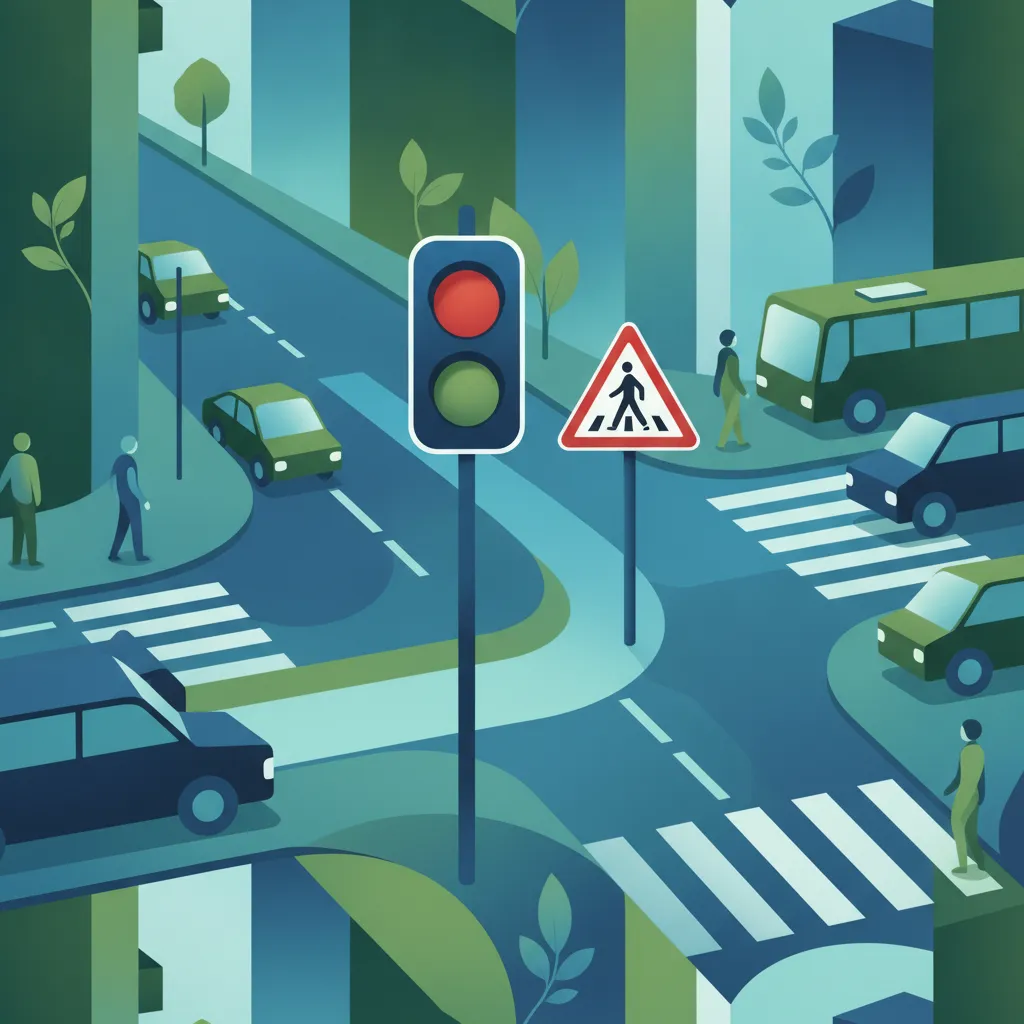
This lesson explains the operation and meaning of traffic light signals in Austria, including the standard red, yellow, and green phases, as well as flashing signals and arrows. It also covers other priority control devices, such as stop signs and yield signs, which are used to manage right-of-way at intersections. Understanding the hierarchy between these signals and signs is crucial for navigating junctions safely and in compliance with the law.

This lesson details the general traffic rules applicable to heavy goods vehicles on Austrian roads, highlighting differences from passenger car regulations. It covers key topics such as right-of-way at intersections, specific rules for overtaking, maintaining proper lane discipline, and adhering to designated speed limits. Understanding these rules is critical for safe integration into mixed traffic.
This lesson covers the various lighting and reflector systems required on heavy goods vehicles in Austria. It explains the function and legal requirements for headlights, taillights, brake lights, indicators, and reflective markings. Ensuring all lighting systems are operational is essential for visibility and communicating intentions to other road users.
This lesson outlines the standardized procedure for handling a vehicle breakdown safely. It covers pulling over to a safe location, activating hazard lights, deploying the warning triangle, and wearing a high-visibility vest. It also explains when and how to contact roadside assistance or emergency services.
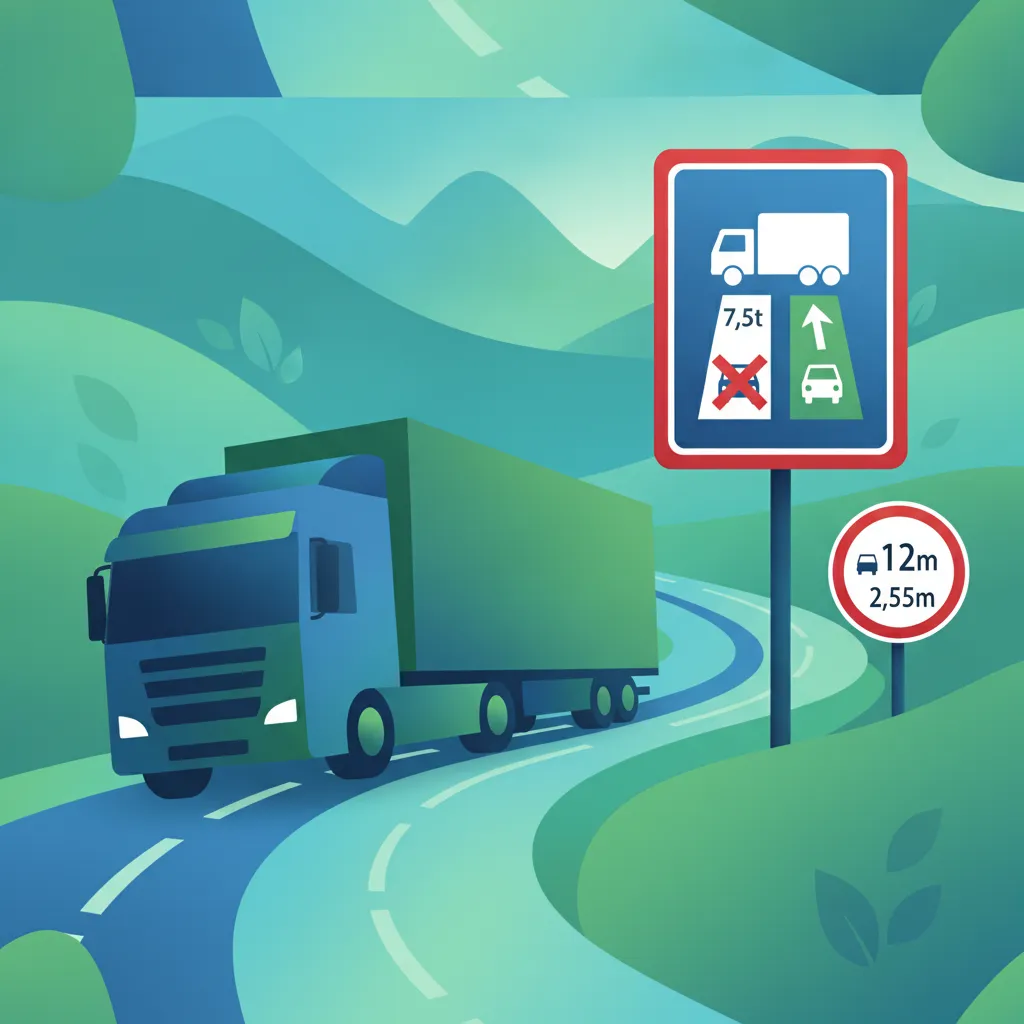
This lesson focuses on the specific Austrian road signs and supplemental plates that apply to heavy goods vehicles. It explains how to interpret signage indicating weight limits, height and width restrictions, lane usage rules, and other critical regulatory information. Correctly understanding these signs is essential for legal compliance and safe navigation on Austria's roads.

This lesson focuses on the specific challenges and safety protocols for operating a heavy vehicle on a construction site. It covers how to communicate with flaggers and site supervisors, navigate around other heavy machinery, and be aware of ground-level personnel. A high level of caution and clear communication is required in these dynamic environments.

Many Austrian cities use special signalling to give buses and trams priority at intersections. This lesson explains how to identify and understand these signals, which often use white bars or letters instead of standard colours. Learning to anticipate these signals allows for a smoother, more efficient driving style that takes full advantage of the public transport infrastructure.
This lesson focuses on the interpretation of traffic lights and road surface markings that guide riders through intersections. It covers the meaning of each traffic light phase, the rules for amber lights, and the significance of various lane lines and stop lines. Properly understanding these signals is essential for maintaining traffic flow and ensuring safety at junctions.

This lesson addresses the challenge of manoeuvring a large vehicle through streets not designed for its size. It covers how to assess vertical and horizontal clearances, plan the vehicle's path through tight turns, and heed all restrictive signage. Careful planning and slow, precise control are essential for success.
This lesson reinforces the critical importance of protecting vulnerable road users in dense urban settings. It teaches drivers to be hyper-aware of pedestrians and cyclists, especially near intersections and crosswalks. Key techniques include reducing speed, making eye contact to confirm intentions, and giving ample space.
Learn how heavy goods vehicles must anticipate traffic light changes and plan stops in complex urban environments. Covers crucial aspects like braking distance and safe intersection passage.
This lesson reinforces the critical importance of protecting vulnerable road users in dense urban settings. It teaches drivers to be hyper-aware of pedestrians and cyclists, especially near intersections and crosswalks. Key techniques include reducing speed, making eye contact to confirm intentions, and giving ample space.
This lesson details the general traffic rules applicable to heavy goods vehicles on Austrian roads, highlighting differences from passenger car regulations. It covers key topics such as right-of-way at intersections, specific rules for overtaking, maintaining proper lane discipline, and adhering to designated speed limits. Understanding these rules is critical for safe integration into mixed traffic.
This lesson addresses the challenge of manoeuvring a large vehicle through streets not designed for its size. It covers how to assess vertical and horizontal clearances, plan the vehicle's path through tight turns, and heed all restrictive signage. Careful planning and slow, precise control are essential for success.
This lesson covers the various lighting and reflector systems required on heavy goods vehicles in Austria. It explains the function and legal requirements for headlights, taillights, brake lights, indicators, and reflective markings. Ensuring all lighting systems are operational is essential for visibility and communicating intentions to other road users.
This lesson provides practical strategies for safely reversing in challenging environments like narrow streets or busy loading zones. It emphasizes the 'get out and look' principle, the proper use of mirrors and cameras, and the critical safety role of a reliable spotter. Executing these manoeuvres slowly and cautiously is paramount to avoiding collisions.

This lesson focuses on the legal restrictions concerning a heavy vehicle's dimensions, including maximum height, width, and length. It teaches drivers how to interpret road signs and supplemental plates that indicate these limits. This knowledge is crucial for route planning, especially when navigating under bridges, through tunnels, and on restricted roads.
This lesson explains the regulations governing the use of designated delivery and loading zones in urban areas. It covers topics such as time restrictions, the potential need for permits, and the correct way to position the vehicle to minimize traffic disruption. Adhering to these rules is essential for efficient and legal urban logistics.
This lesson focuses on the specific Austrian road signs and supplemental plates that apply to heavy goods vehicles. It explains how to interpret signage indicating weight limits, height and width restrictions, lane usage rules, and other critical regulatory information. Correctly understanding these signs is essential for legal compliance and safe navigation on Austria's roads.
This lesson covers the practical aspects of planning a route for a heavy goods vehicle. It explains how to use maps and specialized GPS systems to identify and avoid roads with height, weight, or other restrictions. Proactive route planning is essential for ensuring an efficient, legal, and safe journey.

This lesson focuses on the strategic approach to navigating intersections and roundabouts in a large vehicle. It covers the importance of correct lane positioning well in advance of the turn to accommodate the vehicle's size and off-tracking. The lesson also reinforces right-of-way rules and how to safely merge with and cross traffic.
Find clear answers to common questions learners have about Coordination with Municipal Traffic Control Measures. Learn how the lesson is structured, which driving theory objectives it supports, and how it fits into the overall learning path of units and curriculum progression in Austria. These explanations help you understand key concepts, lesson flow, and exam focused study goals.
Yes. According to Austrian traffic law, instructions given by police officers or authorized personnel at an intersection always take precedence over traffic lights and fixed road signs.
You must clear the intersection as quickly and safely as possible. In your theory exam, always emphasize that a heavy vehicle should never enter an intersection unless there is enough space to clear it fully before the signal changes.
Yes. Drivers must strictly adhere to temporary lane markings and speed restrictions. These are often narrower than standard lanes, requiring extra caution regarding the width of your heavy vehicle.
Observe the surrounding traffic flow, such as pedestrians or cars slowing down, and pay attention to auxiliary signals. In the exam, prioritize maintaining a safe distance that allows for smooth stops rather than sudden braking, which could cause a load shift.
Refine your study plan by searching for specific Austrian driving theory practice sets. Pinpoint questions related to particular road rules, signs, or challenge levels, and begin practicing immediately to reinforce your knowledge and excel in your official exam with confidence. Get started with focused revision today.