
This lesson details the specific rules for using delivery zones and loading areas in Austrian urban centers. You will learn how to navigate narrow streets, respect loading time limits, and plan manoeuvres that avoid obstructing traffic or creating hazards.

Lesson content overview
Professional heavy goods vehicle (HGV) drivers frequently operate in densely populated urban environments, making efficient and legal use of designated delivery zones and loading areas crucial. This lesson explores the regulations, best practices, and safety considerations for accessing these areas in urban settings, particularly within the context of Austrian traffic law. Understanding these rules is not only essential for compliance and avoiding penalties but also for ensuring the smooth flow of city traffic and the safety of all road users.
Urban delivery zones and loading areas are specifically designated spaces designed to manage the logistical demands of city centers without causing undue disruption to traffic or endangering other road users. For heavy goods vehicles, these zones are indispensable, providing legal and practical spaces to stop, load, and unload merchandise in areas where regular parking or stopping might be prohibited.
A designated delivery zone, often referred to as a loading zone, is a specially marked section of a public road or street reserved for the temporary stopping of vehicles for the purpose of loading or unloading goods. These zones are vital for urban logistics, allowing businesses to receive supplies and dispatch products efficiently. Their markings and associated signage clearly differentiate them from general parking spaces or areas where stopping is entirely forbidden.
In Austria, these zones are typically indicated by specific road signs and often accompanied by pavement markings. For instance, a blue painted curb or a road sign with an "L" symbol can denote a loading zone. These visual cues are critical for drivers to quickly identify where they are permitted to conduct their operations.
The importance of well-regulated urban loading areas for heavy goods vehicles cannot be overstated. They serve multiple critical functions:
The use of delivery zones and loading areas in Austria is governed by the Straßenverkehrsordnung (StVO), the Austrian Road Traffic Regulations. These regulations define the types of zones, permissible stopping times, signage, and the consequences of non-compliance. It is imperative for all professional drivers operating heavy goods vehicles in Austria to be thoroughly familiar with the relevant sections of the StVO concerning stopping, parking, and loading activities. Local municipal ordinances may also add further specific restrictions or permit requirements, particularly in city centers.
Operating within urban loading zones requires adherence to several core principles. These principles ensure that loading and unloading operations are conducted safely, efficiently, and in full compliance with traffic laws.
The first step in using a loading zone correctly is to accurately identify it. Designated delivery zones are typically marked by a combination of road signs and pavement markings.
While a specific universal Austrian sign code for "Ladezone" as a single sign isn't always presented like typical traffic signs, the concept is communicated through a combination of signs and markings. Drivers should look for:
Drivers must always interpret these signs and markings carefully. Overlapping signs or temporary signage for events can introduce complexity, demanding heightened attention from the driver.
Many urban loading zones are subject to time-based restrictions. These restrictions are implemented to manage traffic flow during different periods of the day, such as rush hour, or to protect residential areas from noise during certain hours.
Always check the supplementary signs beneath a 'Ladezone' sign for specific time frames. Ignoring these can lead to immediate fines.
Common types of restrictions include:
Drivers must ensure their loading or unloading activities fall strictly within these specified windows. Stopping outside the permitted times without a valid permit is a common violation.
For certain businesses or specific delivery needs, local authorities may issue special permits. These permits grant authorization to use a loading zone beyond its standard restrictions, such as for extended durations or outside the generally permitted hours.
Official authorization issued by local municipal authorities that grants a specific vehicle or business the right to use a loading zone under conditions that differ from standard restrictions.
Operating without a required permit, or exceeding the limits of a valid permit, will lead to fines and could result in the vehicle being towed.
Proper vehicle positioning within a designated loading zone is paramount for safety and traffic flow. It means aligning the heavy goods vehicle precisely within the marked boundaries, ensuring it does not obstruct any part of the traffic lanes, pedestrian walkways, or cycle paths.
Key elements of correct positioning include:
Incorrect positioning, such as parking partially outside the zone, at an angle, or allowing doors to swing into active lanes, is a common cause of traffic disruption and accidents, particularly with vulnerable road users.
The principle of "minimal stopping time" dictates that loading and unloading activities must be completed as quickly and efficiently as possible. This is a crucial aspect of managing urban traffic congestion and reducing the exposure of a stationary HGV to potential hazards.
The requirement for drivers to complete loading or unloading operations in the shortest feasible duration to reduce traffic disruption and hazards.
Before entering an urban loading zone, ensure all necessary paperwork, equipment (e.g., pallet jack, hand truck), and the cargo itself are readily prepared to minimize delays.
The Austrian Straßenverkehrsordnung (StVO) provides explicit rules governing the use of loading zones. Adherence to these is mandatory for all drivers, especially those operating heavy goods vehicles.
It is a strict requirement that the entire heavy goods vehicle, including its load, must be contained within the marked boundaries of the loading zone. This means ensuring that no part of the vehicle, not even wheels or mirrors, extends beyond the painted lines or designated area into active traffic lanes, pedestrian crossings, or bike lanes.
Stopping even partially outside the designated loading zone boundaries is considered an illegal stop and can result in a fine or towing, as it obstructs traffic.
As discussed, all drivers must diligently observe the time and day restrictions indicated on the loading zone signage. For example, if a sign states "Ladezone 07-09 Uhr werktags," loading is only permitted between 7 AM and 9 AM on weekdays. Operating outside these hours without a specific, valid permit is a direct violation of traffic regulations.
If a permit is required for your specific loading operation (e.g., for extended hours, certain days, or specific locations), it must be clearly and visibly displayed within the vehicle. Typically, this means placing it on the dashboard or windshield, making it easily readable from outside the vehicle. Failure to display a valid permit, even if one is held, can lead to the same penalties as operating without a permit.
Many loading zones have a specified maximum duration for stopping, regardless of whether you are actively loading or unloading. This limit is usually short, often between 5 to 15 minutes, and is explicitly stated on the signage. Professional drivers must complete their tasks within this window. If a task requires more time, an alternative solution or a special permit should be sought.
One of the fundamental rules is that the heavy goods vehicle, while stopped in a loading zone, must under no circumstances obstruct or endanger other road users. This includes:
For safety reasons, loading and unloading must only occur when the heavy goods vehicle is completely stationary. This means the engine should ideally be off or in neutral with the handbrake (parking brake) fully engaged. The vehicle must not be rolling, even slowly, while doors are open or cargo is being handled. This prevents accidental movement that could injure personnel or other road users.
While often a recommendation, using hazard warning lights (all turn signals flashing simultaneously) is mandatory in certain conditions and highly recommended in others when a vehicle is stopped for loading or unloading.
When operating a heavy goods vehicle in an urban loading zone, consider activating hazard lights as a standard practice to enhance visibility and alert other road users to your stationary presence.
Despite clear regulations, certain violations frequently occur in urban loading zones, often leading to fines, traffic disruptions, and safety hazards. Professional drivers must be aware of these pitfalls and consistently employ correct practices.
Violation: Parking with part of the vehicle, such as the rear wheels, mirrors, or an overhanging load, extending beyond the marked boundaries of the loading zone into a traffic lane, bike lane, or pedestrian area. This causes other road users to swerve or stop. How to Avoid: Take extra time to maneuver and ensure the entire vehicle is precisely within the painted lines. Use mirrors carefully and, if possible, have a spotter for tight spaces. Prioritize safety over speed during parking.
Violation: Exceeding the maximum allowed stopping duration (e.g., 5, 10, or 15 minutes) even if actively loading or unloading. How to Avoid: Thoroughly plan your delivery. Pre-stage cargo, have paperwork ready, and ensure necessary equipment is accessible. If a task clearly requires more time than allowed, seek alternative arrangements or a specific permit in advance.
Violation: Stopping to load or unload goods in a designated zone before the permitted start time or after the permitted end time, without a valid permit for those specific hours. How to Avoid: Always verify the posted time restrictions before attempting to use a loading zone. If delivery outside these hours is unavoidable, ensure you have obtained and displayed the appropriate permit.
Violation: Opening vehicle doors (especially side or rear doors) into active bike lanes or pedestrian walkways, forcing cyclists or pedestrians to stop, swerve, or walk into traffic. How to Avoid: Position the vehicle as close to the curb as possible. Ensure doors open onto the sidewalk or into a clear, safe area, never into a path where vulnerable road users might be. Always check your surroundings before opening any door.
Violation: Attempting to load or unload while the vehicle is still in gear, rolling slowly, or with the handbrake not fully engaged. How to Avoid: Always bring the vehicle to a complete stop, switch off the engine (if safe to do so), and fully engage the handbrake before opening doors or handling cargo. This prevents unintended movement that can cause accidents or injuries.
Violation: Having a valid permit but failing to display it clearly on the vehicle (e.g., it's in a briefcase, on the seat, or obscured). How to Avoid: Ensure all required permits are prominently displayed on the dashboard or windshield, facing outwards, for easy verification by enforcement officers.
Violation: Stopping a heavy goods vehicle in areas clearly marked as pedestrian zones or no-stopping zones, assuming a 'quick stop' for delivery is permissible. How to Avoid: Respect all signage. If a zone is for pedestrians only or strictly no-stopping, it applies to all vehicles unless a very specific, temporary permit has been granted for that exact location and time. Seek alternative, legal loading zones.
The safe and legal use of urban loading zones is not static; it requires drivers to adapt their practices based on various contextual conditions.
The regulations surrounding urban delivery zones are not arbitrary; they are meticulously designed with a strong emphasis on safety, efficiency, and the protection of all road users. Understanding the rationale behind these rules fosters a deeper appreciation for their importance.
A stationary heavy goods vehicle, particularly when its doors are open or it is partly obscured, can pose a significant hazard. Rules requiring hazard lights and proper positioning are aimed at maximizing the vehicle's visibility. This gives other drivers, cyclists, and pedestrians sufficient reaction time to perceive the HGV and adjust their course, thereby preventing sudden maneuvers, collisions, and near-misses.
Urban environments are prone to congestion. An improperly parked or excessively long-stopped HGV can quickly create bottlenecks, causing significant delays for countless other vehicles. By concentrating loading activities in designated, time-restricted zones, municipalities aim to minimize the impact on overall traffic capacity, ensuring vehicles can continue to move through urban arteries without unnecessary blockages. This directly contributes to reducing travel times and improving the efficiency of urban transportation networks.
While the vehicle is stationary during loading or unloading, there is still a risk of load shift, especially with heavy or unbalanced cargo. Engaging the handbrake fully and ensuring the vehicle is on a stable, level surface prevents unintended vehicle movement. Rules emphasizing a fully stationary vehicle during operations are critical to preventing accidents caused by sudden rolling or shifting of the HGV, which could injure personnel or damage property.
Vulnerable road users, such as pedestrians and cyclists, are at high risk in urban environments. Rules regarding door swing direction and keeping bike lanes/sidewalks clear are direct measures to protect them. An open HGV door suddenly swinging into a bike lane can have catastrophic consequences for a cyclist. By enforcing careful positioning, the regulations create a safer passage for those not enclosed in a vehicle, significantly reducing the likelihood of severe accidents.
Understanding the rules in theory is one thing; applying them correctly in dynamic urban environments is another. These scenarios illustrate how various rules come into play during typical delivery situations for heavy goods vehicles.
Setting: A bustling city street in Vienna, 6:30 AM on a Tuesday. The loading zone sign reads: "Ladezone 07:00 - 09:00 Uhr Werktags." Clear weather.
Relevant Rule: Loading Zone time restrictions.
Correct Behavior: The driver identifies the time restriction. Instead of stopping immediately at 6:30 AM, the driver finds a safe temporary waiting spot nearby or waits until 7:00 AM before pulling into the designated blue loading zone. Once 7:00 AM arrives, the driver parks the HGV fully within the marked area, engages the handbrake, and efficiently unloads the goods within the minimal stopping time allowed.
Incorrect Behavior: The driver, wanting to get an early start, pulls into the loading zone at 6:45 AM and begins unloading.
Explanation: Stopping and loading before the permitted time, even by a few minutes, is a violation. The driver must respect the posted time constraints to avoid illegal loading and potential fines.
Setting: An urban center in Graz, 5:45 PM. It's heavily raining and dusk is setting in. A bike lane runs adjacent to the loading zone.
Relevant Rule: Hazard lights recommended when visibility is reduced; vehicle positioning to avoid obstructing bike lanes.
Correct Behavior: The driver activates the HGV's hazard warning lights immediately upon stopping within the loading zone to enhance visibility. The vehicle is positioned very close to the curb, ensuring the rear loading doors, when opened, swing onto the sidewalk and do not encroach even slightly into the adjacent bike lane. The driver is extra cautious of passing cyclists and pedestrians due to reduced visibility.
Incorrect Behavior: The driver loads without activating hazard lights, and the rear doors, when opened, partially swing into the bike lane, forcing a cyclist to swerve suddenly.
Explanation: In low visibility conditions, hazard lights are crucial for making a stationary HGV visible. Blocking a bike lane, especially with open doors, endangers cyclists and is a serious safety violation.
Setting: A commercial district in Salzburg, 10:00 AM on a Sunday. General signage indicates "No Loading on Sundays." However, the driver has a special municipal permit for Sunday deliveries to a specific retail store.
Relevant Rule: Permit overrides general restrictions if valid and displayed.
Correct Behavior: The business has obtained a valid permit specifically allowing Sunday deliveries at this location. The driver prominently displays this permit on the HGV's windshield before stopping in the loading zone and proceeds with unloading within the permit's specified times and durations.
Incorrect Behavior: The driver, assuming a quick stop is fine, loads without displaying the permit, or attempts to load without having a permit at all.
Explanation: A valid and properly displayed permit grants an exception to general restrictions. Without it, the driver is in violation, regardless of having an actual need for the delivery.
Setting: A narrow residential alley in Linz, weekday 3:00 PM, with light local traffic. A small, designated loading zone is marked.
Relevant Rule: Vehicle must be positioned without obstructing traffic lanes, sidewalks, or building access.
Correct Behavior: The driver carefully maneuvers the HGV into the loading zone, parking as close as possible and perfectly parallel to the curb. Special care is taken to ensure no part of the vehicle extends into the narrow traffic lane, and that pedestrian access points or building entrances are not blocked.
Incorrect Behavior: The driver parks slightly at an angle or too far from the curb, causing the HGV to partially block the already narrow alleyway, forcing other vehicles to wait or struggle to pass.
Explanation: In constricted spaces, precise positioning is critical. Improper alignment exacerbates traffic flow issues and can lead to dangerous situations or property damage in narrow urban passages.
Setting: A busy downtown street in Innsbruck, with a loading zone sign indicating "Max. 5 Minuten Ladedauer" (Max. 5 minutes loading duration).
Relevant Rule: Maximal stopping duration must be respected.
Correct Behavior: The driver completes the unloading of goods within 4 minutes, diligently ensuring all steps are efficient. Once finished, the driver immediately departs the loading zone, allowing it to become available for the next user.
Incorrect Behavior: Due to unexpected paperwork or a chat with store staff, the driver remains stationary in the zone for 8 minutes.
Explanation: Overstaying the maximum duration, even if actively engaged in delivery-related tasks, is a violation. It contributes to congestion, reduces the availability of essential loading spaces, and will likely result in a citation.
Navigating delivery zones and loading areas in urban settings is a cornerstone of professional heavy goods vehicle operation in Austria. It demands a meticulous understanding of local regulations, keen attention to signage and pavement markings, and a constant commitment to safety. By consistently adhering to time restrictions, ensuring correct vehicle positioning, minimizing stopping times, and using hazard lights when appropriate, HGV drivers not only fulfill their legal obligations but also play a vital role in maintaining efficient traffic flow and ensuring the safety of all road users in busy city environments. Mastering these skills is indispensable for effective and responsible urban logistics.
This lesson covers Austrian regulations for using urban delivery and loading zones with heavy goods vehicles, governed by the Straßenverkehrsordnung (StVO). Key requirements include correctly identifying zones through road signs and pavement markings, strictly adhering to posted time restrictions and maximum stopping durations, ensuring the entire vehicle remains within marked boundaries, and using hazard lights in reduced visibility conditions. Professional drivers must also understand when permits are required, how to position vehicles to avoid obstructing cyclists and pedestrians, and why loading operations must only occur when the vehicle is fully stationary with the handbrake engaged. Common violations include overstaying permitted times, improper positioning, unauthorized loading outside operating hours, and blocking vulnerable road user pathways with open doors.
A short set of high-value points that capture the most important learning from this lesson.
Designated loading zones in Austria are marked by specific road signs and pavement markings, typically blue painted curbs or signs displaying an 'L' symbol.
Time restrictions on loading zones are legally enforced: stopping outside permitted hours without a valid permit constitutes a traffic violation under Austrian law.
The entire vehicle, including all axles and mirrors, must be contained within marked zone boundaries; partial obstruction of traffic lanes, bike lanes, or pedestrian paths is prohibited.
Loading and unloading must only occur when the vehicle is fully stationary with the handbrake engaged, never while the vehicle is rolling or in gear.
Permits issued by municipal authorities must be clearly displayed on the dashboard or windshield to grant exceptions to standard loading zone restrictions.
Explore all units and lessons included in this driving theory course.
Loading zones often have strict time windows (e.g., 07:00-09:00) and maximum stopping durations (typically 5-15 minutes), both of which are stated on supplementary signs.
Blue curb markings commonly indicate general loading zones, but other colors like yellow or red may signify more restricted or temporary zones.
Hazard lights must be activated in conditions of reduced visibility (rain, fog, dusk, night) and are highly recommended whenever a vehicle is stationary with open doors in traffic.
Vehicle loading doors must open towards the sidewalk or safe clear space, never into active bike lanes or pedestrian walkways.
Municipal permits grant exceptions to standard restrictions but must be current, applicable to the specific location, and visibly displayed.
Stopping in a loading zone before the permitted start time or after the end time, assuming a brief early or late stop is harmless.
Parking with wheels, mirrors, or load extending beyond the painted zone boundaries into active traffic or bike lanes.
Overstaying the maximum allowed stopping duration (e.g., 5-15 minutes) even when actively engaged in loading or unloading tasks.
Opening side or rear doors into bike lanes or pedestrian pathways, forcing cyclists or pedestrians to swerve or stop.
Having a valid permit but failing to display it clearly on the dashboard or windshield where enforcement officers can see it.
Lesson content overview
A short set of high-value points that capture the most important learning from this lesson.
Designated loading zones in Austria are marked by specific road signs and pavement markings, typically blue painted curbs or signs displaying an 'L' symbol.
Time restrictions on loading zones are legally enforced: stopping outside permitted hours without a valid permit constitutes a traffic violation under Austrian law.
The entire vehicle, including all axles and mirrors, must be contained within marked zone boundaries; partial obstruction of traffic lanes, bike lanes, or pedestrian paths is prohibited.
Loading and unloading must only occur when the vehicle is fully stationary with the handbrake engaged, never while the vehicle is rolling or in gear.
Permits issued by municipal authorities must be clearly displayed on the dashboard or windshield to grant exceptions to standard loading zone restrictions.
Explore all units and lessons included in this driving theory course.
Loading zones often have strict time windows (e.g., 07:00-09:00) and maximum stopping durations (typically 5-15 minutes), both of which are stated on supplementary signs.
Blue curb markings commonly indicate general loading zones, but other colors like yellow or red may signify more restricted or temporary zones.
Hazard lights must be activated in conditions of reduced visibility (rain, fog, dusk, night) and are highly recommended whenever a vehicle is stationary with open doors in traffic.
Vehicle loading doors must open towards the sidewalk or safe clear space, never into active bike lanes or pedestrian walkways.
Municipal permits grant exceptions to standard restrictions but must be current, applicable to the specific location, and visibly displayed.
Stopping in a loading zone before the permitted start time or after the end time, assuming a brief early or late stop is harmless.
Parking with wheels, mirrors, or load extending beyond the painted zone boundaries into active traffic or bike lanes.
Overstaying the maximum allowed stopping duration (e.g., 5-15 minutes) even when actively engaged in loading or unloading tasks.
Opening side or rear doors into bike lanes or pedestrian pathways, forcing cyclists or pedestrians to swerve or stop.
Having a valid permit but failing to display it clearly on the dashboard or windshield where enforcement officers can see it.
Explore search topics learners often look for when studying Delivery Zones and Loading Areas in Urban Settings. These topics reflect common questions about road rules, driving situations, safety guidance, and lesson level theory preparation for learners in Austria.
Browse additional driving theory lessons that cover connected traffic rules, road signs, and common driving situations related to this topic. Improve your understanding of how different rules interact across everyday traffic scenarios.
Learn essential heavy goods vehicle (HGV) maneuvering techniques for urban Austrian streets. Covers managing blind spots, safe right turns with vulnerable road users, and navigating tight spaces. Essential theory for professional drivers.

This lesson provides practical strategies for safely reversing in challenging environments like narrow streets or busy loading zones. It emphasizes the 'get out and look' principle, the proper use of mirrors and cameras, and the critical safety role of a reliable spotter. Executing these manoeuvres slowly and cautiously is paramount to avoiding collisions.

This lesson addresses the specific danger of right-hand turns, where cyclists and pedestrians in the vehicle's right-side blind spot are at high risk. It covers the defensive driving techniques required, including careful observation, slow speed, and yielding the right-of-way. These procedures are critical for preventing serious accidents in urban areas.

This lesson reinforces the critical importance of protecting vulnerable road users in dense urban settings. It teaches drivers to be hyper-aware of pedestrians and cyclists, especially near intersections and crosswalks. Key techniques include reducing speed, making eye contact to confirm intentions, and giving ample space.
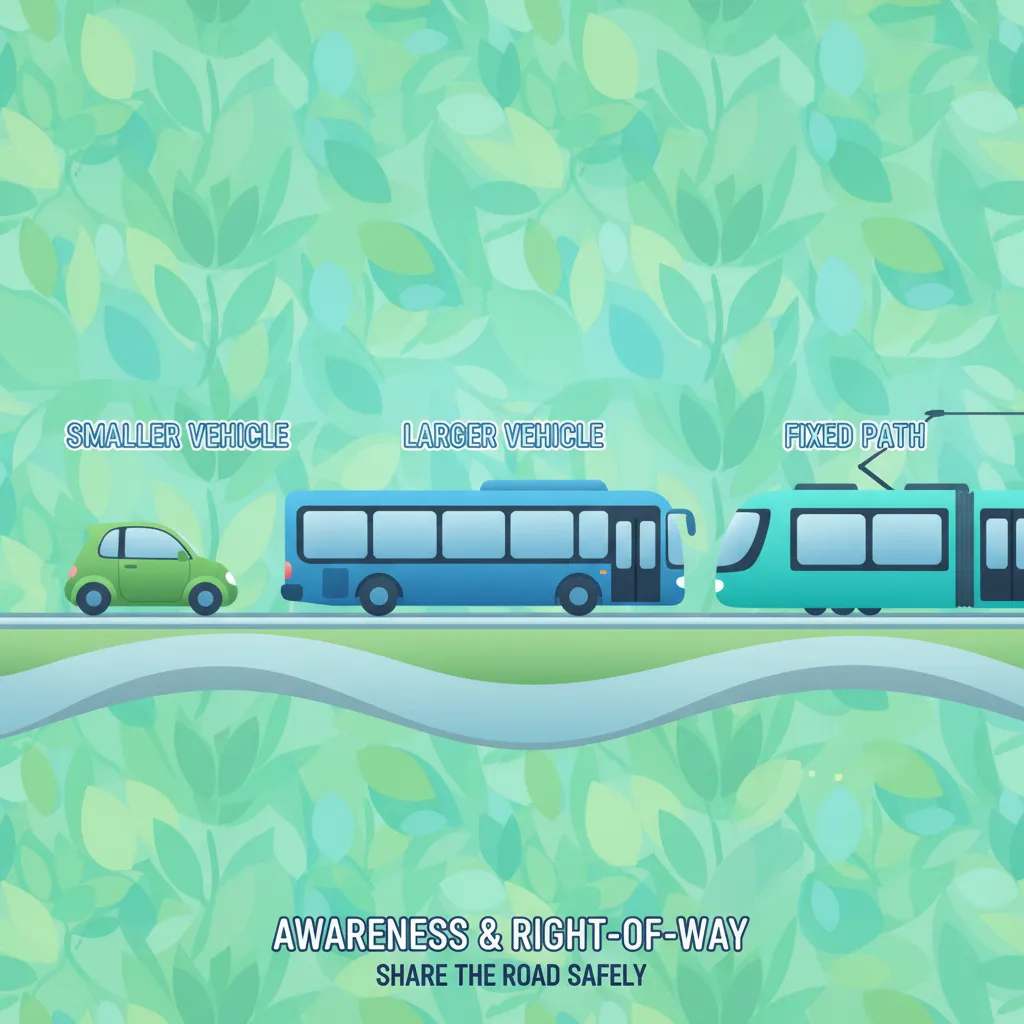
This lesson provides specific guidance for sharing the road with different types of vehicles in Austria. It covers the dangers of large vehicle blind spots, the rules for navigating near buses and dedicated tram tracks, and common conflict points at intersections. Understanding the behavior and limitations of other vehicles is key to safely navigating complex urban environments.

This lesson addresses the challenge of manoeuvring a large vehicle through streets not designed for its size. It covers how to assess vertical and horizontal clearances, plan the vehicle's path through tight turns, and heed all restrictive signage. Careful planning and slow, precise control are essential for success.

This lesson covers the interaction with various forms of urban traffic control. It includes anticipating traffic light cycles to avoid stopping in an intersection and following the directions given by police or road work personnel. Smooth cooperation with these systems ensures better traffic flow and safety for everyone.

This lesson focuses on the critical role of mirrors, cameras, and other electronic aids in minimizing blind spots around a large vehicle. It provides guidance on how to properly adjust mirrors to maximize visibility. Effective use of these systems is vital for detecting smaller vehicles, cyclists, and pedestrians, especially during manoeuvres.

Many Austrian towns and city centres feature narrow roads not designed for large vehicles. This lesson provides strategies for assessing tight spaces, positioning the vehicle to maximize clearance, and navigating complex, non-standard junctions. It emphasizes the importance of slow speeds, constant observation, and understanding the vehicle's swept path to avoid contact with buildings, street furniture, and other vehicles.

This lesson details the general traffic rules applicable to heavy goods vehicles on Austrian roads, highlighting differences from passenger car regulations. It covers key topics such as right-of-way at intersections, specific rules for overtaking, maintaining proper lane discipline, and adhering to designated speed limits. Understanding these rules is critical for safe integration into mixed traffic.

This lesson focuses on the strategic approach to navigating intersections and roundabouts in a large vehicle. It covers the importance of correct lane positioning well in advance of the turn to accommodate the vehicle's size and off-tracking. The lesson also reinforces right-of-way rules and how to safely merge with and cross traffic.
Understand the critical rules for using urban delivery and loading zones in Austria for heavy goods vehicles. Covers time restrictions, permits, correct vehicle positioning, and safe loading practices relevant for C category drivers.
This lesson details the general traffic rules applicable to heavy goods vehicles on Austrian roads, highlighting differences from passenger car regulations. It covers key topics such as right-of-way at intersections, specific rules for overtaking, maintaining proper lane discipline, and adhering to designated speed limits. Understanding these rules is critical for safe integration into mixed traffic.

This lesson summarizes the key legal duties a driver has when making deliveries in a city. It covers adherence to specific delivery time windows, noise regulations, and proper procedures for securing the vehicle and load during unloading. Compliance with these rules is necessary to avoid fines and maintain good public relations.
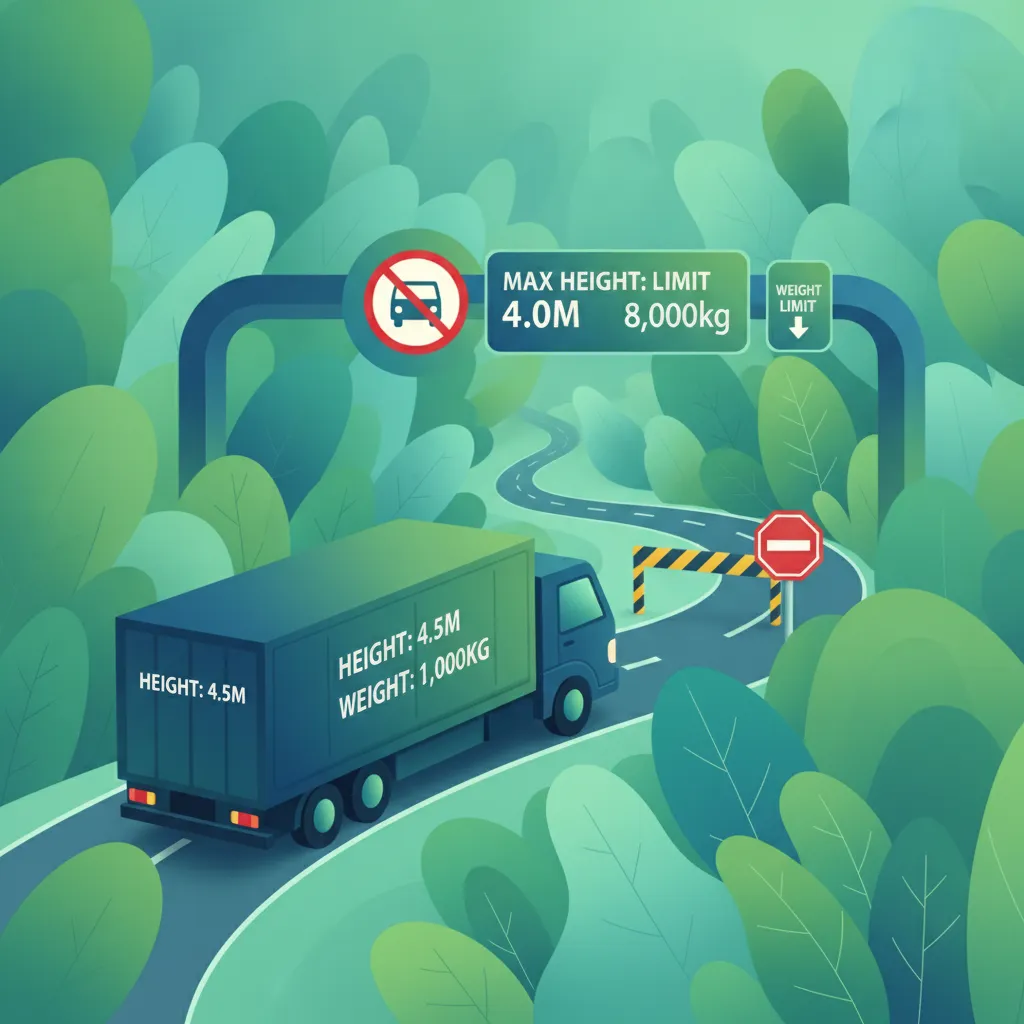
This lesson covers the practical aspects of planning a route for a heavy goods vehicle. It explains how to use maps and specialized GPS systems to identify and avoid roads with height, weight, or other restrictions. Proactive route planning is essential for ensuring an efficient, legal, and safe journey.

This lesson focuses on the legal restrictions concerning a heavy vehicle's dimensions, including maximum height, width, and length. It teaches drivers how to interpret road signs and supplemental plates that indicate these limits. This knowledge is crucial for route planning, especially when navigating under bridges, through tunnels, and on restricted roads.

This lesson details the regulations for heavy goods vehicles on Austria's high-speed road network. It covers the specific speed limits, rules on lane usage (e.g., when overtaking is permitted), and procedures for entering and exiting the motorway. Adherence to these rules is crucial for safety in a fast-paced environment.
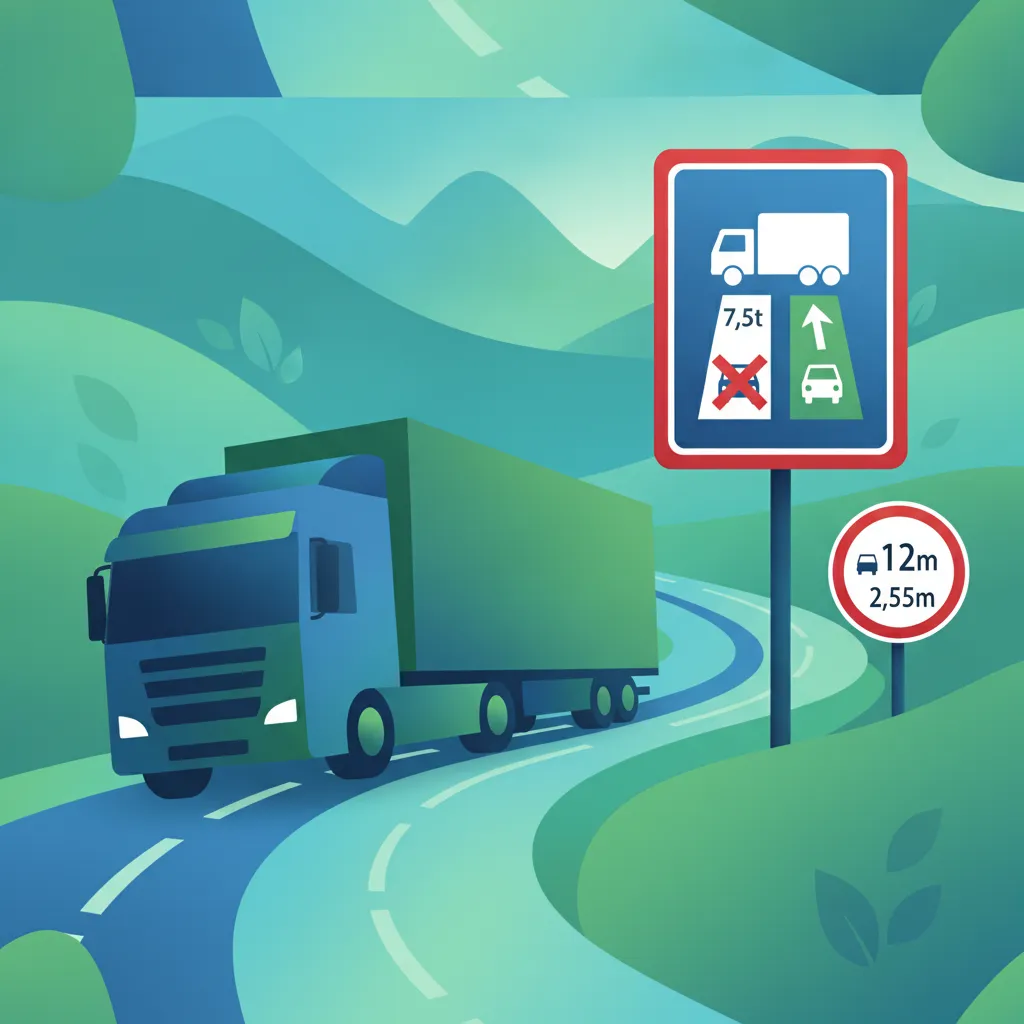
This lesson focuses on the specific Austrian road signs and supplemental plates that apply to heavy goods vehicles. It explains how to interpret signage indicating weight limits, height and width restrictions, lane usage rules, and other critical regulatory information. Correctly understanding these signs is essential for legal compliance and safe navigation on Austria's roads.
This lesson explains the system of penalties and enforcement for heavy vehicle operations in Austria. It covers the fines and penalty points associated with common traffic violations, such as overloading or insecure loads. Learners will understand the role of authorities in conducting roadside checks and inspections to ensure regulatory compliance.

This lesson consolidates the legal restrictions on the maximum dimensions and weight for different vehicle combinations in Austria. It covers how to read signs indicating these limits and the importance of compliance for route planning. Adhering to these regulations is essential for legal operation and avoiding fines.
This lesson addresses the challenge of manoeuvring a large vehicle through streets not designed for its size. It covers how to assess vertical and horizontal clearances, plan the vehicle's path through tight turns, and heed all restrictive signage. Careful planning and slow, precise control are essential for success.

This lesson details the legal ramifications of operating an overloaded heavy vehicle in Austria, which include significant fines and penalty points. It also emphasizes the severe safety risks, such as compromised braking performance and increased mechanical stress on the vehicle. Understanding these consequences reinforces the importance of strict adherence to weight limits.
Find clear answers to common questions learners have about Delivery Zones and Loading Areas in Urban Settings. Learn how the lesson is structured, which driving theory objectives it supports, and how it fits into the overall learning path of units and curriculum progression in Austria. These explanations help you understand key concepts, lesson flow, and exam focused study goals.
No, many delivery zones in Austrian cities have specific time restrictions or may require a special municipal permit for vehicles exceeding certain weights or dimensions. Always check local signage.
Check for supplementary plates (Zusatztafeln) that specify vehicle categories, maximum weight limits, or restricted times. Ignoring these is a common cause for failure in the theory test.
Generally, you cannot obstruct traffic. In urban settings, you must plan your delivery route to include access to authorized loading areas or private loading docks to avoid illegal obstruction.
Exam questions often present a scenario with a specific road sign near a delivery zone. You must identify if your vehicle type (e.g., C or CE) is permitted to stop there based on the displayed restriction.
Refine your study plan by searching for specific Austrian driving theory practice sets. Pinpoint questions related to particular road rules, signs, or challenge levels, and begin practicing immediately to reinforce your knowledge and excel in your official exam with confidence. Get started with focused revision today.