
This lesson guides you through the crucial system of traffic light signals and priority devices used across Austria to maintain safe traffic flow. Understanding these signals is essential for mastering intersection management and is a fundamental requirement for your Category B theory exam. By the end of this lesson, you will be able to interpret light sequences, recognise priority signs, and apply them correctly in complex road scenarios.
Lesson content overview
Navigating the roads in Austria as a Category B driver requires a thorough understanding of all traffic control devices. Among the most crucial are traffic light signals and various priority signs, which together regulate traffic flow and determine right-of-way at intersections. This lesson, part of your Austrian Driving License B Theory Course, will provide a comprehensive overview of how these devices operate, their specific meanings under Austrian traffic law (StVO), and the crucial hierarchy that dictates which instruction to obey when multiple devices are present. Mastering this knowledge is essential for ensuring safety, preventing collisions, and complying with legal obligations on Austrian roads.
Traffic control devices serve as the silent language of the road, communicating essential information to drivers, cyclists, and pedestrians. They are designed to minimize confusion and enhance safety by establishing clear rules for proceeding, stopping, or yielding. In Austria, the Straßenverkehrsordnung (StVO) provides the legal framework for all traffic control devices, ensuring uniformity and predictability across the entire road network.
These devices build upon fundamental right-of-way rules, creating a structured system that reduces uncertainty at complex junctions. Without a clear hierarchy, conflicting instructions could lead to dangerous situations and frequent accidents. Therefore, understanding the ranking of these devices – which one takes precedence over another – is as vital as knowing the meaning of each individual signal or sign.
Traffic light signals are among the most dynamic and universally recognized traffic control devices, dictating when vehicles may enter or proceed through an intersection. In Austria, these signals follow specific phases, some of which have unique characteristics compared to other countries. Recognizing each phase and its associated obligations is fundamental for safe driving.
The most common traffic light sequence involves red, amber (yellow), and green lights. Each color conveys a specific instruction for drivers approaching or within an intersection.
A flashing green light is a crucial warning signal indicating that the green phase is ending and the light will soon change to amber, then red. This signal provides drivers with advance notice to anticipate stopping.
Upon seeing a flashing green light, you must prepare to stop. This means easing off the accelerator and being ready to brake. You should not accelerate to "beat" the light, as this can lead to dangerous situations and potential rear-end collisions. The duration of the flashing green phase is designed to give adequate time for a safe deceleration.
A flashing red light does not function as a standard red light, but rather as a highly restrictive stop sign combined with a yield requirement. When confronted with a continuously flashing red light, you must come to a complete stop before the stop line.
After stopping, you must yield to all traffic already in the intersection or approaching from other directions that has priority. Only when the intersection is completely clear and it is safe to proceed may you do so. This signal is often used at uncontrolled intersections or railway crossings to ensure maximum caution.
Traffic lights often include specific arrows to regulate turning movements, providing protected phases for particular directions. These arrows override the main light if they apply to your intended direction.
Pedestrians have their own dedicated traffic signals at many intersections and crosswalks. These signals typically show a walking human figure (green) or a standing human figure (red).
Beyond traffic lights, specific road signs are crucial for establishing priority at intersections where signals may not be present or are temporarily out of order. These signs convey mandatory instructions regarding yielding or having the right-of-way.
The yield sign, a red-bordered inverted triangle, is one of the most common priority signs. It instructs you to slow down, be prepared to stop, and give way to traffic on the priority road. This means that vehicles on the road you are joining or crossing have the right-of-way. You must not proceed or merge if doing so would force priority traffic to brake or change direction. This sign requires active observation and caution.
The stop sign, a red octagon with "STOP" in white, is the most restrictive priority sign. It mandates a full and complete stop before the stop line or, if no line is present, before the intersection itself, ensuring maximum visibility of cross traffic. After stopping, you must yield to all traffic on the intersecting road before proceeding when it is entirely safe and clear. A rolling stop, even a very slow one, is a violation.
The priority road sign, a white diamond with a yellow center, informs you that the road you are traveling on has the right-of-way at upcoming intersections. This priority remains in effect until you encounter a "priority road ends" sign or another sign explicitly changes the priority rule. While on a priority road, you generally do not need to yield to traffic from minor intersecting roads, but you should always remain vigilant and prepared for unexpected actions by other drivers.
When multiple traffic control devices are present at an intersection or along a road, it is crucial to understand which one takes precedence. This hierarchy of priority devices prevents conflicting instructions and ensures a clear, singular command for drivers.
The order of dominance is as follows:
Practical Application: Imagine an intersection with both a traffic light and a stop sign. If the traffic light is green, you follow the green light and proceed. If the traffic light is out of order or flashing red, then the stop sign becomes active, and you must obey its instruction to stop and yield.
Safe navigation of intersections requires combining your knowledge of traffic signals, priority signs, and general right-of-way rules. Anticipation, observation, and adherence to the law are key to preventing accidents.
Red Light Stop (Rotlicht Halt): Always stop before the stop line. Never enter the intersection on a red light. This is one of the most critical rules to prevent T-bone collisions.
Red + Amber Preparation (Rot + Gelblicht Vorbereitung): Use this phase to get ready to accelerate. Ensure your vehicle is in gear and you are observing the intersection for any unexpected situations.
Green Light Proceed (Grünlicht Weiterfahren): Proceed with caution. Even on a green light, always check for pedestrians, cyclists, and emergency vehicles. Never assume the intersection is clear.
Amber Light Caution (Gelblicht Vorsicht): If you can stop safely before the stop line when the amber light appears, do so. If you are too close and stopping abruptly would be dangerous, proceed cautiously to clear the intersection.
Flashing Green Anticipation (Grünblinklicht Antizipation): This is your signal to start reducing speed and prepare to stop. Do not accelerate.
Flashing Red Stop & Yield (Rotblinklicht Halt & Vorfahrt gewähren): Treat this as a mandatory stop, then yield to all traffic with priority before proceeding.
Yield Sign Compliance (Vorfahrt gewähren): Always be prepared to stop. Actively look for traffic on the priority road and only proceed when there is a safe gap.
Stop Sign Compliance (Halt Schild): Come to a complete, momentary stop. Even if the intersection appears empty, fulfill the stop requirement before moving.
Turn Arrow Obedience (Pfeilsignal befolgen): Always follow the direction indicated by turn arrows. A green straight arrow does not permit a left turn if there's a red left-turn arrow.
Pedestrian Priority (Fußgängervorfahrt): Pedestrian walk signals always take precedence over your vehicle's green light. Stop for pedestrians when they have their green signal.
Ignoring or misinterpreting traffic signals and priority signs is a leading cause of accidents and incurs significant penalties under Austrian law. Being aware of common mistakes can help you avoid them.
Consequences: Violations of traffic light and priority rules can result in substantial fines, accumulation of penalty points, and in serious cases, temporary suspension of your driving license. More importantly, they significantly increase the risk of severe collisions.
Driving conditions are not always ideal, and certain situations require adjusted behavior when interacting with traffic signals and priority devices.
A thorough understanding of traffic light signals and priority devices is non-negotiable for safe and lawful driving in Austria. Each signal and sign has a specific purpose and requires a precise response from drivers. The unique Austrian elements, such as the Red + Amber phase and Flashing Green light, highlight the importance of localized knowledge for your Austrian Driving License B Theory Course. By adhering to the hierarchy of traffic control devices and practicing diligent observation, you contribute significantly to road safety for yourself and all other road users.
Austrian traffic lights include unique phases such as Red+Amber (prepare to proceed while stopped) and Flashing Green (prepare to stop). Flashing red lights function as mandatory stops combined with yield requirements. When multiple devices are present, the hierarchy determines which takes precedence: police signals override everything, then operational traffic lights override road signs, with road markings taking lowest priority. Understanding pedestrian priority—stopping for pedestrians with a green walk signal even when your vehicle has a green light—is essential for both exam success and safe driving.
A short set of high-value points that capture the most important learning from this lesson.
Red+Amber phase in Austria signals preparation to proceed—still stop, but get ready to move when green appears
Flashing green light means the green phase is ending: ease off the accelerator and prepare to stop
Flashing red light requires a full stop AND yielding to all priority traffic before proceeding
Operational traffic lights take precedence over stop signs and yield signs at the same intersection
Pedestrians with a green walk signal always have priority over your vehicle, even with a green traffic light
Explore all units and lessons included in this driving theory course.
Hierarchy order: Police signals > Traffic lights > Priority road signs > Road markings
Red+Amber (Rot + Gelblicht) = prepare to go, still stopped; never move during this phase
Amber alone = stop if safe; proceed only if already too close to stop safely
Right turn on red is generally prohibited in Austria unless a specific green right-turn arrow or permission sign is displayed
A stop sign requires a complete cessation of movement—rolling stops are violations
Proceeding during the Red+Amber phase before the light turns solid green
Accelerating or failing to prepare for a stop when a green light begins flashing
Treating a flashing red light as a simple stop sign without giving way to existing traffic
Performing a rolling stop at a stop sign instead of a complete momentary stop
Entering an intersection on green without checking for pedestrians and cyclists who have right-of-way
Lesson content overview
A short set of high-value points that capture the most important learning from this lesson.
Red+Amber phase in Austria signals preparation to proceed—still stop, but get ready to move when green appears
Flashing green light means the green phase is ending: ease off the accelerator and prepare to stop
Flashing red light requires a full stop AND yielding to all priority traffic before proceeding
Operational traffic lights take precedence over stop signs and yield signs at the same intersection
Pedestrians with a green walk signal always have priority over your vehicle, even with a green traffic light
Explore all units and lessons included in this driving theory course.
Hierarchy order: Police signals > Traffic lights > Priority road signs > Road markings
Red+Amber (Rot + Gelblicht) = prepare to go, still stopped; never move during this phase
Amber alone = stop if safe; proceed only if already too close to stop safely
Right turn on red is generally prohibited in Austria unless a specific green right-turn arrow or permission sign is displayed
A stop sign requires a complete cessation of movement—rolling stops are violations
Proceeding during the Red+Amber phase before the light turns solid green
Accelerating or failing to prepare for a stop when a green light begins flashing
Treating a flashing red light as a simple stop sign without giving way to existing traffic
Performing a rolling stop at a stop sign instead of a complete momentary stop
Entering an intersection on green without checking for pedestrians and cyclists who have right-of-way
Explore search topics learners often look for when studying Traffic Light Signals and Priority Devices. These topics reflect common questions about road rules, driving situations, safety guidance, and lesson level theory preparation for learners in Austria.
Browse additional driving theory lessons that cover connected traffic rules, road signs, and common driving situations related to this topic. Improve your understanding of how different rules interact across everyday traffic scenarios.
Learn the precise order of precedence for traffic control devices in Austria. Understand how police signals, traffic lights, and road signs interact to dictate right-of-way and ensure safe intersection navigation.
This lesson provides a comprehensive explanation of Austria's right-of-way laws, which are fundamental to intersection safety. It covers the meaning of different priority signs and clarifies the 'Rechts vor Links' (priority to the right) rule that applies at unmarked junctions. A clear understanding of these rules is essential to prevent conflicts and collisions in urban and rural settings.
Many Austrian cities use special signalling to give buses and trams priority at intersections. This lesson explains how to identify and understand these signals, which often use white bars or letters instead of standard colours. Learning to anticipate these signals allows for a smoother, more efficient driving style that takes full advantage of the public transport infrastructure.

This lesson explains the core principles of Vorrang (having priority) and Nachrang (the obligation to yield) which form the basis of the Austrian traffic hierarchy. Learners will understand how priority roads are designated by signs and how drivers on secondary roads must yield right-of-way. The content clarifies the legal foundation for these rules under the Austrian road traffic act (StVO), providing a clear framework for decision-making at intersections.
This lesson examines various common intersection layouts, including T-intersections, four-way junctions, and complex multi-lane crossings. It explains how right-of-way is determined in each scenario, whether through traffic signals, stop or yield signs, or the default right-hand rule. Understanding how to identify conflict points and apply the correct priority rule is essential for preventing collisions and ensuring smooth traffic movement.
This lesson explains the fundamental concepts of priority that govern traffic at Austrian junctions. It differentiates between having priority ('Vorfahrt') and the duty to yield ('Nachrang'), detailing the signs that establish these rules. Correct application of these principles is critical for preventing collisions at intersections and roundabouts.
This lesson provides a detailed analysis of the core Austrian traffic rules that govern priority at junctions and in traffic. It focuses on the principles of Vorrang (having priority), Nachrang (yielding), and the Rechtsregel (default right-of-way from the right). Learners will understand the hierarchy of these rules and their application at various types of intersections, from unmarked junctions to those controlled by priority road signs, ensuring correct and safe decision-making.
This lesson addresses the unique challenges and priority rules that apply when interacting with public transport and cyclists at intersections. It clarifies the specific right-of-way regulations for trams, which often have priority over other traffic, and the procedures for navigating around bus stops. The content also covers how to safely manage crossings with dedicated bicycle lanes, ensuring the protection of all road users.
This lesson focuses on the interpretation of traffic lights and road surface markings that guide riders through intersections. It covers the meaning of each traffic light phase, the rules for amber lights, and the significance of various lane lines and stop lines. Properly understanding these signals is essential for maintaining traffic flow and ensuring safety at junctions.
This lesson focuses on the rules for navigating roundabouts (Kreisverkehr) in Austria. It highlights the fundamental give-way rule, where traffic entering the roundabout must yield to traffic already circulating within it. Learners will understand the correct procedures for lane selection, signaling intent to exit, and maintaining safe traffic flow, supported by explanations of specific Austrian roundabout signage.
This lesson details the specific regulations and best practices for driving in areas with high pedestrian activity, such as bus stops and school zones. It explains the driver's obligation to stop for school buses with flashing lights and to yield to public buses pulling out from a stop. The content emphasizes the requirement to significantly reduce speed in marked school zones to ensure the safety of children.
Explore the specific meanings of less common traffic signals like flashing green, flashing red, and flashing amber arrows. This lesson clarifies their implications for drivers and ensures compliance with Austrian road rules.
This lesson focuses on the interpretation of traffic lights and road surface markings that guide riders through intersections. It covers the meaning of each traffic light phase, the rules for amber lights, and the significance of various lane lines and stop lines. Properly understanding these signals is essential for maintaining traffic flow and ensuring safety at junctions.
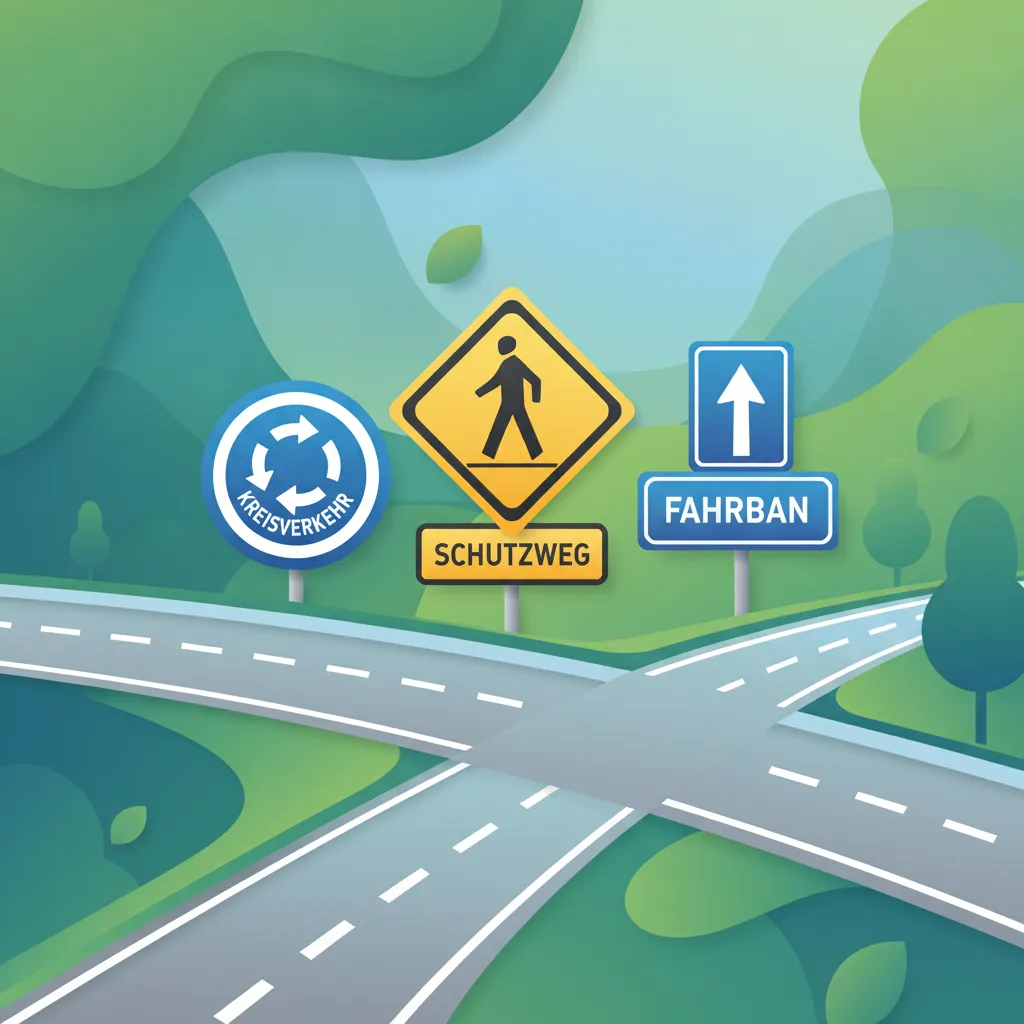
This lesson covers the specific regulations associated with special Austrian road signs and areas. It details the rules for 'Schutzweg' (protected pedestrian crossings), 'Kreisverkehr' (roundabouts), and the distinction between 'Fahrbahn' (road) and 'Fahrstreifen' (lane). Understanding these specific contexts is essential for safe navigation in urban and suburban environments.
This lesson focuses on warning signs, which are designed to alert drivers to potential hazards ahead. Learners will explore the meanings of signs indicating sharp curves, changes in road surface, potential animal crossings, and upcoming construction zones. The content explains how the characteristic triangular shape and symbols convey specific dangers, enabling drivers to anticipate conditions and adjust their speed and attention accordingly.

This lesson focuses on clear communication with other road users through the correct use of signals. It covers the proper operation of turn indicators, including the importance of cancelling them after a maneuver, and the use of brake lights. Additionally, it reviews standard hand signals for turning and stopping, which serve as a vital backup or supplementary communication tool.
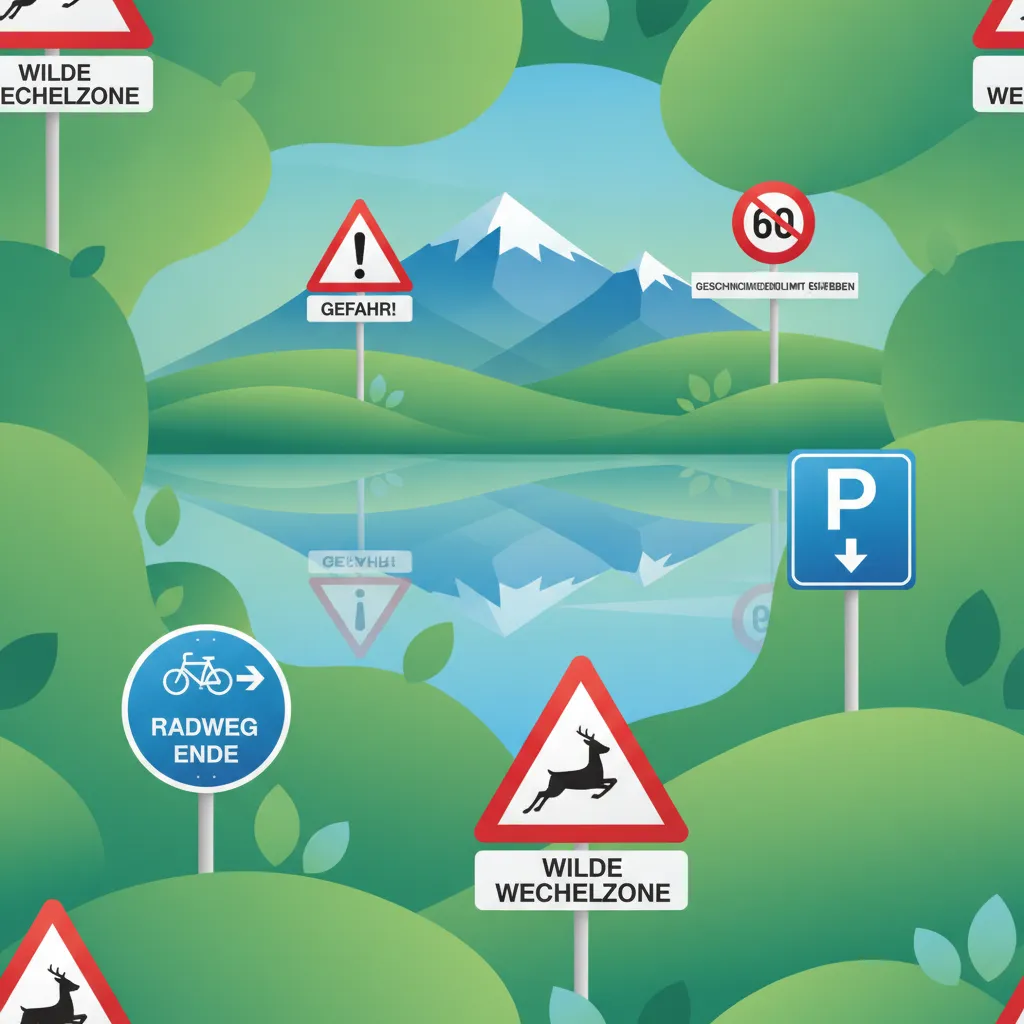
This lesson categorizes and explains the different types of Austrian road signs, including warning, regulatory, and informational signs. It details how the shape and color of a sign indicate its function, such as communicating speed limits, prohibitions, or mandatory actions. Understanding this visual system is fundamental for making correct and safe decisions while riding.
This lesson details the various types of road markings and their significance for guiding traffic and ensuring safety. Learners will understand the rules associated with solid versus broken lane lines, the instructions provided by directional arrows painted on the road, and the purpose of stop lines and pedestrian crossing markings. The content emphasizes how these markings work in conjunction with signs to regulate traffic flow and define legal lane usage.
Many Austrian cities use special signalling to give buses and trams priority at intersections. This lesson explains how to identify and understand these signals, which often use white bars or letters instead of standard colours. Learning to anticipate these signals allows for a smoother, more efficient driving style that takes full advantage of the public transport infrastructure.
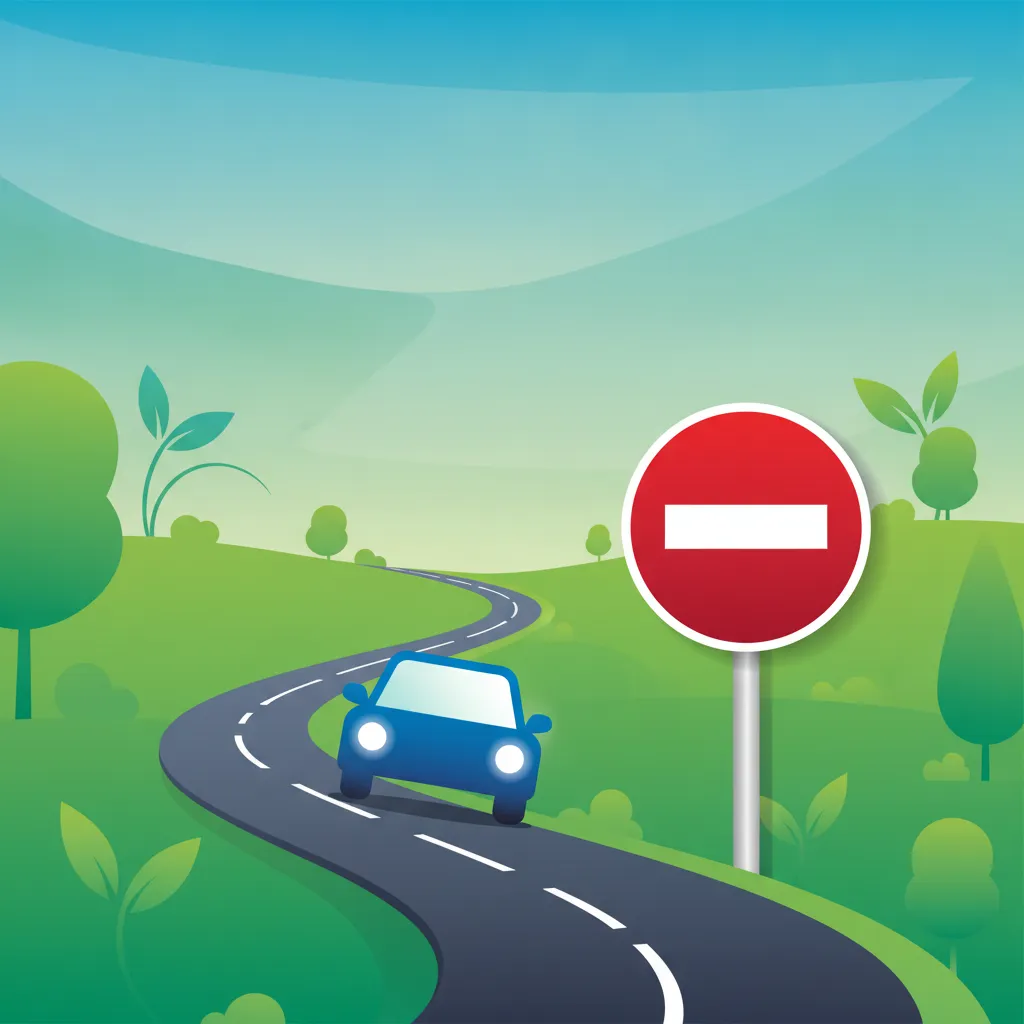
This lesson introduces the category of regulatory road signs, explaining the crucial difference between mandatory signs that require a specific action and prohibitory signs that forbid one. Learners will learn to interpret common signs such as speed limits, parking restrictions, no-entry signs, and those that establish priority at intersections. Understanding the distinct shapes and colours associated with these signs is essential for legal compliance and safe driving in Austria.

This lesson covers the proper and legal use of a vehicle's entire lighting system to see and be seen. It explains the regulations for using headlights, including daytime running lights, and the specific conditions under which fog lights and high beams are permitted. Correct use of turn signals and brake lights is also emphasized as essential for communicating intentions to other drivers and ensuring safety in all visibility conditions.
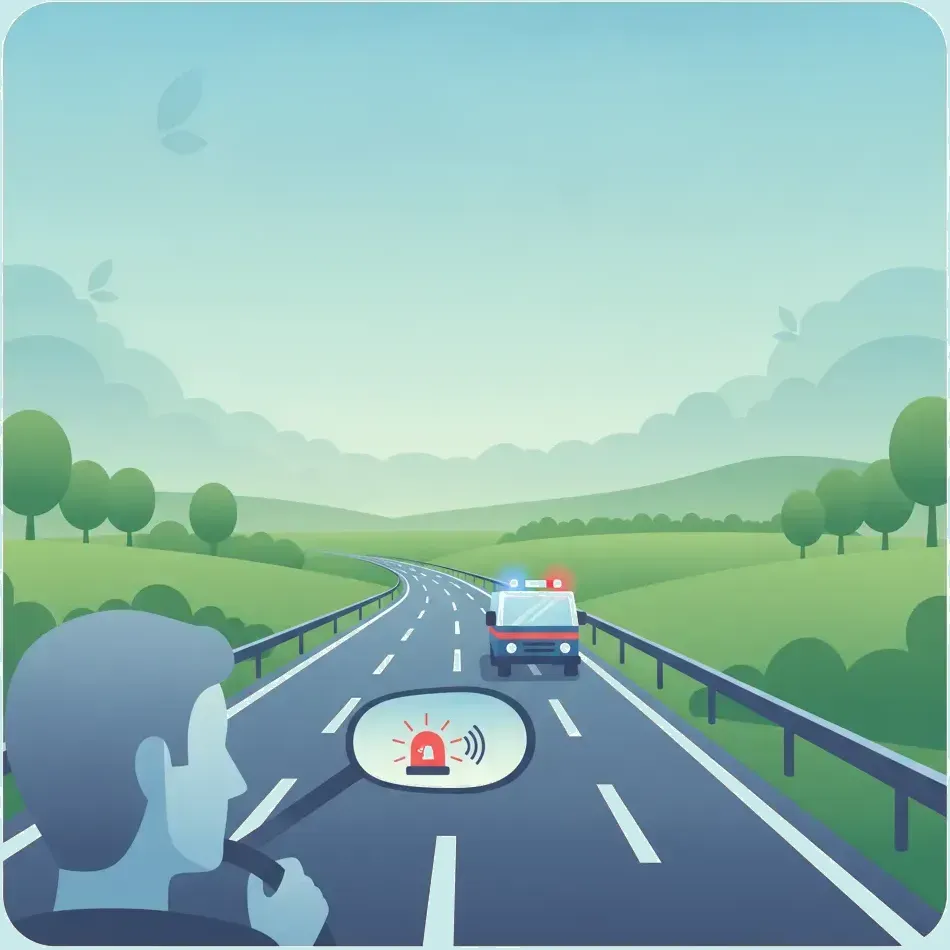
This lesson explains the correct protocol when encountering emergency vehicles with active sirens and lights. It details the legal requirement to yield the right-of-way and provides practical guidance on how to pull over safely and efficiently. Understanding these procedures helps ensure emergency services can reach their destination without delay.
Find clear answers to common questions learners have about Traffic Light Signals and Priority Devices. Learn how the lesson is structured, which driving theory objectives it supports, and how it fits into the overall learning path of units and curriculum progression in Austria. These explanations help you understand key concepts, lesson flow, and exam focused study goals.
A flashing yellow light means you must exercise extreme caution and follow the priority signs at the intersection. If no signs are present, the general right-hand rule applies, or the intersection is considered uncontrolled.
Yes, a Stop sign (Halt) mandates a complete standstill for your vehicle at the stop line or the edge of the intersection. Even if the road appears clear, failing to come to a full stop is a common cause for failure in the practical driving test.
In Austria, traffic light signals always take precedence over traffic signs. If the light is operational, you follow the signals; if the light is off or flashing yellow, you revert to the priority indicated by the road signs.
Trams generally have priority in most standard traffic situations unless otherwise indicated by signs or signals. Always observe the specific tram signals which may operate independently of standard vehicle traffic lights.
Refine your study plan by searching for specific Austrian driving theory practice sets. Pinpoint questions related to particular road rules, signs, or challenge levels, and begin practicing immediately to reinforce your knowledge and excel in your official exam with confidence. Get started with focused revision today.