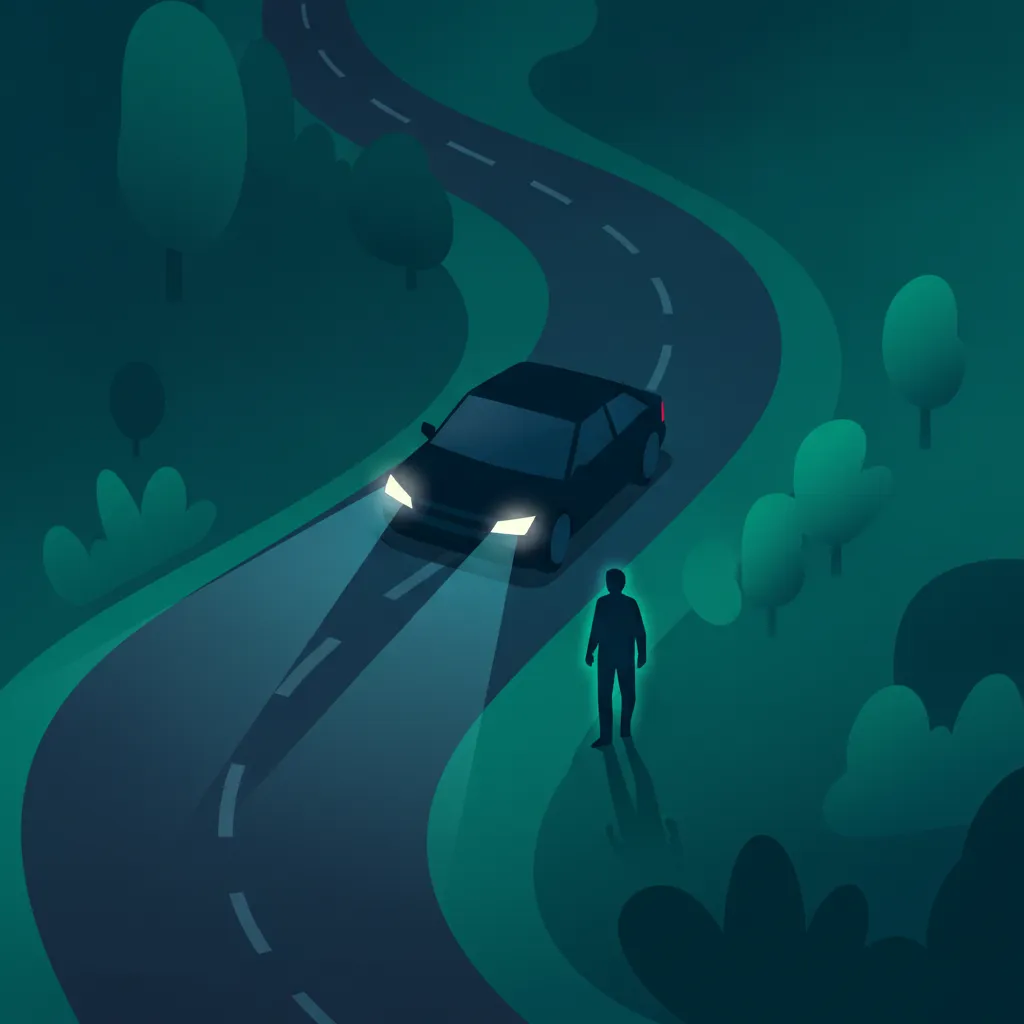
Driving at night presents a unique set of challenges compared to daytime driving. Reduced visibility, the glare from oncoming headlights, and increased fatigue risk are all factors that demand drivers adjust their observation, speed, and vehicle control. In Belgium, understanding these risks and applying appropriate safety measures is crucial for passing your theory test and driving safely on any road after dark.
Theory topic content overview
Read the full theory topic guide for Driving at Night with structured, easy-to-scan content built for learners in Belgium. This detailed section explains the exact rule, meaning, traffic context, comparison points, and exam logic behind this Belgian driving theory topic so you can study faster, understand the concept more clearly, and avoid common interpretation mistakes on the theory test.
Driving at night fundamentally alters the driving environment by severely limiting your field of vision. Unlike daytime driving, where you can see far ahead and observe a wide range of your surroundings, night driving restricts your view primarily to the area illuminated by your vehicle's headlights. This reduced visibility profoundly impacts your ability to detect hazards, judge distances, and react safely, making it a critical topic for all Belgian drivers.
In Belgium, as elsewhere, the darker conditions, combined with factors like headlight glare and increased driver fatigue, contribute to a heightened risk of accidents. Understanding these unique challenges and knowing how to adapt your driving style and vehicle use is essential for both passing your theory test and ensuring safety on Belgian roads after dark.
Night driving is not simply daytime driving in the dark; it requires a distinct shift in approach due to several critical factors:
For your Belgian theory test, questions often focus on these risks, the correct use of vehicle lighting, and specific rules that apply after dark, particularly concerning provisional license holders.
Successfully navigating Belgian roads at night requires understanding and compensating for several compounding factors:
Your vehicle's headlights typically illuminate the road effectively for about 50-100 meters (for dipped beams or 'feux de croisement') and further with main beams ('feux de route'). This means your safe driving speed must be such that you can stop within the distance you can clearly see. If you are travelling at 90 km/h, your stopping distance on dry roads can be over 60 meters, meaning you are already pushing the limits of your visibility range with dipped headlights. On wet or icy Belgian roads, this distance can easily double.
The intense light from oncoming vehicles' headlights, or the high beams of a vehicle behind you, can temporarily blind or 'dazzle' you. This phenomenon, known as éblouissement, significantly impairs your vision, sometimes for several seconds, reducing your ability to see hazards or maintain your lane.
Driving when tired, especially at night, is extremely dangerous. The effects of fatigue can be comparable to driving under the influence of alcohol, leading to:
Driving long distances on monotonous roads, such as Belgian motorways (autoroutes), can exacerbate fatigue.
Proper use and maintenance of your vehicle's lighting system are paramount for both seeing and being seen.
Your editorial angle is "Hazard Anticipation & Adaptation." Here's how to reflect that:
The most crucial adaptation for night driving in Belgium is to reduce your speed. Drive only at a speed that allows you to stop safely within the distance illuminated by your headlights. On unlit rural roads, this often means driving significantly below the daytime speed limit, which is a maximum, not a recommendation for all conditions. Remember that road signs indicating limits apply to ideal conditions; night reduces those ideal conditions.
Belgium has distinct rules for novice drivers that are critical for your theory exam:
Learners and even experienced drivers often make these critical errors when driving in darkness:
You are driving on a provincial road (e.g., N90) through a sparsely populated area of Wallonia after sunset. There are no streetlights.
You are on a busy avenue in Brussels with multiple lanes. An oncoming car with exceptionally bright LED headlights approaches.
You are driving on a dimly lit street in a Flemish town. Ahead, you notice a subtle reflection near the side of the road.
Driving at night in Belgium is primarily about proactive adaptation and conscious hazard anticipation. Always remember the '3 V's':
Mastering these adaptations will not only prepare you for the Belgian theory test but, more importantly, equip you for safer journeys on the road after dark.
Start with a short, direct summary of Driving at Night before reading the full explanation below.
Driving at night fundamentally alters your perception of the road due to limited visibility, making it harder to spot hazards like pedestrians, cyclists, or obstacles. Drivers must adapt by reducing speed, carefully managing their vehicle's lights, and being aware of the effects of glare and fatigue. In Belgium, specific rules apply, and provisional license holders have additional restrictions on night driving.
Review the most important terms, rule signals, and traffic concepts linked to Driving at Night.
Explore related theory topic pages connected to Driving at Night and continue with the next useful rule explanation.
See the common search queries learners use when trying to understand Driving at Night in Belgium.

Start your comprehensive preparation for the Belgian driving licence theory exam. Dive into our expertly curated topics, master the road rules and concepts, and build the confidence you need to pass your test and drive safely on Belgian roads. Begin mastering theory today.
Explore Belgian Theory TopicsTheory topic content overview
Start with a short, direct summary of Driving at Night before reading the full explanation below.
Driving at night fundamentally alters your perception of the road due to limited visibility, making it harder to spot hazards like pedestrians, cyclists, or obstacles. Drivers must adapt by reducing speed, carefully managing their vehicle's lights, and being aware of the effects of glare and fatigue. In Belgium, specific rules apply, and provisional license holders have additional restrictions on night driving.
Review the most important terms, rule signals, and traffic concepts linked to Driving at Night.
Explore related theory topic pages connected to Driving at Night and continue with the next useful rule explanation.
See the common search queries learners use when trying to understand Driving at Night in Belgium.
Start your comprehensive preparation for the Belgian driving licence theory exam. Dive into our expertly curated topics, master the road rules and concepts, and build the confidence you need to pass your test and drive safely on Belgian roads. Begin mastering theory today.
Explore Belgian Theory TopicsUse this exam-focused revision tip to understand how Driving at Night is likely to appear in theory questions for learners in Belgium. This section helps you identify the most testable part of the rule, avoid common traps, and remember the concept more effectively during Belgian driving theory exam preparation.
Pay close attention to the specific rules regarding provisional licenses and night driving in Belgium, as these are common exam questions. Remember that reduced visibility demands lower speeds and increased observation, and always be prepared to adjust your lighting usage according to traffic and road conditions to prevent dazzling others.
Read direct answers to the most common learner questions about Driving at Night in Belgium. This FAQ focuses on rule confusion, practical meaning, comparison with similar concepts, and the exact uncertainties that appear most often in Belgian driving theory revision and exam preparation.
The primary risks include significantly reduced visibility, making it harder to detect hazards; blinding glare from oncoming vehicle headlights; and a higher likelihood of driver fatigue, which impairs reaction time and concentration.
You must adapt your speed so you can stop safely within the distance illuminated by your headlights. This often means driving slower than you would during the day, especially on unlit roads or in poor weather conditions.
To minimize glare, avoid looking directly at oncoming headlights. Instead, shift your gaze slightly to the right edge of your lane to maintain orientation and road awareness until the vehicle has passed.
Yes, in Belgium, you must use appropriate lights, typically dipped headlights (feux de croisement), at night. Full beam headlights (feux de route) can be used on unlit roads when no other traffic is approaching or directly ahead, but must be switched off when encountering other road users to avoid dazzling them. Fog lights (antibrouillards) have specific conditions for use.
Yes, according to Belgian law, provisional license holders (apprentis) are generally prohibited from driving at night between 10 PM and 6 AM on Fridays, Saturdays, Sundays, and the eve of public holidays. Always check current regulations as these can be updated.
Fatigue at night can severely impair your driving ability, similar to driving under the influence of alcohol. It slows reaction times, reduces concentration, makes it harder to maintain a straight trajectory, and significantly increases the risk of serious accidents as you may not react or brake in time.
Ready to focus your Belgian driving theory revision? Utilize our powerful search tool to pinpoint exact topics, road signs, or difficulty levels. Engage with practice questions that directly address your learning needs and solidify your understanding of Belgian traffic laws for your upcoming exam.