
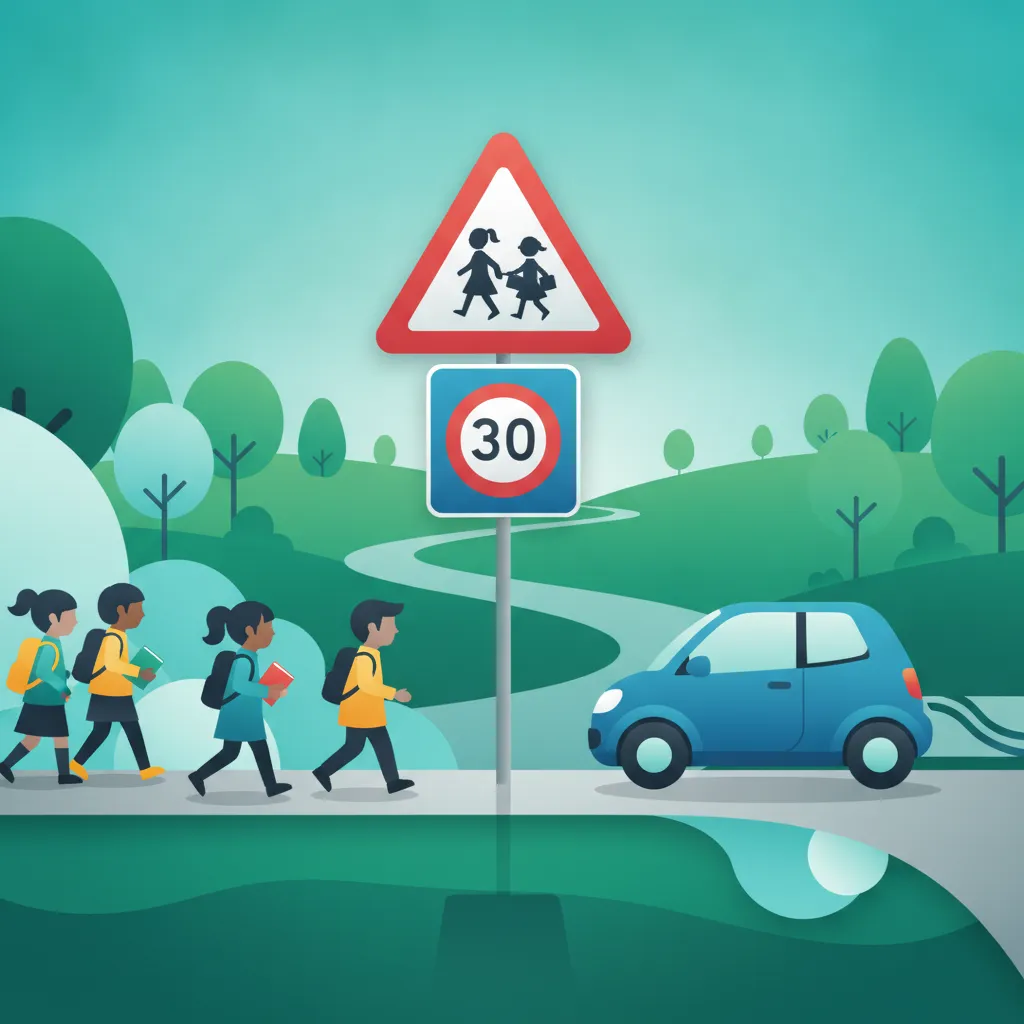
Driving near schools in Belgium demands extreme vigilance and adherence to specific rules due to the unpredictable presence of children. These areas, often designated as 'Zone 30 abords d'école' or 'rue scolaire', require drivers to significantly reduce speed and be constantly prepared for sudden movements. Your primary responsibility is to ensure the safety of all children, who are considered highly vulnerable road users.
Theory topic content overview
Read the full theory topic guide for School Zones & Child Safety with structured, easy-to-scan content built for learners in Belgium. This detailed section explains the exact rule, meaning, traffic context, comparison points, and exam logic behind this Belgian driving theory topic so you can study faster, understand the concept more clearly, and avoid common interpretation mistakes on the theory test.
Driving in Belgium requires particular vigilance in areas where children are present, especially around schools. These areas, known as school zones (zones scolaires), are designated with specific rules and signage to protect vulnerable young pedestrians and cyclists. The core concept is simple: children are unpredictable, and drivers bear the primary responsibility for their safety.
The importance of driving safely in Belgian school zones cannot be overstated, both for road safety and for your driving theory exam.
In Belgium, different types of school zones exist, each with specific rules. Your driving behaviour must adapt to these designations.
agent qualifié) is present, you must obey their signals. They have the authority to stop traffic.This is the most common designated school zone in Belgium.
Zone 30 sign (C43) often accompanied by a pictogram of children, or sometimes just the standard Zone 30 sign if it covers an area around a school.Zone 30 abords d'école around school entrances is largely mandatory across Belgium, unless exceptional circumstances apply.A more restrictive and increasingly common measure in Belgium to enhance child safety and promote active travel.
Rues scolaires are typically closed to most motor vehicle traffic during school drop-off and pick-up times (e.g., 15-30 minutes at start and end of school day). Exceptions are usually for residents with permits, emergency services, or school personnel.allure du pas (walking pace). This means exceptionally slow, barely faster than a pedestrian.Understanding the subtle differences between zone types is crucial for the Belgian theory exam:
Zone 30 (General) vs. Zone 30 abords d'école: While both have a 30 km/h limit, the latter specifically highlights the presence of a school and the heightened need for caution due to children.Zone 30 abords d'école vs. Rue Scolaire: The rue scolaire is far more restrictive. It often involves temporary closures to most vehicles and imposes the allure du pas (walking pace) rule for any permitted traffic, giving full priority to pedestrians and cyclists, even to the point of stopping completely for them. This is a higher level of protection than a standard Zone 30.Zone 30 abords d'école. You see parents and children gathering near the entrance. You must already be slowing down, scanning for children running to meet parents, and prepared to stop for those crossing unexpectedly, even if there's no designated crossing.Rue Scolaire: You encounter a rue scolaire sign in Flanders during the morning rush. The road ahead is filled with children walking and cycling. Even if you have special permission to enter, you must reduce your speed to a walking pace, patiently wait for children to move, and give them absolute priority, being ready to stop at any moment. You must not put children at risk or hinder them.Learners often make these mistakes regarding school zones in Belgium:
Rue Scolaire Rules: Misunderstanding the "allure du pas" requirement and the absolute priority for pedestrians and cyclists, treating it like a normal street.The core takeaway for driving in Belgian school zones is absolute vigilance and prioritizing the safety of children. These areas are legally and ethically distinct. The Belgian traffic code places a high burden of responsibility on drivers when vulnerable road users, especially children, are present.
Remember the mental model: "Always expect the unexpected from children." Drive defensively, be prepared to react instantly, and fully respect the specific rules for Zone 30 abords d'école and rue scolaire. Your actions can prevent tragedies and contribute to a safer environment for Belgium's youngest road users.
Belgian school zones require drivers to exercise absolute vigilance and prioritize child safety. The most common designation is Zone 30 abords d'école, marked by C43 signs with a 30 km/h maximum speed limit that has been mandatory around school entrances since 2005. Rue scolaire represents a stricter measure, closing roads to most motor vehicles during school times and requiring permitted traffic to proceed at walking pace while giving pedestrians and cyclists absolute priority. The core principle is that children are unpredictable, drivers are primarily responsible for their safety, and speed should always be reduced to allow instant stopping. Understanding the distinction between these zone types and their specific signage is essential for both road safety and the Belgian theory exam.
A short set of high-value points that capture the most important ideas from this theory explanation.
Children in Belgian school zones are considered highly vulnerable road users and drivers bear primary responsibility for their safety
Zone 30 abords d'école establishes a mandatory 30 km/h speed limit around school entrances across Belgium since 2005
Rue scolaire is a more restrictive zone where motor vehicles are temporarily prohibited during school times and pedestrians have absolute priority
Drivers must always drive at a speed allowing instant stopping and anticipate children emerging from behind parked cars or obstructions
School buses with flashing warning indicators require all drivers to slow down and be prepared to stop for boarding or alighting children
Rue scolaire requires allure du pas (walking pace) for any permitted vehicle and gives full priority to pedestrians and cyclists
A school crossing guard (agent qualifié) has legal authority to stop traffic and drivers must obey their signals
The 30 km/h speed limit in Zone 30 abords d'école is a maximum, not a target speed, especially during peak school times
Rue scolaire roads are typically closed to most vehicles during 15-30 minute windows at start and end of school day
Different signs indicate different restrictions: C43 for Zone 30 abords d'école, F99a/F99b variants for rue scolaire
Treating the posted 30 km/h speed limit as a safe cruising speed rather than an absolute maximum in busy school areas
Assuming children will look before crossing or obey traffic signals; always assume unpredictable behavior
Tunnel vision focusing only on the road ahead while missing children on sidewalks or emerging from behind parked vehicles
Misunderstanding rue scolaire rules and treating it like a normal street with standard priority arrangements
Failing to recognize that risk is highest during specific times: school drop-off and pick-up periods when traffic density peaks
Start with a short, direct summary of School Zones & Child Safety before reading the full explanation below.
School zones in Belgium are areas near educational facilities where drivers must exercise heightened caution. Due to children's unpredictable behavior and limited awareness of traffic, you must reduce your speed significantly and remain highly alert. These areas often have specific speed limits, such as 30 km/h, or even require 'allure du pas' (walking pace) in 'school streets' ('rue scolaire'), prioritizing pedestrians and cyclists.
Review the most important terms, rule signals, and traffic concepts linked to School Zones & Child Safety.
Explore related theory topic pages connected to School Zones & Child Safety and continue with the next useful rule explanation.
See the common search queries learners use when trying to understand School Zones & Child Safety in Belgium.

Start your comprehensive preparation for the Belgian driving licence theory exam. Dive into our expertly curated topics, master the road rules and concepts, and build the confidence you need to pass your test and drive safely on Belgian roads. Begin mastering theory today.
Explore Belgian Theory TopicsTheory topic content overview
A short set of high-value points that capture the most important ideas from this theory explanation.
Children in Belgian school zones are considered highly vulnerable road users and drivers bear primary responsibility for their safety
Zone 30 abords d'école establishes a mandatory 30 km/h speed limit around school entrances across Belgium since 2005
Rue scolaire is a more restrictive zone where motor vehicles are temporarily prohibited during school times and pedestrians have absolute priority
Drivers must always drive at a speed allowing instant stopping and anticipate children emerging from behind parked cars or obstructions
School buses with flashing warning indicators require all drivers to slow down and be prepared to stop for boarding or alighting children
Rue scolaire requires allure du pas (walking pace) for any permitted vehicle and gives full priority to pedestrians and cyclists
A school crossing guard (agent qualifié) has legal authority to stop traffic and drivers must obey their signals
The 30 km/h speed limit in Zone 30 abords d'école is a maximum, not a target speed, especially during peak school times
Rue scolaire roads are typically closed to most vehicles during 15-30 minute windows at start and end of school day
Different signs indicate different restrictions: C43 for Zone 30 abords d'école, F99a/F99b variants for rue scolaire
Treating the posted 30 km/h speed limit as a safe cruising speed rather than an absolute maximum in busy school areas
Assuming children will look before crossing or obey traffic signals; always assume unpredictable behavior
Tunnel vision focusing only on the road ahead while missing children on sidewalks or emerging from behind parked vehicles
Misunderstanding rue scolaire rules and treating it like a normal street with standard priority arrangements
Failing to recognize that risk is highest during specific times: school drop-off and pick-up periods when traffic density peaks
Start with a short, direct summary of School Zones & Child Safety before reading the full explanation below.
School zones in Belgium are areas near educational facilities where drivers must exercise heightened caution. Due to children's unpredictable behavior and limited awareness of traffic, you must reduce your speed significantly and remain highly alert. These areas often have specific speed limits, such as 30 km/h, or even require 'allure du pas' (walking pace) in 'school streets' ('rue scolaire'), prioritizing pedestrians and cyclists.
Review the most important terms, rule signals, and traffic concepts linked to School Zones & Child Safety.
Explore related theory topic pages connected to School Zones & Child Safety and continue with the next useful rule explanation.
See the common search queries learners use when trying to understand School Zones & Child Safety in Belgium.
Start your comprehensive preparation for the Belgian driving licence theory exam. Dive into our expertly curated topics, master the road rules and concepts, and build the confidence you need to pass your test and drive safely on Belgian roads. Begin mastering theory today.
Explore Belgian Theory TopicsUse this exam-focused revision tip to understand how School Zones & Child Safety is likely to appear in theory questions for learners in Belgium. This section helps you identify the most testable part of the rule, avoid common traps, and remember the concept more effectively during Belgian driving theory exam preparation.
In the Belgian theory exam, pay close attention to scenarios involving school zones. Remember that children's behavior is unpredictable. Always prioritize their safety by reducing your speed, being ready to stop, and understanding the specific rules for 'Zone 30 abords d'école' and 'rue scolaire', as these are common traps.
Read direct answers to the most common learner questions about School Zones & Child Safety in Belgium. This FAQ focuses on rule confusion, practical meaning, comparison with similar concepts, and the exact uncertainties that appear most often in Belgian driving theory revision and exam preparation.
Belgian school zones are areas near schools, often marked by specific signs like F99a or F99b, or designated as 'Zone 30 abords d'école' (30 km/h school approach zone) or 'rue scolaire' (school street).
Typically, a speed limit of 30 km/h applies in 'Zone 30 abords d'école'. In 'rue scolaire' (school streets) and 'speelstraten' (play streets), drivers must proceed at 'allure du pas' (walking pace) and yield to pedestrians and cyclists.
Children often have limited perception of traffic dangers, can act impulsively, and may cross roads unexpectedly, making them particularly vulnerable to accidents. Drivers must anticipate these behaviors.
A 'rue scolaire' is a public road reserved primarily for pedestrians and cyclists, often during school drop-off and pick-up times. Other vehicles may be allowed with authorization, but must drive at walking pace and yield priority to pedestrians and cyclists.
If a school bus signals children boarding or alighting, you must slow down and, if necessary, stop to allow the children to safely enter or exit the bus and cross the road.
Yes, school zones and specific traffic regulations like 'Zone 30 abords d'école' or 'rue scolaire' are always indicated by specific road signs, and sometimes with variable message panels for temporary zones.
Ready to focus your Belgian driving theory revision? Utilize our powerful search tool to pinpoint exact topics, road signs, or difficulty levels. Engage with practice questions that directly address your learning needs and solidify your understanding of Belgian traffic laws for your upcoming exam.