
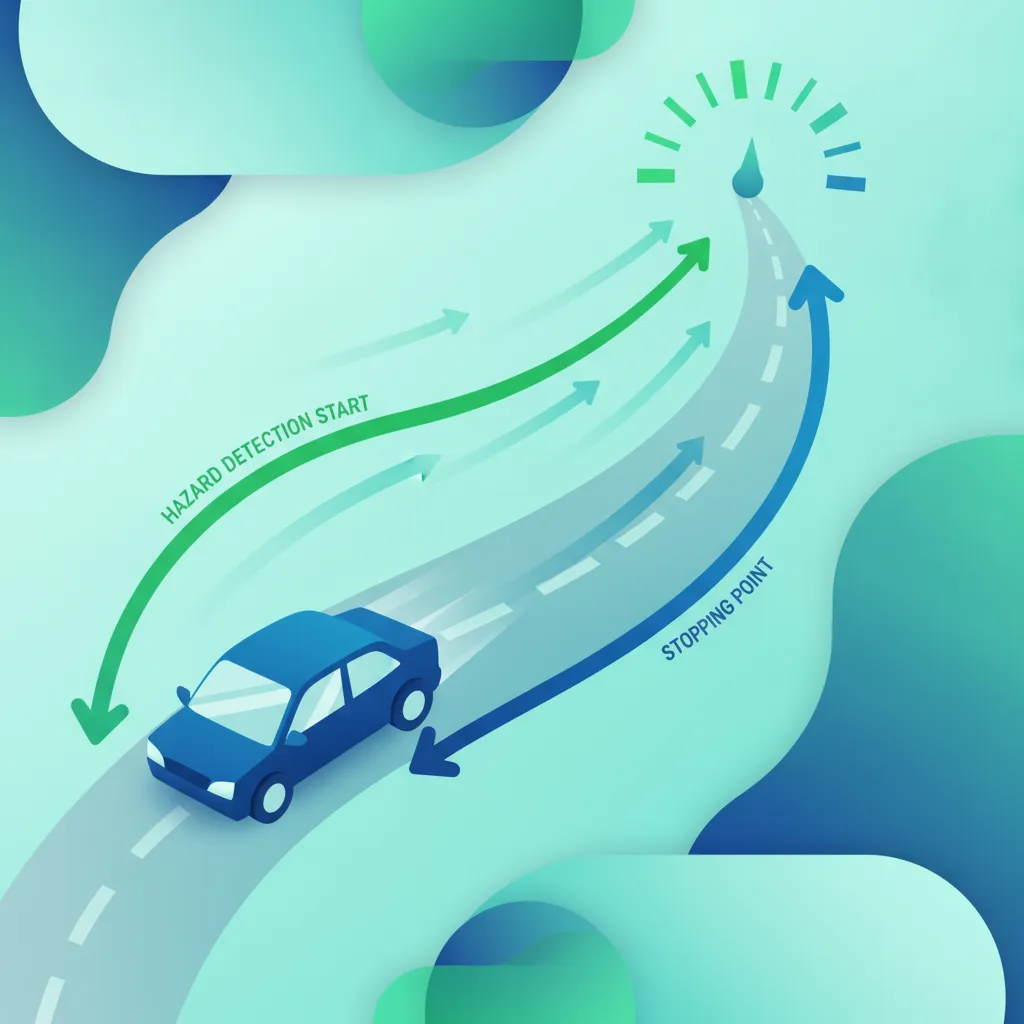
Your total stopping distance is the sum of your reaction distance and your braking distance. Understanding how speed influences both is vital for safe driving and passing your Belgian theory exam. This page explains the physics behind this relationship and why faster speeds reduce your margin for error on Belgian roads.
Theory topic content overview
Read the full theory topic guide for Speed & Stopping Distance with structured, easy-to-scan content built for learners in Belgium. This detailed section explains the exact rule, meaning, traffic context, comparison points, and exam logic behind this Belgian driving theory topic so you can study faster, understand the concept more clearly, and avoid common interpretation mistakes on the theory test.
The relationship between your vehicle's speed and the distance it takes to stop is one of the most fundamental concepts in safe driving and a critical part of the Belgian driving theory exam. Your total stopping distance is the sum of two distinct phases: your reaction distance and your braking distance. Understanding how each component is affected by speed is essential for road safety in Belgium and successfully navigating its varied road conditions.
Reaction distance is the distance your vehicle travels from the moment you detect a hazard until you begin to apply the brakes. Even for an attentive driver, this process takes time. In general, a driver's average reaction time is approximately one second. During this second, your car continues to travel at its current speed.
autoroutes or snelwegen.Braking distance is the distance your vehicle travels from the moment you apply the brakes until it comes to a complete stop. This phase is governed by physics, specifically the vehicle's kinetic energy.
When you combine reaction distance and braking distance, the effect of speed on your total stopping distance becomes critically clear. As speed increases, both components grow, but the rapid increase in braking distance makes the total much longer than many drivers anticipate.
Total Stopping Distance = Reaction Distance + Braking Distance
This fundamental relationship means that driving faster significantly reduces your margin for error and your ability to avoid collisions. The higher the speed, the less time and space you have to react and bring your vehicle to a halt.
While speed is the primary factor, several other conditions can dramatically alter your total stopping distance in Belgium:
ijsgladde wegen) or even damp leaves drastically reduce tire grip, multiplying braking distance.versleten banden) or incorrect pressure reduce grip.Wegcode / Code de la route) emphasizes the responsibility of drivers to account for their vehicle's load.afleiding) significantly delay hazard detection, increasing reaction distance.It's crucial for Belgian learners to distinguish between stopping distance and safe following distance.
veiligheidsafstand / distance de sécurité): The recommended distance you should maintain behind the vehicle in front of you under ideal conditions, to allow both for your reaction and for the leading vehicle's sudden braking.The Belgian Wegcode / Code de la route strongly recommends the "two-second rule" (often taught as the "two crocodile" rule in French-speaking Belgium) for maintaining a safe following distance. This practical rule accounts for a typical reaction time and provides a basic safety margin. However, it's vital to remember that this is a minimum and should be extended in adverse conditions. Your actual stopping distance will always be greater than your following distance if you need to react to a sudden stop of the car in front, and your initial following distance was too short.
Consider these common situations on Belgian roads:
zone 50 and need to stop suddenly for a pedestrian entering the crossing or a car failing to give way, your combined stopping distance will be much longer than expected. Driving closer to 30 km/h would drastically shorten this distance, giving you a greater chance to avoid an incident.autoroute / snelweg) in heavy rain: At 120 km/h, your reaction distance is already substantial. Add to that the effect of rain, which can easily double or triple your braking distance due to reduced grip and the risk of aquaplaning. Your total stopping distance becomes immense, making high speeds extremely dangerous. This is why the Wegcode stipulates adapting speed to conditions.buiten bebouwde kom / hors agglomération) at dusk: If you're driving at 70 km/h and an animal suddenly crosses the road, the distance covered during your reaction time, plus the significant braking distance at that speed, may make an impact unavoidable, even with immediate braking.Learners frequently misunderstand or underestimate the impact of speed on stopping distance:
Wegcode clearly states that drivers must always adapt their speed to conditions, not just to the speed limit.The Belgian driving theory exam (het theorie-examen / l'examen théorique) places significant emphasis on your understanding of speed and stopping distance. Questions will often test:
Wegcode and advice from bodies like AWSR (Agence Wallonne pour la Sécurité Routière) or VIAS.Remember, the Belgian rules of the road (verkeersregels / règles de circulation) require you to be able to stop your vehicle within the visible distance ahead and to always adapt your speed to the circumstances.
The most crucial takeaway is that your speed must always be appropriate for you to stop safely within the distance you can see to be clear. This means:
By mastering the relationship between speed and stopping distance, you not only prepare effectively for your Belgian driving theory exam but also develop a fundamental skill for safe and responsible driving throughout your life on Belgian roads.
Speed and stopping distance is a core topic in Belgian driving theory that separates the two components of stopping distance: reaction distance (the distance traveled during your approximately one-second reaction time, which increases linearly with speed) and braking distance (which increases with the square of your speed due to kinetic energy physics). The Belgian Wegcode and Code de la route require drivers to stop within the visible clear distance and to always adapt speed to conditions, not just to the limit. Key exam points include understanding why small speed increases disproportionately lengthen stopping distance, recognizing how road conditions amplify braking distance, and applying the two-second following rule as a minimum rather than a safe maximum. Learners should internalize that safe driving means continuously scanning ahead and reducing speed proactively to ensure a survivable margin.
A short set of high-value points that capture the most important ideas from this theory explanation.
Doubling your speed roughly quadruples your braking distance because braking distance increases with the square of velocity.
Your total stopping distance is the sum of reaction distance (speed × reaction time) and braking distance, both of which grow with speed.
The two-second rule for following distance is a minimum baseline, not a safe absolute—it must be extended in poor conditions.
Belgian law requires you to be able to stop within the visible clear distance ahead, not just within the posted speed limit.
At motorway speeds (120 km/h), even a one-second reaction delay covers over 33 meters before braking begins.
Reaction distance increases linearly with speed; braking distance increases with the square of speed.
Wet, icy, or loose road surfaces can double or triple your braking distance, making speed adaptation mandatory.
Distraction adds meters to reaction distance—phone use while driving at speed is especially dangerous.
The two-second rule (or 'two crocodile' rule in French-speaking Belgium) accounts for reaction time but assumes ideal conditions.
Heavy loads, worn tires, and poorly maintained brakes all extend your actual stopping distance beyond calculations for a standard vehicle.
Assuming doubling speed only doubles stopping distance, when in fact it roughly quadruples braking distance.
Treating the posted speed limit as automatically safe rather than adjusting speed to actual road and weather conditions.
Using the two-second rule as a fixed rule rather than a minimum that needs extending in rain, fog, or ice.
Failing to anticipate hazards and maintain scanning distance, leaving insufficient time to react at higher speeds.
Not accounting for the vehicle's load or condition when estimating stopping capability, especially under Belgian cargo regulations.
Start with a short, direct summary of Speed & Stopping Distance before reading the full explanation below.
Stopping distance is the total distance your vehicle travels from the moment you detect a hazard until it comes to a complete stop. It consists of reaction distance (during which you react) and braking distance (while the brakes are applied). Speed significantly increases both components; notably, braking distance quadruples when your speed doubles, making higher speeds far more dangerous and reducing your ability to avoid collisions in Belgian traffic.
Review the most important terms, rule signals, and traffic concepts linked to Speed & Stopping Distance.
Explore related theory topic pages connected to Speed & Stopping Distance and continue with the next useful rule explanation.
See the common search queries learners use when trying to understand Speed & Stopping Distance in Belgium.

Start your comprehensive preparation for the Belgian driving licence theory exam. Dive into our expertly curated topics, master the road rules and concepts, and build the confidence you need to pass your test and drive safely on Belgian roads. Begin mastering theory today.
Explore Belgian Theory TopicsTheory topic content overview
A short set of high-value points that capture the most important ideas from this theory explanation.
Doubling your speed roughly quadruples your braking distance because braking distance increases with the square of velocity.
Your total stopping distance is the sum of reaction distance (speed × reaction time) and braking distance, both of which grow with speed.
The two-second rule for following distance is a minimum baseline, not a safe absolute—it must be extended in poor conditions.
Belgian law requires you to be able to stop within the visible clear distance ahead, not just within the posted speed limit.
At motorway speeds (120 km/h), even a one-second reaction delay covers over 33 meters before braking begins.
Reaction distance increases linearly with speed; braking distance increases with the square of speed.
Wet, icy, or loose road surfaces can double or triple your braking distance, making speed adaptation mandatory.
Distraction adds meters to reaction distance—phone use while driving at speed is especially dangerous.
The two-second rule (or 'two crocodile' rule in French-speaking Belgium) accounts for reaction time but assumes ideal conditions.
Heavy loads, worn tires, and poorly maintained brakes all extend your actual stopping distance beyond calculations for a standard vehicle.
Assuming doubling speed only doubles stopping distance, when in fact it roughly quadruples braking distance.
Treating the posted speed limit as automatically safe rather than adjusting speed to actual road and weather conditions.
Using the two-second rule as a fixed rule rather than a minimum that needs extending in rain, fog, or ice.
Failing to anticipate hazards and maintain scanning distance, leaving insufficient time to react at higher speeds.
Not accounting for the vehicle's load or condition when estimating stopping capability, especially under Belgian cargo regulations.
Start with a short, direct summary of Speed & Stopping Distance before reading the full explanation below.
Stopping distance is the total distance your vehicle travels from the moment you detect a hazard until it comes to a complete stop. It consists of reaction distance (during which you react) and braking distance (while the brakes are applied). Speed significantly increases both components; notably, braking distance quadruples when your speed doubles, making higher speeds far more dangerous and reducing your ability to avoid collisions in Belgian traffic.
Review the most important terms, rule signals, and traffic concepts linked to Speed & Stopping Distance.
Explore related theory topic pages connected to Speed & Stopping Distance and continue with the next useful rule explanation.
See the common search queries learners use when trying to understand Speed & Stopping Distance in Belgium.
Start your comprehensive preparation for the Belgian driving licence theory exam. Dive into our expertly curated topics, master the road rules and concepts, and build the confidence you need to pass your test and drive safely on Belgian roads. Begin mastering theory today.
Explore Belgian Theory TopicsUse this exam-focused revision tip to understand how Speed & Stopping Distance is likely to appear in theory questions for learners in Belgium. This section helps you identify the most testable part of the rule, avoid common traps, and remember the concept more effectively during Belgian driving theory exam preparation.
For the Belgian theory exam, remember that increasing your speed has a disproportionate effect on your stopping distance. Doubling your speed doesn't just double the stopping distance; it roughly quadruples the braking distance, making it a critical factor in preventing accidents. Always relate speed to your ability to react and stop safely.
Read direct answers to the most common learner questions about Speed & Stopping Distance in Belgium. This FAQ focuses on rule confusion, practical meaning, comparison with similar concepts, and the exact uncertainties that appear most often in Belgian driving theory revision and exam preparation.
Reaction distance is the distance your vehicle travels from the moment you recognize a hazard until you apply the brakes. Braking distance is the distance covered from the moment you apply the brakes until your vehicle comes to a complete stop.
Reaction distance increases directly with speed. If you take one second to react, you will cover twice the distance at 100 km/h than you would at 50 km/h during that same reaction time.
Braking distance increases exponentially with speed, specifically with the square of the speed. This means if you double your speed, your braking distance will be approximately four times longer, due to the increased kinetic energy that needs to be dissipated.
Total stopping distance is the sum of your reaction distance and your braking distance. It represents the entire distance needed to stop your vehicle safely after identifying a potential danger.
Belgian traffic law (Wegcode / Code de la route) emphasizes maintaining a sufficient safety distance to be able to stop in time, considering your speed and road conditions. While no fixed stopping distances for all speeds are prescribed, the principle is crucial for collision avoidance.
Poor road conditions like wet, icy, or gravel surfaces significantly increase braking distance due to reduced grip. In Belgium, drivers must adjust their speed accordingly to ensure they can stop within the visible distance, especially in adverse weather.
A common guideline in Belgium, especially on motorways, is the 'two-second rule' (or even three seconds in poor conditions). Choose a fixed point, and when the vehicle in front passes it, you should count two seconds before your vehicle reaches the same point. If you reach it sooner, you are too close.
Ready to focus your Belgian driving theory revision? Utilize our powerful search tool to pinpoint exact topics, road signs, or difficulty levels. Engage with practice questions that directly address your learning needs and solidify your understanding of Belgian traffic laws for your upcoming exam.