
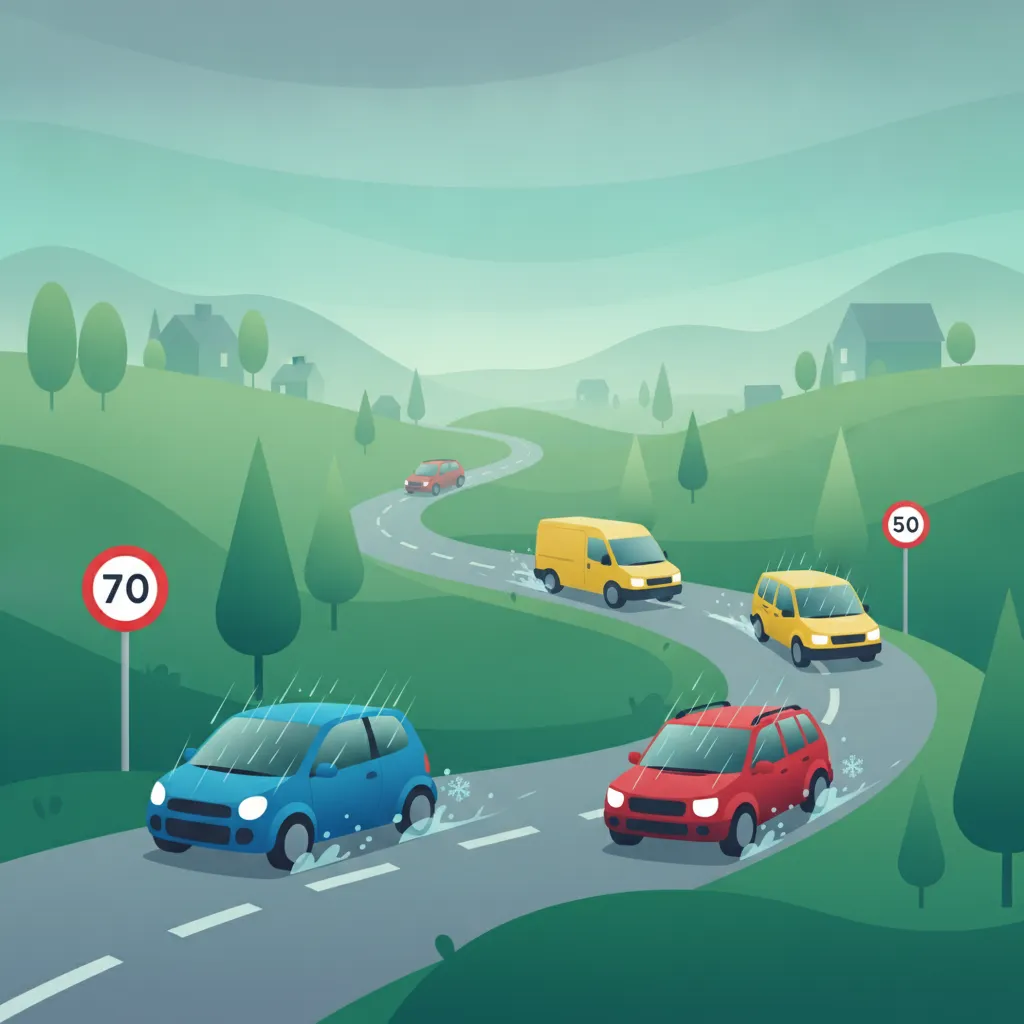
Speed limits are a fundamental aspect of Belgian traffic law, setting the maximum legal speed for different road types and areas. However, merely adhering to the posted limit is insufficient; drivers must also constantly adapt their speed based on prevailing road, weather, traffic, and visibility conditions. This page clarifies these distinctions and emphasizes the critical role of appropriate speed in preventing accidents.
Theory topic content overview
Read the full theory topic guide for Speed Limits Explained with structured, easy-to-scan content built for learners in Belgium. This detailed section explains the exact rule, meaning, traffic context, comparison points, and exam logic behind this Belgian driving theory topic so you can study faster, understand the concept more clearly, and avoid common interpretation mistakes on the theory test.
Speed limits are fundamental regulations within Belgian traffic law that specify the absolute maximum speed at which vehicles are legally permitted to travel on a particular road or within a defined area. These limits are marked by official road signs (typically circular signs with a red border and black numbers, known as C43 signs in Belgium) or implied by the type of road and environment in the absence of explicit signage.
The primary purpose of Belgian speed limits is to enhance road safety, reduce the risk and severity of collisions, and create a more predictable and harmonious traffic flow. They are not merely suggestions but strictly enforced legal requirements, and exceeding them constitutes a traffic offense.
Understanding and adhering to speed limits is paramount for every driver in Belgium, not just to pass the driving theory exam but for daily safety on the road.
Code de la Route (Wegcode), clearly mandates adherence to speed limits. Violations carry penalties ranging from fines to driving license suspensions.speed adaptation. Simply memorizing numbers is insufficient; you must demonstrate an understanding of when and why to reduce speed, even below the maximum limit.A key distinction in Belgian road safety, often highlighted in the driving exam, is between:
Vitesse excessive (Excessive Speed): This refers to driving above the posted or default legal maximum speed limit. This is a clear breach of traffic law.Vitesse inappropriée (Inappropriate Speed): This refers to driving at a speed that, while possibly below the legal maximum, is still too fast for the prevailing conditions (e.g., weather, traffic, road layout). Even if you are within the speed limit, driving at an inappropriate speed is illegal and dangerous, contributing to a significant portion of accidents in Belgium.While specific signs always take precedence, these are the default speed limits for common road types in Belgium:
Agglomération): 50 km/h
Zone 30, where the limit is 30 km/h. These are critical for pedestrian and cyclist safety.Woonerf (Residential Zone) / Erf (Yard Zone): In these specially designated areas, often shared by pedestrians and vehicles, the speed limit is walking pace (stapvoets rijden), roughly 20 km/h.Hors Agglomération):
Autoroutes): 120 km/h
Always remember: These are maximum limits. A lower speed may be indicated by signs, and these signs always override the default limits.
Vitesse Inappropriée)In Belgium, drivers are not only expected to observe the legal maximum speed but are legally obliged to adapt their speed to the actual prevailing conditions. This means that even if you are driving below the posted speed limit, your speed could still be considered inappropriate if it's not safe for the situation. This principle is central to defensive driving and hazard perception in Belgium.
Factors that demand speed adaptation include:
Disposition des Lieux): Bends, crests, narrow roads, blind spots, intersections, proximity to buildings, or sudden changes in road type.Encombrement): Heavy traffic, queues, or slow-moving vehicles.Your speed must never be a cause of an accident or an obstruction to normal traffic flow. You must always be able to stop in time for any foreseeable obstacle.
Mastering speed limits in Belgium involves more than just knowing numbers.
safe speed is the one appropriate for current conditions, which is often lower than the legal maximum. For instance, on a Belgian motorway (autoroute) at night with heavy rain, 120 km/h would be excessive if you couldn't stop safely, and certainly inappropriate.Zone 30 applies to an entire area until an end-of-zone sign is encountered, often implemented with traffic-calming measures. A C43 speed limit sign (e.g., a circle with '70') applies from the sign until revoked by another speed limit sign, an end-of-all-restrictions sign, or entry into a built-up area.reaction distance (the distance traveled while reacting) and a much longer braking distance (the distance traveled while braking). Together, these form the stopping distance. Doubling your speed roughly quadruples your braking distance. This is a frequent subject in the Belgian theory exam.Consider these common Belgian driving situations:
Zone 30 with Rain: Even though the default agglomération limit is 50 km/h, you're in a Zone 30. With rain reducing grip and visibility, and the potential for pedestrians, an inappropriate speed could be anything above 20-25 km/h, even if it's below 30 km/h. Your adapted speed should allow you to stop safely if a pedestrian steps out.N-road in Flanders (70 km/h limit) at Dusk with Deer Warnings: Even if the sign says 70 km/h, the reduced visibility and wildlife warning sign (A33) dictate a significantly lower, adapted speed. Failing to reduce speed in such conditions would be inappropriate speed, increasing collision risk.Autoroute During Heavy Traffic: The legal maximum is 120 km/h. However, during heavy traffic or a traffic jam, you must adapt your speed to the flow of traffic, maintaining a safe following distance. Trying to reach 120 km/h would be dangerous and inappropriate.Zone 30 sign, the presence of many children (vulnerable road users) mandates a significantly reduced speed, likely walking pace, to ensure safety.Learners frequently make these mistakes regarding speed limits and adaptation:
F1a/F1b) change the default.speed adaptation and the concept of vitesse inappropriée.gewestwegen (regional roads) or rural roads in Flanders or Wallonia.excessive speed in Flanders or inappropriate speed in Wallonia if conditions are poor.For safe driving in Belgium and success in your theory exam, always remember:
agglomération (50 km/h), hors agglomération (70 km/h in Flanders, 90 km/h in Wallonia/Brussels), and autoroutes (120 km/h).Zone 30, Woonerf).This topic covers Belgian speed limits as strict legal maximums marked by C43 signs, with default limits of 50 km/h in built-up areas, 70-90 km/h outside built-up areas depending on region, and 120 km/h on motorways. A crucial distinction exists between vitesse excessive (exceeding the legal limit) and vitesse inappropriée (speed inappropriate for conditions, even if within the limit), both illegal under Belgian traffic law. Speed adaptation is legally mandatory whenever conditions demand it, including weather, traffic density, visibility, and vulnerable road users. The Belgian theory exam tests not only numeric limits but also judgment on when to reduce speed below the maximum for safety.
A short set of high-value points that capture the most important ideas from this theory explanation.
Speed limits in Belgium are absolute legal maximums enforced by law, not suggestions or recommended speeds.
The critical distinction between vitesse excessive (exceeding the limit) and vitesse inappropriée (speed inappropriate for conditions even if below the limit) is a core exam topic.
Belgium has distinct default limits: 50 km/h in built-up areas, 70/90 km/h outside built-up areas depending on region, and 120 km/h on motorways.
Speed adaptation is a legal obligation in Belgium; drivers must always adjust speed to weather, traffic, visibility, and vulnerable road users regardless of posted limits.
Zone 30 and Woonerf areas require significantly lower speeds (30 km/h and walking pace respectively) to protect pedestrians and cyclists.
Built-up areas: 50 km/h default; Zone 30: 30 km/h; Woonerf/Erf: walking pace (~20 km/h).
Outside built-up areas: 70 km/h in Flanders, 90 km/h in Wallonia and Brussels on single-carriageway roads.
Motorways: 120 km/h maximum; heavy vehicles over 3.5 tonnes MAM limited to 90 km/h.
Speed adaptation is mandatory whenever conditions require it, including rain, fog, darkness, heavy traffic, or presence of vulnerable users.
Signs always override default limits; explicit C43 speed limit signs take precedence.
Assuming that driving below the posted limit automatically means driving safely; vitesse inappropriée applies even within legal limits.
Confusing the 70 km/h Flanders limit outside built-up areas with the 90 km/h Wallonia/Brussels limit, risking excessive speed violations in Flanders.
Not reducing speed sufficiently for adverse weather conditions such as rain, fog, or icy roads on regional roads.
Failing to slow down adequately near schools, bus stops, or areas with pedestrians and cyclists, even without specific Zone 30 signage.
Only watching for posted signs and ignoring that built-up area entry/exit signs (F1a/F1b) automatically change the applicable default limit.
Start with a short, direct summary of Speed Limits Explained before reading the full explanation below.
Speed limits in Belgium define the absolute maximum speed allowed on a particular road or zone, enforced by law. Beyond these legal maximums, drivers are legally obliged to adjust their speed to ensure safety, accounting for factors like weather, traffic density, and the presence of vulnerable road users. Failure to adapt speed, even below the posted limit, can lead to dangerous situations and is considered inappropriate driving.
Review the most important terms, rule signals, and traffic concepts linked to Speed Limits Explained.
Explore related theory topic pages connected to Speed Limits Explained and continue with the next useful rule explanation.
See the common search queries learners use when trying to understand Speed Limits Explained in Belgium.

Start your comprehensive preparation for the Belgian driving licence theory exam. Dive into our expertly curated topics, master the road rules and concepts, and build the confidence you need to pass your test and drive safely on Belgian roads. Begin mastering theory today.
Explore Belgian Theory TopicsTheory topic content overview
A short set of high-value points that capture the most important ideas from this theory explanation.
Speed limits in Belgium are absolute legal maximums enforced by law, not suggestions or recommended speeds.
The critical distinction between vitesse excessive (exceeding the limit) and vitesse inappropriée (speed inappropriate for conditions even if below the limit) is a core exam topic.
Belgium has distinct default limits: 50 km/h in built-up areas, 70/90 km/h outside built-up areas depending on region, and 120 km/h on motorways.
Speed adaptation is a legal obligation in Belgium; drivers must always adjust speed to weather, traffic, visibility, and vulnerable road users regardless of posted limits.
Zone 30 and Woonerf areas require significantly lower speeds (30 km/h and walking pace respectively) to protect pedestrians and cyclists.
Built-up areas: 50 km/h default; Zone 30: 30 km/h; Woonerf/Erf: walking pace (~20 km/h).
Outside built-up areas: 70 km/h in Flanders, 90 km/h in Wallonia and Brussels on single-carriageway roads.
Motorways: 120 km/h maximum; heavy vehicles over 3.5 tonnes MAM limited to 90 km/h.
Speed adaptation is mandatory whenever conditions require it, including rain, fog, darkness, heavy traffic, or presence of vulnerable users.
Signs always override default limits; explicit C43 speed limit signs take precedence.
Assuming that driving below the posted limit automatically means driving safely; vitesse inappropriée applies even within legal limits.
Confusing the 70 km/h Flanders limit outside built-up areas with the 90 km/h Wallonia/Brussels limit, risking excessive speed violations in Flanders.
Not reducing speed sufficiently for adverse weather conditions such as rain, fog, or icy roads on regional roads.
Failing to slow down adequately near schools, bus stops, or areas with pedestrians and cyclists, even without specific Zone 30 signage.
Only watching for posted signs and ignoring that built-up area entry/exit signs (F1a/F1b) automatically change the applicable default limit.
Start with a short, direct summary of Speed Limits Explained before reading the full explanation below.
Speed limits in Belgium define the absolute maximum speed allowed on a particular road or zone, enforced by law. Beyond these legal maximums, drivers are legally obliged to adjust their speed to ensure safety, accounting for factors like weather, traffic density, and the presence of vulnerable road users. Failure to adapt speed, even below the posted limit, can lead to dangerous situations and is considered inappropriate driving.
Review the most important terms, rule signals, and traffic concepts linked to Speed Limits Explained.
Explore related theory topic pages connected to Speed Limits Explained and continue with the next useful rule explanation.
See the common search queries learners use when trying to understand Speed Limits Explained in Belgium.
Start your comprehensive preparation for the Belgian driving licence theory exam. Dive into our expertly curated topics, master the road rules and concepts, and build the confidence you need to pass your test and drive safely on Belgian roads. Begin mastering theory today.
Explore Belgian Theory TopicsUse this exam-focused revision tip to understand how Speed Limits Explained is likely to appear in theory questions for learners in Belgium. This section helps you identify the most testable part of the rule, avoid common traps, and remember the concept more effectively during Belgian driving theory exam preparation.
In the Belgian theory exam, simply knowing the numeric speed limits isn't enough. Expect questions that test your judgment on when to reduce your speed, even if you're below the maximum limit. Always prioritize safety and consider conditions like rain, fog, heavy traffic, or residential areas with children, as these often require a significantly lower, adapted speed.
Read direct answers to the most common learner questions about Speed Limits Explained in Belgium. This FAQ focuses on rule confusion, practical meaning, comparison with similar concepts, and the exact uncertainties that appear most often in Belgian driving theory revision and exam preparation.
Speed limits in Belgium are primarily designed to enhance road safety by controlling vehicle speeds, reducing accident severity, and creating predictable traffic flow, especially in areas with vulnerable road users.
No. Speed limits define the maximum legal speed you can drive, but you must always adapt your speed to current conditions, such as weather, visibility, road surface, traffic density, and the presence of other road users.
Unless otherwise indicated by specific signage, the general speed limit in Belgian built-up areas (agglomerations) is 50 km/h. Some zones, like residential or school streets, may have lower limits such as 30 km/h or even walking pace.
On Belgian motorways, the general maximum speed limit is 120 km/h for passenger cars. However, specific vehicle types like heavy goods vehicles (over 3.5 tons) and buses have lower limits, typically 90 km/h or 100 km/h for certain coaches.
Excessive speed means driving above the posted or general speed limit, which is always illegal. Inappropriate speed means driving at a speed that is too high for the prevailing conditions (e.g., heavy rain, fog, dense traffic), even if you are below the maximum legal limit, and it is also illegal and dangerous.
In adverse weather such as heavy rain, fog, or snow, drivers must significantly reduce their speed, often well below the posted speed limit, to maintain control, ensure adequate stopping distance, and respond safely to hazards.
While many speed limits are indicated by road signs (e.g., C43), general speed limits for different road types (e.g., built-up areas, outside built-up areas) apply by default even without explicit signage. Drivers are expected to know these basic rules.
Adapting speed is critical for vulnerable road users (pedestrians, cyclists) because higher speeds dramatically increase the risk of a fatal or serious injury in a collision. Lower speeds provide more reaction time and reduce impact force.
Ready to focus your Belgian driving theory revision? Utilize our powerful search tool to pinpoint exact topics, road signs, or difficulty levels. Engage with practice questions that directly address your learning needs and solidify your understanding of Belgian traffic laws for your upcoming exam.