
Performing a turn safely requires careful coordination, awareness of your surroundings, and adherence to Belgian traffic laws. This guide will clarify the essential steps for both right and left turns, focusing on pre-turn checks, correct execution, and ensuring the safety of all road users, especially pedestrians and cyclists.
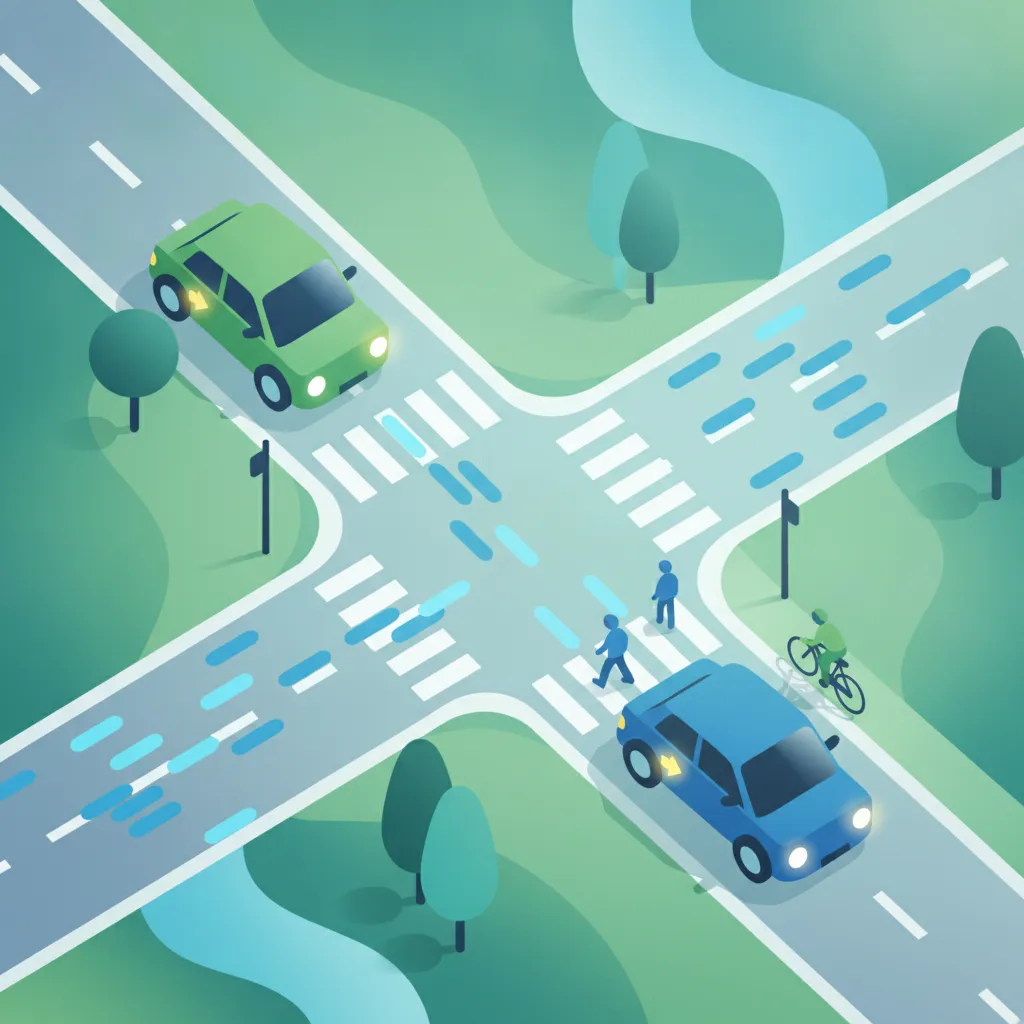
Theory topic content overview
Read the full theory topic guide for Belgian Turning Rules with structured, easy-to-scan content built for learners in Belgium. This detailed section explains the exact rule, meaning, traffic context, comparison points, and exam logic behind this Belgian driving theory topic so you can study faster, understand the concept more clearly, and avoid common interpretation mistakes on the theory test.
In Belgian traffic, a "safe turning manoeuvre" refers to the precise set of actions a driver takes to change direction – either turning right or left – from one road onto another, or to exit the current roadway, ensuring the safety of all road users. This concept is fundamental to the Belgian Traffic Code (Article 19 on "Changement de direction") and is essential for preventing collisions and maintaining smooth traffic flow. It's not merely about steering the wheel; it's about a systematic process of observation, communication, positioning, and yielding.
Understanding and executing safe turns is paramount for several reasons:
angle mort) are frequently tested topics in the Belgian driving theory exam. Common mistakes often revolve around priority and inadequate observation.Every safe turning manoeuvre in Belgium follows a sequence of actions, often remembered as "MSM-CL": Mirrors, Signal, Manoeuvre (Position, Speed, Look).
Regardless of whether you are turning right or left, these initial steps are critical:
Contrôle de la circulation): Begin checking your mirrors (rear-view and side mirrors) well in advance to assess traffic behind and to your sides. Look for other vehicles, motorcycles, cyclists, and pedestrians. Pay particular attention to your blind spots (angle mort), especially when cycling lanes or footpaths are present.Indication de l'intention): Activate your indicator (turn signal) sufficiently in advance to clearly communicate your intention to other road users. This warning allows others to adjust their speed or position. The signal should cease once the turn is completed.Adapter la vitesse): Reduce your speed to a safe level that allows you to control the vehicle through the turn and react to unexpected hazards. Downshifting (retrograde) may be necessary.Turning right is generally simpler than turning left, but still demands diligence:
Left turns are significantly more complex in Belgium due to multiple conflict points and priority rules:
Céder la priorité): This is the most critical aspect of a left turn in Belgium:
angle mort) just before turning to ensure no cyclist is immediately beside you. You must yield to them.angle mort), especially when turning right and checking for cyclists, or left for motorcycles.The rules for safe turning are deeply embedded in the Belgian Traffic Code (Article 19). The emphasis on yielding to vulnerable road users (usagers faibles) during any change of direction is particularly strong in Belgium. Theory exams frequently test these priority rules, especially for left turns. The concept of the angle mort (blind spot) is a critical element in Belgian driving education, as evidenced by its mention in official guides for license B. Be prepared to demonstrate comprehensive observation skills, including head checks, for both your theory and practical exams.
To consistently perform safe turning manoeuvres in Belgium, adopt a mindset of anticipation, clear communication, and absolute yielding to those with priority. Always assume potential hazards exist. Observe diligently, signal early, position correctly, and always be prepared to stop if it means preventing a collision with an oncoming vehicle or protecting a pedestrian or cyclist.
Safe turning in Belgium requires systematic preparation through observation, early signalling, and correct lane positioning, following the MSM-CL framework. Right turns are simpler but demand staying close to the right edge, while left turns involve more complex priority rules, requiring drivers to yield to oncoming vehicles and all vulnerable road users even when they approach from the left. Blind spot checks are mandatory and must include a physical head check to identify cyclists and motorcyclists not visible in mirrors. Belgian Traffic Code Article 19 governs these rules, and the exam frequently tests priority scenarios, especially regarding cyclists, pedestrians, and trams in urban areas.
A short set of high-value points that capture the most important ideas from this theory explanation.
Safe turning follows the MSM-CL sequence: Mirrors, Signal, Manoeuvre (checking Position, Speed, and Look)
Right turns require positioning close to the right-hand side and yielding to pedestrians and cyclists crossing your path
Left turns must yield to oncoming traffic and vulnerable road users, even overriding the general priority-from-the-right rule
Blind spot checks (angle mort) must include a physical head check, not just mirror observation
Vulnerable road users (pedestrians, cyclists, tram passengers) always have priority during any turn in Belgium
Article 19 of the Belgian Traffic Code defines changing direction and mandates yielding to vulnerable road users
On roundabouts, you do not signal when entering but signal when exiting in Belgium
Trams always have absolute priority; never turn across a tram's path
Cyclists on dedicated cycle paths have priority and must be checked in your right blind spot before any right turn
Turning left means positioning towards the left of your lane on a two-way road, or close to the left edge on a one-way road
Failing to perform a physical head check for the blind spot, especially when cyclists may be beside the vehicle
Signalling too late or forgetting to signal entirely, leaving other road users unable to anticipate the turn
Incorrect lane positioning, such as not staying close enough to the right for right turns or entering the intersection too early for left turns
Assuming priority when turning left against oncoming traffic or towards crossing pedestrians and cyclists
Turning at excessive speed, reducing reaction time and control, particularly in wet or low-visibility conditions
Start with a short, direct summary of Belgian Turning Rules before reading the full explanation below.
To turn safely in Belgium, drivers must first observe the road, signal their intention well in advance, and position their vehicle correctly. When turning right, stay as close as possible to the right-hand side. For left turns, position towards the left of your lane but yield to oncoming traffic and other road users. Always adjust your speed and check blind spots to prevent conflicts with pedestrians and cyclists.
Review the most important terms, rule signals, and traffic concepts linked to Belgian Turning Rules.
Explore related theory topic pages connected to Belgian Turning Rules and continue with the next useful rule explanation.
See the common search queries learners use when trying to understand Belgian Turning Rules in Belgium.

Start your comprehensive preparation for the Belgian driving licence theory exam. Dive into our expertly curated topics, master the road rules and concepts, and build the confidence you need to pass your test and drive safely on Belgian roads. Begin mastering theory today.
Explore Belgian Theory TopicsTheory topic content overview
A short set of high-value points that capture the most important ideas from this theory explanation.
Safe turning follows the MSM-CL sequence: Mirrors, Signal, Manoeuvre (checking Position, Speed, and Look)
Right turns require positioning close to the right-hand side and yielding to pedestrians and cyclists crossing your path
Left turns must yield to oncoming traffic and vulnerable road users, even overriding the general priority-from-the-right rule
Blind spot checks (angle mort) must include a physical head check, not just mirror observation
Vulnerable road users (pedestrians, cyclists, tram passengers) always have priority during any turn in Belgium
Article 19 of the Belgian Traffic Code defines changing direction and mandates yielding to vulnerable road users
On roundabouts, you do not signal when entering but signal when exiting in Belgium
Trams always have absolute priority; never turn across a tram's path
Cyclists on dedicated cycle paths have priority and must be checked in your right blind spot before any right turn
Turning left means positioning towards the left of your lane on a two-way road, or close to the left edge on a one-way road
Failing to perform a physical head check for the blind spot, especially when cyclists may be beside the vehicle
Signalling too late or forgetting to signal entirely, leaving other road users unable to anticipate the turn
Incorrect lane positioning, such as not staying close enough to the right for right turns or entering the intersection too early for left turns
Assuming priority when turning left against oncoming traffic or towards crossing pedestrians and cyclists
Turning at excessive speed, reducing reaction time and control, particularly in wet or low-visibility conditions
Start with a short, direct summary of Belgian Turning Rules before reading the full explanation below.
To turn safely in Belgium, drivers must first observe the road, signal their intention well in advance, and position their vehicle correctly. When turning right, stay as close as possible to the right-hand side. For left turns, position towards the left of your lane but yield to oncoming traffic and other road users. Always adjust your speed and check blind spots to prevent conflicts with pedestrians and cyclists.
Review the most important terms, rule signals, and traffic concepts linked to Belgian Turning Rules.
Explore related theory topic pages connected to Belgian Turning Rules and continue with the next useful rule explanation.
See the common search queries learners use when trying to understand Belgian Turning Rules in Belgium.
Start your comprehensive preparation for the Belgian driving licence theory exam. Dive into our expertly curated topics, master the road rules and concepts, and build the confidence you need to pass your test and drive safely on Belgian roads. Begin mastering theory today.
Explore Belgian Theory TopicsUse this exam-focused revision tip to understand how Belgian Turning Rules is likely to appear in theory questions for learners in Belgium. This section helps you identify the most testable part of the rule, avoid common traps, and remember the concept more effectively during Belgian driving theory exam preparation.
Pay close attention to priority rules during turns in the Belgian theory exam, especially for left turns where oncoming traffic and vulnerable road users (pedestrians, cyclists) always have priority. Remember to check your blind spots ('angle mort') and signal early; these are common areas for mistakes.
Read direct answers to the most common learner questions about Belgian Turning Rules in Belgium. This FAQ focuses on rule confusion, practical meaning, comparison with similar concepts, and the exact uncertainties that appear most often in Belgian driving theory revision and exam preparation.
For any turn, you must first observe your surroundings (mirrors, blind spots), signal your intention in time, position your vehicle correctly in the lane, adjust your speed, and then execute the turn while yielding to those with priority.
When making a left turn in Belgium, you must yield priority to all oncoming traffic on the road you are leaving, as well as to pedestrians and cyclists crossing the road you are entering or leaving.
Before a right turn, you should position your vehicle as close as possible to the right edge of the roadway. This helps prevent other vehicles from attempting to pass you on the right and guides your turn.
Yes, you must always indicate your intention to turn sufficiently in advance using your indicator lights. This signal must continue until the manoeuvre is completed. This applies to leaving a roundabout too, but not entering it.
Pedestrians and cyclists often have priority and are particularly vulnerable during turns. Always check for them, especially in your blind spots, and be prepared to stop. You must yield to them if they are crossing the path you intend to take.
The 'angle mort' or blind spot check involves quickly turning your head to look over your shoulder in the direction you intend to turn, covering areas not visible in your mirrors. This is critical before changing direction to spot cyclists or smaller vehicles.
You must execute turns at a moderate speed. Entering a turn too quickly reduces your control and reaction time, increasing the risk of losing traction or failing to yield to other road users safely.
When turning left on a one-way street, you should position your vehicle as close as possible to the left edge of the roadway. For right turns, you still keep to the right edge.
Ready to focus your Belgian driving theory revision? Utilize our powerful search tool to pinpoint exact topics, road signs, or difficulty levels. Engage with practice questions that directly address your learning needs and solidify your understanding of Belgian traffic laws for your upcoming exam.