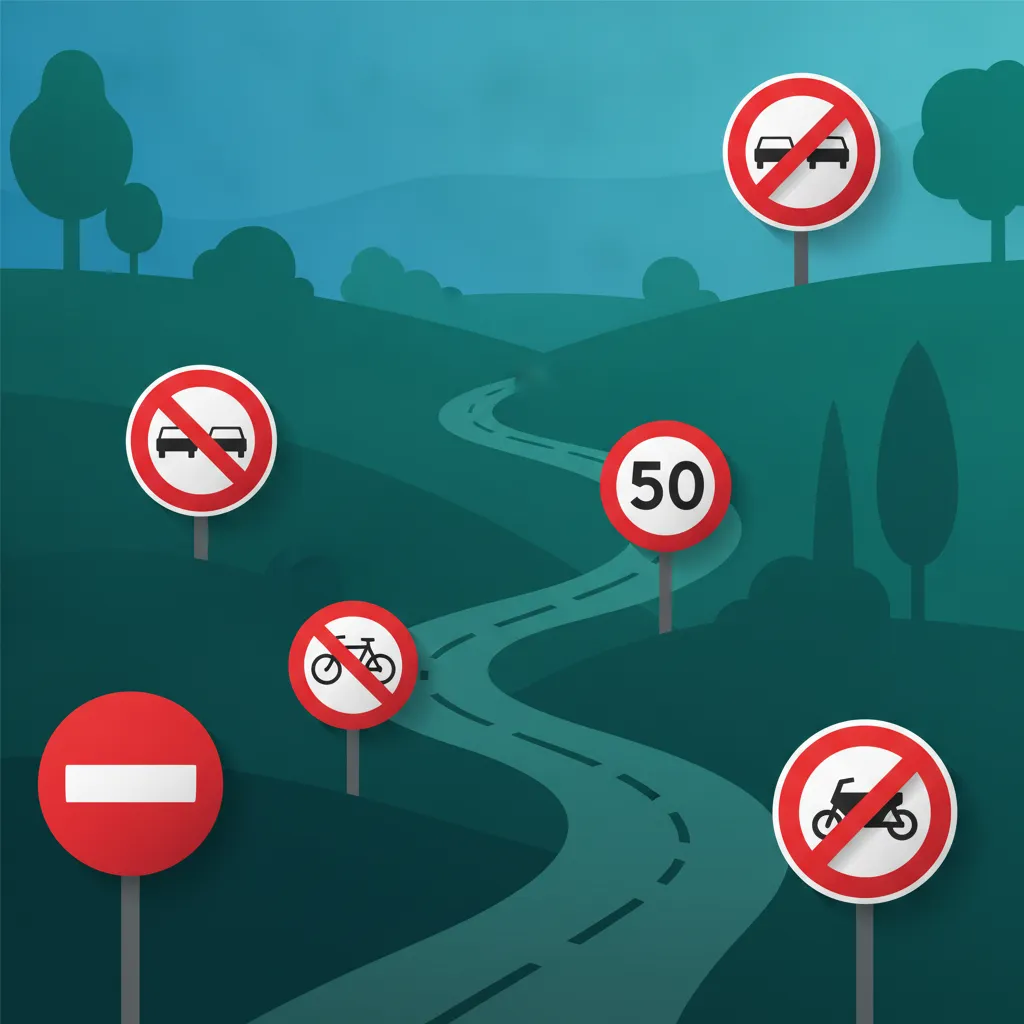
Prohibition signs are essential directives on Belgian roads that indicate actions drivers are not permitted to perform. Distinguished by their universal design, typically a red circle, they enforce legal restrictions vital for safety and traffic organization. Mastering the meaning of these signs is fundamental for every driver in Belgium, impacting everything from your daily commute to specific urban zones.
Theory topic content overview
Read the full theory topic guide for Prohibition Signs with structured, easy-to-scan content built for learners in Belgium. This detailed section explains the exact rule, meaning, traffic context, comparison points, and exam logic behind this Belgian driving theory topic so you can study faster, understand the concept more clearly, and avoid common interpretation mistakes on the theory test.
Prohibition traffic signs in Belgium are critical directives that communicate actions drivers are legally forbidden to perform on the road. These signs are instantly recognisable, typically featuring a circular shape with a red border and a black symbol on a white or blue background, clearly indicating a restriction. Their primary purpose is to maintain road safety, prevent accidents, and ensure the orderly flow of traffic according to the Belgian Highway Code (Code de la route).
Mastering these signs is not just about memorising symbols; it's about understanding the specific restrictions they impose, how they apply in various scenarios, and their legal implications for every driver in Belgium.
Prohibition signs are more than just suggestions; they are legally binding instructions designed to protect all road users. In Belgium, misunderstanding or ignoring these signs can lead to severe consequences, including:
Belgian prohibition signs impose an immediate and ongoing restriction from the point they are displayed, unless otherwise indicated by supplementary panels or a "end of prohibition" sign.
The Belgian Highway Code classifies prohibition signs clearly, with distinct codes for each type. Understanding these categories is essential for correct interpretation:
Entry and Access Restrictions:
Sens interdit (No Entry): A red circle with a white horizontal bar. This sign means no entry in this direction for any driver. It typically guards one-way streets or exits.Accès interdit, dans les deux sens (No Access, Both Directions): A solid red circle. This means no access whatsoever for any driver from either direction into the road or area beyond the sign. It often marks the beginning of private roads or closed-off sections.Speed Limits (e.g., C43): A red circle with numbers indicating the maximum allowed speed in km/h. This is the legal limit, not necessarily the safe speed, which can be lower depending on conditions.
Overtaking Prohibitions (e.g., C21, C23):
Dépassement interdit (No Overtaking): Two cars, one black, one red, with the red car on the left. Prohibits all drivers from overtaking motor vehicles other than two-wheeled mopeds and motorcycles without a sidecar.Dépassement interdit aux véhicules dont la masse maximale autorisée dépasse 3,5 tonnes (No Overtaking for Vehicles over 3.5 tonnes): Similar to C21 but with a lorry symbol.Stopping and Parking Restrictions: These are common sources of confusion for Belgian learners.
Stationnement interdit (No Parking): A blue circle with a red border and a single red diagonal line. You may stop briefly (e.g., to let passengers out or load/unload goods) as long as you don't leave your vehicle, but you cannot park.Arrêt et stationnement interdits (No Stopping and No Parking): A blue circle with a red border and two red diagonal lines forming an 'X'. This is the most restrictive; you cannot stop or park, even for a moment, unless forced to by traffic.Other Prohibitions: These include turning restrictions, weight/height/width limits, prohibitions on using horns, or minimum distances between vehicles.
Sens interdit) vs. C3 (Accès interdit): Remember, C1 prevents entry from one direction (often found at the end of a one-way street), while C3 prevents any access at all to the road or area it marks (e.g., a pedestrian zone entrance). Entering a Sens interdit road against the flow of traffic is one of the most dangerous and commonly tested mistakes.Sens interdit (C1) Sign: You are driving in a city and see a C1 sign on the street ahead. This immediately tells you that you cannot turn into that street in the direction you are travelling. It's a one-way street coming towards you.No Parking (E1) Zone: You pull up to drop off a friend outside a shop displaying an E1 sign. You may stop for a moment to let them out, provided you remain in the vehicle and are ready to move if you obstruct traffic. However, if you leave your car to go into the shop, even for a minute, you are parking illegally.Sens interdit (C1) signs: This is one of the most dangerous and common errors, sometimes due to distraction or misinterpretation of one-way streets.No Parking (E1) and No Stopping (E3): Many learners underestimate the strictness of the Arrêt et stationnement interdits sign, leading to immediate violations.Prohibition signs are non-negotiable legal commands. For your safety, the safety of others, and to pass your Belgian driving theory test, always:
By diligently observing and understanding Belgian prohibition signs, you contribute to safer roads and demonstrate your competence as a responsible driver in Belgium.
Belgian prohibition signs are circular with a red border and communicate legally forbidden actions, with specific codes like C1 for no entry from one direction and C3 for no access at all. Understanding the critical difference between E1 (no parking, brief stops allowed if you remain in the vehicle) and E3 (no stopping or parking under any circumstance) is essential for both road safety and exam success. Always check supplementary panels for time restrictions, vehicle exemptions, or distance information, as these modify the sign's meaning. Speed limit signs establish maximum legal speeds that must be adjusted downward for unsafe conditions, and restrictions persist until an official end-of-prohibition sign is displayed.
A short set of high-value points that capture the most important ideas from this theory explanation.
Prohibition signs in Belgium are legally binding and marked by a red circle, indicating actions drivers are forbidden to perform
The C1 (Sens interdit) prohibits entry from one direction only, while C3 (Accès interdit) prohibits any access from either direction
Speed limit signs set the legal maximum, not the recommended speed—always adjust for weather, visibility, and traffic conditions
Supplementary panels below prohibition signs are essential and modify the rule by specifying time, vehicle type, or distance applicability
Belgian theory exam questions frequently test the distinction between E1 (no parking, stopping allowed) and E3 (no stopping or parking whatsoever)
C1 is a red circle with white horizontal bar—entry forbidden from one direction only; C3 is a solid red circle—no access from any direction
E1 (single diagonal line) allows brief stops for passengers or loading; E3 (double diagonal lines forming X) prohibits any stopping
Prohibition signs remain in effect until an end-of-prohibition sign explicitly cancels them
Check for supplementary panels indicating restricted hours (e.g., 7h-19h), vehicle exemptions, or distance to restriction
C21 prohibits overtaking all motor vehicles except two-wheeled mopeds and motorcycles without sidecars
Confusing C1 (no entry from one direction) with C3 (no access at all), leading to dangerous wrong-way entries
Believing E1 allows you to leave your vehicle—E1 prohibits parking but not brief stops if you stay with the car
Assuming a restriction ends at a junction or intersection without seeing an official end-of-prohibition sign
Ignoring supplementary panels and misinterpreting time-based or vehicle-specific prohibitions
Treating speed limits as target speeds rather than maximum limits, especially in adverse weather or heavy traffic
Start with a short, direct summary of Prohibition Signs before reading the full explanation below.
Prohibition signs in Belgium are traffic signs that communicate a legal restriction or a forbidden action to drivers. Commonly recognized by their circular shape with a red border, they include rules such as 'no entry', 'no overtaking', 'no parking', and various speed limits. These signs are crucial for road safety, preventing conflicts, and maintaining orderly traffic flow in accordance with the Belgian Highway Code.
Review the most important terms, rule signals, and traffic concepts linked to Prohibition Signs.
Explore related theory topic pages connected to Prohibition Signs and continue with the next useful rule explanation.
See the common search queries learners use when trying to understand Prohibition Signs in Belgium.

Start your comprehensive preparation for the Belgian driving licence theory exam. Dive into our expertly curated topics, master the road rules and concepts, and build the confidence you need to pass your test and drive safely on Belgian roads. Begin mastering theory today.
Explore Belgian Theory TopicsTheory topic content overview
A short set of high-value points that capture the most important ideas from this theory explanation.
Prohibition signs in Belgium are legally binding and marked by a red circle, indicating actions drivers are forbidden to perform
The C1 (Sens interdit) prohibits entry from one direction only, while C3 (Accès interdit) prohibits any access from either direction
Speed limit signs set the legal maximum, not the recommended speed—always adjust for weather, visibility, and traffic conditions
Supplementary panels below prohibition signs are essential and modify the rule by specifying time, vehicle type, or distance applicability
Belgian theory exam questions frequently test the distinction between E1 (no parking, stopping allowed) and E3 (no stopping or parking whatsoever)
C1 is a red circle with white horizontal bar—entry forbidden from one direction only; C3 is a solid red circle—no access from any direction
E1 (single diagonal line) allows brief stops for passengers or loading; E3 (double diagonal lines forming X) prohibits any stopping
Prohibition signs remain in effect until an end-of-prohibition sign explicitly cancels them
Check for supplementary panels indicating restricted hours (e.g., 7h-19h), vehicle exemptions, or distance to restriction
C21 prohibits overtaking all motor vehicles except two-wheeled mopeds and motorcycles without sidecars
Confusing C1 (no entry from one direction) with C3 (no access at all), leading to dangerous wrong-way entries
Believing E1 allows you to leave your vehicle—E1 prohibits parking but not brief stops if you stay with the car
Assuming a restriction ends at a junction or intersection without seeing an official end-of-prohibition sign
Ignoring supplementary panels and misinterpreting time-based or vehicle-specific prohibitions
Treating speed limits as target speeds rather than maximum limits, especially in adverse weather or heavy traffic
Start with a short, direct summary of Prohibition Signs before reading the full explanation below.
Prohibition signs in Belgium are traffic signs that communicate a legal restriction or a forbidden action to drivers. Commonly recognized by their circular shape with a red border, they include rules such as 'no entry', 'no overtaking', 'no parking', and various speed limits. These signs are crucial for road safety, preventing conflicts, and maintaining orderly traffic flow in accordance with the Belgian Highway Code.
Review the most important terms, rule signals, and traffic concepts linked to Prohibition Signs.
Explore related theory topic pages connected to Prohibition Signs and continue with the next useful rule explanation.
See the common search queries learners use when trying to understand Prohibition Signs in Belgium.
Start your comprehensive preparation for the Belgian driving licence theory exam. Dive into our expertly curated topics, master the road rules and concepts, and build the confidence you need to pass your test and drive safely on Belgian roads. Begin mastering theory today.
Explore Belgian Theory TopicsUse this exam-focused revision tip to understand how Prohibition Signs is likely to appear in theory questions for learners in Belgium. This section helps you identify the most testable part of the rule, avoid common traps, and remember the concept more effectively during Belgian driving theory exam preparation.
For the Belgian theory exam, pay close attention to the exact symbol and any supplementary panels on prohibition signs. Many questions hinge on distinguishing between similar signs (e.g., 'no parking' vs. 'no stopping') or understanding when a restriction applies (e.g., specific hours or vehicle types).
Read direct answers to the most common learner questions about Prohibition Signs in Belgium. This FAQ focuses on rule confusion, practical meaning, comparison with similar concepts, and the exact uncertainties that appear most often in Belgian driving theory revision and exam preparation.
In Belgium, most prohibition signs are circular with a red border. The specific prohibition is usually indicated by a black symbol or a red diagonal line through the symbol on a white or blue background.
A 'No Entry' sign (C1 - sens interdit / verboden richting) in Belgium prohibits all drivers from entering the road or direction where the sign is displayed. It's a critical safety sign, often seen on one-way streets or exits.
The 'No Parking' sign (E1 - stationnement interdit / parkeerverbod) allows stopping briefly to let someone in or out, or to load/unload, but prohibits leaving the vehicle. The 'No Stopping' sign (E3 - arrêt et stationnement interdits / stilstaan en parkeren verboden) prohibits both stopping and parking, even briefly, unless traffic requires it.
Unless indicated by an additional panel or specific symbol on the sign itself, a general prohibition sign in Belgium applies to all categories of road users for which the restriction is relevant. Some signs, like C5 (no motor vehicles with more than two wheels), are specific.
Yes, some prohibition signs, especially for parking or stopping, can be temporary or apply only during specific hours or days. This is usually indicated by an additional panel below the main sign, common in Belgian urban areas.
Ignoring a prohibition sign in Belgium can result in a traffic fine, penalty points, or even more severe legal consequences depending on the severity of the infraction. Such violations are also frequently tested in the theory exam.
Ready to focus your Belgian driving theory revision? Utilize our powerful search tool to pinpoint exact topics, road signs, or difficulty levels. Engage with practice questions that directly address your learning needs and solidify your understanding of Belgian traffic laws for your upcoming exam.