In Belgium, turn signals (or indicators) are your primary way to communicate your planned movements to other road users. This page clarifies when and how you must use them for various maneuvers, such as turning, changing lanes, merging, or exiting roundabouts. Mastering these rules ensures predictability on the road, significantly reduces accident risks, and is a core requirement for your Belgian driving license.
Theory topic content overview
Read the full theory topic guide for Belgian Signalling Rules with structured, easy-to-scan content built for learners in Belgium. This detailed section explains the exact rule, meaning, traffic context, comparison points, and exam logic behind this Belgian driving theory topic so you can study faster, understand the concept more clearly, and avoid common interpretation mistakes on the theory test.
Signalling, often referred to as using turn signals or direction indicators, is the fundamental way drivers communicate their intentions to other road users in Belgium. It involves activating the flashing lights at the front and rear of your vehicle to show you plan to change direction, switch lanes, or perform another manoeuvre.
Under the Belgian Road Code (Code de la route / Wegcode), signalling is not merely a courtesy but a mandatory requirement. Its primary purpose is to enhance road safety by making your actions predictable, thereby reducing confusion and significantly lowering the risk of collisions, especially in busy Belgian urban and motorway environments.
Imagine traffic as a constant conversation. Your turn signals are your voice, announcing your next "sentence" (manoeuvre). Without this communication, other drivers, cyclists, and pedestrians are left guessing, which can lead to sudden braking, swerving, or even accidents. Proper signalling gives others sufficient time to react safely to your intended actions.
The Code de la route dictates specific situations where signalling is required. Crucially, the signal must be given sufficiently in advance of the manoeuvre and maintained until the action is complete. The official phrasing from the Code de la route emphasizes indicating your intention "suffisamment à temps" (sufficiently in time).
The Belgian Road Code specifies "suffisamment à temps" (sufficiently in time). This means your signal should be activated early enough for other road users to notice it and adjust their speed or position. There's no fixed distance, but it should be a reasonable time-frame, typically a few seconds before the manoeuvre begins. This allows for anticipation, especially for vulnerable road users like cyclists and pedestrians who might be affected by your change of direction.
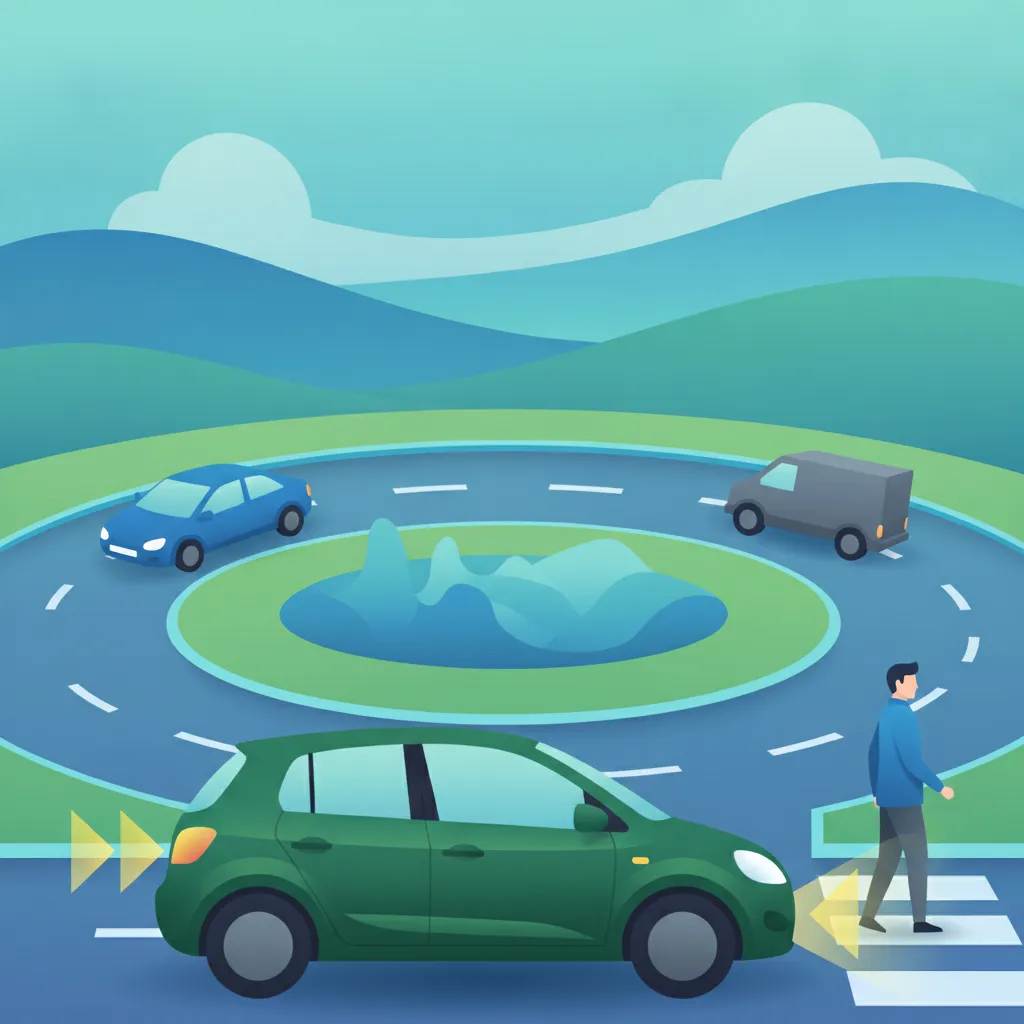
Roundabout signalling is a frequent point of confusion and a key topic in the Belgian driving theory exam. Mastering this specific rule is essential for both your exam and safe driving on Belgian roads, which feature many roundabouts.
Belgian Roundabout Signalling Rules:
This rule is designed to clarify your exit path and prevent conflicting movements, particularly for vehicles waiting to enter the roundabout or those behind you.
A common misconception among learners, especially in the Belgian context, is that signalling grants you priority. This is incorrect. Signalling only communicates your intention; it does not give you the right-of-way.
In certain specific situations, the Code de la route allows or requires the use of simultaneous indicators (hazard warning lights) to alert other drivers to an exceptional danger or situation. These include:
Failing to signal correctly is a major cause of road incidents and a common reason for failing the practical driving test in Belgium. Understanding these pitfalls is crucial:
For your Belgian driving licence, remember that effective signalling is about proactive, clear, and timely communication. It’s a core component of defensive driving. Always think: "Observe (Mirrors & Blind Spot), Signal, Manoeuvre, (Observe again)" – and specifically apply the Belgian roundabout rule. By consistently signalling correctly, you contribute significantly to the safety and smooth flow of traffic on Belgian roads, satisfying both legal requirements and practical road wisdom.
Start with a short, direct summary of Belgian Signalling Rules before reading the full explanation below.
Signalling involves using your vehicle's turn indicators to communicate your intended direction or maneuver to other drivers and road users. In Belgium, you must signal well in advance before making a turn, changing lanes, merging, or exiting a roundabout, as stipulated by the Belgian Road Code. This proactive communication is essential for road safety, allowing others to anticipate your actions and react accordingly, and is a critical component of the driving theory exam.
Review the most important terms, rule signals, and traffic concepts linked to Belgian Signalling Rules.
Explore related theory topic pages connected to Belgian Signalling Rules and continue with the next useful rule explanation.
See the common search queries learners use when trying to understand Belgian Signalling Rules in Belgium.

Start your comprehensive preparation for the Belgian driving licence theory exam. Dive into our expertly curated topics, master the road rules and concepts, and build the confidence you need to pass your test and drive safely on Belgian roads. Begin mastering theory today.
Explore Belgian Theory TopicsTheory topic content overview
Start with a short, direct summary of Belgian Signalling Rules before reading the full explanation below.
Signalling involves using your vehicle's turn indicators to communicate your intended direction or maneuver to other drivers and road users. In Belgium, you must signal well in advance before making a turn, changing lanes, merging, or exiting a roundabout, as stipulated by the Belgian Road Code. This proactive communication is essential for road safety, allowing others to anticipate your actions and react accordingly, and is a critical component of the driving theory exam.
Review the most important terms, rule signals, and traffic concepts linked to Belgian Signalling Rules.
Explore related theory topic pages connected to Belgian Signalling Rules and continue with the next useful rule explanation.
See the common search queries learners use when trying to understand Belgian Signalling Rules in Belgium.
Start your comprehensive preparation for the Belgian driving licence theory exam. Dive into our expertly curated topics, master the road rules and concepts, and build the confidence you need to pass your test and drive safely on Belgian roads. Begin mastering theory today.
Explore Belgian Theory TopicsUse this exam-focused revision tip to understand how Belgian Signalling Rules is likely to appear in theory questions for learners in Belgium. This section helps you identify the most testable part of the rule, avoid common traps, and remember the concept more effectively during Belgian driving theory exam preparation.
In the Belgian theory exam, pay close attention to questions about signalling duration and specific roundabout rules. A common mistake is signalling into a roundabout or cancelling the signal too early. Remember to signal before the maneuver and throughout (until completed), except for roundabouts where you signal only before exiting.
Read direct answers to the most common learner questions about Belgian Signalling Rules in Belgium. This FAQ focuses on rule confusion, practical meaning, comparison with similar concepts, and the exact uncertainties that appear most often in Belgian driving theory revision and exam preparation.
You must use your turn signal whenever you intend to change direction, such as turning left or right, changing lanes, overtaking, merging, or exiting a roundabout, to inform other road users of your intention.
You should activate your turn signal sufficiently in advance of the maneuver to give other road users ample time to react and anticipate your movement, without confusing them by signalling too early.
No, you do not signal when entering a roundabout in Belgium. You only signal when you are about to exit the roundabout, indicating your intended exit direction.
Yes, it is always mandatory to signal a lane change in Belgium, even if you perceive no other traffic nearby. It's a legal requirement and good practice for safety.
If your vehicle's turn signals are not functioning, you must use hand signals to indicate your intentions, where possible and safe, and address the vehicle fault as soon as possible.
Yes, failing to use your turn signals when required by the Belgian Road Code is a traffic infraction that can result in a fine.
Not signalling creates uncertainty for other road users, significantly increasing the risk of collisions, especially during turns, lane changes, or at intersections, as others cannot predict your movements.
Ready to focus your Belgian driving theory revision? Utilize our powerful search tool to pinpoint exact topics, road signs, or difficulty levels. Engage with practice questions that directly address your learning needs and solidify your understanding of Belgian traffic laws for your upcoming exam.